The 2010 Tesla Roadster is not a car you buy for practicality. It's a car you buy because you want to own a piece of electric-vehicle history — the production EV that proved lithium-ion could deliver supercar-rivaling performance while traveling 244 EPA-rated miles on a single charge. Sixteen years later, Tesla's first production car remains a fascinating, flawed, and increasingly collectible machine. This review breaks down what owning a 2010 Roadster actually looks like in 2026: real-world range, charging logistics, battery health, and whether the math works as a weekend toy or a collector investment.
2010 Tesla Roadster: Quick Verdict
The 2010 Tesla Roadster (officially the Roadster 1.5 and 2.0 Sport, depending on build date) is a two-seat, rear-wheel-drive electric sports car built on a modified Lotus Elise chassis. It delivers 288 horsepower, a 3.7-second 0-60 mph time, and an EPA-rated 244 miles of range from a 53 kWh lithium-cobalt-oxide battery pack. In 2026, it's no longer a daily driver — it's a collector-grade EV with real limitations in charging speed, service access, and battery replacement cost. But for enthusiasts who understand what they're signing up for, it remains one of the most engaging electric cars ever built.
Spec Table: 2010 Tesla Roadster at a Glance
| Specification | 2010 Tesla Roadster (Sport) |
|---|---|
| EPA Range | 244 miles |
| Battery Capacity | 53 kWh (usable ~50 kWh) |
| Battery Chemistry | Lithium-cobalt-oxide (LiCoO₂ / LCO) |
| Drivetrain | Rear-wheel drive (single motor) |
| Horsepower | 288 hp |
| Torque | 295 lb-ft |
| 0-60 mph | 3.7 seconds |
| Top Speed | 125 mph (electronically limited) |
| EPA Efficiency | 119 MPGe (combined) / 28 kWh/100mi |
| Max DC Fast Charge | None (AC-only charging) |
| Level 2 Charge Rate | Up to 16.8 kW (70A, proprietary connector) |
| 10-80% Charge Time | ~2.5 hours at 16.8 kW; ~3.5 hours at typical 40A L2 |
| Cargo Space | ~4.5 cu ft (rear trunk, minimal) |
| Seating | 2 passengers |
| Curb Weight | ~2,886 lbs |
| Original MSRP (2010) | $109,000 (base) / $128,500 (Sport) |
| 2026 Used Market Price | $120,000 – $200,000+ |
| Battery Warranty (Original) | 7 years / 100,000 miles (expired) |
Real-World Range: What 244 EPA Miles Actually Means
EPA Estimated Range: 244 miles
Real-World Expectation: 180–210 miles highway; 200–230 miles mixed city/highway; 140–170 miles in cold weather (below 40°F).
The 2010 Roadster's 244-mile EPA rating was extraordinary for its era — and it still holds up on paper. But real-world range depends heavily on driving style, temperature, and battery age. The Roadster has no active thermal management system for the battery (it uses passive air cooling), which means range degrades noticeably in extreme heat and cold.
In mild conditions (60–75°F) with mixed driving, owners consistently report 200–220 miles before needing to recharge. Highway driving at 70+ mph drops that to roughly 180–200 miles due to the Roadster's aerodynamic drag and lack of regenerative braking sophistication compared to modern EVs. In cold weather, expect a 25–35% reduction — the battery's internal resistance increases, and cabin heat draws from the main pack.
A critical 2026 consideration: battery degradation. Most surviving 2010 Roadsters have undergone at least one battery replacement or refurbishment under Tesla's original warranty program or the later Tesla Roadster battery replacement program. A well-maintained replacement pack may deliver 90–95% of original capacity; an original, un-replaced pack could be at 60–75% State of Health (SoH), reducing usable range to 150–180 miles. Always request a battery health diagnostic before purchasing.
Charging: AC-Only and the Connector Problem
| Charging Level | Power (kW) | Miles Added per Hour | Notes |
|---|---|---|---|
| Level 1 (120V household) | ~1.4 kW | ~5 mi/hr | Emergency/trickle only; 35+ hours for full charge |
| Level 2 (240V, 40A) | ~9.6 kW | ~34 mi/hr | Common home setup; ~7 hours 0-100% |
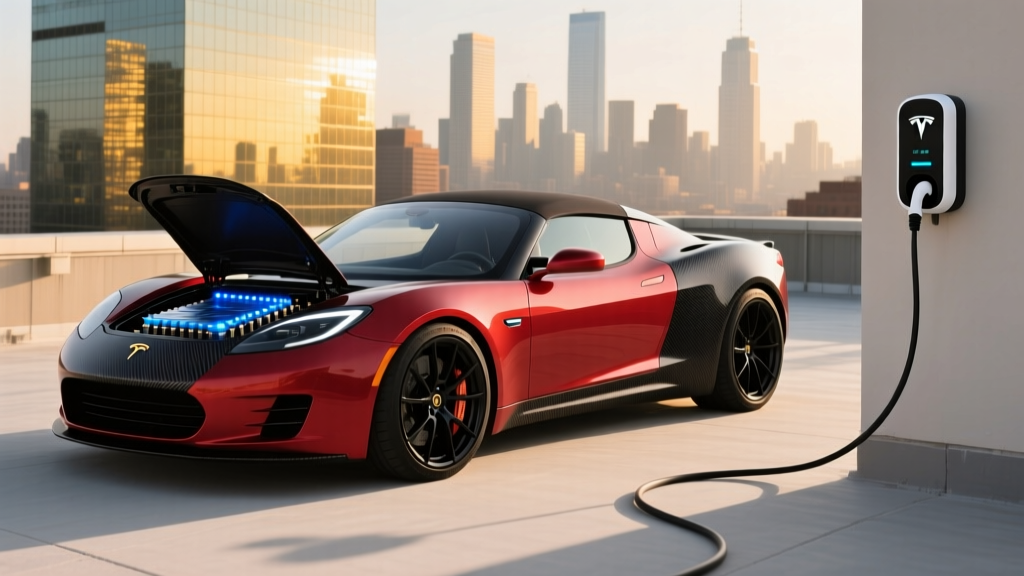
| Level 2 (240V, 70A Tesla HPWC) | 16.8 kW | ~59 mi/hr | Requires Tesla High Power Wall Connector + dual onboard chargers |
| DC Fast Charging | N/A | N/A | No DC fast-charge capability |
This is the 2010 Roadster's biggest practical limitation in 2026: it cannot DC fast charge. There is no CCS, no CHAdeMO, and no NACS port. The Roadster uses Tesla's proprietary AC connector (predating the modern NACS standard), and it relies entirely on onboard chargers to convert AC power to DC for the battery.
The Roadster was available with either a single onboard charger (40A / ~9.6 kW) or an optional dual-charger setup (70A / 16.8 kW). With dual chargers and Tesla's High Power Wall Connector (HPWC), you can add roughly 59 miles of range per hour — impressive for AC charging, but a far cry from the 200+ kW DC fast-charging speeds of modern EVs. A 10–80% charge at 16.8 kW takes approximately 2.5 hours. At a more typical 40A Level 2 station, expect 3.5 hours or more.
For public charging, you'll need a Tesla Roadster-specific adapter to connect to J1772 Level 2 stations. These adapters are available but increasingly niche. The Roadster cannot use Tesla Superchargers — the Supercharger network was designed for the Model S and later vehicles with DC fast-charge capability. This means road trips require careful planning around Level 2 destinations: hotels, restaurants, and shopping centers with 240V charging.
Performance: Still Thrilling After 16 Years
The 2010 Roadster Sport produces 288 horsepower and 295 lb-ft of torque from a single AC induction motor driving the rear wheels through a single-speed gearbox (the original two-speed transmission was abandoned early in production due to reliability issues). The result is a 3.7-second 0-60 mph time that still commands respect.
What makes the Roadster special isn't straight-line speed — modern EVs match or beat it easily. It's the experience: the raw, go-kart-like handling inherited from the Lotus Elise chassis, the absence of power steering (yes, it's manual), the instant torque delivery at any RPM, and the visceral connection between driver and machine. There's no sound deadening to speak of, no adaptive cruise control, no lane-keeping assist. This is an analog driving experience wrapped around an electric powertrain.
The single-speed reduction gear means acceleration is linear and relentless up to the 125 mph electronic limiter. Braking is handled by conventional discs with regenerative braking layered in, though the regen is less aggressive than modern one-pedal-driving systems. You'll still use the brake pedal regularly.
Battery Health, Degradation, and Replacement Cost
The Roadster's 53 kWh pack uses lithium-cobalt-oxide (LCO) cells — the same chemistry found in laptops and phones, chosen for its high energy density. LCO offers excellent specific energy but has a shorter cycle life and greater thermal sensitivity than the NMC (nickel-manganese-cobalt) or LFP (lithium iron phosphate) chemistries used in modern EVs.
Degradation reality: Original, never-replaced Roadster packs from 2008–2012 are now 14–18 years old. Tesla's own data and owner reports suggest these packs lose approximately 2–3% capacity per year under normal use, meaning an original pack could be at 60–75% SoH by 2026. That translates to 150–180 miles of usable range on a full charge.
Battery replacement cost: Tesla offered a Roadster battery replacement program, and as of recent years, a replacement ESS (Energy Storage System) costs approximately $29,000–$35,000 installed. This is a significant expense that must factor into any purchase decision. Some third-party EV shops have begun offering cell-level refurbishment at lower cost, but Tesla remains the primary service channel.
The original battery warranty was 7 years / 100,000 miles — long expired for all 2010 examples. Buyers should treat battery health as the single most important variable in a pre-purchase inspection.
Ownership in 2026: Tax Credits, Insurance, and Costs
Federal tax credit: The 2010 Tesla Roadster does not qualify for the current §30D new EV tax credit (it's a used vehicle, and the credit applies to new purchases). It may have qualified for the Used Clean Vehicle Credit (up to $4,000 or 30% of sale price, whichever is lower) if purchased from a dealer, subject to IRS income caps ($75,000 single / $150,000 joint) and the requirement that the sale price not exceed $25,000. Given that 2010 Roadsters sell for $120,000+, the price cap eliminates eligibility entirely. See IRS Used Clean Vehicle Credit rules for details.
Insurance: Specialty collector-car insurance is the norm. Hagerty and similar providers offer agreed-value policies, typically ranging from $2,500–$5,000/year depending on mileage limits and storage conditions. Standard insurers often struggle to value the car accurately.
Maintenance: Minimal by internal-combustion standards — no oil changes, no spark plugs, no transmission fluid. But tires (special low-rolling-resistance rubber), brake components, and suspension bushings from the Lotus Elise parts bin require periodic attention. Tesla service centers still support the Roadster, but turnaround times can be lengthy for specialized parts.
Pros and Cons
Pros
- Historic significance — the car that launched the modern EV era
- 244-mile EPA range still respectable for a sports car
- 3.7-second 0-60 mph with instant electric torque
- Raw, analog driving dynamics from the Lotus Elise chassis
- Appreciating collector value — many examples sell above original MSRP
- Minimal routine maintenance compared to ICE sports cars
Cons
- No DC fast charging — road trips require multi-hour L2 stops
- Proprietary AC connector requires adapters for public charging
- Battery replacement costs $29,000–$35,000 if pack is degraded
- No modern driver-assist features (no Autopilot, no AEB, no backup camera)
- Extremely limited cargo space (~4.5 cu ft) and two-seat layout
- No active battery thermal management — range suffers in extreme temperatures
- Service parts availability may become increasingly difficult
Who Should Buy the 2010 Tesla Roadster?
Buy it if: You're an EV enthusiast or automotive collector who wants the car that started it all. You have access to Level 2 home charging, understand the battery replacement cost risk, and plan to drive it as a weekend/show car rather than a daily commuter. You value driving engagement over technology features.
Skip it if: You need a practical daily driver, want DC fast charging for road trips, expect modern infotainment or driver-assist systems, or cannot absorb a potential $30,000+ battery replacement. For a usable Tesla experience, a used Model 3 or Model S offers vastly more practicality, Supercharger access, and lower ownership risk.
Frequently Asked Questions
What is the real-world range of the 2010 Tesla Roadster?
The EPA rates it at 244 miles, but real-world range is typically 180–220 miles depending on driving style, temperature, and battery health. A degraded original pack may deliver only 150–180 miles.
How fast does the 2010 Tesla Roadster charge?
It cannot DC fast charge. On Level 2 AC power, it charges at up to 16.8 kW (with dual onboard chargers and Tesla's HPWC), adding about 59 miles per hour. A 10–80% charge takes roughly 2.5 hours at peak rate, or 3.5+ hours at a standard 40A Level 2 station.
Does the 2010 Tesla Roadster qualify for any federal EV tax credit?
No. The Used Clean Vehicle Credit (§25E) has a $25,000 sale price cap, and 2010 Roadsters sell for $120,000+, making them ineligible. The new-vehicle §30D credit does not apply to used purchases. Consult a tax professional for your specific situation.
How much does a 2010 Tesla Roadster cost in 2026?
Used market prices range from approximately $120,000 to over $200,000 for low-mileage, well-documented examples with replacement batteries. The original MSRP was $109,000 (base) to $128,500 (Sport).
Is the 2010 Tesla Roadster worth buying vs. a modern EV?
As a collector piece and driving experience, yes — it's irreplaceable. As a practical EV for daily use or road trips, no. A 2024+ Tesla Model 3 Performance offers more range, Supercharger access, Autopilot, and a warranty, for a fraction of the Roadster's current market price.
Can I use Tesla Superchargers with the 2010 Roadster?
No. The Roadster predates the Supercharger network and lacks DC fast-charge hardware. It can only charge on AC power via Level 1 or Level 2 stations with the appropriate adapter.
What is the battery replacement cost?
Approximately $29,000–$35,000 through Tesla. Third-party cell-level refurbishment may be available at lower cost but varies by provider and region.