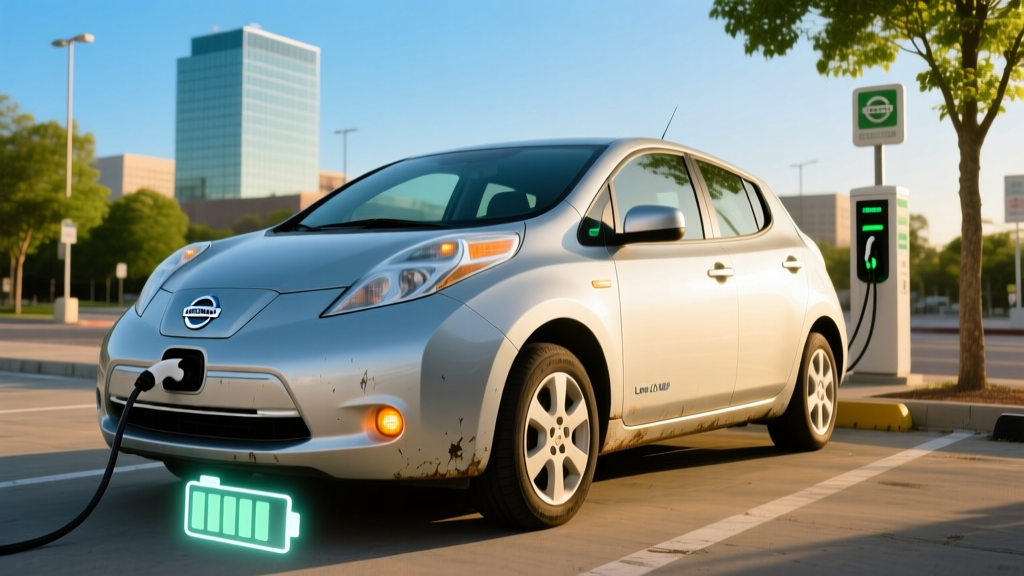
The 2010 Nissan Leaf (technically sold as a 2011 model in the U.S., unveiled and branded as the 2010 Leaf in Japan) was the vehicle that proved a mass-market, fully electric car could exist. Over a decade later, these early Leafs are flooding the used market at bargain prices — often under $5,000. But buying a first-generation EV in 2026 comes with serious caveats that most listings won't tell you about. This review covers the real-world numbers you need before handing over cash.
2010 Nissan Leaf Core Specifications
| Spec | Value |
|---|---|
| EPA Range (Original) | 73 miles |
| Battery Capacity | 24 kWh (usable ~21 kWh) |
| Battery Chemistry | Lithium Manganese Oxide (LMO) |
| Motor Output | 107 hp / 207 lb-ft torque |
| 0–60 mph | ~9.9 seconds |
| Drivetrain | FWD (front-wheel drive) |
| MPGe (Combined, Original) | 99 MPGe |
| Efficiency | 34 kWh/100 mi |
| Max DC Fast Charge | ~40 kW (CHAdeMO) |
| Level 2 Charge Rate | 3.3 kW (6.6 kW on later 2013+ models) |
| Cargo Volume | 14.5 cu ft |
| Rear Legroom | 33.3 inches |
| Original MSRP | $32,780 (before incentives) |
| Battery Warranty (Original) | 8 years / 100,000 miles (capacity) |
Real-World Range in 2026: What the Sticker Won't Tell You
The 73-mile EPA figure was optimistic even in 2011. The Leaf's 24 kWh pack (with only about 21 kWh usable to protect the cells from deep discharge) was paired with passive air cooling — no active thermal management. That design choice has proven devastating for long-term battery health, especially in hot climates.
Based on owner-reported data aggregated by fueleconomy.gov and community tracking on forums like Speak EV and My Nissan Leaf, a 2010–2011 Leaf in 2026 typically shows:
- Healthy battery (10–11 bars on the capacity gauge): 55–65 miles real-world
- Average degradation (9 bars): 40–55 miles real-world
- Heavy degradation (7–8 bars): 25–40 miles real-world
- Cold weather penalty (below 32°F): subtract 20–35% from any of the above
- Highway driving at 70 mph: subtract 15–25% due to the Leaf's poor aerodynamic efficiency at speed
The air-cooled battery is the root cause. Unlike modern EVs with liquid-cooled packs (Tesla, Hyundai, Ford), the Leaf's cells cook in summer heat and freeze in winter, accelerating degradation. A 2010 Leaf originally sold in Phoenix or Las Vegas will almost certainly have worse battery health than one from Portland or Seattle.
Charging Speed: The Leaf's Biggest 2026 Limitation
| Charging Level | Power | Connector | Time (Empty–Full or 10–80%) | Miles Added/Hour |
|---|---|---|---|---|
| Level 1 (120V household) | 1.2–1.4 kW | J1772 | ~20+ hours (full) | ~4 mi/hr |
| Level 2 (240V home/public) | 3.3 kW | J1772 | ~7 hours (full) | ~12 mi/hr |
| DC Fast Charge | ~40 kW peak | CHAdeMO | ~30 min (10–80%) | ~80 mi/hr (peak) |
The 2010 Leaf's 3.3 kW onboard charger is painfully slow by 2026 standards. A full charge from empty takes about 7 hours on Level 2 — adequate for overnight charging, but it means you can't meaningfully top up during a quick stop at a public charger. Nissan didn't offer the 6.6 kW onboard charger until the 2013 model year.
DC fast charging uses the CHAdeMO connector, which is being rapidly phased out in North America. As of 2026, Electrify America, EVgo, and most networks have prioritized CCS and NACS (Tesla's standard). CHAdeMO stalls are shrinking, and some new stations don't include them at all. This is a serious practical concern for any Leaf buyer relying on public fast charging.
Even when you find a CHAdeMO station, the Leaf's ~40 kW peak charge rate and aggressive taper curve mean you won't sustain that speed. Expect 10–80% to take roughly 30 minutes under ideal conditions — and longer if the battery is warm, since the Leaf's battery management system throttles charging to protect overheated cells (a phenomenon owners call "Rapidgate").
Battery Degradation: How to Check Before You Buy
The 2010 Leaf's dashboard includes a battery capacity indicator — a series of bars on the far right of the instrument cluster. A brand-new Leaf showed 12 bars. Each lost bar represents roughly 6–8% capacity degradation.
- 12 bars: Near-original capacity (extremely rare for a 2010 model)
- 11 bars: ~85–93% State of Health (SoH) — good condition
- 10 bars: ~78–85% SoH — acceptable, expect 55–65 mi range
- 9 bars: ~70–78% SoH — noticeable degradation, ~45–55 mi range
- 8 bars or below: Under 70% SoH — the original 8-year/100,000-mile capacity warranty threshold was 66.25% (roughly 4 bars lost), so most of these are out of warranty coverage
The original battery warranty guaranteed the pack would retain at least 66.25% capacity (9 bars or above) for 8 years or 100,000 miles. For a 2010 model, that warranty expired in 2018–2019 at the latest. Any battery replacement now is entirely out of pocket.
A replacement battery from Nissan runs approximately $6,500–$8,500 installed as of 2026, though availability of new OEM packs for the 2010 model is increasingly limited. Some owners have sourced refurbished packs or upgraded to the 30 kWh or 40 kWh pack from later Leaf generations, but this requires specialized knowledge and isn't a plug-and-play swap.
Performance and Driving Impressions
The 2010 Leaf's 107-horsepower electric motor and 207 lb-ft of instant torque made it feel peppy around town in 2011 — and it still does in low-speed urban driving. The 0–60 mph time of roughly 9.9 seconds is leisurely by 2026 EV standards (a Tesla Model 3 RWD does it in 5.8 seconds, a Hyundai Ioniq 6 in 5.1), but the Leaf's torque delivery from zero RPM gives it adequate merge-and-pass ability below 45 mph.
Above 60 mph, the Leaf runs out of breath quickly. The motor's power band falls off, and highway passing requires planning. Top speed is electronically limited to approximately 90 mph.
Ride quality is comfortable and compliant — the Leaf was tuned for comfort, not sportiness. Steering is light and numb. The regenerative braking offers two modes: D (drive) with mild regen, and Eco mode with stronger regen that approaches but doesn't quite achieve one-pedal driving. There's no true one-pedal mode that brings the car to a complete stop without touching the brake.
Interior, Tech, and Practicality in 2026
The 2010 Leaf's interior was designed to communicate "futuristic eco-car" with its bio-plastic dashboard and tree-branch-inspired center console. In 2026, it reads as dated but functional.
Infotainment: The base model came with a basic AM/FM/CD unit. The optional navigation system included a touchscreen with real-time range estimation, nearby charging station lookup, and the ability to pre-heat or pre-cool the cabin while plugged in (a genuine energy-saver in extreme weather). There is no Apple CarPlay, Android Auto, Bluetooth audio streaming (only hands-free calling on equipped models), or USB port for modern devices. Plan on using your phone as your primary infotainment.
Driver Assistance: The 2010 Leaf has no active driver-assist features. No lane-keeping, no adaptive cruise, no automatic emergency braking, no blind-spot monitoring. You get front and side airbags, stability control, and ABS — standard safety for the era, but nothing that qualifies as ADAS.
Cargo and Passenger Space: The 14.5 cubic-foot trunk is adequate for a week's groceries or two carry-on bags, but the battery pack sits beneath the rear seat and cargo floor, eliminating any possibility of a flat load floor or frunk. Rear legroom at 33.3 inches is tight for adults on longer trips. Front seats are comfortable for commuting.
Pros
- Dirt-cheap used prices ($3,000–$6,000 in 2026)
- Low running costs — electricity far cheaper than gas
- Smooth, quiet, zero-tailpipe-emission commuting
- Reliable drivetrain (the motor and inverter rarely fail)
- Hatchback practicality for a small footprint
- Eligible for HOV lane access in some states (check local rules)
Cons
- Severely degraded battery — often under 50 miles real range
- CHAdeMO connector is disappearing from public networks
- No active thermal management — battery degrades faster
- Slow 3.3 kW Level 2 charging
- Zero modern safety tech or driver assistance
- Outdated infotainment with no smartphone integration
- Battery replacement cost exceeds vehicle value
Pricing, Tax Credits, and Total Cost
As of 2026, a used 2010 Nissan Leaf typically sells for $3,000–$6,000 depending on mileage, condition, and critically, battery bar count. A 10-bar car commands a premium; an 8-bar car is essentially a rolling liability.
Federal Tax Credit: The IRS §30D Clean Vehicle Credit applies only to new vehicles. For used EVs, the separate §25E Used Clean Vehicle Credit offers up to $4,000 (or 30% of the sale price, whichever is less) — but it requires the vehicle to be at least two model years old, purchased from a dealer (not a private party), priced under $25,000, and the buyer must meet income caps ($75,000 single / $150,000 joint). A $5,000 Leaf bought from a qualifying dealer could yield a $1,500 credit (30% of $5,000). Consult a tax professional — rules and dealer eligibility vary.
Total Cost of Ownership: At $5,000 purchase, home charging at $0.14/kWh, and 34 kWh/100 mi efficiency, your fuel cost is roughly $0.048 per mile — about one-quarter the cost of a 30 MPG gas car at $3.50/gallon. Insurance is cheap (typically $60–$90/month). The major financial risk is battery replacement: if the pack fails or degrades below usability, you're looking at $6,500–$8,500 for a new one, which may exceed the car's value.
Who Should Buy a 2010 Leaf in 2026?
- You need a dirt-cheap second car for a sub-30-mile round-trip commute
- You can charge at home (Level 1 or Level 2) every night
- You live in a mild climate (Pacific Northwest, coastal California)
- You find a 10+ bar example with documented battery health
- You view it as a 2–4 year disposable commuter appliance
- You need highway range or road-trip capability
- You live in a hot climate (Arizona, Texas, Florida summers)
- You rely on public DC fast charging
- You want modern safety features or infotainment
- You can't absorb a potential $7,000+ battery replacement
Frequently Asked Questions
What is the real-world range of a 2010 Nissan Leaf in 2026?
Expect 40–65 miles depending on battery degradation (bar count), ambient temperature, and driving style. Highway driving and cold weather will push you toward the lower end. A healthy 11-bar car in mild weather can still deliver 60+ miles in city driving.
Does the 2010 Nissan Leaf qualify for any federal EV tax credit?
Not the new-vehicle §30D credit. It may qualify for the §25E Used Clean Vehicle Credit (up to $4,000 or 30% of sale price) if purchased from a licensed dealer, priced under $25,000, and the buyer meets income thresholds. Verify with a tax professional and the IRS guidelines.
How fast does the 2010 Leaf charge at home?
On a standard 120V outlet (Level 1), expect about 4 miles of range per hour — a full charge takes over 20 hours. On a 240V Level 2 charger, the Leaf's 3.3 kW onboard charger adds roughly 12 miles per hour, filling the pack in about 7 hours.
Is the 2010 Leaf worth buying vs. a used 2016+ Leaf or Chevy Bolt?
For pure budget commuting under $5,000, the 2010 Leaf can work if the battery is healthy. But a 2016+ Leaf with the 30 kWh pack (84–107 miles EPA) or a used 2017+ Chevy Bolt (238 miles EPA, liquid-cooled battery, CCS charging) offers dramatically more range and longevity for $8,000–$12,000. If your budget allows, the Bolt is the far better used EV buy.
Can I replace the 2010 Leaf's battery?
Yes, but it's expensive relative to the car's value. Nissan dealers quote approximately $6,500–$8,500 for a new OEM replacement pack. Some independent EV shops offer refurbished packs for $3,500–$5,000. The swap requires several hours of labor and specialized equipment. A few aftermarket options exist for upgrading to a larger pack from a later Leaf generation, but this is not a straightforward process.
Is the CHAdeMO connector a dealbreaker?
For home-only charging, no. For road trips or public fast charging, increasingly yes. As of 2026, most new DC fast-charging installations in North America prioritize CCS and NACS. CHAdeMO stalls still exist on older Electrify America and EVgo stations, but their numbers are declining. If you can't charge at home, the 2010 Leaf is a risky choice.