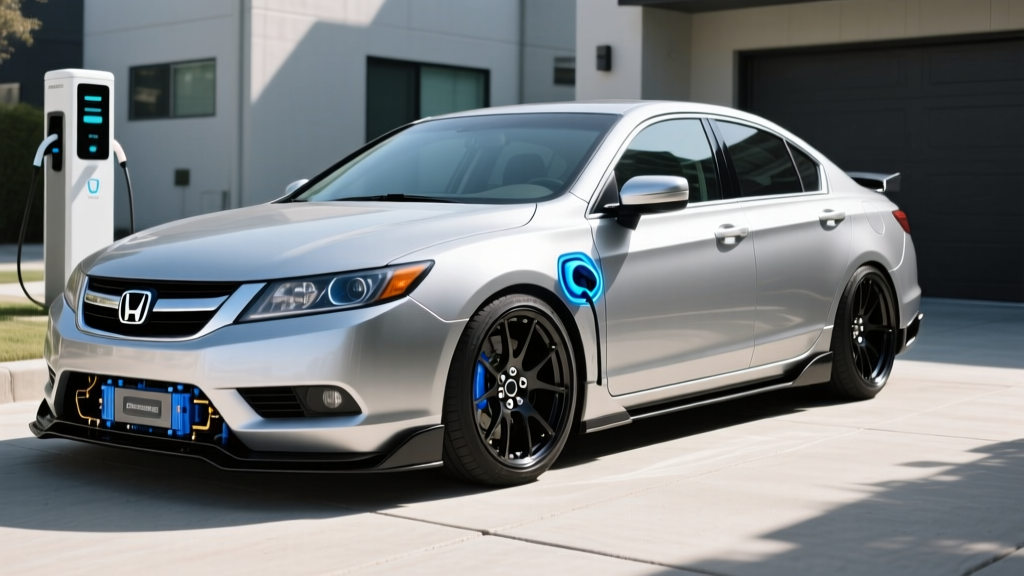
If you're researching the 2010 Honda Accord bolt pattern, you're likely planning a wheel upgrade, evaluating a set of used rims, or exploring an EV conversion project. The bolt pattern — also called the pitch circle diameter (PCD) — is the single most critical wheel-fitment spec, and getting it wrong means the wheel simply won't mount. This guide covers the exact bolt pattern for every 2010 Accord trim, related fitment specs (center bore, thread size, offset), and why this 5-lug pattern has become a crossover favorite in the EV conversion and electric swap community.
2010 Honda Accord Bolt Pattern: The Exact Specs
Every 2010 Honda Accord — whether the 4-cylinder LX, the V6 EX-L, or the Accord Coupe — shares the same bolt pattern:
| Specification | Value |
|---|---|
| Bolt Pattern (PCD) | 5x114.3 mm (5x4.5 inches) |
| Number of Lugs | 5 |
| Center Bore | 64.1 mm |
| Lug Nut Thread Size | M12 x 1.5 |
| Stock Wheel Offset (ET) | +45 to +55 mm (varies by trim/wheel) |
| Stock Wheel Sizes | 16" (LX), 17" (EX/EX-L), 18" (Coupe V6) |
| Lug Nut Torque Spec | 80 lb-ft (108 Nm) |
The 5x114.3 pattern means five lug bolts arranged on a circle with a diameter of 114.3 millimeters. In imperial terms, that's 5x4.5 inches — a measurement you'll see on many aftermarket wheel listings. This pattern is one of the most common in the automotive world, shared across dozens of vehicles from Honda, Toyota, Nissan, Hyundai, Kia, and Ford, which has major implications for wheel sourcing and EV projects.
Why the 5x114.3 Bolt Pattern Matters for EV Conversions
The 2010 Accord's 5x114.3 bolt pattern has become a favorite in the EV conversion world for practical reasons. When builders swap an internal combustion engine for an electric powertrain — typically using a salvaged Tesla drive unit, a NetGain Hyper9 motor, or a Cascadia Motion system — they need wheels that can handle the instant torque and added weight of battery packs.
The 5x114.3 pattern opens up an enormous wheel catalog. Builders can source EV-rated wheels designed for heavier vehicles (like the Hyundai Ioniq 5 or Kia EV6, which also use 5x114.3) that carry higher load ratings than standard Accord wheels. This is critical because a typical EV conversion adds 300–600 lbs of battery mass over the stock curb weight of approximately 3,230–3,470 lbs depending on trim.
Wheel Compatibility: What Else Fits 5x114.3?
The 5x114.3 bolt pattern is shared by a wide range of vehicles, making it one of the easiest patterns for sourcing replacement, aftermarket, or EV-optimized wheels. Here's a compatibility reference:
| Brand | Models with 5x114.3 |
|---|---|
| Honda | Accord (2003+), Civic (2016+), CR-V, Passport, Pilot |
| Toyota | Camry, RAV4, Highlander, Sienna, bZ4X |
| Hyundai | Ioniq 5, Ioniq 6, Tucson, Santa Fe, Sonata |
| Kia | EV6, EV9, Sportage, Telluride, K5 |
| Nissan | Leaf, Ariya, Rogue, Altima, Maxima |
| Ford | Mustang Mach-E, Edge, Explorer |
| Tesla | Model 3, Model Y (2021+ refresh) |
This cross-compatibility is a major advantage for EV conversions. A builder doing a 2010 Accord electric swap can mount wheels from a wrecked Tesla Model 3, a set of Hyundai Ioniq 5 aero wheels, or Ford Mustang Mach-E GT performance rims — all without adapters, provided the center bore (64.1 mm for the Accord) is matched or adapted with hub-centric rings.
Hub-Centric vs. Lug-Centric: The Center Bore Factor
The 2010 Accord's center bore is 64.1 mm. This is the hole in the center of the wheel that slides over the hub flange. When the center bore matches exactly, the wheel is "hub-centric" — the hub bears the vehicle's weight, and the lug nuts simply clamp the wheel in place.
Many aftermarket and EV-donor wheels have larger center bores. For example:
- Hyundai/Kia wheels: 67.1 mm center bore
- Toyota wheels: 60.1 mm center bore (smaller — will NOT fit without machining)
- Tesla Model 3/Y: 64.1 mm center bore (direct fit on the Accord)
- Ford Mach-E: 63.4 mm center bore (slightly smaller — will not fit)
When mounting a wheel with a larger center bore, you must use hub-centric rings (typically $15–$30 per set) to fill the gap. Running a wheel without proper centering causes vibration at highway speeds and places uneven stress on the lug studs — a serious safety concern, especially on a heavier EV-converted vehicle.
EV Conversion Considerations: Torque, Weight, and Wheel Choice
Electric motors deliver peak torque from 0 RPM. A typical EV conversion using a Tesla small drive unit produces 250–350 lb-ft of torque to the wheels instantly, compared to the 2010 Accord's stock 4-cylinder (161 lb-ft) or V6 (251 lb-ft). This torque spike places significantly more stress on wheels, particularly during hard acceleration from a stop.
For an EV-converted 2010 Accord, follow these wheel-selection guidelines:
- Load rating: Minimum 1,500 lbs per wheel (6,000 lbs total for a 4,200-lb conversion with margin)
- Construction: Forged or flow-formed aluminum preferred over cast — forged wheels handle impact and torque loads better
- Diameter: 17" or 18" offers the best tire selection for EV-weight vehicles; avoid going larger than 19" as unsprung mass increases and efficiency drops
- Aero covers: If efficiency matters (e.g., maximizing range on a limited battery), consider EV-style aero wheel covers — they can improve highway efficiency by 2–4%
- Tire choice: Use EV-rated or high-load-range tires (XL or reinforced) — standard Accord tires are not designed for the added weight and instant torque
Offset and Brake Clearance for EV Swaps
The stock 2010 Accord wheel offset ranges from +45 to +55 mm. Offset determines how far the wheel sits inward or outward relative to the hub mounting surface. In an EV conversion, this becomes more complex because builders often install larger brake calipers to handle the added vehicle weight.
Common EV conversion brake upgrades include:
- Wilwood 4-piston calipers with 12.19" rotors
- OEM Honda Pilot or Acura MDX calipers (larger than Accord, same 5x114.3 pattern)
- Tesla Model 3 performance brake assemblies
Each of these requires verifying that the chosen wheel's inner barrel clears the caliper. A +45 mm offset 17" wheel typically clears most 4-piston caliper setups, but always perform a physical test-fit before committing to a full wheel set.
Frequently Asked Questions
What is the bolt pattern on a 2010 Honda Accord?
The 2010 Honda Accord uses a 5x114.3 mm bolt pattern (also expressed as 5x4.5 inches). This applies to all trims: LX, EX, EX-L, and the Coupe variants, regardless of 4-cylinder or V6 engine.
Will Tesla Model 3 wheels fit a 2010 Honda Accord?
Yes, with caveats. The Tesla Model 3 uses the same 5x114.3 bolt pattern and a 64.1 mm center bore, making it a direct bolt-on fit. However, verify the offset (Tesla uses +35 to +40 mm) to ensure proper clearance with your Accord's suspension and brakes. The slightly lower offset will push the wheel outward by roughly 5–10 mm compared to stock.
Can I use wheels from a Hyundai Ioniq 5 on my 2010 Accord?
The Ioniq 5 shares the 5x114.3 bolt pattern, but its center bore is 67.1 mm — larger than the Accord's 64.1 mm hub. You will need a set of 67.1-to-64.1 mm hub-centric rings to properly center the wheels. With rings installed, the fitment is safe and vibration-free.
What lug nuts do I need for aftermarket wheels on a 2010 Accord?
The 2010 Accord uses M12 x 1.5 thread pitch lug nuts with a ball-seat (spherical) style for OEM wheels. Many aftermarket wheels require cone-seat (60-degree taper) lug nuts. Always match the lug nut seat type to the wheel's lug hole design — mixing them is dangerous and can cause loosening under load.
Does the 2010 Accord bolt pattern match other Honda models?
Yes. The 5x114.3 pattern is shared with the Honda Civic (2016 and newer), CR-V, Pilot, Passport, Odyssey, and Ridgeline. However, center bore sizes vary across these models, so always verify the center bore (64.1 mm for the Accord) before swapping wheels between vehicles.
How does bolt pattern affect an EV conversion project?
The 5x114.3 pattern is one of the most common in the EV conversion community because it allows builders to source high-load-rated wheels from modern EVs (Ioniq 5, EV6, Model 3, Mach-E) that are engineered for heavier vehicles and instant electric torque. This dramatically expands the wheel and tire selection beyond what the original Accord catalog offers.
Key Takeaways for Wheel Fitment and EV Projects
- One of the most common bolt patterns globally — massive wheel selection
- Direct compatibility with many modern EV wheels (Tesla, Hyundai, Kia, Ford)
- Easy to find high-load-rated options for EV conversions
- Abundant aftermarket support at every price point
- Ignoring center bore differences — always use hub-centric rings when needed
- Using incorrect lug nut seat type (ball vs. cone) for the wheel
- Selecting wheels rated below the converted vehicle's gross weight
- Overlooking brake caliper clearance with lower-offset wheels
The 2010 Honda Accord's 5x114.3 bolt pattern is one of the most versatile in the automotive world. Whether you're fitting a set of lightweight aftermarket wheels for better efficiency, mounting EV-donor wheels for a conversion project, or simply replacing a damaged rim, the cross-compatibility with dozens of modern vehicles gives you options that most other platforms can't match. Just respect the center bore, match your lug nuts, verify your load ratings, and torque everything to 80 lb-ft.