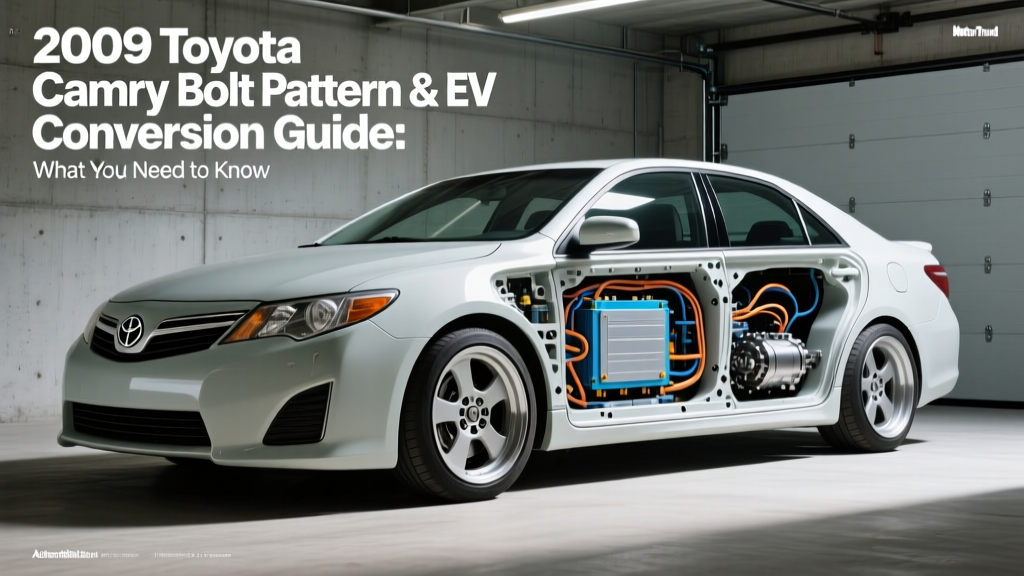
If you've landed here searching for the 2009 Toyota Camry bolt pattern, you likely have one of two goals: fitting aftermarket wheels on a well-loved midsize sedan, or scoping out the Camry's hub specs for a custom electric-vehicle conversion project. Either way, the answer is straightforward, but the context around it matters — especially if you're weighing whether to keep a 15-year-old gas sedan on the road or step into a modern EV that renders wheel-swap headaches irrelevant.
This guide gives you the exact bolt pattern data, explains fitment implications, and then pivots to the real question many Camry owners are asking in 2026: does it make more sense to convert, or to replace with a new electric sedan that costs roughly the same after federal tax credits?
2009 Toyota Camry Bolt Pattern: The Exact Spec
The 2009 Toyota Camry (XV40 generation, model years 2007–2011) uses a 5-lug bolt pattern of 5x114.3 mm (also expressed as 5x4.5 inches). This is one of the most common bolt patterns in the automotive world, shared across many Toyota, Lexus, Honda, Nissan, Hyundai, and Kia models.
| Specification | Value |
|---|---|
| Bolt Pattern (PCD) | 5x114.3 mm (5x4.5") |
| Center Bore | 60.1 mm |
| Thread Size (Lug Nut) | M12 x 1.5 |
| Stock Wheel Sizes | 16" (LE/CE), 17" (SE/XLE) |
| Stock Offset Range | +39 to +45 mm |
| Lug Type | Nut (stud-mounted) |
The 60.1 mm center bore is critical: wheels with a larger bore will need hub-centric rings to prevent vibration, while wheels with a smaller bore simply won't fit. The M12 x 1.5 thread pitch means you must use the correct lug nuts — reusing old nuts on new wheels with different seat types (conical vs. mag vs. ball) is a safety hazard.
Why People Look Up This Bolt Pattern in 2026
Two camps are searching for this data today. The first is wheel upgraders — owners replacing damaged steelies, moving to lighter alloys for handling, or fitting winter tire setups. The 5x114.3 pattern is a blessing here: the used and aftermarket wheel market is massive, meaning affordable options from Enkei, Konig, and even take-off Lexus 17" or 18" wheels fit directly (provided center bore and offset are compatible).
The second camp is EV conversion enthusiasts. The Camry's relatively simple front-wheel-drive layout, ample engine bay, and 3,300-lb curb weight make it a candidate for DIY electric swaps using NetGain Hyper9 motors or Tesla drive unit adaptations. The bolt pattern matters here because conversion builders often need custom adapter plates for motor-to-transaxle mounting, and understanding hub specs is essential when selecting donor drivetrain components or fitting wider tires to handle instant electric torque.
EV Conversion Reality Check: Cost, Complexity, and Trade-Offs
Before you commit a 2009 Camry to an EV conversion, here's the unvarnished math. A competent DIY electric conversion in 2026 typically costs between $15,000 and $35,000 in parts alone — motor, controller, battery pack (usually salvaged Nissan Leaf or Tesla modules), BMS, charger, DC-DC converter, and fabrication. That's before the hundreds of hours of labor, custom motor-mount machining, and the engineering required to integrate power steering, braking, and HVAC without the original engine's accessory drives.
The results? Most Camry conversions yield 60–100 miles of range on a pack that fits the available space, with charging limited to Level 2 (6–7 kW) because integrating DC fast charging into a custom build adds significant cost and complexity. You'll have a unique, satisfying project car — but not a practical daily driver that competes with production EVs on range, charging speed, safety, or warranty.
The Practical Alternative: Modern EV Sedans That Cost Less Than You Think
If your goal is daily electric driving rather than a passion project, the 2026 EV sedan market offers compelling options that, after the federal §30D tax credit, can cost less than a full Camry EV conversion — and come with warranties, fast charging, and modern safety tech.
| Metric | DIY Camry EV Swap | 2026 Hyundai Ioniq 6 SE | 2026 Tesla Model 3 RWD |
|---|---|---|---|
| Estimated Total Cost | $18,000–$40,000+ | $38,250 MSRP | $38,990 MSRP |
| After §30D Credit | $0 credit (not eligible) | ~$30,750* | ~$31,490* |
| EPA Range | ~60–100 mi (estimated) | 361 mi | 341 mi |
| DC Fast Charge (Peak) | None (L2 only typical) | 239 kW (10–80% in 18 min) | 170 kW (10–80% in ~25 min) |
| Battery Warranty | None | 10 yr / 100,000 mi | 8 yr / 120,000 mi |
| Safety (NHTSA/IIHS) | 2009 standards, no ADAS | 5-star NHTSA, IIHS TSP+ | 5-star NHTSA, IIHS TSP+ |
*§30D credit eligibility depends on buyer income caps ($150K single / $300K joint), vehicle MSRP caps ($55K sedans), and battery critical-mineral sourcing requirements. Check current rules at irs.gov before purchasing. Point-of-sale transfer is available at participating dealers.
Who Should Actually Convert a 2009 Camry to Electric?
Be honest about your motivation. An EV conversion makes sense if:
- You're a hobbyist who values the process as much as the result
- You have fabrication skills, electrical knowledge, and 200+ hours to invest
- The car has sentimental value and you want to keep it on the road emission-free
- You're building a show car or educational project, not a primary commuter
- You understand the converted vehicle will have a 2009 safety structure, no airbag system integration guarantees, and essentially zero resale market
It does not make sense if you simply want cheap electric transportation. A used Nissan Leaf (2018+, 150+ mile range) can be had for $10,000–$14,000 in 2026, and a new Ioniq 6 after tax credits undercuts most conversion budgets while delivering 3x the range, DC fast charging, and a decade of battery warranty.
Bolt Pattern Compatibility: What Fits the 5x114.3 Hub?
Whether you're keeping the Camry gas-powered or sourcing wheels for a conversion, the 5x114.3 pattern opens up an enormous selection. Here's a compatibility snapshot:
| Brand | Example Models (Various Years) |
|---|---|
| Toyota / Lexus | Camry, RAV4, Highlander, ES, RX |
| Honda / Acura | Accord, Civic (2022+), CR-V, TLX |
| Nissan / Infiniti | Altima, Maxima, Q50, Rogue |
| Hyundai / Kia | Sonata, Tucson, Sportage, Ioniq 5/6 |
| Ford | Mustang, Edge, Explorer |
Critical reminder: Matching bolt pattern alone is not sufficient. You must also match center bore (60.1 mm for the Camry), offset (stay within ±5 mm of stock to avoid bearing wear and fender rubbing), and load rating. A wheel from a heavier vehicle may be fine; a lighter vehicle's wheel may be unsafe on a Camry. Always verify all four parameters.
FAQ: 2009 Camry Bolt Pattern & EV Questions
Can I put Tesla Model 3 wheels on a 2009 Camry?
No. The Tesla Model 3 uses a 5x114.3 bolt pattern but has a 64.1 mm center bore, which is larger than the Camry's 60.1 mm hub. You'd need hub-centric rings (64.1 to 60.1) and must verify the offset (Tesla's +35 to +40 mm is close to Camry spec). It can work with rings and proper lug nuts, but always test-fit and check for clearance.
What size wheels can I fit on a 2009 Camry?
Stock sizes are 16x6.5" (LE/CE) and 17x7" (SE/XLE). Most owners safely fit 17" or 18" aftermarket wheels with offsets between +35 and +45 mm. Going to 19" is possible but compromises ride quality and risks fender contact on bumps unless you're careful with offset and tire profile.
Is a 2009 Camry EV conversion legal for street use?
It depends entirely on your state. Some states (like California) have specific procedures for registering converted vehicles through the BAR (Bureau of Automotive Repair) referee program. Others have no clear pathway, which can mean registration denial. Check with your state DMV before beginning a conversion. You'll also need to address insurance — most standard insurers won't cover a home-converted EV without specialized appraisal.
What's the cheapest way to go electric if I own a 2009 Camry?
Sell the Camry (private party value: $4,000–$7,000 depending on condition) and put that money plus your conversion budget toward a used EV. A 2019–2021 Hyundai Kona Electric (~$14,000–$18,000 used) gives you 258 miles of EPA range, DC fast charging, and remaining factory battery warranty — for less than a conversion costs.
Does the 5x114.3 bolt pattern apply to all Camry generations?
No. Earlier Camrys (1992–2006, XV10/XV20/XV30) used a 5x114.3 pattern on V6 models but 4x114.3 on 4-cylinder variants. The XV40 (2007–2011) unified to 5-lug across all trims. Later generations (XV50, XV70) continued with 5x114.3. Always verify by year and trim, not assumption.
Whether you're bolting on winter wheels or dreaming of an electric swap, knowing your exact hub specs is the foundation. But if daily electric driving is the goal, the math in 2026 strongly favors a production EV over a project-car conversion — and the 5x114.3 bolt pattern you were researching is shared by many of them, should you ever need to swap wheels on your new Ioniq or Model 3.