Why the 2009 Impala Bolt Pattern Matters for EV Builders
If you've landed here searching for the 2009 Impala bolt pattern, you're likely one of two people: a restorer hunting for compatible wheels, or an EV-conversion hobbyist evaluating the ninth-generation Chevrolet Impala (2006–2013 platform) as a donor chassis for an electric powertrain swap. Either way, the bolt pattern is the gateway spec — get it wrong, and nothing else fits.
The 2009 Chevrolet Impala uses a 5x115 mm bolt pattern (also written as 5x4.53 inches). This means five lug nuts arranged on a circle with a 115 mm diameter. It shares this pattern with several other GM vehicles of the era, including the Chevrolet Malibu, Pontiac G6, and Buick LaCrosse — a useful detail when sourcing wheels, hub adapters, or brake rotors for a conversion project.
This guide covers the exact bolt pattern specs, compatible wheel fitment, and the practical realities of using a 2009 Impala as an EV conversion donor — including what it takes to turn this front-wheel-drive sedan into a battery-electric vehicle in 2026.
2009 Impala Bolt Pattern: Exact Specifications
| Specification | Value |
|---|---|
| Bolt Pattern | 5x115 mm (5x4.53 in) |
| Lug Nut Thread Size | M12 x 1.5 |
| Center Bore | 70.3 mm |
| Wheel Offset (Stock) | +38 to +42 mm |
| Stock Wheel Sizes | 16x6.5 in (base/LS), 17x7 in (LT/LTZ) |
| Recommended Tire Sizes | 225/60R16 (base), 225/55R17 (LT/LTZ) |
The 5x115 pattern is sometimes confused with the far more common 5x114.3 mm (5x4.5 in) pattern found on many Japanese and Korean vehicles. While the difference is only 0.7 mm, forcing 5x114.3 wheels onto a 5x115 hub can cause lug-centric vibration, stud stress, and potential failure. Always match the pattern exactly or use hub-centric rings with the correct PCD adapter.
Wheel Compatibility and Cross-Reference
For EV conversions or stock restorations, knowing which wheels share the 5x115 bolt pattern expands your options significantly. Vehicles sharing this pattern include:
- Chevrolet Impala (2006–2016, ninth and tenth gen)
- Chevrolet Malibu (2004–2012, Epsilon platform)
- Pontiac G6 (2005–2010)
- Buick LaCrosse (2005–2009)
- Saturn Aura (2007–2009)
- Cadillac CTS (first-gen, 2003–2007, with correct center bore)
Center bore caveat: Even with matching bolt patterns, the 70.3 mm center bore must match or the wheel must be fitted with hub-centric rings. A larger center bore wheel can be adapted down; a smaller bore wheel will not physically mount.
The 2009 Impala as an EV Conversion Donor
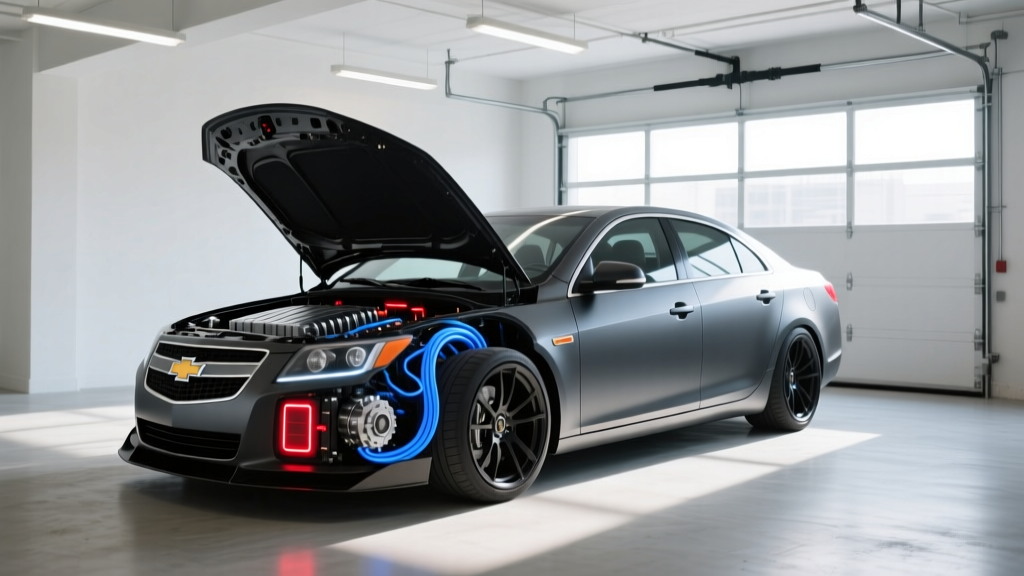
The ninth-gen Impala has attracted attention in the DIY EV conversion community for several reasons: it's affordable (clean examples run $3,000–$6,000 in 2026), it has a spacious engine bay originally designed around a 3.5L–3.9L V6 (or a 5.3L V8 in the SS), and its front-wheel-drive layout simplifies drivetrain packaging for a single-motor EV swap.
What a Typical Impala EV Conversion Involves
A conversion generally replaces the internal combustion engine, transmission, fuel tank, and exhaust system with:
- Electric motor: Commonly a salvaged Tesla drive unit (Large or Small), a NetGain Hyper9, or a Cascadia Motion system producing 100–250 horsepower
- Battery pack: Typically salvaged Nissan Leaf modules, Chevy Volt/Bolt modules, or Tesla modules wired in series/parallel for 96–144V (basic) or 300–400V (advanced) systems
- BMS (Battery Management System): Orion BMS, SimpBMS, or Thunderstruck for cell monitoring and balancing
- Charger: Elcon or TC charger for Level 2 AC charging (3.3–6.6 kW typical)
- DC-DC converter: To power the 12V accessory system (lights, power steering, HVAC controls)
The 5x115 bolt pattern remains unchanged after conversion, meaning you retain full wheel and tire compatibility — important when you consider that an EV-converted Impala will be 200–500 lbs heavier than stock due to battery mass. You may want to upgrade to a 17-inch wheel with a higher load-rating tire.
Realistic Performance Expectations
| Metric | Stock 3.5L V6 | Typical EV Conversion |
|---|---|---|
| Horsepower | 211 hp | 100–200 hp (motor-dependent) |
| 0–60 mph | ~8.5 seconds | 7–12 seconds (weight-dependent) |
| Range | ~400 miles (gas) | 40–100 miles (battery-dependent) |
| Energy Capacity | 17.5-gallon tank | 15–35 kWh usable |
| Refuel/Recharge Time | ~3 minutes | 4–8 hours (Level 2, 6.6 kW) |
| Curb Weight | ~3,600 lbs | ~3,900–4,200 lbs |
Most budget-conscious conversions using 15–20 kWh of battery capacity yield 40–70 miles of real-world range. That's adequate for a commuter car or neighborhood cruiser but not a road-trip vehicle. Higher-end builds with 30–40 kWh packs (using Bolt or Tesla modules) can push 90–120 miles, at significantly higher cost and weight.
Cost Breakdown: 2009 Impala EV Conversion in 2026
| Component | Budget Build | Mid-Range Build |
|---|---|---|
| Donor Vehicle (2009 Impala) | $3,000–$5,000 | $4,000–$6,000 |
| Motor + Controller | $1,500–$3,000 | $4,000–$8,000 |
| Battery Pack (salvaged) | $2,000–$4,000 | $5,000–$10,000 |
| BMS + Wiring | $500–$1,000 | $1,500–$2,500 |
| Charger + DC-DC | $800–$1,500 | $1,500–$3,000 |
| Fabrication / Adapter Plate | $500–$2,000 | $2,000–$5,000 |
| Miscellaneous (cooling, gauges, safety) | $500–$1,500 | $1,500–$3,000 |
| Total Estimated Cost | $8,800–$18,000 | $19,500–$37,500 |
For context, a new 2026 Chevrolet Bolt EV starts around $28,000 (before incentives) with an EPA-estimated 259 miles of range, DC fast charging, full safety tech, and an 8-year/100,000-mile battery warranty. A conversion Impala will not match that on range, reliability, or safety — it's a project car for enthusiasts who value the build process and customization over convenience.
Tax Credit Reality for EV Conversions
A common question: does an EV-converted 2009 Impala qualify for the IRS §30D federal clean vehicle credit?
No. The §30D credit applies only to new qualifying vehicles that meet specific MSRP caps ($55,000 for sedans, $80,000 for SUVs/trucks), buyer income limits, and battery critical-mineral sourcing requirements. A DIY conversion of a 2009 vehicle does not meet any of these criteria.
Some states and local air-quality districts have offered incentives for EV conversions in the past, but these are sporadic and jurisdiction-specific. Check with your state's energy office or department of environmental quality for current programs.
Should You Convert a 2009 Impala to Electric?
Choose the conversion if:
- You're a hands-on builder who enjoys fabrication, wiring, and problem-solving
- You want a unique, custom EV with a full-size sedan's interior space
- You need a short-range commuter and value the project experience over convenience
- You already own a clean 2009 Impala and want to extend its life
Buy a production EV instead if:
- You need reliable daily transportation with 200+ miles of range
- You want DC fast charging for road trips
- You need modern safety features (AEB, lane-keep, blind-spot monitoring)
- You want warranty coverage and federal tax credit eligibility
- Your total budget is under $15,000 (a used Bolt or Leaf is more practical)
Frequently Asked Questions
What is the bolt pattern on a 2009 Chevrolet Impala?
The 2009 Impala uses a 5x115 mm bolt pattern with M12 x 1.5 lug nuts and a 70.3 mm center bore. This is shared with many GM Epsilon and W-body vehicles of the same era.
Can I put 5x114.3 wheels on a 2009 Impala?
Not recommended. The 0.7 mm difference per stud adds up to misalignment across the bolt circle, which can cause vibration, uneven stud loading, and potential failure under heavy loads. Use the correct 5x115 pattern or a precision adapter.
How much does it cost to convert a 2009 Impala to electric?
A budget conversion using salvaged components runs roughly $9,000–$18,000 (plus the donor car). A higher-quality build with better range and charging can reach $20,000–$38,000. This does not include professional labor if you're not doing the work yourself.
What range can I expect from an Impala EV conversion?
Most conversions achieve 40–70 miles of real-world range with a 15–20 kWh pack. Higher-end builds with 30–40 kWh packs can reach 90–120 miles. Range drops 20–30% in cold weather and at sustained highway speeds above 65 mph.
Does the 2009 Impala bolt pattern change after an EV conversion?
No. The bolt pattern is determined by the hub and knuckle assembly, which remains unchanged in a typical conversion. You retain full 5x115 wheel compatibility. However, the added weight of batteries may warrant upgrading to higher-load-rating tires.
Is a 2009 Impala EV conversion street-legal?
It depends on your state. Most states require a converted vehicle to pass a special inspection (often through the DMV or state patrol) to receive a rebuilt/converted title. You'll need to document the conversion, ensure proper lighting, braking, and safety equipment, and carry appropriate insurance. Check your state's specific EV conversion registration requirements before beginning the build.