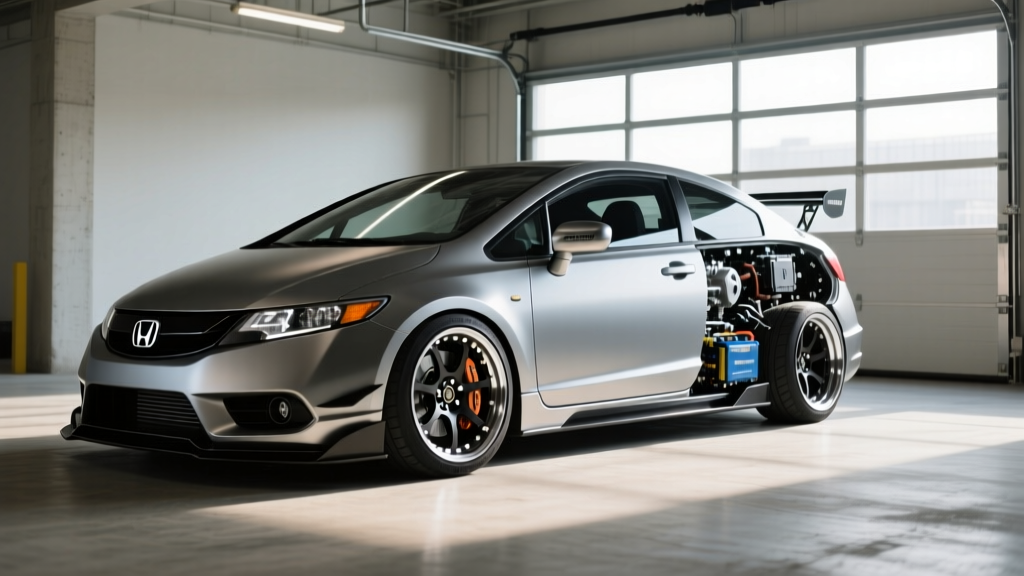
If you're researching the 08 Honda Civic bolt pattern, you're likely sizing up replacement wheels, planning a brake upgrade, or scoping out whether this lightweight, ultra-efficient platform can serve as a candidate for an electric-vehicle conversion. The 2008 Civic (eighth generation, FA/FD chassis) remains one of the most popular compact cars on the road, and its wheel specifications are well-documented — but getting them right matters for safety, handling, and, increasingly, EV-swap compatibility.
This guide covers the exact bolt pattern, center bore, thread pitch, and offset specs for every 2008 Civic trim, then explores how those numbers intersect with EV conversion projects — including wheel selection for added battery weight, brake clearance for regen-compatible calipers, and what you need to know before bolting on aftermarket rollers to an electrified Civic.
2008 Honda Civic Bolt Pattern: The Exact Numbers
The 2008 Honda Civic uses a 5-lug, 114.3 mm bolt circle — commonly written as 5x114.3 (or 5x4.5 in inches). This pattern is shared across all trims: DX, LX, EX, EX-L, Si, and Hybrid. It is one of the most common bolt patterns in the import world, shared with many Honda, Acura, Toyota, Nissan, and Mazda vehicles, which makes sourcing compatible wheels straightforward.
| Specification | Value |
|---|---|
| Bolt Pattern | 5x114.3 mm (5x4.5 in) |
| Center Bore | 64.1 mm |
| Thread Size (Lug Nuts) | M12 x 1.5 |
| Lug Nut Torque Spec | 80 lb-ft (108 Nm) |
| Stock Wheel Sizes | 15" (DX/LX), 16" (EX/EX-L/Hybrid), 17" (Si) |
| Stock Offset Range | +38 to +45 mm |
| Recommended Tire Sizes | 195/65R15, 205/55R16, 215/45R17 |
The 64.1 mm center bore is critical. If you mount wheels with a larger bore (common with aftermarket or take-off wheels from other brands), you'll need hub-centric rings (e.g., 73.1 mm to 64.1 mm) to prevent vibration at highway speeds. Wheels with a smaller bore simply won't fit over the Civic's hub.
Trim-by-Trim Wheel Breakdown
DX and LX Trims
The base DX and volume-selling LX came with 15-inch steel wheels with hubcaps or 15-inch alloys (LX). The 195/65R15 tire prioritizes ride comfort and fuel economy — this combo weighs roughly 35 lbs per corner, which matters if you're planning an EV conversion where unsprung weight affects range and suspension longevity.
EX and EX-L Trims
Stepping up to the EX or EX-L gets you 16-inch alloy wheels wrapped in 205/55R16 rubber. The slightly wider contact patch improves grip without a meaningful fuel-economy penalty. These wheels have a +42 mm offset from the factory.
Si Trim
The performance-oriented Si rides on 17-inch alloys with 215/45R17 tires and a slightly more aggressive +45 mm offset. The Si also uses larger front brake rotors (11.8 in vs. 10.3 in on non-Si models), which affects wheel clearance — a key consideration if you're adapting wheels from other platforms.
Hybrid Trim
The 2008 Civic Hybrid uses the same 16-inch, 5x114.3 pattern but often came with low-rolling-resistance 205/55R16 tires to maximize its EPA-rated 40/45 mpg city/highway. The Hybrid's IMA (Integrated Motor Assist) system was Honda's first-generation mild-hybrid setup — a 20-hp electric motor sandwiched between the 1.3L engine and CVT. While not a full EV, the Hybrid's architecture foreshadowed the electrified Civic lineage.
Why the 08 Honda Civic Bolt Pattern Matters for EV Conversions
The eighth-generation Civic (2006–2011) has become a popular EV conversion donor car for several reasons: it's light (curb weight around 2,600–2,800 lbs depending on trim), it has a roomy engine bay for motor and inverter packaging, and its 5x114.3 bolt pattern opens up a massive catalog of aftermarket and OEM wheels from other manufacturers.
Here's why bolt pattern knowledge becomes mission-critical when converting this chassis to electric:
Handling Added Battery Weight
A typical DIY EV conversion adds 300–600 lbs of battery mass to a Civic. That extra weight shifts the vehicle's load rating requirements. Stock 15-inch Civic wheels have a load rating around 1,100 lbs each — adequate for the stock car but potentially marginal for a converted vehicle with a 500-lb battery pack in the trunk or under the floor. Upgrading to wheels rated for 1,400+ lbs per corner (common among 17- and 18-inch options from brands like Enkei, Konig, or OEM Honda/Acura performance wheels) is a prudent safety step.
Brake Clearance for Regen-Compatible Upgrades
EV conversions often retain the stock brake system but rely heavily on regenerative braking to slow the car. If you're upgrading brakes to handle the added mass — say, swapping in larger front rotors from an Acura TSX (which shares the 5x114.3 pattern) — you need to verify that your chosen wheels clear the new caliper and rotor package. The Si's 17-inch wheels generally clear larger brake setups; 15-inch wheels do not.
Sourcing Wheels From the EV Ecosystem
Several popular EVs and hybrids share the 5x114.3 bolt pattern, which means you can source take-off wheels from vehicles like:
- Tesla Model 3 (2018+): 5x114.3, 64.1 mm bore — direct fit, no rings needed
- Hyundai Ioniq 5: 5x114.3, 67.1 mm bore — requires 67.1-to-64.1 mm hub-centric rings
- Kia EV6: 5x114.3, 67.1 mm bore — same ring requirement
- Toyota bZ4X: 5x114.3, 60.1 mm bore — will NOT fit (bore too small)
Tesla Model 3 18- or 19-inch wheels are a popular choice for Civic EV conversions because they're lightweight, aero-optimized, and designed to handle the heavier curb weight of an EV — all while being a direct bolt-on to the Civic's 64.1 mm hub.
Torque Specs and Installation Best Practices
Whether you're mounting stock replacements, EV-donor wheels, or aftermarket alloys, correct installation is non-negotiable:
| Item | Specification |
|---|---|
| Lug Nut Torque | 80 lb-ft (108 Nm) |
| Torque Pattern | Star/criss-cross pattern |
| Re-Torque Interval | After 50–100 miles on new wheels |
| Lug Nut Type | Ball-seat (spherical) — OEM Honda |
| Aftermarket Note | Many aftermarket wheels use conical (tapered) seat — verify before torquing |
A critical note for EV conversions: the instant torque of an electric motor places higher cyclic stress on lug studs than a stock 140-hp gasoline engine. If your conversion motor produces 200+ lb-ft of torque (common with NetGain Hyper9 or Cascadia Motion setups), consider upgrading to ARP wheel studs for added tensile strength. The stock M12x1.5 studs are adequate for the stock powertrain but represent a weak point under sustained high-torque EV acceleration.
EV Conversion Wheel & Tire Selection Framework
- Choose 15-inch wheels if: You prioritize maximum range (lower weight, narrower tires reduce rolling resistance) and your conversion adds less than 300 lbs of battery.
- Choose 16-inch wheels if: You want a balance of range, grip, and load capacity — the sweet spot for most Civic EV conversions with 20–40 kWh packs.
- Choose 17-inch (or 18-inch) wheels if: Your conversion exceeds 500 lbs of added weight, you've upgraded to larger brakes, or you need the load rating of EV-rated wheels (e.g., Tesla Model 3 take-offs).
For tire selection, EV conversions benefit from low-rolling-resistance (LRR) tires like the Michelin Energy Saver A/S or Continental EcoContact — these can recover 3–5% of range compared to standard all-season tires. However, the added weight of batteries means you should prioritize load rating (look for XL — Extra Load — designated tires) over absolute lowest rolling resistance.
Connecting the 2008 Civic to Honda's Electrified Future
The 2008 Civic Hybrid's modest IMA system was a stepping stone. Today's electrified Honda lineup tells a different story:
- 2026 Honda Civic Hybrid: Returns an EPA-estimated 50 mpg combined with a two-motor system producing 200 hp — a massive leap from the 2008 Hybrid's 110 combined hp.
- Honda Prologue (2024+): Honda's first dedicated EV SUV, built on GM's Ultium platform with up to 308 miles of EPA range.
- Honda 0 Series (announced for 2026+): Honda's next-generation dedicated EV platform, promising thinner batteries and Level 3-capable automated driving on highways.
For enthusiasts who love the eighth-gen Civic's lightweight, tossable chassis, an EV conversion using the stock 5x114.3 wheel architecture represents a way to keep that driving experience alive while eliminating tailpipe emissions — and the bolt pattern's universality means you'll never struggle to find compatible wheels.
Frequently Asked Questions
What is the bolt pattern on a 2008 Honda Civic?
The 2008 Honda Civic uses a 5x114.3 mm bolt pattern (also expressed as 5x4.5 inches) across all trims including DX, LX, EX, EX-L, Si, and Hybrid. The center bore is 64.1 mm, and lug nuts are M12 x 1.5 thread pitch, torqued to 80 lb-ft.
Will Tesla Model 3 wheels fit a 2008 Honda Civic?
Yes. The Tesla Model 3 uses the same 5x114.3 bolt pattern and 64.1 mm center bore as the 2008 Civic. Model 3 18- and 19-inch wheels are a direct bolt-on with no hub-centric rings required. Verify offset (Tesla uses +35 to +40 mm) for proper fender clearance.
Can I use 5x114.3 wheels from a Hyundai or Kia on my Civic?
The bolt pattern matches, but Hyundai and Kia wheels typically have a 67.1 mm center bore — larger than the Civic's 64.1 mm hub. You'll need 67.1-to-64.1 mm hub-centric rings to eliminate vibration. Never mount wheels with a bore smaller than 64.1 mm, as they physically won't fit over the hub.
What is the largest tire I can fit on a stock 2008 Civic?
On stock 16-inch wheels with no suspension modifications, most owners fit up to a 225/50R16 without rubbing. On 17-inch Si wheels, 225/45R17 is a common upgrade. If your EV conversion lowers the car (common with added battery weight compressing stock springs), you may need to stay closer to OEM tire sizes or add a mild spacer.
Is the 2008 Civic Hybrid a good EV conversion donor?
The 2008 Civic Hybrid can work, but most converters prefer the non-hybrid DX or LX trims. The Hybrid's IMA system, high-voltage battery, and CVT add complexity you'll be removing anyway. A clean DX/LX chassis is lighter, simpler, and cheaper — letting you allocate budget to the EV drivetrain. The shared 5x114.3 bolt pattern means wheel options remain identical regardless of trim.
Do I need to upgrade lug studs for an EV conversion?
If your electric motor produces more than ~180 lb-ft of torque (which many conversion motors do), upgrading to aftermarket ARP wheel studs is recommended. The stock M12x1.5 studs handle the Civic's original 126–197 lb-ft gasoline engines adequately, but the instant-on torque characteristic of electric motors creates higher peak stress on studs during hard launches.