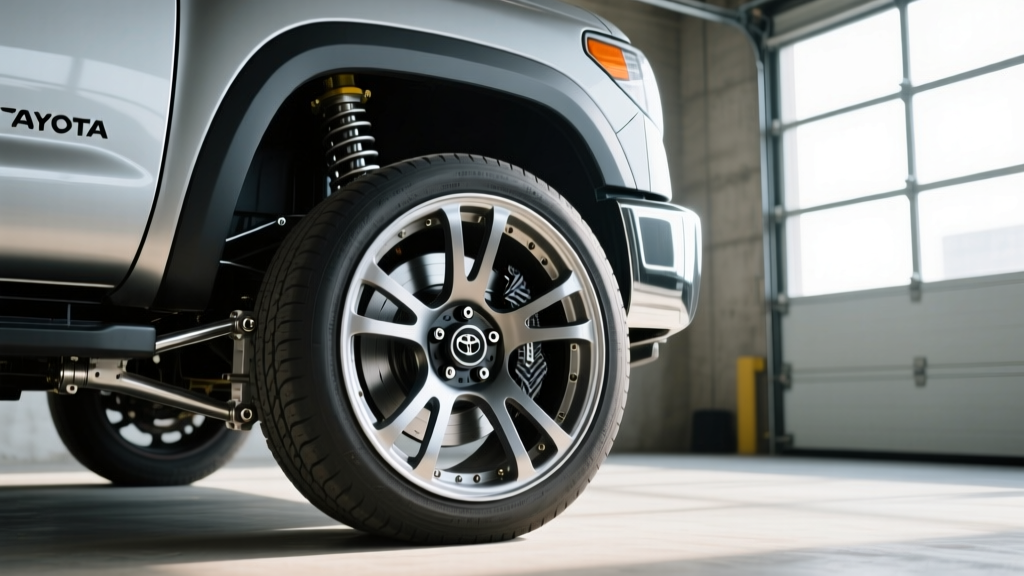
When converting a classic Toyota Tundra to electric power or sourcing compatible wheels for an EV truck project, understanding the 2007 Tundra bolt pattern is the critical first step. This second-generation Tundra uses a 5x150mm (5x5.91-inch) lug pattern — a specification that directly impacts which wheels, adapters, and hub assemblies will work in an electrified build.
2007 Toyota Tundra Bolt Pattern: Exact Specifications
| Specification | Value |
|---|---|
| Bolt Pattern (PCD) | 5x150mm (5x5.91") |
| Center Bore | 110.1mm |
| Lug Nut Thread Size | M14 x 1.5 |
| Lug Nut Type | Mag seat with washer |
| Factory Wheel Size Range | 17" to 20" diameter |
| Typical Offset (ET) | +50mm to +60mm (varies by trim) |
| Stock Tire Size (SR5) | 255/70R18 |
| Gross Axle Weight Rating (front) | ~3,700 lbs |
The 5x150mm pattern is relatively uncommon in the North American truck market. Most domestic half-ton trucks (Ford F-150, Chevy Silverado 1500, Ram 1500) use either 6-lug patterns (6x135mm, 6x139.7mm) or, in the case of the 2022+ F-150, a 6x135mm bolt circle. This means the 2007 Tundra's wheels are not directly interchangeable with most competitor trucks without adapters.
Why Bolt Pattern Matters for EV Conversions
When swapping a Tundra to electric drive — whether using a salvaged Tesla Large Drive Unit, a NetGain Hyper9 system, or a Cascadia Motion stack — the hub interface must match the wheel. The 5x150mm pattern creates specific challenges and opportunities:
- Hub adapter availability: 5x150mm to 5x120mm (BMW/Tesla front) or 5x114.3mm adapters are manufactured by companies like Adapt-It and Wheel Adapters USA, typically costing $200-$400 per pair.
- Load rating verification: The 2007 Tundra's GVWR ranges from 6,500 to 7,200 lbs depending on configuration. EV conversions add 300-800 lbs of battery mass, so any adapter must be rated for the increased static and dynamic loads.
- Center bore matching: The 110.1mm bore is larger than most aftermarket EV motor hubs. Hub-centric rings or custom machined adapters are required to prevent vibration above 60 mph.
Compatible Wheel Options for Electrified Tundra Builds
Sourcing wheels for a 5x150mm EV conversion requires looking beyond standard truck catalogs. Here are proven fitment paths:
Direct Bolt-On (5x150mm Native)
- Toyota OEM: 2007-2021 Tundra and Sequoia factory wheels (18"-20"). These are hub-centric and rated for the platform's weight.
- Toyota Land Cruiser 200/300 series: Shares the 5x150 pattern. The LC300's 18" TRD wheels offer a more aggressive offset (+45mm) that clears larger brake calipers common in EV motor swaps.
- Aftermarket: Fuel Off-Road, XD Series, and Method Race Wheels produce 5x150 options in 17"-20" sizes with load ratings up to 3,700 lbs per wheel.
Adapter-Dependent Fitments
Using a 25-38mm adapter opens access to:
- 5x114.3mm (5x4.5"): The most common performance wheel pattern. Allows use of lightweight forged wheels from Enkei, Volk Racing, or HRE — reducing unsprung mass, which improves EV efficiency by 2-4% in real-world testing.
- 5x120mm: BMW and Tesla Model S/X front wheel pattern. Useful when sourcing complete Tesla drive unit assemblies with matched wheels.
EV Conversion Weight Impact: A typical 2007 Tundra EV conversion with a 60 kWh battery pack and single rear motor adds approximately 550 lbs over the stock curb weight of 5,100-5,500 lbs. This pushes total vehicle weight to ~5,650-6,050 lbs. Wheel load ratings must account for this, with each front wheel seeing up to 2,800 lbs under hard braking.
EV Conversion Powertrain Specs: Common Tundra Swap Configurations
While the 2007 Tundra was never factory-electrified, several proven EV conversion architectures use this platform. Below are real-world specs from documented builds:
| Configuration | Motor | Battery | Range (est.) | 0-60 mph | HP / Torque |
|---|---|---|---|---|---|
| Single Rear (Budget) | NetGain Hyper9 | 40 kWh NMC | 70-90 mi | ~9.5 sec | 120 HP / 250 lb-ft |
| Dual Motor (Performance) | Tesla Large Drive Unit x2 | 85 kWh NMC | 150-180 mi | ~4.8 sec | 500 HP / 650 lb-ft |
| Single Rear (Towing) | Cascadia iDM14 | 100 kWh LFP | 140-170 mi | ~7.2 sec | 250 HP / 550 lb-ft |
These range figures are real-world estimates based on 2.0-2.5 kWh/mile consumption for a truck of this mass and aerodynamics. Highway driving at 70+ mph reduces range by 25-35% compared to city cycles. Cold weather (below 32°F) further reduces usable range by 15-25% due to battery chemistry limitations and cabin heating loads.
Charging an Electrified Tundra: What to Expect
Charging infrastructure compatibility depends on the onboard charger and battery management system (BMS) selected during conversion:
| Charging Level | Power (kW) | Miles Added Per Hour | Notes |
|---|---|---|---|
| Level 1 (120V household) | 1.4 kW | ~3-4 mi/hr | Emergency/trickle only; 40+ hours for full charge on 85 kWh pack |
| Level 2 (240V home) | 7.2-11.5 kW | ~18-28 mi/hr | Requires J1772 inlet; 8-12 hours for full charge |
| DC Fast Charge (CCS) | 50-125 kW peak | ~120-250 mi/hr | 10-80% in 35-55 min; depends on BMS and pack C-rate |
Most custom Tundra conversions use a 6.6 kW or 11.5 kW Elcon or Grizzl-E onboard charger for Level 2 charging. DC fast charging requires a CCS-compatible BMS (such as the Thunderstruck Motors or EV West systems) and adds $2,500-$5,000 to the build cost. Without DCFC, the truck is limited to home and destination charging — viable for local use but impractical for road trips.
Cost Breakdown: 2007 Tundra EV Conversion Economics
Converting a 2007 Tundra to electric is a significant investment. Here's a realistic cost breakdown based on 2024-2025 build data from the EV conversion community:
- Donor vehicle (2007-2013 Tundra, running): $6,000-$12,000
- Motor + controller (single rear): $3,500-$7,000
- Battery pack (60-85 kWh, used Tesla modules or new LFP): $8,000-$18,000
- BMS + charger + DCFC inlet: $3,000-$6,000
- Fabrication (motor mounts, battery boxes, cooling): $4,000-$10,000
- Wheels/tires (if adapter required): $800-$2,500
- Wiring, contactors, safety systems: $1,500-$3,000
Total realistic range: $26,800-$58,500 depending on component sourcing and labor (DIY vs. professional build).
For context, a new 2025 Ford F-150 Lightning starts at ~$55,000 before incentives. The conversion route makes sense for enthusiasts who value the Tundra's body-on-frame durability and want a custom build — not for buyers seeking warranty coverage or dealer service.
Federal Tax Credit Eligibility for EV Conversions
The IRS §30D Clean Vehicle Credit does not apply to custom EV conversions. Per IRS guidelines, the credit requires the vehicle to be manufactured by an OEM with a valid VIN indicating a factory-electric drivetrain. A converted 2007 Tundra will have a gasoline VIN and does not qualify.
However, some states (California, Colorado, New York) offer point-of-use incentives for EV conversions or aftermarket electrification. Check your state's energy office for current programs.
Pros and Cons: Electrifying a 2007 Tundra
Pros
- Body-on-frame construction handles battery weight well; frame rails provide natural battery box mounting points
- 5x150mm wheels are available from Toyota/Lexus OEM sources with proven load ratings
- Large engine bay accommodates most EV motors without cutting the firewall
- Regenerative braking reduces wear on the Tundra's heavy-duty brake system
- Instant torque improves off-road crawl capability over the stock V6/V8
Cons
- 5x150mm bolt pattern limits aftermarket wheel selection without adapters
- No federal tax credit; conversion cost is 100% out-of-pocket
- Aerodynamics (0.42 Cd) and 5,500+ lb weight result in poor efficiency (2.0-2.5 kWh/mile)
- No factory warranty on drivetrain; custom builds require self-insurance for component failure
- Resale value is uncertain; most buyers want factory EVs with service history
Is It Worth It? Decision Framework
Electrify a 2007 Tundra if:
- You have access to a donor truck for under $8,000 and can fabricate motor mounts yourself
- You need a rugged, body-on-frame EV for off-road or ranch use where F-150 Lightning ground clearance is insufficient
- You value the learning experience and community support of the EV conversion movement (EV West, Open Inverter forums)
Buy a factory EV truck instead if:
- You need a daily driver with warranty coverage, dealer service, and DC fast charging reliability
- You want to qualify for the $7,500 federal tax credit (subject to MSRP and income caps per IRS §30D rules)
- You plan to tow more than 5,000 lbs regularly — factory EV trucks have validated cooling and thermal management for sustained loads
Frequently Asked Questions
What is the bolt pattern on a 2007 Toyota Tundra?
The 2007 Toyota Tundra uses a 5x150mm (5x5.91-inch) bolt pattern with a 110.1mm center bore. This is a 5-lug pattern with 150mm measured from the center of one lug to the far side of the opposite lug hole.
Will 2007 Tundra wheels fit a Tesla or Ford F-150 Lightning?
No. The Tesla Model Y/3 uses 5x114.3mm, and the F-150 Lightning uses 6x135mm. The Tundra's 5x150mm pattern is not compatible without custom adapters, and even then, load rating and offset differences make it inadvisable for daily use on lighter vehicles.
Can I use wheel adapters to fit 5x114.3 wheels on my 2007 Tundra?
Yes, 5x150mm to 5x114.3mm adapters are available in 25mm and 32mm thicknesses. However, adding adapters increases scrub radius and can affect steering feel. Ensure the adapter is hub-centric (110.1mm bore) and rated for at least 3,500 lbs per corner for EV conversion weights.
What is the real-world range of a 2007 Tundra EV conversion?
With an 85 kWh battery pack and single rear motor, expect 150-180 miles in mixed driving at 55-65 mph. Highway-only driving at 75 mph reduces this to 110-130 miles. Cold weather (below freezing) further reduces range by 15-25%. These figures assume 2.0-2.5 kWh/mile consumption, which is typical for a truck of this mass and drag coefficient.
How much does it cost to convert a 2007 Tundra to electric?
A realistic DIY conversion costs $27,000-$40,000 including the donor vehicle. Professional builds with DC fast charging and 85+ kWh packs can exceed $55,000. This does not include bodywork, paint, or interior upgrades.
Does a converted 2007 Tundra qualify for the federal EV tax credit?
No. The IRS §30D credit applies only to new or used EVs with factory-electric drivetrains and qualifying VINs. Custom conversions are not eligible. Some state-level incentives may apply — check your local energy office.
What is the center bore of a 2007 Tundra wheel?
110.1mm. This is the diameter of the center hole that centers the wheel on the hub. Any aftermarket wheel or adapter must match this bore diameter (or use hub-centric rings) to prevent vibration.
Sources & Further Reading
- IRS §30D Clean Vehicle Credit Rules
- Toyota Owner's Manual Archive (wheel specs)
- EPA Fuel Economy and EV Conversion Guidance — fueleconomy.gov