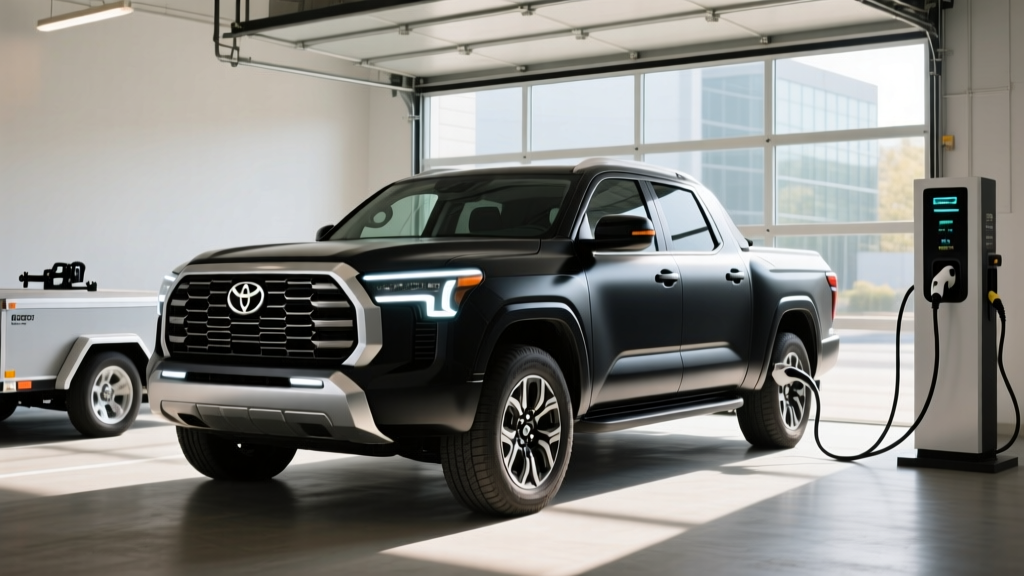
The Toyota Tundra has been a full-size pickup staple for nearly two decades, and the current third-generation platform (introduced for 2022, refreshed through 2026) offers something rare in the truck segment: a standard twin-turbo V6 hybrid powertrain. While truck forums still buzz about the 2007 Toyota Tundra bolt pattern—a 5×150 mm (5×5.9-inch) lug configuration carried forward from the second-generation Tundra—today's buyers are equally focused on hybrid fuel economy, towing capacity, and whether Toyota's i-FORCE MAX powertrain can compete with the Ford F-150 PowerBoost and Ram 1500 lineup.
This review covers the 2026 Toyota Tundra i-FORCE MAX hybrid in depth: real-world MPG, towing and payload specs, wheel compatibility legacy from the 2007 model year, pricing by trim, and how it stacks up against hybrid and conventional rivals.
Powertrain, Horsepower, and 0-60 Performance
The 2026 Tundra's available i-FORCE MAX hybrid pairs a 3.4-liter twin-turbo V6 with a 49-hp electric motor integrated between the engine and the 10-speed automatic transmission. Combined output is 437 horsepower and 583 lb-ft of torque—available from just 2,400 rpm thanks to the electric motor's instant torque fill.
| Spec | Value |
|---|---|
| Engine | 3.4L twin-turbo V6 + 49-hp electric motor |
| Combined Horsepower | 437 hp |
| Combined Torque | 583 lb-ft |
| Transmission | 10-speed automatic |
| Drivetrain | RWD or 4WD (part-time or full-time depending on trim) |
| 0-60 mph (4WD CrewMax) | ~5.7 seconds |
| Top Speed | Electronically limited to ~107 mph |
The base i-FORCE (non-hybrid) twin-turbo V6 produces 389 hp and 479 lb-ft, which is respectable, but the hybrid's low-end torque makes a noticeable difference when towing or merging onto highways. In real-world driving, the 0-60 time of approximately 5.7 seconds (CrewMax 4WD) puts the Tundra hybrid ahead of the Ram 1500 5.7L HEMI V8 and competitive with the F-150 PowerBoost.
Fuel Economy: EPA MPG vs. Real-World Efficiency
The i-FORCE MAX hybrid is not a plug-in hybrid (PHEV) or battery-electric vehicle (BEV)—it's a conventional hybrid (HEV) that recovers energy via regenerative braking and assists the gas engine with a small battery pack. There is no electric-only driving range and no plug to charge.
| Configuration | City MPG | Highway MPG | Combined MPG |
|---|---|---|---|
| 4×2 CrewMax | 20 | 24 | 22 |
| 4×4 CrewMax | 19 | 22 | 20 |
| 4×4 CrewMax (TRD Pro/Off-Road tires) | 18 | 21 | 19 |
The 2007 Toyota Tundra Bolt Pattern: What Owners Need to Know
One of the most-searched specifications among Tundra owners remains the 2007 Toyota Tundra bolt pattern. The second-generation Tundra (2007–2021) uses a 5×150 mm (5×5.9-inch) bolt pattern with a 110 mm center bore and M14×1.5 lug nuts. This is the same bolt pattern used on the current third-generation Tundra (2022–2026), meaning:
- Wheel interchangeability: Factory and many aftermarket wheels from a 2007–2021 Tundra will physically bolt onto a 2022–2026 Tundra, provided offset, backspacing, and load rating are compatible.
- Center bore: Both generations share a 110 mm hub-centric bore. Wheels with a larger bore require hub-centric rings; smaller-bore wheels will not fit.
- Lug nuts: Both generations use M14×1.5 thread pitch, though the 2022+ models use a different seat style (conical/acorn vs. some flat-seat variants on early second-gen). Always verify lug nut compatibility when swapping wheels.
- Brake clearance: The 2022+ Tundra has larger front brake calipers on certain trims (TRD Pro, Capstone). A wheel that fits a 2007 Tundra may not clear the brakes on a 2026 model even though the bolt pattern matches.
| Spec | 2007 Tundra (2nd Gen) | 2026 Tundra (3rd Gen) |
|---|---|---|
| Bolt Pattern | 5×150 mm (5×5.9") | 5×150 mm (5×5.9") |
| Center Bore | 110 mm | 110 mm |
| Lug Thread | M14×1.5 | M14×1.5 |
| Lug Count | 5 | 5 |
| Typical Wheel Size | 18" (stock) | 18"–22" (trim-dependent) |
This continuity is useful for owners upgrading from a second-gen Tundra who want to carry over aftermarket wheels, or for those sourcing used OEM wheels from the large 2007–2021 parts pool. Always confirm load rating—full-size trucks require wheels rated for the vehicle's gross axle weight rating (GAWR).
Towing, Payload, and Cargo Dimensions
The 2026 Tundra i-FORCE MAX 4×4 CrewMax with the proper tow package is rated for up to 12,000 lbs of towing capacity (10,900 lbs for the hybrid specifically, depending on trim and configuration). Payload tops out around 1,735 lbs for hybrid models, slightly less than the non-hybrid due to the hybrid battery and electric motor weight.
| Spec | CrewMax (5.5' Bed) | CrewMax (6.5' Bed) | Double Cab (6.5' Bed) |
|---|---|---|---|
| Bed Length | 65.6 in | 78.7 in | 78.7 in |
| Bed Volume | ~48 cu ft | ~60 cu ft | ~60 cu ft |
| Rear Legroom | 41.6 in | 41.6 in | 34.7 in |
| Front Legroom | 41.2 in | 41.2 in | 41.2 in |
| Max Towing (i-FORCE MAX) | ~10,900 lbs | ~11,400 lbs | ~12,000 lbs |
| Max Payload (i-FORCE MAX) | ~1,640 lbs | ~1,735 lbs | ~1,735 lbs |
The Tundra's composite bed is a standout feature—dent- and corrosion-resistant, with integrated rail caps and available 120V bed power. Compared to the Ford F-150's aluminum bed and the Ram 1500's steel bed, Toyota's SMC (sheet molding compound) bed resists bed rash better in daily use.
Technology, Safety, and Driver Assistance
All 2026 Tundra trims feature Toyota's updated infotainment system with a standard 8.0-inch touchscreen (SR, SR5) or an available 14.0-inch touchscreen (Limited and above) running Toyota's latest multimedia interface with wireless Apple CarPlay and Android Auto.
Toyota Safety Sense 3.0 is standard across the lineup and includes:
- Pre-Collision System with Pedestrian Detection
- Full-Speed Range Dynamic Radar Cruise Control
- Lane Departure Alert with Steering Assist
- Lane Tracing Assist
- Automatic High Beams
- Road Sign Assist
Available features on higher trims include a 360-degree camera, panoramic view monitor, trailer backup guidance, head-up display, and a 12-speaker JBL premium audio system. The TRD Pro adds FOX internal-bypass shocks, a front skid plate, and an electronic locking rear differential.
Pricing, Trims, and Tax Considerations
The 2026 Toyota Tundra is available in eight trims. The i-FORCE MAX hybrid is available from the Limited trim upward (and optional on some SR5 configurations).
| Trim | Powertrain | Starting MSRP (approx.) |
|---|---|---|
| SR (base) | i-FORCE (non-hybrid) | $38,000 |
| SR5 | i-FORCE / i-FORCE MAX opt. | $43,000 |
| Limited | i-FORCE MAX (std) | $53,500 |
| Platinum | i-FORCE MAX (std) | $60,500 |
| 1794 Edition | i-FORCE MAX (std) | $62,000 |
| TRD Pro | i-FORCE MAX (std) | $69,000 |
| Capstone | i-FORCE MAX (std) | $75,000 |
A well-equipped 4×4 CrewMax Limited with the i-FORCE MAX and popular options (panoramic roof, tow mirrors, bed step) typically lands in the $58,000–$62,000 range before dealer adjustments. The TRD Pro and Capstone trims, while loaded, push well past $70,000, entering luxury truck territory.
How It Compares: Tundra Hybrid vs. Key Rivals
| Spec | Toyota Tundra i-FORCE MAX | Ford F-150 PowerBoost | Ram 1500 (5.7L HEMI eTorque) |
|---|---|---|---|
| Hybrid Type | Full hybrid (HEV) | Full hybrid (HEV) | Mild hybrid (eTorque) |
| Combined HP | 437 hp | 430 hp | 395 hp |
| Combined Torque | 583 lb-ft | 570 lb-ft | 410 lb-ft |
| EPA Combined MPG (4×4) | 20 MPG | 22 MPG | 17 MPG |
| Max Towing | ~11,400 lbs | ~12,700 lbs | ~12,750 lbs |
| Bed Material | Composite (SMC) | Aluminum | Steel |
| 0-60 mph | ~5.7 sec | ~5.4 sec | ~6.2 sec |
- You prioritize long-term powertrain reliability (Toyota's hybrid track record)
- You want a composite bed that resists dents and corrosion
- Low-end hybrid torque for around-town towing matters to you
- You value standard Toyota Safety Sense 3.0 on every trim
- Maximum towing capacity is your priority (12,700 lbs vs. 11,400)
- You want an onboard generator (Pro Power Onboard up to 7.2 kW)
- Slightly better EPA highway MPG is important (24 vs. 22)
- You need the widest dealer and aftermarket support network
Warranty Coverage
Toyota backs the 2026 Tundra with competitive warranty terms:
- Basic: 3 years / 36,000 miles
- Powertrain: 5 years / 60,000 miles
- Hybrid Battery: 10 years / 150,000 miles (whichever comes first)
- Corrosion Perforation: 5 years / unlimited miles
- Complimentary Maintenance: 2 years / 25,000 miles (ToyotaCare)
The 10-year/150,000-mile hybrid battery warranty is one of the strongest in the segment and reflects Toyota's decades of hybrid system experience (dating to the 1997 Prius). For owners planning to keep the truck 10+ years, this is a significant peace-of-mind factor over competitors with shorter hybrid coverage.
Frequently Asked Questions
What is the bolt pattern on a 2007 Toyota Tundra, and does it fit the 2026 model?
The 2007 Toyota Tundra uses a 5×150 mm (5×5.9-inch) bolt pattern with a 110 mm center bore and M14×1.5 lug nuts. The 2022–2026 third-generation Tundra uses the identical bolt pattern and center bore. Wheels from a 2007 Tundra will physically bolt onto a 2026 Tundra, but you must verify brake caliper clearance (larger on 2026 TRD trims), offset, and load rating before driving.
Is the 2026 Tundra i-FORCE MAX a plug-in hybrid?
No. The i-FORCE MAX is a conventional (self-charging) hybrid. It uses regenerative braking and the gas engine to charge its ~1.5 kWh battery. There is no plug, no electric-only range, and no eligibility for the federal §30D EV tax credit. If you want a plug-in truck, the Ford F-150 Lightning (BEV) or upcoming Ram 1500 REV are electric alternatives.
What is the real-world fuel economy of the Tundra hybrid?
The EPA rates the 4×4 CrewMax i-FORCE MAX at 19 city / 22 highway / 20 combined MPG. In real-world mixed driving, most owners report 18-21 MPG. Highway cruising at 75+ MPH typically yields 19-20 MPG. Towing drops this to 11-13 MPG depending on trailer weight and terrain.
Does the 2026 Tundra qualify for any federal tax credits?
The Tundra i-FORCE MAX does not qualify for the IRS §30D Clean Vehicle Credit because it is not a plug-in vehicle. The §30D credit is reserved for BEVs and PHEVs meeting battery capacity, MSRP, buyer income, and critical-mineral sourcing requirements. See IRS.gov for current rules.
Can I use 2007 Tundra wheels on a 2022–2026 Tundra?
Yes, with caveats. The bolt pattern (5×150), center bore (110 mm), and lug thread (M14×1.5) are identical. However, the third-gen Tundra has larger front brakes on TRD and upper trims, which may not clear older wheel designs. Always test-fit one wheel before mounting a full set and confirm the wheel's load rating meets the truck's GAWR.
How does the Tundra hybrid compare to the Ford F-150 PowerBoost?
The F-150 PowerBoost edges ahead on maximum towing (12,700 vs. ~11,400 lbs) and highway MPG (24 vs. 22). The Tundra hybrid offers more peak torque (583 vs. 570 lb-ft), a more durable composite bed, and a longer hybrid battery warranty (10/150k vs. Ford's 8/100k). Both are strong choices; the decision often comes down to brand loyalty, dealer proximity, and whether you need Ford's Pro Power Onboard generator feature.