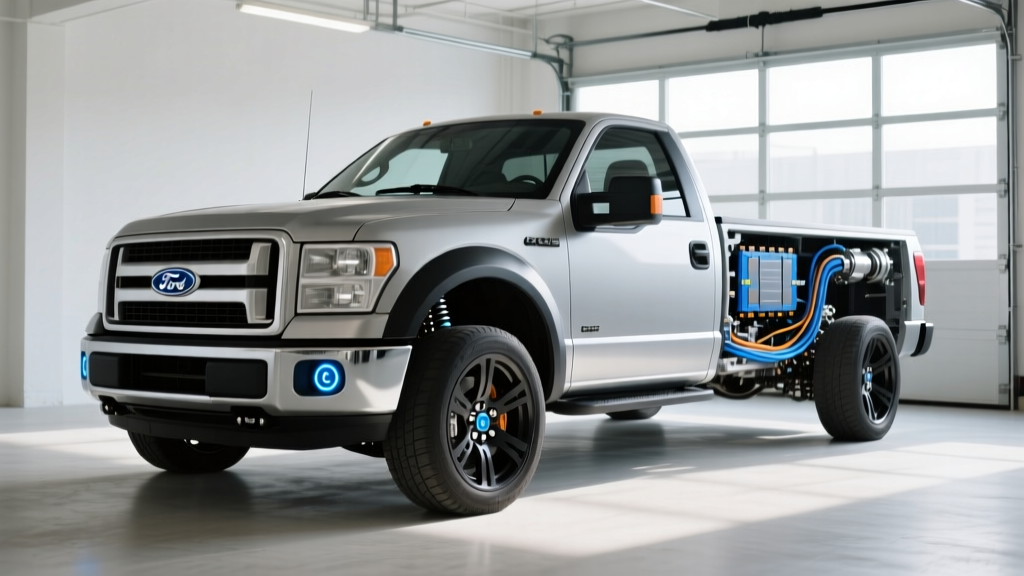
If you are researching the 2007 Ford F-150 bolt pattern, you are likely planning a wheel upgrade, brake conversion, or — increasingly — an electric-vehicle powertrain swap on one of America's most common used trucks. The 2007 F-150 rides on a 6×135 mm (6×5.5-inch) bolt pattern with a 14 mm × 2.0 lug thread and a 87.1 mm center bore. That specification governs every wheel, hub, rotor, and axle assembly that bolts to it, and it becomes critical when adapting EV drivetrain components or choosing wheels for a converted electric F-150.
This guide breaks down the exact bolt-pattern dimensions, explains why they matter for EV conversions and restomods, and compares what a modern factory-electric truck like the 2026 Ford F-150 Lightning delivers versus a DIY electric swap on a 2007 chassis.
2007 Ford F-150 Bolt Pattern: Exact Specifications
Before ordering wheels, adapters, or conversion axles, confirm these factory dimensions. The 2007 F-150 (11th generation, 2004–2008 platform) uses a consistent six-lug layout across all trims (XL, XLT, Lariat, King Ranch, Harley-Davidson) and cab configurations (Regular, SuperCab, SuperCrew).
| Specification | Value |
|---|---|
| Bolt Pattern | 6 × 135 mm (6 × 5.315 in) |
| Lug Nut Thread | M14 × 2.0 |
| Center Bore | 87.1 mm |
| Typical Offset (OEM) | +44 mm (varies by wheel width) |
| OEM Wheel Size Range | 17" × 7.5" to 20" × 8.5" |
| Front Brake Rotor Diameter | 330 mm (13.0 in) standard |
| Rear Brake Type | Drum (standard) or Disc (FX4 / Limited) |
The 6×135 mm pattern is unique to Ford's full-size truck and SUV platform of this era. It does not match the Chevrolet/GMC 6×139.7 mm (6×5.5 in) pattern or the Toyota/Dodge 6×127 mm (6×5 in) pattern, despite the common "six-lug" shorthand. Adapters exist to bridge these differences, but they add unsprung mass and change scrub radius — both of which matter more when you are dealing with the instant torque of an EV drivetrain.
Why Bolt Pattern Matters for EV Conversions
Electric-vehicle conversions of older trucks have accelerated since 2023, driven by falling costs of salvaged battery packs and the availability of crate EV motors from companies like Ford Performance and third-party suppliers. When you pull the 4.6L or 5.4L V8 out of a 2007 F-150 and replace it with an electric motor, the original rear axle and its 6×135 hub pattern must handle dramatically different torque characteristics.
Torque Load and Hub Stress
A stock 2007 F-150 with the 5.4L Triton V8 produces 330 lb-ft of torque. A typical EV swap using a salvaged Tesla Large Drive Unit or a Ford crate motor can deliver 400–600 lb-ft instantly at zero RPM. That instantaneous torque spikes stress on wheel studs, hub bearings, and axle shafts. The 14 mm × 2.0 studs on the 6×135 pattern are adequate for stock power but should be inspected and potentially upgraded (ARP studs are a common choice) for any EV conversion exceeding 400 lb-ft.
Brake Compatibility Under Regeneration
EV conversions add regenerative braking, which can handle the majority of deceleration. However, the physical brakes must still be sized for the vehicle's gross weight — which increases by 500–1,500 lbs once you add battery packs. The 2007 F-150's 330 mm front rotors are marginal for a 6,000+ lb EV-converted truck. Upgrading to larger rotors often requires new caliper brackets and, critically, wheels that clear them. The 6×135 bolt pattern limits your big-brake kit options to Ford-specific aftermarket suppliers unless you use hub adapters.
Axle and Driveshaft Adaptation
Most EV conversions retain the stock rear axle to preserve the 6×135 bolt pattern and avoid re-drilling or replacing hubs. The 2007 F-150 uses either a Ford 8.8-inch or 9.75-inch rear axle (the 9.75 is found on heavy-duty towing packages and the 5.4L 3V models). The 9.75-inch axle is preferred for EV swaps due to its thicker ring gear and 35-spline axle shafts. If you need to replace the axle, aftermarket units from Currie Enterprises or Strange Engineering can be ordered with 6×135 hubs.
EV Swap vs. Factory Electric: 2026 F-150 Lightning Comparison
Before committing to a 2007 F-150 EV conversion, it is worth comparing the total cost, capability, and warranty of a DIY swap against a factory-built 2026 Ford F-150 Lightning. The gap has narrowed significantly as used EV prices drop and conversion parts costs remain stubbornly high.
| Metric | 2007 F-150 EV Conversion | 2026 F-150 Lightning XLT |
|---|---|---|
| Total Cost (vehicle + conversion) | $35,000–$65,000 | $56,990 MSRP (before credit) |
| EPA Range | None (estimated 120–200 mi) | 240 mi (Std Range) / 320 mi (Ext Range) |
| Battery Capacity | 60–100 kWh (varies) | 98 kWh usable (Std) / 131 kWh usable (Ext) |
| DC Fast Charge | Rarely equipped; 25–50 kW typical | 150 kW peak (10–80% in ~41 min) |
| Level 2 Home Charge | 6.6–11.5 kW (if equipped) | 11.5 kW (~25 mi/hr on Ext Range) |
| 0–60 mph | 6.5–9.0 sec (varies widely) | 4.0 sec (Ext Range AWD) |
| Horsepower | 250–450 hp | 580 hp (AWD) |
| Towing Capacity | 3,000–5,000 lb (reduced) | 7,700 lb (Std) / 10,000 lb (Max Tow) |
| Warranty | None (builder assumes risk) | 3 yr/36k basic, 8 yr/100k battery |
| Federal Tax Credit (§30D) | Not eligible | Up to $7,500 (subject to eligibility) |
| ADAS / Safety | None (2007 chassis) | Ford Co-Pilot360 2.0 (Level 2 assist) |
Wheels and Adapters: Fitting Modern EV Wheels to 6×135
A common goal in 2007 F-150 EV swaps is fitting modern, low-rolling-resistance wheels designed for electric trucks — like the aero-optimized 20-inch wheels from the Lightning or aftermarket EV-specific wheels from brands like Fast Wheels or TSW. The 6×135 bolt pattern makes this tricky.
Direct-Fit Options
- 2004–2008 F-150 OEM wheels: The most straightforward option. Available in 17", 18", and 20" diameters. Many owners source take-off wheels from later-model F-150s on the same platform.
- 2009–2014 F-150 wheels: The 12th-generation F-150 (2009–2014) retains the 6×135 pattern. These wheels fit directly and offer more modern styling.
- Aftermarket 6×135 wheels: Companies like Fuel Off-Road, XD Wheels, and Method Race Wheels produce 6×135 options, primarily in 17"–20" diameters. Look for wheels rated for at least 2,800 lbs per corner to handle EV conversion weight.
Adapter Plates: Risks and Considerations
Hub adapters (e.g., 6×135 to 6×139.7) open up a wider wheel selection but introduce real engineering concerns:
- Added thickness: Most adapters are 25–38 mm thick, which pushes the wheel outward, changes the effective offset, and increases scrub radius. This degrades handling and accelerates wheel-bearing wear.
- Torque multiplication: With EV torque levels, adapters create a longer moment arm on the studs. Use only hub-centric adapters machined from 6061-T6 aluminum or steel, and torque studs to spec with a calibrated wrench.
- Legal and inspection issues: Some states flag adapter plates during safety inspections. Check your local regulations before committing.
Federal Tax Credits and EV Conversion Economics
One of the biggest financial gaps between a DIY EV conversion and a factory EV is tax-credit eligibility. Under IRS §30D rules, the federal clean vehicle credit applies only to new vehicles purchased from a manufacturer. A 2007 F-150 EV conversion does not qualify for the new-vehicle credit, the used-EV credit (§25E, up to $4,000 on vehicles under $25,000), or any point-of-sale transfer.
2026 F-150 Lightning Credit Eligibility
The 2026 F-150 Lightning may qualify for up to $7,500 under §30D, but eligibility depends on:
- MSRP cap: Trucks must be under $80,000 MSRP. The Lightning XLT ($56,990) and Lariat ($67,990) qualify; the Platinum ($96,874) does not.
- Buyer income cap: Adjusted gross income must not exceed $150,000 (single), $225,000 (head of household), or $300,000 (joint).
- Battery sourcing: A percentage of critical minerals and battery components must be sourced from the U.S. or free-trade-agreement countries. These percentages increase annually; verify current-year compliance on fueleconomy.gov.
- Point-of-sale transfer: As of 2024, buyers can transfer the credit to the dealer for an upfront price reduction, subject to dealer participation.
| Trim | Base MSRP | Max §30D Credit | Effective Price (if eligible) |
|---|---|---|---|
| Pro (Std Range) | $50,490 | $7,500 | ~$42,990 |
| XLT (Std Range) | $56,990 | $7,500 | ~$49,490 |
| Lariat (Ext Range) | $67,990 | $7,500 | ~$60,490 |
| Platinum (Ext Range) | $96,874 | $0 (exceeds MSRP cap) | $96,874 |
Note: Tax credit eligibility is subject to change. Consult a tax professional and verify on irs.gov before purchasing.
Who Should Convert a 2007 F-150 to Electric?
An EV conversion on a 2007 F-150 chassis is not for everyone. Here is a realistic breakdown of who this project suits:
- Hobbyist builders with fabrication and high-voltage safety training
- Short-range farm/ranch trucks (30–60 mi daily loops)
- Restomod enthusiasts who want a unique, emissions-free classic truck
- Fleets with in-house mechanics and predictable routes
- Daily commuters needing 200+ mile range and DC fast charging
- Anyone who needs a warranty, roadside assistance, or dealer service
- Buyers on a tight budget (conversions routinely exceed $50k total)
- Those who need modern ADAS (automatic emergency braking, lane-keep)
- Heavy towing (>5,000 lb) — conversions lack factory tow ratings
Charging Setup for a Converted 2007 F-150 EV
If you are building an electric 2007 F-150, charging infrastructure is part of the build plan. Most conversions use a ChargePoint or Grizzl-E Level 2 onboard charger (6.6 kW or 11.5 kW) paired with a J1772 inlet mounted in the stock fuel-filler location or the front grille.
| Level | Power | Miles Added per Hour | Equipment Cost | Notes |
|---|---|---|---|---|
| Level 1 (120V) | 1.4 kW | ~4–5 mi/hr | $0 (included cord) | Emergency/trickle only; 80 kWh pack takes ~57 hours |
| Level 2 (240V) | 6.6 kW | ~18–22 mi/hr | $500–$800 + install | Standard for most conversions; overnight charge |
| Level 2 (240V) | 11.5 kW | ~32–38 mi/hr | $700–$1,200 + install | Requires dual onboard chargers; faster but costlier |
| DC Fast Charge | 25–50 kW | ~80–150 mi/hr | $2,000–$5,000 (vehicle hardware) | Rare in conversions; CCS or CHAdeMO protocol |
DC fast charging is the biggest compromise in a conversion. Adding a CCS-compatible DC inlet and the required high-voltage contactors and battery-management-system (BMS) communication can add $3,000–$5,000 to the build. Many builders skip it entirely, limiting the truck to local use. This is the single biggest practical gap between a conversion and a factory EV like the Lightning, which charges at 150 kW DC and can add ~150 miles in 20 minutes.
Pros and Cons: 2007 F-150 EV Conversion
Pros
- Abundant, cheap donor trucks ($3,000–$8,000 for a running 2007 F-150)
- Large engine bay accommodates motors and controllers easily
- 6×135 bolt pattern has strong aftermarket wheel support
- Body-on-frame construction simplifies battery-box mounting
- No emissions testing or smog compliance in most states post-conversion
- Deeply satisfying project with a unique end result
Cons
- Total cost often exceeds a used factory EV ($40k–$65k)
- No warranty, no tax credits, no dealer support
- Range typically 120–200 miles; DC fast charging rare
- 2007 chassis lacks modern safety features (no ESC standard, weak crash ratings by modern standards)
- Insurance is difficult and expensive (specialty EV conversion policies)
- Resale value is highly uncertain
- Build time: 500–1,500+ hours for a first-time converter
Frequently Asked Questions
What is the bolt pattern on a 2007 Ford F-150?
The 2007 Ford F-150 uses a 6×135 mm (6×5.315-inch) bolt pattern with six lug nuts, M14 × 2.0 thread pitch, and an 87.1 mm center bore. This is consistent across all trims and cab configurations for that model year.
Will 2026 F-150 Lightning wheels fit a 2007 F-150?
No. The 2026 F-150 Lightning uses a 6×135 mm bolt pattern, which matches numerically, but the Lightning's wheels are designed for a different hub pilot diameter, offset, and brake clearance. Test-fitting is mandatory, and adapters may be needed for proper centering. Consult a wheel specialist before mounting.
How much does it cost to convert a 2007 F-150 to electric?
A realistic budget is $30,000–$55,000 for parts alone (motor, controller, battery pack, BMS, charger, wiring, cooling), plus the cost of the donor truck ($3,000–$8,000) and any professional fabrication labor. Total project costs of $40,000–$65,000 are common for a roadworthy, street-legal conversion with 150+ miles of range.
Does a 2007 F-150 EV conversion qualify for any tax credits?
No. Federal EV tax credits (§30D for new vehicles, §25E for used) apply only to qualifying production vehicles purchased from a licensed dealer. A home-built EV conversion on a 2007 chassis is not eligible for any federal clean-vehicle credit. Some states may offer aftermarket conversion rebates — check your state energy office.
What is the best battery for a 2007 F-150 EV swap?
Most builders use salvaged Tesla Model S/X modules (NMC chemistry, ~5.3 kWh per module, wired in series/parallel for 80–100 kWh total) or Nissan Leaf modules (LMO/NMC, lower energy density but simpler BMS integration). LFP (lithium iron phosphate) cells from CALB or EVE Power are gaining popularity for their thermal stability and longer cycle life, though they are heavier for the same capacity.
Is a 2007 F-150 EV conversion street-legal?
It can be, but the process varies by state. Most states require a converted vehicle to pass a safety inspection and be re-titled as an electric vehicle. California's BAR (Bureau of Automotive Repair) has specific EV-conversion registration procedures. You will need to document the conversion, provide component specs, and pass brake and lighting inspections. Check with your state DMV before starting the build.