Why the 2003 Mustang Mach One Still Matters in an Electrified World
The 2003 Ford Mustang Mach One occupies a unique space in American automotive history. Built for just two model years (2003–2004), it revived one of Ford's most storied nameplates with a 4.6-liter DOHC V8, a shaker hood scoop, and a 6-speed manual transmission that connected driver to road in a way no modern EV can replicate. For enthusiasts researching the 2003 Mustang Mach One today, the question is no longer just about horsepower and quarter-mile times — it's about where this analog legend fits as Ford's Mustang lineup expands into electrification.
This article serves a dual purpose: a precise mechanical profile of the 2003 Mach One for collectors and enthusiasts, and a clear-eyed comparison with Ford's current electrified Mustang offerings (the Mustang Mach-E and upcoming performance EV variants) for buyers weighing heritage against modern efficiency. We'll give you exact numbers for both worlds.
2003 Mustang Mach One: Original Specs and Performance Profile
The 2003 Mach One was positioned between the Mustang GT and the SVT Cobra in Ford's performance hierarchy. Here are the factory-confirmed specifications:
| Specification | Value |
|---|---|
| Engine | 4.6L DOHC V8 (MOD 4V) |
| Horsepower | 305 hp @ 5,800 rpm |
| Torque | 320 lb-ft @ 4,900 rpm |
| Transmission | Tremec T-56 6-speed manual (std); 4-speed auto (opt) |
| 0–60 mph | ~5.2 seconds (manual, Motor Trend tested) |
| Quarter Mile | ~13.7 sec @ 102 mph |
| Drivetrain | Rear-wheel drive |
| Curb Weight | ~3,465 lbs |
| EPA Fuel Economy | 17 city / 23 highway / 19 combined (manual) |
| Fuel Tank | 15.7 gallons |
| MSRP (2003) | $29,305 (base, coupe) |
The 4.6-liter four-valve V8 was the heart of the Mach One. Borrowing cylinder heads from the 2003–2004 SVT Cobra and featuring a unique intake manifold, the engine delivered a broad torque curve and a distinctive exhaust note through its Magnaflow mufflers. The functional shaker hood scoop — which actually moved with engine vibration, just like the 1969 original — wasn't cosmetic theater; it fed cooler air to the intake.
Ford also equipped the Mach One with specific suspension tuning, 17-inch Heritage wheels wrapped in performance rubber, and a retro-themed interior with comfort-weave seats and a retro gauge cluster. Only two model years were produced before Ford ended the fourth-generation (SN95/New Edge) Mustang platform, making the 2003–2004 Mach One a finite production run that has since appreciated in collector value.
Real-World Ownership: What 2003 Mach One Drivers Report
Two decades after production, the 2003 Mach One's real-world ownership profile is well-documented across enthusiast communities. Here's what to expect if you're considering one today:
EPA sticker: 17 city / 23 highway / 19 combined mpg. Owner-reported averages on fueleconomy.gov cluster around 16–20 mpg combined depending on driving style. With a 15.7-gallon tank, expect a real-world driving range of approximately 250–310 miles before refueling — a far cry from modern EV range, but typical for a performance V8 of this era.
Common maintenance considerations for the 4.6L DOHC V8 include timing chain guide wear (listen for rattles at startup), coil-on-plug ignition failures, and the occasional heater core replacement. Parts availability remains strong through Ford Performance and the aftermarket, and the Tremec T-56 transmission is widely supported. Many examples now carry 80,000–140,000 miles, and well-maintained specimens command $18,000–$35,000 on the collector market depending on condition, mileage, and originality.
The Electric Mustang Comparison: Mach One vs. Mach-E in 2026
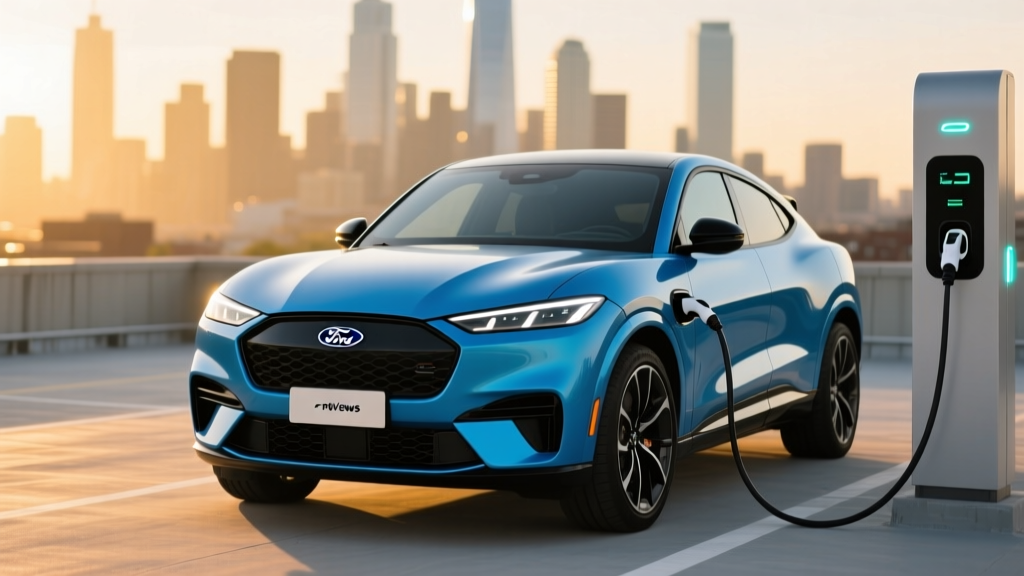
For buyers drawn to the Mustang badge but weighing modern practicality, the 2003 Mach One's spiritual successor is the Ford Mustang Mach-E — Ford's electric crossover that adopted the Mustang nameplate in 2021. By 2026, the Mach-E lineup has matured considerably. Here's a side-by-side spec comparison:
| Attribute | 2003 Mach One | 2026 Mach-E GT (Ext. Range) |
|---|---|---|
| Powertrain | 4.6L V8, RWD | Dual-motor AWD, BEV |
| Horsepower | 305 hp | 480 hp |
| Torque | 320 lb-ft | 634 lb-ft |
| 0–60 mph | ~5.2 sec | ~3.3 sec |
| EPA Range / Tank Range | ~250–310 mi (gas) | ~290 mi (EPA est.) |
| Energy Capacity | 15.7 gal gasoline | 91 kWh usable (NMC) |
| Efficiency | 19 mpg combined | ~84 MPGe combined |
| Max DC Fast Charge | N/A | ~150 kW peak |
| 10–80% Charge Time | N/A | ~36 minutes |
| Cargo Space | 10.9 cu ft (trunk) | 29.7 cu ft (rear) + 4.7 cu ft (frunk) |
| Original MSRP | $29,305 | ~$62,995 |
| Drivetrain | RWD, 6-speed manual | AWD, single-speed direct |
The performance gap is stark: the Mach-E GT delivers nearly 60% more horsepower and nearly double the torque, with a 0–60 time that places it in sports-car territory. But the Mach One offers something the Mach-E cannot — mechanical engagement, a manual gearbox, and an analog driving experience that defines an era. These are different vehicles for different purposes.
Mustang Mach-E in 2026: Charging, Battery, and Efficiency Details
If the Mach-E is on your shopping list, here are the precise charging and battery details that matter for daily ownership:
| Charging Level | Power | Miles Added per Hour | Notes |
|---|---|---|---|
| Level 1 (120V) | ~1.4 kW | ~3–4 miles/hr | Emergency/trickle only |
| Level 2 (240V, 48A) | ~11.5 kW | ~26–30 miles/hr | Home overnight charging standard |
| DC Fast Charge (CCS) | ~150 kW peak | ~150+ miles in 20 min | 10–80% in ~36 min; tapers above 80% |
The Mach-E GT Extended Range carries an EPA-estimated range of approximately 290 miles. In real-world highway driving at 75 mph, expect closer to 240–260 miles. In cold weather (below 30°F), range can drop 20–30%, yielding roughly 200–230 miles per charge. The NMC lithium-ion battery pack benefits from active liquid thermal management, which helps mitigate extreme degradation and enables preconditioning for faster DC charging in cold conditions.
The Mach-E uses the CCS1 connector standard and has access to the broader Electrify America, EVgo, and ChargePoint networks. Ford has also provided adapter solutions for Tesla Supercharger (NACS) access, expanding the available DC fast-charging infrastructure significantly. Per fueleconomy.gov, the Mach-E's efficiency translates to roughly $0.04–$0.06 per mile on average residential electricity rates, compared to $0.15–$0.20 per mile for the 2003 Mach One at current fuel prices.
Pricing, Tax Credits, and Total Cost of Ownership
The 2003 Mach One is now a collector vehicle. Pricing is entirely market-driven:
- Driver-quality examples (80k–130k miles): $15,000–$22,000
- Clean, well-maintained (40k–80k miles): $22,000–$30,000
- Low-mileage, original (under 30k miles): $30,000–$45,000+
No federal tax credits apply to collector vehicle purchases. Annual insurance runs $1,200–$2,500 depending on coverage and driver profile. Fuel costs at 12,000 miles/year and 19 mpg average approximately $2,200–$2,800 annually at 2026 fuel prices.
For the 2026 Mach-E GT, the purchase equation is different:
| Item | Amount |
|---|---|
| Base MSRP (GT Extended Range AWD) | ~$62,995 |
| Federal Tax Credit (§30D) Eligibility | Up to $7,500 — subject to MSRP cap ($80,000 SUVs), buyer income limits ($150k single / $300k joint), and critical mineral + battery component sourcing requirements per IRS §30D rules |
| Estimated Price After Max Credit | ~$55,495 (if eligible) |
| Annual Electricity Cost (12k mi/yr) | ~$600–$900 |
| Battery Warranty | 8 years / 100,000 miles (capacity retention threshold: ≥70%) |
- Vehicle MSRP must not exceed $80,000 (SUVs/trucks/vans) or $55,000 (sedans)
- Buyer AGI must not exceed $150,000 (single), $225,000 (HOH), or $300,000 (joint)
- Battery must meet critical mineral and component sourcing thresholds (percentages increase annually)
- Credit can be transferred to the dealer at point of sale for an immediate price reduction
- Vehicles with battery components from certain foreign entities of concern may be disqualified
- Confirm eligibility at purchase — rules change annually. Consult a tax professional.
Who Should Buy the 2003 Mach One — and Who Should Look Electric?
These are fundamentally different purchase decisions, and clarity on use case prevents buyer's remorse:
- You want an appreciating collector vehicle with manual-transmission engagement
- You drive fewer than 5,000–8,000 miles per year
- You value analog mechanical feedback over infotainment and ADAS
- You have garage space and a maintenance budget for a 20+ year old vehicle
- You want a weekend car, not a daily commuter
- You need a daily driver with low per-mile operating costs
- You commute 30+ miles daily and can charge at home
- You want modern safety (AEB, blind-spot monitoring, lane-keeping)
- You need cargo space and rear-seat usability for family duty
- You want new-vehicle warranty coverage and minimal maintenance
Pros and Cons at a Glance
- Rare, limited-production V8 with collector appreciation potential
- Tremec T-56 6-speed manual — engaging, driver-focused
- Strong aftermarket and parts availability
- Functional shaker hood, retro styling holds up well
- Robust 4.6L DOHC V8 with proven reliability when maintained
- 19 mpg combined — expensive to drive daily
- No modern ADAS (no AEB, no blind-spot monitoring, no backup camera)
- Aging components: heater cores, timing chain guides, COPs
- Limited cargo and rear-seat practicality
- Insurance costs rising as collector values increase
Frequently Asked Questions
What is the real-world fuel economy of the 2003 Mustang Mach One?
Owner-reported averages cluster between 16–20 mpg combined, with highway-only driving occasionally reaching 23–25 mpg. City driving with aggressive throttle use can drop below 14 mpg. At 12,000 miles per year, expect to spend $2,200–$2,800 on fuel at 2026 prices.
How many 2003 Mustang Mach One units were produced?
Ford produced approximately 7,100 Mach One units for the 2003 model year, followed by roughly 5,600 for 2004. The limited two-year production run contributes to the car's growing collector appeal.
Is the 2003 Mach One a good investment?
Low-mileage, unmodified examples have appreciated steadily. Cars under 30,000 miles in original condition can command $35,000–$45,000+. However, high-mileage or modified examples remain relatively affordable. As with any collector car, originality and documentation drive value more than mileage alone.
Does the 2003 Mach One qualify for any federal tax credits?
No. The IRS §30D clean vehicle credit applies only to new qualifying plug-in electric vehicles. The Mach One is a gasoline-powered collector vehicle with no electrification. If you're seeking tax-credit-eligible performance, the Mustang Mach-E may qualify for up to $7,500 depending on MSRP caps, buyer income, and battery-sourcing compliance.
How does the Mach One compare to the SVT Cobra of the same era?
The 2003–2004 SVT Cobra featured a supercharged 4.6L V8 producing 390 hp and 390 lb-ft of torque — significantly more than the Mach One's 305 hp. The Cobra was faster (0–60 in ~4.5 seconds) but also more expensive (~$34,000 MSRP). The Mach One occupies a middle ground: more powerful than the GT, less extreme than the Cobra, with unique retro styling the Cobra didn't offer.
Can I convert a 2003 Mach One to electric?
EV conversion kits exist for classic Mustangs (companies like EV West and Zero EV offer components), but converting a Mach One would destroy its collector value. The car's value proposition is its original powertrain and limited-production authenticity. If you want electric performance in a Mustang package, the Mach-E or a future Ford performance EV is the rational path.
What is the best modern alternative to the 2003 Mach One?
For analog V8 engagement: the 2024–2026 Ford Mustang Dark Horse (500 hp, 5.0L V8, 6-speed manual available, ~$58,000 MSRP) is the closest spiritual successor. For electric performance under the Mustang badge: the Mach-E GT (480 hp, ~$63,000). For classic looks with modern reliability: restomod shops like Ringbrothers and Icon produce updated classic Mustangs, though at $150,000+ price points.