2002 Ram 1500 Bolt Pattern: The Essential Specs
If you're sourcing replacement wheels, upgrading to aftermarket alloys, or planning an electric-vehicle conversion on a third-generation Ram chassis, the bolt pattern is your starting point. The 2002 Dodge Ram 1500 uses a 5-lug, 5x139.7 mm (5x5.5 inch) bolt pattern. This configuration — five lug nuts arranged on a circle 139.7 millimeters (5.5 inches) in diameter — was carried over from the second-generation Ram and remained standard through the 2005 model year before Dodge shifted to a metric 5x127 mm (5x5") pattern on later trucks.
Getting this number wrong means wheels that simply won't mount. Here's every dimension you need before ordering wheels or beginning a chassis modification.
| Specification | Value |
|---|---|
| Bolt Pattern (PCD) | 5x139.7 mm (5x5.5") |
| Center Bore (Hub Bore) | 77.8 mm |
| Lug Nut Thread Size | 1/2"-20 UNF |
| Lug Nut Torque Spec | 130 lb-ft (176 Nm) |
| Stock Wheel Diameter | 16" or 17" (trim dependent) |
| Stock Offset Range | +18 mm to +25 mm |
| Stock Tire Size (typical) | 245/70R16 or 265/70R17 |
| Wheel Mount Type | Lug-centric (conical seat 60°) |
Why the 5x139.7 Bolt Pattern Matters for EV Swaps
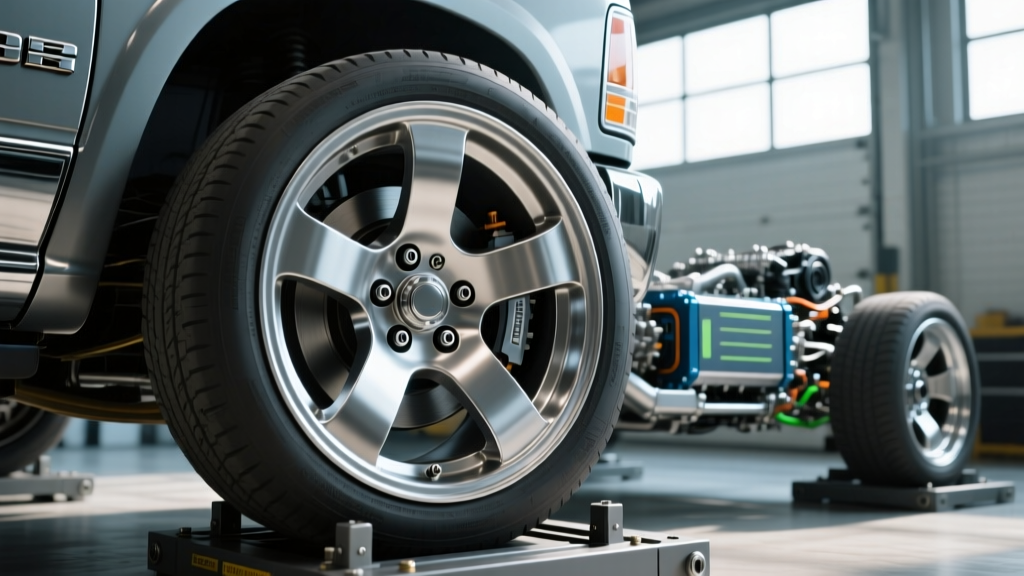
The 2002 Ram 1500 has become a popular donor chassis for electric-vehicle conversions. Its body-on-frame construction, generous payload capacity, and widely available aftermarket parts make it an attractive platform for installing a salvaged Tesla drive unit, a NetGain Hyper9 motor, or a Cascadia Motion powertrain. But the moment you retain the stock axles and hubs, you're locked into the 5x139.7 mm bolt pattern — and that creates a wheel-sourcing challenge that many first-time EV converters underestimate.
Most modern EVs — the Ford F-150 Lightning, Rivian R1T, Chevrolet Silverado EV — use 6-lug patterns. The Tesla Model X uses a 5x120 mm pattern. The mismatch means you cannot simply bolt on wheels from a contemporary electric truck without adapters or a hub swap.
Wheel Compatibility Across Common EV Donor Components
| Vehicle / Component | Bolt Pattern | Compatible with Ram 1500? |
|---|---|---|
| 2002 Dodge Ram 1500 | 5x139.7 mm | — (baseline) |
| Tesla Model S / X (rear) | 5x120 mm | No — adapter required |
| Ford F-150 Lightning | 6x135 mm | No — different lug count |
| Rivian R1T | 6x139.7 mm | No — different lug count |
| Chevrolet Silverado EV | 6x139.7 mm | No — different lug count |
| 2005-2018 Ram 1500 | 5x127 mm (5x5") | No — different PCD |
| Toyota Tundra (2007-2021) | 5x150 mm | No — different PCD |
| Jeep Grand Cherokee (1999-2004 WJ) | 5x127 mm | No — different PCD |
Hub Bore, Offset, and Load Rating: The Specs Beyond the Bolt Pattern
Bolt pattern alone doesn't guarantee fitment. Three additional measurements determine whether a wheel will safely center on the hub, clear the brake calipers, and support the vehicle's weight — which becomes especially critical in an EV conversion where battery packs can add 800 to 1,500 pounds to the chassis.
Center Bore: 77.8 mm
The 2002 Ram 1500 is lug-centric, meaning the lug nuts — not the hub bore — center the wheel. This is good news for conversions: aftermarket wheels with a larger center bore (e.g., 78.1 mm or 106 mm) can be used as long as the bolt pattern matches and proper conical-seat lug nuts are torqued to spec. However, if you use a wheel with a center bore smaller than 77.8 mm, it physically will not slide over the hub.
Offset and Backspacing
Stock 16-inch wheels carry approximately +18 mm to +25 mm offset. For an EV conversion with added weight, maintaining the stock offset range preserves bearing life and steering geometry. Pushing offset to zero or negative (common with "deep dish" aftermarket wheels) accelerates wheel bearing wear — a problem compounded by the higher static load of battery packs mounted in the bed or under the floor.
Load Rating: Non-Negotiable for EV Conversions
A stock 2002 Ram 1500 has a curb weight between 4,700 and 5,200 lbs depending on cab configuration and drivetrain. Add a 60 kWh battery pack (~900 lbs), an electric motor (~150 lbs), and associated power electronics, and you're looking at 5,800 to 6,300 lbs curb weight. Each wheel must support at least 1,575 lbs (6,300 ÷ 4). Verify that any aftermarket wheel carries a minimum load rating of 1,600 lbs per wheel — many passenger-car-rated alloy wheels max out at 1,300 lbs and are unsafe for this application.
Torque Specs and Lug Nut Selection for Modified Setups
The factory specification is 130 lb-ft (176 Nm) for the 1/2"-20 UNF lug nuts, tightened in a star pattern. This applies whether you're running stock steel wheels or aftermarket alloys. Two common mistakes in EV conversions deserve attention:
- Using the wrong lug seat type: Stock Ram wheels use a 60° conical (acorn) seat. If your aftermarket wheels require a flat-seat (mag-style) or ball-seat lug nut, using the wrong type creates point-loading that can crack the wheel or allow the nut to back off under the higher torque pulses of an electric drivetrain.
- Skipping re-torque after break-in: After the first 50-100 miles on new wheels or adapters, re-torque all lug nuts to 130 lb-ft. This is standard practice but frequently skipped in garage-built EV conversions.
Wheel Adapters: When and When Not to Use Them
If you want to run wheels from a different bolt pattern (e.g., 5x120 mm Tesla wheels on your Ram 1500 EV conversion), hub-centric billet aluminum adapters are available from manufacturers like Motorsport Tech and Adapt-It USA. These typically add 25-38 mm (1"-1.5") of thickness, which changes your effective offset and widens the track. Consider these trade-offs:
| Factor | Without Adapter | With 32mm Adapter |
|---|---|---|
| Effective Offset Change | None | -32 mm (pushes wheel outward) |
| Wheel Bearing Load | Stock | Increased ~15-20% (lever arm effect) |
| Fender Clearance | Stock | May rub at full lock or under load |
| Weight Added (per corner) | 0 lbs | 3-5 lbs (billet aluminum) |
| Failure Points | None additional | Adapter-to-hub AND adapter-to-wheel interfaces |
EV Conversion Wheel Sourcing: Practical Options
Given the 5x139.7 mm bolt pattern, here are the most practical wheel-sourcing strategies for a Ram 1500 EV build, ranked by simplicity:
- Retain stock Ram wheels. The simplest path. Stock 16" or 17" steel or alloy wheels are rated for the truck's GVWR, are widely available used, and eliminate all fitment uncertainty. The downside: heavier than necessary, which reduces range.
- Aftermarket truck-rated wheels in 5x139.7. Companies like Method Race Wheels, Fuel Off-Road, and Pro Comp offer 5x139.7 wheels with appropriate load ratings. Look for flow-formed or forged construction to reduce unsprung weight — every pound saved at the wheels improves EV range by roughly 0.3-0.5% due to reduced rotational inertia.
- Hub swap to a more common pattern. Some converters swap front hub assemblies and rear axle shafts to adopt a 6x139.7 mm (6x5.5") pattern, opening up wheels from Toyota Tacomas, Chevrolet Silverados, and many aftermarket catalogs. This is a significant fabrication effort but yields the widest wheel selection long-term.
- Custom billet wheels. For high-budget builds, companies like HRE and Forgeline will machine custom wheels to any bolt pattern, offset, and load rating. Expect $2,500-$4,500 per wheel.
Real-World EV Conversion Considerations: Weight, Aero, and Range
Wheel and tire selection directly impacts the range of your EV-converted Ram 1500. Here's how the numbers stack up:
| Setup | Wheel Weight (each) | Rolling Resistance Coeff. | Est. Range (combined) |
|---|---|---|---|
| Stock 16" steel + A/T tire | ~42 lbs | 0.009 | ~95-105 mi |
| Aftermarket 17" alloy + LRR tire | ~28 lbs | 0.007 | ~115-130 mi |
| Aftermarket 18" alloy + mud-terrain | ~38 lbs | 0.012 | ~80-90 mi |
Low-rolling-resistance (LRR) tires like the Michelin Defender LTX or Bridgestone Alenza can recover 8-12% range versus standard all-terrain tires. For a conversion with a 60 kWh usable battery, that's the difference between 95 and 110 miles of real-world driving. Tire pressure matters equally: running 40-44 psi (check tire sidewall max) instead of the stock 35 psi door-jamb sticker spec reduces deformation losses at the cost of some ride comfort.
Frequently Asked Questions
What is the bolt pattern on a 2002 Dodge Ram 1500?
The 2002 Ram 1500 uses a 5x139.7 mm bolt pattern, also expressed as 5x5.5 inches. This means five lug nuts arranged on a circle measuring 139.7 mm in diameter. This pattern was used on Ram 1500 trucks from 1994 through 2005.
Will 2006 or newer Ram 1500 wheels fit a 2002 model?
No. Starting with the 2006 model year, Dodge changed the Ram 1500 bolt pattern to 5x127 mm (5x5"). The 2002 truck requires 5x139.7 mm. The two patterns are not interchangeable, and forcing the wrong wheels will damage studs and create a safety hazard.
Can I use Ford F-150 wheels on my 2002 Ram 1500?
No. Ford F-150 wheels (1997-present) use a 6x135 mm bolt pattern — six lugs instead of five. They are physically incompatible with the Ram's 5-lug hubs without a complete hub and axle conversion.
What size center bore do I need for aftermarket wheels?
The stock hub bore is 77.8 mm. Because the 2002 Ram 1500 is lug-centric, you can use wheels with a center bore equal to or larger than 77.8 mm. Wheels with a smaller bore will not fit over the hub. Hub-centric ring adapters are available to fill the gap if you use wheels with a significantly larger bore (e.g., 106 mm).
What is the correct lug nut torque for a 2002 Ram 1500?
Factory specification is 130 lb-ft (176 Nm) for the 1/2"-20 UNF lug nuts. Always tighten in a star (criss-cross) pattern and re-torque after the first 50-100 miles on newly installed wheels. This is especially important on EV conversions where instant electric torque can place higher transient loads on wheel hardware.
Is the 5x139.7 bolt pattern the same as 5x5.5 inches?
Yes. 139.7 millimeters equals exactly 5.5 inches. They are two expressions of the same measurement. When shopping for wheels, listings may use either notation — both refer to the identical bolt circle diameter.
Sources: Ram Trucks Owner Resources; Tire Rack Fitment Database; Dodge Ram 1500 Factory Service Manual (2002, DaimlerChrysler).