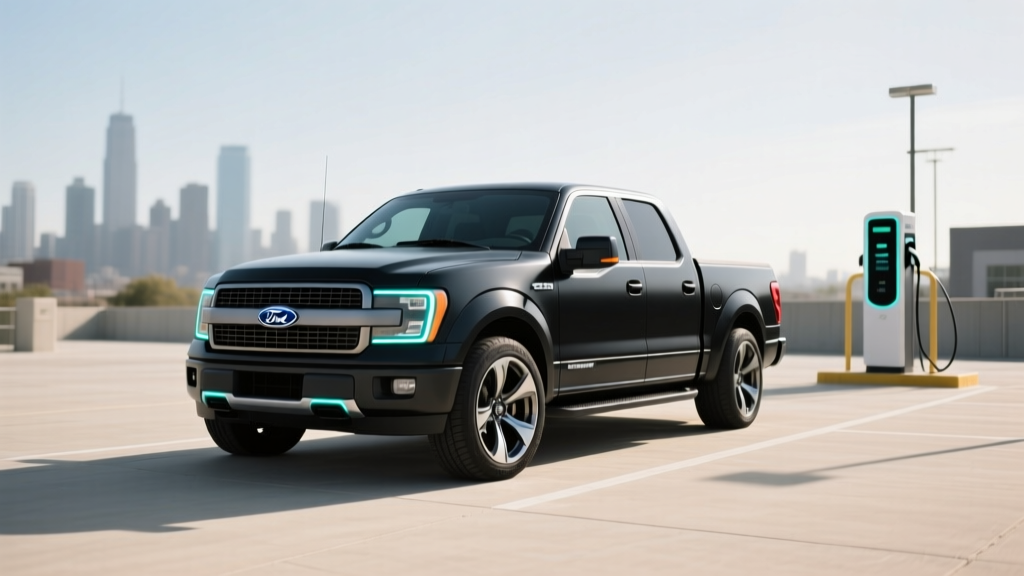
Before the current-generation F-150 Lightning became a mainstream electric truck, Ford built a little-known prototype that carried the same iconic nameplate over two decades earlier. The 2002 Ford F-150 Lightning was never sold to retail customers — it was a limited-run fleet demonstrator, with roughly 100 units produced to prove that a full-size electric pickup was technically feasible. Today, as the modern F-150 Lightning competes in an increasingly crowded electric truck segment, revisiting the 2002 original offers a fascinating window into how far EV battery and drivetrain technology has come — and where it still has room to grow.
This article is a technical profile and historical review of the 2002 F-150 Lightning. Because it was never a production vehicle available for consumer purchase, we'll examine its specs as a prototype, then compare them against the current 2026 Ford F-150 Lightning to quantify two decades of EV progress.
What Was the 2002 Ford F-150 Lightning?
The 2002 F-150 Lightning was developed by Ford's Advanced Vehicle Technology group as a battery-electric research and fleet demonstrator. It was based on the 10th-generation F-150 short-bed regular-cab platform and was intended for government fleets, utility companies, and research institutions — not dealership showrooms. Approximately 100 units were built, primarily deployed to California and other states with early zero-emission vehicle (ZEV) mandates.
The project was Ford's response to California's ZEV credit requirements in the late 1990s and early 2000s, a regulatory environment that also produced the GM EV1, Toyota RAV4 EV, and Honda EV Plus. When California relaxed its ZEV mandate in 2003, Ford — like most automakers — shelved its electric truck program.
| Specification | Value |
|---|---|
| Production Status | Fleet prototype / demonstrator (not sold retail) |
| Units Built | ~100 |
| Body Style | Regular cab, short bed (2-door) |
| Battery Chemistry | Nickel-Metal Hydride (NiMH) |
| Battery Capacity | ~95 kWh (estimated, gross) |
| EPA-Equivalent Range | ~135 miles (estimated, city driving cycle) |
| Motor Type | AC induction (single motor) |
| Horsepower | ~150 hp |
| 0–60 mph | Not officially published (~12–14 sec estimated) |
| Drivetrain | Rear-wheel drive |
| DC Fast Charging | Not available (Level 2 only, ~6.6 kW) |
| Level 2 Charge Time (0–100%) | ~14–16 hours |
| MPGe (estimated) | ~50–55 MPGe combined |
| Curb Weight | ~5,800 lbs (estimated) |
| Payload / Towing | Significantly reduced vs. gas F-150 (battery weight penalty) |
| Retail MSRP | Never sold — fleet lease only |
| Warranty | Ford fleet program coverage (varied) |
Battery, Range, and the NiMH Era
The 2002 F-150 Lightning used a large nickel-metal hydride (NiMH) battery pack — the same chemistry that powered the Toyota Prius of that era and the GM EV1's later generation. NiMH was the best available option before lithium-ion cells became commercially viable for automotive use around 2008–2010.
The ~95 kWh battery pack was enormous by modern standards (the 2026 F-150 Lightning Extended Range uses 131 kWh), but NiMH has a significantly lower energy density than today's lithium-ion cells. That meant the 2002 Lightning's pack was far heavier per unit of stored energy, contributing to a curb weight around 5,800 lbs and reducing payload and towing capability compared to its gas-powered F-150 siblings.
NiMH batteries also suffered from higher self-discharge rates and a narrower optimal operating temperature window. Active thermal management — now standard on virtually every modern EV — was rudimentary or absent on the 2002 prototype.
Charging: A Glimpse at Early-2000s Infrastructure
DC fast charging as we know it (CCS, CHAdeMO, NACS) did not exist in 2002. The F-150 Lightning prototype charged exclusively via Level 2 AC charging at approximately 6.6 kW using the J1772-adjacent connectors of the era. A full 0–100% charge took roughly 14–16 hours — meaning overnight charging was feasible, but mid-day top-ups were impractical.
| Charging Level | 2002 F-150 Lightning | 2026 F-150 Lightning (Extended Range) |
|---|---|---|
| Level 1 (120V AC) | Available, ~1.4 kW (~3 mi/hr) | ~1.4 kW (~2 mi/hr) |
| Level 2 (240V AC) | ~6.6 kW (~10 mi/hr), 14–16 hr full charge | Up to 19.2 kW (~30 mi/hr), ~7 hr full charge |
| DC Fast Charge | Not available | Up to 150 kW peak, 15–80% in ~41 min |
| Charging Standard | Pre-J1772 / Avcon | CCS1 (NACS adapter available) |
The absence of DC fast charging was the single biggest practical limitation of the 2002 Lightning. Without the ability to add 100+ miles of range in 20–30 minutes, the truck was confined to predictable daily routes within its range envelope — a constraint that modern EVs have largely solved.
Performance and Driving Impressions
The 2002 F-150 Lightning's single AC induction motor produced approximately 150 horsepower driving the rear wheels. For context, the gas-powered 2002 F-150 SVT Lightning (a completely different, supercharged V8 performance truck that shared the nameplate) made 380 hp and hit 0–60 in roughly 5.2 seconds.
The electric prototype was tuned for efficiency and fleet duty, not performance. Estimated 0–60 times of 12–14 seconds placed it well behind the gas F-150 of its era. However, the electric motor's instant torque delivery — a characteristic EV buyers now take for granted — gave it responsive off-the-line behavior in city driving, even if it lacked top-end acceleration.
The heavy battery pack also affected handling. The weight was mounted low (under the bed floor), which gave the truck a lower center of gravity than a gas F-150, but the overall mass penalty was substantial. Ride quality was reportedly firm, and the regenerative braking system — primitive by today's standards — provided modest energy recapture but nothing close to modern one-pedal driving capability.
How the 2002 Lightning Compares to the 2026 F-150 Lightning
Two decades of battery chemistry advances, power electronics miniaturization, and charging infrastructure buildout have transformed the F-150 Lightning from a limited-run experiment into a mainstream full-size electric pickup. Here's a side-by-side look at the generational leap:
| Attribute | 2002 Prototype | 2026 F-150 Lightning (Lariat Ext. Range) |
|---|---|---|
| Battery Chemistry | NiMH | NMC lithium-ion |
| Battery Capacity | ~95 kWh | 131 kWh usable |
| EPA Range | ~135 mi (est.) | 320 mi (EPA) |
| Horsepower | ~150 hp | 580 hp |
| Torque | Not published | 775 lb-ft |
| 0–60 mph | ~12–14 sec | ~3.8 sec |
| Drivetrain | RWD, single motor | AWD, dual motor |
| Max DC Fast Charge | None | 150 kW |
| Towing Capacity | Severely limited | Up to 10,000 lbs |
| Payload | Reduced | Up to 2,235 lbs |
| Frunk (Front Trunk) | No | 14.1 cu ft (400L) |
| Pro Power Onboard | No | Up to 9.6 kW V2L |
| Retail Price | Not sold | $71,990 MSRP (Lariat Ext. Range) |
| Tax Credit | N/A | Up to $7,500 (§30D, eligibility varies) |
The numbers tell the story: the 2026 F-150 Lightning delivers nearly 2.4× the range, nearly 4× the horsepower, DC fast charging, and a usable frunk and V2L capability that the 2002 prototype couldn't have imagined — all in a truck you can actually buy at a dealership.
The 2026 F-150 Lightning: Current Pricing and Tax Credits
For buyers considering the modern F-150 Lightning, here's the current pricing landscape as of the 2026 model year:
| Trim | Battery | EPA Range | Base MSRP |
|---|---|---|---|
| Pro (Standard Range) | 98 kWh | ~240 mi | ~$54,990 |
| XLT (Standard Range) | 98 kWh | ~240 mi | ~$59,990 |
| Lariat (Extended Range) | 131 kWh | ~320 mi | ~$71,990 |
| Platinum (Extended Range) | 131 kWh | ~300 mi | ~$86,990 |
Federal Tax Credit (§30D): The F-150 Lightning may qualify for up to $7,500 under the IRS §30D Clean Vehicle Credit, but eligibility is not guaranteed for every buyer. Key requirements include:
- MSRP cap: The vehicle must have an MSRP at or below $80,000 (vans, SUVs, and trucks). The Platinum trim may exceed this cap depending on options.
- Income limits: Modified adjusted gross income (MAGI) must not exceed $150,000 (single), $225,000 (head of household), or $300,000 (joint filers).
- Battery sourcing: Critical minerals and battery component sourcing requirements phase in progressively. Ford has worked to localize supply chains, but exact eligibility varies by build date and VIN. Always verify with your dealer and consult IRS.gov §30D guidance before purchase.
- Point-of-sale transfer: Eligible buyers can transfer the credit to the dealer at purchase, reducing the upfront cost rather than waiting for a tax refund.
Real-World Ownership: What the 2026 Lightning Actually Delivers
EPA: 320 miles. Expect approximately 260–290 miles on mixed highway driving at 70–75 mph. In freezing temperatures (below 32°F), range can drop to 210–250 miles depending on cabin heating use and whether the truck is preconditioned while plugged in. Towing a 5,000-lb trailer at highway speeds may reduce range to 150–180 miles — a significant consideration for truck buyers.
Charging on a 150 kW DC fast charger, the Extended Range pack typically peaks around 150 kW and tapers as State of Charge (SoC) climbs above 80%. A 15–80% session takes roughly 41 minutes under ideal thermal conditions. Ford's battery preconditioning feature (activated when navigating to a charger via the infotainment system) warms the pack to optimize charge speed — a critical feature that the 2002 prototype entirely lacked.
Home charging on a 48-amp Level 2 circuit (requiring a 60-amp breaker) delivers approximately 11.5 kW, adding about 18 miles of range per hour. A full 0–100% charge takes roughly 11 hours. Upgrading to Ford's 80-amp Charge Station Pro enables 19.2 kW charging (~30 mi/hr), cutting a full charge to about 7 hours — but this requires a 100-amp dedicated circuit and professional installation that typically runs $1,500–$3,500 depending on your electrical panel capacity.
The 2026 F-150 Lightning's battery is covered by an 8-year/100,000-mile warranty (whichever comes first), with Ford guaranteeing a minimum of 70% capacity retention over that period. This is standard for the segment and provides meaningful long-term protection that no 2002-era prototype could offer.
Pros of the Modern F-150 Lightning
- 320-mile EPA range (Extended Range) handles most daily and road-trip use cases
- 14.1 cu ft Mega Power Frunk — class-leading lockable front storage
- Pro Power Onboard (up to 9.6 kW) turns the truck into a mobile generator for job sites, camping, and home backup
- 580 hp / 775 lb-ft delivers sports-car acceleration in a full-size truck
- Up to 10,000-lb towing capacity (with Max Trailer Tow package)
- BlueCruise hands-free highway driving (SAE Level 2 — driver must remain attentive)
- Ford's OTA updates continue to improve the truck post-purchase
Cons of the Modern F-150 Lightning
- Extended Range trims push past $70,000, potentially exceeding the §30D MSRP cap
- Highway and cold-weather range loss is significant — plan conservatively
- Towing range remains a real limitation for long-distance haulers
- 150 kW peak DC charge rate trails competitors like the Silverado EV (up to 350 kW)
- Insurance premiums are higher than gas F-150 equivalents
- Large battery means higher embedded carbon in manufacturing
Who Should Buy the Modern F-150 Lightning?
The current F-150 Lightning is best suited for:
- Home-owning commuters who can install a Level 2 charger and rarely exceed 200 miles per day — the Standard Range model covers this easily and saves money on fuel.
- Job-site professionals who benefit from Pro Power Onboard to run tools, lights, and equipment without a separate generator.
- Truck owners who tow locally — boat launches, utility trailers, and campers within a 75-mile radius are well within the Lightning's capability.
- Families wanting a full-size truck with car-like refinement, quiet operation, and low running costs.
It's less ideal for buyers who regularly tow over 200 miles one-way, live in areas with sparse DC fast-charging infrastructure, or need a sub-$45,000 truck for basic work duty.
Legacy and Lessons: What the 2002 Lightning Taught Ford
The 2002 F-150 Lightning wasn't a commercial product, but it wasn't a failure either. It demonstrated that a full-size electric pickup was physically possible — the barriers were battery energy density, charging infrastructure, and cost, not fundamental engineering. Ford engineers who worked on the 2002 prototype reportedly carried those lessons forward into later electrification programs, including the Ford Focus Electric, the C-Max Energi, and eventually the Mustang Mach-E and current F-150 Lightning.
For EV historians and enthusiasts, the 2002 Lightning is a reminder that the electric truck revolution didn't begin with Tesla's Cybertruck announcement or even with Ford's 2022 Lightning launch. It started with heavy NiMH packs, rudimentary thermal management, and a handful of fleet vehicles proving a concept that the world wasn't quite ready for yet.
Frequently Asked Questions
Can I buy a 2002 Ford F-150 Lightning?
No. The 2002 F-150 Lightning was a fleet-only prototype and was never sold to retail consumers. A small number of units may exist in private hands (some were reportedly sold at government surplus auctions), but they are collector curiosities with no dealer support, no available replacement batteries, and no modern charging compatibility. If you want an F-150 Lightning, the 2022–2026 production models are the real option.
What was the range of the 2002 F-150 Lightning?
Approximately 135 miles under ideal city-driving conditions. Real-world highway or cold-weather range was likely 80–110 miles. The NiMH battery chemistry and lack of active thermal management made the truck highly sensitive to temperature and driving style.
How does the 2002 Lightning's battery compare to today's?
The 2002 prototype used NiMH cells with low energy density and no active thermal management. The 2026 F-150 Lightning uses NMC lithium-ion cells with roughly 3–4× the energy density per kilogram, liquid-cooled thermal management, and a battery management system that optimizes longevity and charge speed — delivering 320 miles of EPA range from a 131 kWh pack.
Does the current F-150 Lightning qualify for the $7,500 federal tax credit?
It may, depending on your income, the specific trim's MSRP (must be ≤$80,000 for trucks), and battery sourcing compliance. The Pro and XLT Standard Range trims fall well under the MSRP cap. The Lariat Extended Range at ~$71,990 also qualifies on MSRP. The Platinum Extended Range may exceed $80,000 with options. Always verify current eligibility at IRS.gov and with your Ford dealer before purchasing.
Why did Ford stop making the 2002 Lightning?
California relaxed its ZEV mandate in 2003, removing the regulatory driver for low-volume electric trucks. NiMH battery costs were high, charging infrastructure was virtually nonexistent, and consumer demand for a $60,000+ electric truck with 135 miles of range was minimal. Ford redirected its electrification investment toward hybrids (the 2005 Escape Hybrid) and waited for lithium-ion technology to mature.
Sources: EPA Fuel Economy, IRS §30D Clean Vehicle Credits, Ford Motor Company historical fleet documentation.