If you're researching the 2002 F-150 bolt pattern, you likely fall into one of two camps: a classic-truck enthusiast planning an EV swap on a beloved tenth-generation F-150, or a shopper trying to figure out whether modern electric trucks like the Ford F-150 Lightning share the same wheel lug configuration. Either way, the bolt pattern is the starting point for any wheel, hub, or drivetrain conversation — and when electrification enters the picture, the details matter more than ever.
This guide covers the exact bolt pattern specifications for the 2002 Ford F-150, explains what that means for electric conversions and wheel fitment, and then benchmarks those specs against today's production electric pickups. If you're weighing a vintage-to-EV project against buying a factory-electric truck, you'll have the numbers to decide.
2002 F-150 Bolt Pattern: The Exact Specifications
The 2002 Ford F-150 (tenth generation, 1997–2003) uses a 5-lug, 139.7 mm (5.5-inch) bolt circle, commonly written as 5×139.7 or 5×5.5. This was the standard pattern across nearly all F-150 trims of that era, including the XL, XLT, and Lariat.
| Specification | Value |
|---|---|
| Bolt Pattern | 5×139.7 mm (5×5.5 in) |
| Center Bore | 87.1 mm |
| Lug Nut Thread Size | 1/2"-20 UNF |
| Stock Wheel Diameter | 16" (standard), 17" (optional) |
| Typical Offset | +14 mm to +40 mm (varies by wheel) |
The 87.1 mm center bore is critical for EV conversions because many electric-drive hub assemblies and aftermarket adapters are machined to specific bore diameters. If you're sourcing a Tesla drive unit or a Cascadia Motion e-axle for a swap, the adapter plate must match both the 5×139.7 bolt circle and this center bore — or you'll need hub-centric rings to prevent vibration at speed.
Why Bolt Pattern Matters for EV Conversions
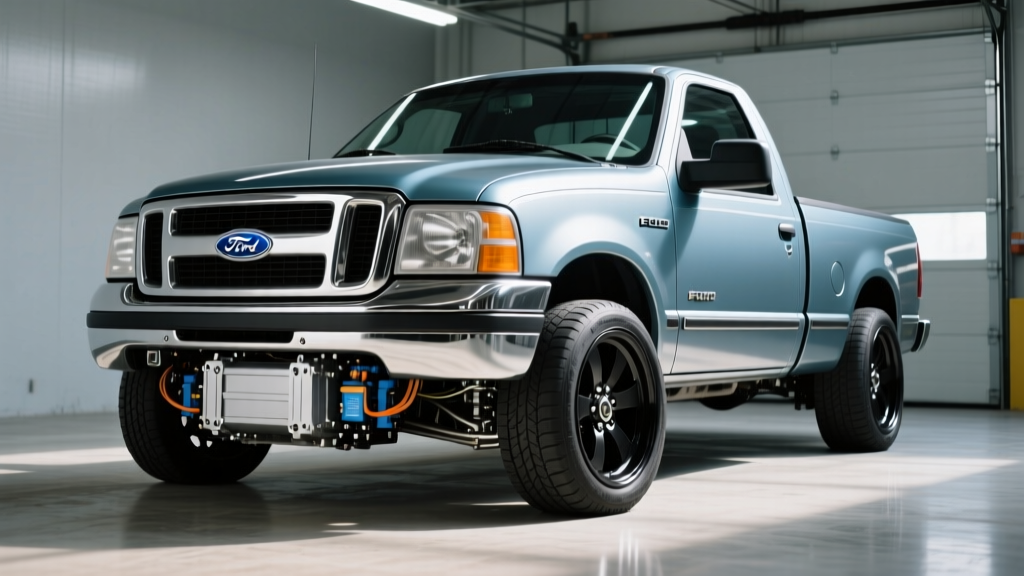
Converting a 2002 F-150 to electric power isn't just about dropping in a motor and battery pack. The bolt pattern determines which wheels, hubs, brake rotors, and drive-unit adapters you can use. Here's where it intersects with the EV build:
- Drive-unit adapters: Popular swap motors (NetGain Hyper9, Cascadia Motion, or salvaged Tesla Model S/X rear drive units) require custom adapter plates between the motor and the stock transmission or a direct-drive setup. The output shaft ultimately drives the stock F-150 axles, which retain the 5×139.7 pattern at the hub.
- Weight considerations: A battery pack for a truck conversion typically adds 800–1,500 lbs over the stock curb weight. You'll want wheels rated for the increased gross vehicle weight — and the 5×139.7 pattern limits your selection compared to the more common 6-lug patterns on modern trucks.
- Regenerative braking compatibility: If you retain the stock F-150 brake calipers and rotors, the 5×139.7 bolt pattern dictates which aftermarket big-brake kits fit. Larger rotors help manage the added kinetic energy of a heavier, electrified truck.
- Wheel spacers and adapters: Some builders use 5×139.7-to-5×120.65 (5×4.75) adapters to access a wider range of performance EV wheels, but these add unsprung weight and change offset — engineering trade-offs that affect handling and bearing life.
Modern Electric Truck Comparison: F-150 Lightning Bolt Pattern
If you're considering skipping the conversion and buying a factory electric truck instead, it's worth noting that Ford changed the bolt pattern for the F-150 Lightning (2022–present). The Lightning uses a 6×135 mm pattern — one more lug and a different circle diameter than the 2002 model. This means zero wheel interchangeability between the tenth-generation F-150 and the Lightning.
| Attribute | 2002 F-150 (XLT 4×4) | 2025 F-150 Lightning (Lariat Ext. Range) |
|---|---|---|
| Bolt Pattern | 5×139.7 mm | 6×135 mm |
| Powertrain | 4.6L V8, 240 hp | Dual-motor AWD, 580 hp |
| EPA Range | N/A (gasoline) | 320 miles |
| Battery | N/A | 131 kWh usable (NMC) |
| 0–60 mph | ~8.5 sec | 3.8 sec |
| Max Tow Capacity | 7,200 lbs | 10,000 lbs |
| Base MSRP (when new / current) | ~$23,500 (2002) | $69,995 (2025 Lariat) |
The Lightning's move to a 6-lug pattern reflects its heavier gross vehicle weight rating (GVWR) and the structural demands of a 131 kWh battery pack. If you need a work truck with modern EV capability and factory warranty, the Lightning is the pragmatic choice. If you want a unique, lightweight project truck with personal meaning, the 2002 F-150 conversion route has its own appeal.
2002 F-150 EV Conversion: What the Build Looks Like
A typical electric conversion on a 2002 F-150 with the 5×139.7 bolt pattern involves these major components:
Motor & Drivetrain
Most builders retain the stock rear axle and leaf-spring suspension, mating an electric motor to the existing transmission or using a direct-drive setup. The NetGain Hyper9 HV (120 kW peak) is a popular choice for trucks in the 4,000–5,500 lb range. Because you're keeping the factory axles, the 5×139.7 bolt pattern stays intact at the hubs.
Battery Pack
Converted F-150s typically run 40–80 kWh of battery capacity, often sourced from salvaged Tesla modules, Chevrolet Bolt packs, or new LiFePO4 (LFP) prismatic cells. An 80 kWh pack using NMC chemistry weighs roughly 900–1,000 lbs; LFP cells are heavier per kWh but offer longer cycle life and better thermal stability.
Charging
Most conversions use a J1772 inlet for Level 2 AC charging at 6.6–11.5 kW (depending on the onboard charger). DC fast charging is possible but requires a CCS or NACS inlet, a high-voltage contactor system, and communication with the charger — adding $2,000–$5,000 to the build. Expect Level 2 charging to add 15–25 miles of range per hour at 7.2 kW.
Expected Performance
| Metric | 40 kWh Build | 80 kWh Build |
|---|---|---|
| Estimated Range | 70–90 miles | 140–180 miles |
| Motor Power (peak) | 80–120 kW | 120–160 kW |
| 0–60 mph (est.) | 9–11 sec | 6–8 sec |
| Battery Weight | ~500 lbs | ~950 lbs |
| Estimated Build Cost | $18,000–$25,000 | $30,000–$45,000 |
The Factory EV Alternative: 2025 F-150 Lightning In Depth
If the conversion math isn't adding up, here's a closer look at what Ford's factory electric truck delivers. The 2025 F-150 Lightning Lariat with the Extended Range battery is the volume seller and the trim most buyers cross-shop.
| Specification | Value |
|---|---|
| EPA Range | 320 miles |
| Battery (usable) | 131 kWh, NMC lithium-ion |
| Max DC Fast Charge | 150 kW peak |
| 10–80% DC Charge Time | ~41 minutes |
| Level 2 Home Charge Rate | 19.2 kW (80A Ford Charge Station Pro) / 11.5 kW (mobile) |
| 0–60 mph | 3.8 seconds |
| Horsepower / Torque | 580 hp / 775 lb-ft |
| Drivetrain | Dual-motor AWD |
| MPGe (combined) | 70 MPGe |
| Efficiency | 48 kWh/100 mi |
| Max Towing | 10,000 lbs |
| Payload | 1,803 lbs |
| Cargo Bed | 5.5 ft (67.1 cu ft) |
| Frunk Volume | 14.1 cu ft |
| Base MSRP (Lariat Ext. Range) | $69,995 |
| Battery Warranty | 8 years / 100,000 miles (≥70% capacity retention) |
Lightning Charging Reality
The Lightning's 150 kW peak DC charge rate is modest compared to rivals like the Rivian R1T (200+ kW) or the Chevrolet Silverado EV (350 kW). The charge curve tapers significantly above 80% state of charge — that last 20% can add another 30+ minutes. For road trips, plan stops around the 10–80% sweet spot for the fastest turnaround.
At home on a 19.2 kW Ford Charge Station Pro (requires a 100-amp dedicated circuit and professional installation — budget $1,500–$3,000 for the electrician work), a full charge from 10% takes about 8 hours. On a standard 32-amp Level 2 outlet (7.7 kW), expect roughly 13 hours for a full charge.
Federal Tax Credit & Cost Analysis
The F-150 Lightning's eligibility for the federal EV tax credit under IRS §30D is nuanced and depends on your income, the vehicle's MSRP, and battery-component sourcing requirements that tighten annually.
- MSRP Cap: Trucks/vans/SUVs must be ≤$80,000 MSRP. Lightning Lariat Extended Range ($69,995) qualifies on price. Higher trims (Platinum at $96,874) do NOT qualify.
- Buyer Income Cap: Modified AGI must not exceed $150,000 (single), $225,000 (head of household), or $300,000 (joint).
- Battery Sourcing: The credit splits into two halves ($3,750 each) — one for critical-mineral sourcing and one for battery-component manufacturing. As of 2025, the sourcing requirements exclude vehicles with battery components from a "foreign entity of concern" (FEOC). Check the latest DOE/FuelEconomy eligible vehicle list before purchasing.
- Point-of-Sale Transfer: You can transfer the credit to the dealer at purchase for an immediate price reduction, rather than waiting to claim it on your tax return.
For eligible buyers, the Lightning Lariat Extended Range can effectively drop from $69,995 to as low as $62,495 with the full $7,500 credit applied at point of sale. However, battery-sourcing rules may limit some buyers to $3,750 or zero — always verify the current status on fueleconomy.gov before signing.
Conversion vs. Factory: Which Path Makes Sense?
✅ Build the EV Conversion If:
- You have a sentimental or rust-free 2002 F-150 you want to preserve
- You only need 80–150 miles of daily range
- You enjoy fabrication, wiring, and learning EV systems
- You want a lightweight (~4,800 lb) truck — lighter than any factory EV pickup
- You're okay without a factory warranty, crash-test validation, or modern ADAS
✅ Buy the F-150 Lightning If:
- You need 300+ miles of range and DC fast charging for road trips
- You tow or haul regularly and need rated capacities
- You want a factory warranty (8 yr/100,000 mi battery, 3 yr/36,000 mi bumper-to-bumper)
- You need modern safety tech (automatic emergency braking, blind-spot monitoring, BlueCruise Level 2 assist)
- You want to potentially qualify for the $7,500 federal tax credit
There's also a middle ground: some shops now offer "restomod" EV conversions on tenth-generation F-150s with modernized suspensions, disc brakes, and 200+ mile range for $60,000–$100,000 total. These are boutique builds, not budget projects, but they retain the classic 5×139.7 bolt pattern while delivering usable daily-driver range.
Frequently Asked Questions
What is the bolt pattern on a 2002 Ford F-150?
The 2002 F-150 uses a 5×139.7 mm bolt pattern (also written as 5×5.5 inches). It has 5 lug nuts arranged on a 139.7 mm diameter circle, with an 87.1 mm center bore and 1/2"-20 UNF lug nut threads.
Will F-150 Lightning wheels fit a 2002 F-150?
No. The F-150 Lightning uses a 6×135 mm bolt pattern — six lugs on a different circle diameter. The wheels are not interchangeable without adapters, and adapters for a 5-lug to 6-lug conversion introduce safety and engineering concerns that make them impractical for daily use.
Can I convert my 2002 F-150 to electric?
Yes, but it requires significant fabrication, electrical expertise, and budget. A basic conversion with a 40 kWh pack and 80 kW motor starts around $18,000–$25,000 in parts alone (not counting labor if you're not doing it yourself). A capable 150+ mile build typically costs $30,000–$45,000 in components. The stock 5×139.7 bolt pattern is retained when you keep the original axles.
Does the F-150 Lightning qualify for the $7,500 federal tax credit?
It depends on the trim, your income, and current battery-sourcing rules. The Lariat Extended Range ($69,995 MSRP) falls under the $80,000 truck MSRP cap. Your modified AGI must be within IRS limits ($150K single / $300K joint). Battery-sourcing requirements change annually — verify current eligibility at fueleconomy.gov before purchasing.
What is the real-world range of the F-150 Lightning?
The EPA rates the Extended Range Lightning at 320 miles. In real-world highway driving at 70–75 mph, expect 260–280 miles in mild weather. Below freezing, plan for 210–240 miles. Towing significantly reduces range — roughly 150–170 miles with a 5,000 lb trailer.
How fast does the F-150 Lightning charge?
On DC fast charging, the Lightning peaks at 150 kW and charges from 10–80% in approximately 41 minutes. At home on a 19.2 kW Level 2 Ford Charge Station Pro, a full charge takes about 8 hours. On a standard 7.7 kW Level 2 connection, expect roughly 13 hours from near-empty.