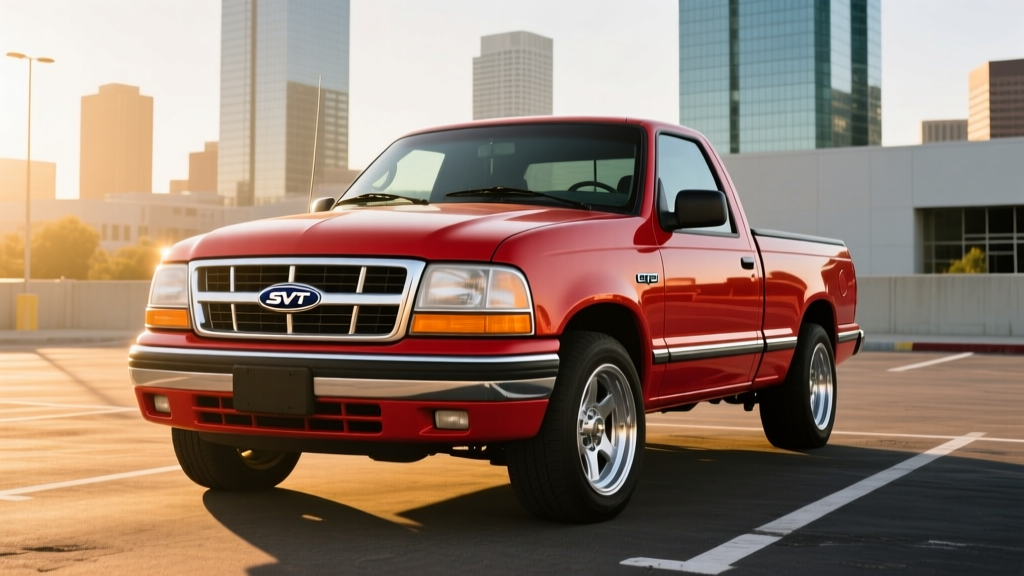
If you search for the roots of Ford's performance-truck lineage, every road leads back to one machine: the 1999 Ford F-150 SVT Lightning. Born from Ford's Special Vehicle Team (SVT) and built on the tenth-generation F-150 platform, this street-performance pickup arrived at a time when trucks were still firmly body-on-frame, solid-rear-axle workhorses — and turned the formula on its head with a supercharged 5.4L V8, aggressive styling, and a focus on pavement-burning speed rather than off-road prowess.
More than 25 years later, the nameplate lives on in the all-electric F-150 Lightning. But for enthusiasts, collectors, and buyers weighing a classic muscle truck against a modern electric pickup, the 1999 SVT Lightning remains a benchmark. This retrospective covers the original truck's specs, real-world ownership realities in 2026, and how it stacks up against its battery-powered successor.
The 1999 SVT Lightning by the Numbers
| Specification | 1999 Ford F-150 SVT Lightning |
|---|---|
| Engine | 5.4L Supercharged Triton V8 (2-valve SOHC) |
| Horsepower | 360 hp @ 4,750 rpm |
| Torque | 440 lb-ft @ 2,500 rpm |
| Transmission | 4-speed automatic (4R100) |
| Drivetrain | Rear-wheel drive |
| 0–60 mph | ~6.2 seconds (Motor Trend tested) |
| Top Speed | ~142 mph (electronically limited) |
| EPA Fuel Economy | 12 city / 17 highway / 14 combined mpg |
| Curb Weight | ~4,640 lbs |
| Payload Capacity | ~1,000 lbs |
| Towing Capacity | ~5,000 lbs (with proper equipment) |
| Bed Length | 6.5 ft (Flareside) |
| Original MSRP | $30,845 (1999) |
| Production Years | 1999–2004 (Gen 1: '99–'01; Gen 2: '03–'04) |
The 1999 model year marked the debut of the SVT Lightning. Ford's SVT division, led by engineers who also developed the Mustang Cobra R, fitted a Roots-type Eaton supercharger to the 5.4-liter Triton V8, producing 360 horsepower and a massive 440 lb-ft of torque available low in the rev range. For context, the standard 1999 F-150 with the 5.4L made just 260 hp — the Lightning was nearly 40% more powerful.
Power was routed through a heavy-duty 4R100 four-speed automatic transmission to a limited-slip rear axle with 3.73:1 gears. There was no all-wheel-drive option, no independent rear suspension, and no electronic stability control — this was a raw, analog performance truck in every sense.
Real-World Performance and Driving Impressions
The 1999 SVT Lightning's 0–60 mph time of approximately 6.2 seconds was genuinely quick for a full-size pickup in 1999 — and it remains respectable today. The supercharger delivers linear, immediate thrust with minimal lag, and the V8's torque curve makes highway passing effortless. Motor Trend's original road test clocked the quarter-mile at roughly 14.8 seconds at 95 mph.
However, the driving experience reflects its era. The recirculating-ball steering is vague by modern standards, body roll through corners is pronounced, and the solid rear axle with leaf springs transmits every imperfection in the road. Braking performance, with front discs and rear drums, is adequate but not confidence-inspiring at the truck's 4,640-pound curb weight.
The Flareside (stepside) bed, unique to the Lightning, gives the truck an aggressive, hot-rod stance but sacrifices bed width. Cargo volume in the 6.5-foot bed is approximately 35 cubic feet — enough for tools or a weekend's gear, but less practical than the Styleside beds on standard F-150s.
The EPA rated the 1999 SVT Lightning at 12 mpg city / 17 mpg highway / 14 mpg combined. In real-world ownership, expect 12–14 mpg in mixed driving. With the 25-gallon fuel tank, practical range is approximately 300–350 miles per tank — and enthusiastic driving can drop that below 280 miles. For comparison, the 2026 F-150 Lightning Extended Range achieves 70 MPGe combined with an EPA-estimated 320 miles of electric range.
Design, Interior, and Technology
The 1999 SVT Lightning was available exclusively in Oxford White, Ebony Black, or Rio Red — a deliberate simplification that echoed the SVT philosophy of performance over options. The exterior featured a body-colored grille with integrated fog lamps, Lightning badging, 18-inch five-spoke alloy wheels wrapped in Goodyear Eagle F1-GS tires, and aggressive front and rear fascias.
Inside, the Lightning received SVT-specific sport seats upholstered in a cloth-and-vinyl combination with embroidered Lightning logos. A leather-wrapped steering wheel, aluminum-look instrument cluster, and a premium audio system rounded out the cabin. By 2026 standards, the interior is Spartan: no touchscreen, no Bluetooth, no backup camera, no USB ports. The factory cassette deck (with an optional 6-disc CD changer) and analog gauges are relics of a pre-digital automotive era.
Driver-assistance technology was essentially nonexistent. There was no traction control in the 1999 model year (it was added for 2000), no stability control, no blind-spot monitoring, and no adaptive cruise. The Lightning demanded driver attention and skill — a feature for enthusiasts, a liability for daily commuting.
Ownership Costs in 2026: Collector Pricing and Running Expenses
The 1999 Ford F-150 SVT Lightning is no longer a used-truck bargain. Clean, low-mileage examples have become genuine collector vehicles. Here's what the market looks like in 2026:
| Condition / Mileage | Approximate Market Price (2026) |
|---|---|
| Concours / Under 15k miles | $45,000–$65,000+ |
| Excellent / 15k–50k miles | $30,000–$45,000 |
| Good / 50k–100k miles | $18,000–$30,000 |
| Driver-quality / 100k+ miles | $10,000–$18,000 |
| Project / Needs work | $5,000–$10,000 |
Beyond the purchase price, running a 25-year-old supercharged truck requires budgeting for maintenance that modern vehicles largely avoid:
- Supercharger service: The Eaton M112 Roots blower requires periodic coupler and oil service. Rebuild costs run $800–$1,500.
- Spark plugs: The 5.4L 2-valve Triton is notorious for difficult spark plug changes (some require special extraction tools). Budget $300–$600 at a shop.
- Fuel costs: At 12–14 mpg combined and requiring premium (91+ octane), annual fuel expense for 12,000 miles exceeds $3,500 at 2026 fuel prices.
- Insurance: Collector-vehicle insurance (Hagerty, Grundy) typically runs $400–$800/year for agreed-value coverage — significantly less than standard auto insurance, but with mileage restrictions.
- Tires: The 18-inch Goodyear Eagle F1s (or equivalent performance rubber) cost $200–$300 per corner and wear quickly under the truck's weight and torque.
Federal Tax Credits and Incentives: What Applies?
Because the 1999 Ford F-150 SVT Lightning is a conventional internal-combustion vehicle, it does not qualify for the federal EV tax credit under IRS §30D. There are no federal incentives for purchasing a used gasoline truck, regardless of its collector status.
However, if you're cross-shopping the 1999 SVT Lightning against the modern F-150 Lightning EV, the electric version may qualify for up to $7,500 in federal tax credits (or a point-of-sale price reduction) depending on your income, the vehicle's MSRP, and battery-sourcing requirements. Key 2026 §30D eligibility thresholds include:
- MSRP cap: Trucks and SUVs must have an MSRP at or below $80,000.
- Income cap: Modified adjusted gross income (MAGI) must not exceed $300,000 (joint filers), $225,000 (head of household), or $150,000 (single filers).
- Battery sourcing: A percentage of critical minerals and battery components must be sourced from the U.S. or free-trade-agreement partners — percentages increase annually.
- Point-of-sale transfer: Eligible buyers can transfer the credit to the dealer at purchase for an immediate price reduction.
Always verify current-year rules on IRS.gov or consult a tax professional before making a purchase decision based on credit eligibility.
1999 SVT Lightning vs. 2026 F-150 Lightning EV: A Generational Showdown
| Specification | 1999 SVT Lightning | 2026 F-150 Lightning (Extended Range) |
|---|---|---|
| Powertrain | 5.4L Supercharged V8 | Dual-motor AWD (BEV) |
| Horsepower | 360 hp | 580 hp |
| Torque | 440 lb-ft | 775 lb-ft |
| 0–60 mph | ~6.2 sec | ~3.8 sec |
| Drivetrain | RWD | AWD (dual-motor) |
| Range / Tank | ~300–350 mi (25 gal tank) | EPA 320 mi (131 kWh usable) |
| Efficiency | 14 mpg combined | 70 MPGe combined |
| DC Fast Charge | N/A | 150 kW peak; 10–80% in ~41 min |
| Level 2 Home Charge | N/A | 11.5 kW (~26 mi/hr) |
| Towing Capacity | ~5,000 lbs | 10,000 lbs |
| Payload | ~1,000 lbs | ~2,235 lbs |
| Base MSRP | $30,845 (1999) | ~$60,000 (2026) |
| Federal Tax Credit | None | Up to $7,500 (§30D) |
| Warranty | Expired (3-yr/36k new) | 3-yr/36k basic; 8-yr/100k battery |
The comparison reveals just how far truck technology has advanced. The 2026 F-150 Lightning EV delivers nearly double the horsepower, 75% more torque, all-wheel drive, and a sub-4-second 0–60 time — while offering more than triple the payload and double the towing capacity. The electric Lightning also serves as a mobile power source with Pro Power Onboard (up to 9.6 kW of exportable power), something the '99 could never imagine.
But the 1999 SVT Lightning has something the EV cannot replicate: analog character and collector value. The supercharger whine, the V8 exhaust note, the mechanical feedback through the steering wheel — these are sensory experiences that electric motors, for all their efficiency and instant torque, simply do not produce. And as a finite-production collector vehicle (only ~4,000 were built in 1999), the SVT Lightning has appreciation potential that a mass-produced EV will not match.
Who Should Buy the 1999 SVT Lightning — and Who Shouldn't
- You're a Ford truck enthusiast or SVT collector seeking a landmark performance vehicle.
- You want a weekend/show car with strong community support and aftermarket parts availability.
- You value raw, analog driving feel over technology and efficiency.
- You have a second vehicle for daily commuting and don't need practical cargo or towing capacity.
- You need a daily driver with modern safety features, infotainment, and driver assists.
- You tow more than 5,000 lbs or need full-size payload capacity regularly.
- Fuel costs matter — the SVT Lightning's 12–14 mpg will cost $3,500+/year in fuel alone.
- You want the lowest total cost of ownership, including potential federal tax credits.
Pros and Cons of the 1999 Ford F-150 SVT Lightning
Pros
- Iconic SVT heritage and collector appreciation potential
- 360 hp supercharged V8 with a distinctive, visceral sound
- Strong aftermarket and enthusiast community (lightningforce.com, SVT forums)
- Simple mechanical layout — easier to wrench on than modern trucks
- Low production numbers (~4,000 in 1999; ~11,000 total Gen 1) support long-term value
- Aggressive Flareside styling that still turns heads
Cons
- 12–14 mpg combined on premium fuel — expensive to drive regularly
- No modern safety tech (no ESC, no airbags beyond dual front, no backup camera)
- Solid rear axle and leaf springs compromise ride quality
- Limited bed practicality (Flareside is narrow; ~35 cu ft)
- Rising collector prices mean "driver-quality" examples now cost $15k–$25k
- Triton 5.4L 2-valve engines have known spark plug and coil-on-plug issues
- No federal tax credits or EV incentives apply
Frequently Asked Questions
What is the real-world fuel economy (range) of the 1999 SVT Lightning?
The EPA rated the 1999 SVT Lightning at 12 city / 17 highway / 14 combined mpg. In real-world ownership, most owners report 12–14 mpg in mixed driving and as low as 10 mpg under aggressive use. With the 25-gallon fuel tank, expect 300–350 miles per tank in normal driving — less if you're exercising the supercharger.
How many 1999 SVT Lightnings were built?
Ford produced approximately 4,000 units of the SVT Lightning for the 1999 model year, all at the Oakville Assembly Plant in Ontario, Canada. Total first-generation production (1999–2001) was roughly 11,000 units. The second generation (2003–2004) added approximately 10,000 more.
Is the 1999 SVT Lightning a good investment?
Clean, low-mileage examples have appreciated significantly. Concours-condition trucks now command $45,000–$65,000+, well above their original $30,845 MSRP. As a limited-production SVT vehicle with a strong enthusiast following, the Lightning has collector-investment potential — but like any classic car, returns depend on condition, mileage, documentation, and market timing.
Does the 1999 SVT Lightning qualify for any tax credits?
No. The IRS §30D clean vehicle credit applies only to new plug-in electric and fuel-cell vehicles meeting specific battery-sourcing, MSRP, and buyer-income requirements. The 1999 SVT Lightning is a gasoline-powered vehicle and is ineligible for any federal electrification incentives.
How does the 1999 SVT Lightning compare to the modern F-150 Lightning EV?
They share a nameplate but little else. The 2026 F-150 Lightning EV produces 580 hp and 775 lb-ft from dual electric motors, hits 0–60 in ~3.8 seconds, offers AWD, 320 miles of EPA-estimated range, and 10,000-lb towing. The 1999 SVT Lightning's advantage is its analog character, collector status, and supercharged V8 soundtrack — qualities the EV cannot replicate.
What are common problems with the 1999 SVT Lightning?
The 5.4L 2-valve Triton V8 is known for difficult spark plug removal (plugs can seize in the cylinder head), coil-on-plug failures, and occasional timing chain guide wear. The Eaton supercharger's isolator coupler can develop a rattling noise (a relatively inexpensive fix). The 4R100 transmission is robust but should have regular fluid service. Rust is a concern on trucks from salt-belt states, particularly in the rocker panels and cab corners.
Is it worth buying a 1999 SVT Lightning vs. a modern performance truck?
It depends on your priorities. If you want a collector vehicle with heritage, sound, and community, the SVT Lightning is a compelling choice. If you need daily usability, modern safety, towing capability, and lower running costs, a modern truck — whether the F-150 Lightning EV, a Raptor, or a RAM TRX — will serve you better. Many enthusiasts own both: the SVT for weekends and shows, the modern truck for everything else.