The Electric Truck That Time Forgot
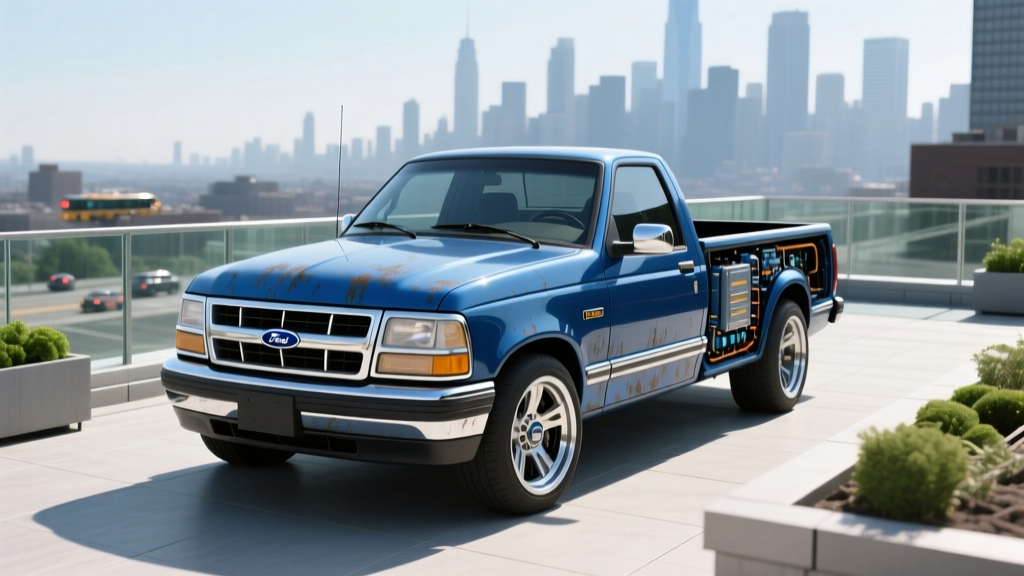
Search interest in the 1999 Ford F-150 Lightning has surged among EV enthusiasts and collectors — not because it's a new release, but because it represents one of the earliest factory-produced electric pickup trucks in American automotive history. Built in extremely limited numbers between 1999 and 2002, the electric F-150 Lightning (officially known as the Ford F-150 Electric Vehicle, or the "Electric Lightning" concept variant) was a product of California's ZEV mandate era, predating the modern EV revolution by two decades.
If you're researching this truck in 2026, you're likely either a collector, an EV historian, or someone who encountered the name and wants to understand what it was. This profile covers the real specs, the context of its creation, and how it stacks up against the current-generation Ford F-150 Lightning that carries the nameplate today.
1999 Ford F-150 Lightning EV — Key Specifications
| Spec | 1999 F-150 Electric | 2025 F-150 Lightning (Extended Range) |
|---|---|---|
| Battery Chemistry | Lead-acid (NiMH in later fleet tests) | NMC lithium-ion |
| Battery Capacity | ~26 kWh (usable, lead-acid pack) | 131 kWh usable |
| EPA-Equivalent Range | ~50–70 miles (estimated, no formal EPA cycle) | 320 miles (EPA est.) |
| Motor Power | ~85 kW (~114 hp) | 580 hp / 775 lb-ft torque |
| 0–60 mph | Not officially published; est. 12–15 sec | ~3.8 sec |
| DC Fast Charging | None (Level 1/Level 2 AC only) | Up to 150 kW peak |
| Level 2 Charge Time | ~6–8 hours (est., 6.6 kW onboard charger) | ~10 hours (80A, 19.2 kW) |
| Drivetrain | Rear-wheel drive, single motor | Dual-motor AWD |
| Production Volume | ~100–200 units (fleet/lease only) | Mass production (100,000+ annually) |
| Original MSRP | Not sold to public; lease-only fleet program | $54,995–$96,874 (2025) |
Why Did Ford Build an Electric F-150 in 1999?
The late 1990s were a pivotal moment for electric vehicles in the United States. California's Air Resources Board (CARB) had enacted its Zero Emission Vehicle mandate, requiring automakers to sell a percentage of zero-emission vehicles in the state. This regulation directly spurred vehicles like the GM EV1, the Toyota RAV4 EV, and Ford's own electric efforts — including the Ranger EV and the F-150 electric prototype/fleet vehicle.
Ford's electric F-150 was never intended for retail consumers. It was developed primarily as a fleet and demonstration vehicle, leased to government agencies and utility companies. The truck used a lead-acid battery pack — the dominant rechargeable chemistry available at scale at the time — which severely limited both range and payload compared to the gasoline F-150.
The "Lightning" name in 1999 was actually associated with Ford's gasoline-powered SVT F-150 Lightning, a supercharged 5.4L V8 performance truck producing 360 hp. The electric F-150 and the SVT Lightning were entirely separate programs, though the nameplate convergence is precisely why the 1999 electric F-150 generates search interest today — especially now that Ford has revived "Lightning" for its modern battery-electric pickup.
Range, Battery, and the Lead-Acid Limitation
Real-World Range Reality
Estimated range: 50–70 miles under ideal conditions (flat terrain, moderate temperatures, light payload).
Real-world expectation: With a heavy lead-acid pack weighing over 1,500 lbs, range degraded sharply under load. Cold-weather operation would have reduced usable range by an estimated 30–40%, given lead-acid chemistry's poor low-temperature performance. Highway-speed driving (65+ mph) would further cut range due to the truck's aerodynamic drag and lack of regenerative braking sophistication compared to modern systems.
No formal EPA test cycle was published for this vehicle — the EPA's modern 5-cycle test and MPGe standard were not yet in use for EVs in 1999.
The battery pack in the 1999 electric F-150 was fundamentally a technology dead end. Lead-acid batteries offered energy density of roughly 30–40 Wh/kg, compared to the 250+ Wh/kg of modern NMC lithium-ion cells. This meant the truck carried an enormous, heavy battery for very modest range. The pack also suffered from limited cycle life — typically 300–500 deep cycles before significant capacity loss — and required regular maintenance (water topping for flooded cells in some configurations).
Some later Ford electric fleet vehicles experimented with nickel-metal hydride (NiMH) packs, which improved energy density somewhat but still fell far short of today's lithium-ion standards. Neither chemistry offered meaningful fast-charging capability.
Charging: What "Plugging In" Looked Like in 1999
Charging Levels — 1999 vs. Modern F-150 Lightning
| Level | 1999 F-150 Electric | 2025 F-150 Lightning |
|---|---|---|
| Level 1 (120V AC) | ~1.4 kW; ~4–5 mi/hr added | ~1.4 kW; ~2–3 mi/hr |
| Level 2 (240V AC) | ~6.6 kW (est.); ~15–20 mi/hr | Up to 19.2 kW; ~30 mi/hr |
| DC Fast Charging | Not available | Up to 150 kW; 10–80% in ~41 min |
| Connector | Avcon conductive or inductive paddle (period-specific) | NACS (2025+ models) |
Charging infrastructure in 1999 was essentially nonexistent outside of a few California demonstration sites. The truck would have charged via early conductive connectors (such as the Avcon paddle-style plug) or inductive paddle systems that were briefly standard before the J1772 connector was adopted. A full charge from empty would take 6–8 hours on a 240V circuit — comparable to early-2010s EVs like the first-generation Nissan Leaf, but with far less range to show for it.
The concept of DC fast charging for consumer EVs did not exist in any practical sense. CHAdeMO wouldn't arrive until 2010, and CCS/NACS were more than a decade away. Fleet operators typically installed dedicated Level 2 stations at depots and accepted overnight charging as the only viable workflow.
Performance and Driving Experience
With roughly 85 kW (114 hp) from a single rear-mounted electric motor, the 1999 electric F-150 was not a performance vehicle. Acceleration was leisurely by any standard — 0–60 mph times were likely in the 12–15 second range, compared to the gasoline SVT Lightning's 5.4-second run. Top speed was electronically limited, reportedly around 75 mph.
What the electric drivetrain did offer was instant torque at zero RPM — a characteristic that impressed fleet drivers accustomed to diesel-like lag. The truck could move heavy loads from a standstill with surprising authority at low speeds, even if highway merging was a nerve-wracking affair.
The driving experience lacked regenerative braking in any sophisticated form. Most early EVs of this era used simple resistive braking or minimal regen, meaning the truck drove much like a conventional automatic — lift off the accelerator and it coasted. One-pedal driving, a hallmark of modern EVs, was not a feature.
Where the 1999 Electric F-150 Fits in EV History
The 1999 electric F-150 occupies a fascinating but narrow place in EV history. It was part of a wave of compliance-oriented electric vehicles that automakers built in response to CARB's ZEV mandate — vehicles that were technically impressive for their time but commercially unviable due to battery limitations. When CARB relaxed the mandate's pure-ZEV requirements in the early 2000s (partly due to automaker lobbying and partly due to genuine technological limitations), most of these programs were shelved.
Ford, like other manufacturers, recalled and crushed many of its early EVs — a fate shared by the GM EV1 and documented in the 2006 film Who Killed the Electric Car?. A small number of 1999-era electric F-150s may survive in private collections or museum archives, but they are extraordinarily rare.
The truck's legacy is primarily as a proof of concept. It demonstrated that a full-size pickup could be electrified — it just couldn't be done practically with 1990s battery technology. It would take another 23 years, and the development of high-density lithium-ion cells, for Ford to launch the production F-150 Lightning in 2022 with 320 miles of range, 580 horsepower, and DC fast charging.
The Modern F-150 Lightning: What "Lightning" Means Today
For buyers researching the 1999 F-150 Lightning out of curiosity, the practical takeaway is that the modern Ford F-150 Lightning (2022–present) is the vehicle that actually delivers on the electric truck promise. Here's how the two compare in the metrics that matter:
| Metric | 1999 Electric F-150 | 2025 F-150 Lightning (Lariat Ext. Range) |
|---|---|---|
| EPA Range | ~50–70 mi (est.) | 320 mi |
| Efficiency | Not rated (MPGe standard didn't exist) | 66 MPGe combined |
| Towing Capacity | Minimal (battery weight limited payload) | 10,000 lbs |
| Cargo Bed | Standard 6.5-ft bed (reduced payload) | 5.5-ft bed + front trunk (frunk) |
| Pro Power Onboard | No | Yes — up to 9.6 kW V2L |
| Over-the-Air Updates | No | Yes (Ford Power-Up) |
| ADAS | None | BlueCruise (SAE Level 2 hands-free on approved highways) |
| Federal Tax Credit | N/A (no credit existed) | Up to $7,500 (§30D, subject to MSRP, income, and sourcing rules) |
The 2025 F-150 Lightning starts at $54,995 for the Pro trim with the standard-range 98 kWh battery and reaches approximately $96,874 for the Platinum Extended Range. Federal tax credit eligibility under IRS §30D depends on multiple factors: the buyer's modified adjusted gross income must not exceed $150,000 (single) or $300,000 (joint); the truck's MSRP must be under $80,000 (the F-150 Lightning qualifies as a truck/van, which carries the higher cap); and the vehicle must meet critical-mineral and battery-component sourcing requirements that have tightened significantly since 2024. Always verify current eligibility with a tax professional before purchasing.
Who Should Care About the 1999 Electric F-150?
If you landed on this article searching for a "1999 Ford F-150 Lightning" to buy, here's the reality check: this vehicle is not available on the used market in any meaningful quantity. It was a lease-only fleet vehicle produced in the low hundreds, and most units were decommissioned and scrapped. You cannot walk into a dealership or browse Autotrader and find one.
However, the 1999 electric F-150 is relevant to several audiences:
- EV historians and collectors — If you're documenting early American EVs or building a collection, tracking down a surviving unit (likely through Ford archives, fleet-auction residuals, or museum networks) is a worthy pursuit.
- EV conversion enthusiasts — The 1999 F-150's body and chassis are common (millions of gasoline F-150s from this era were sold), making it a popular candidate for aftermarket EV conversions using modern lithium-ion packs and motors. Companies like EV West and Zero EV offer conversion kits that can give a 1999 F-150 modern range and performance.
- Shoppers confused by the name — If you searched "1999 F-150 Lightning" thinking it was the modern electric truck, you're looking for the 2022–2025 Ford F-150 Lightning. The SVT Lightning (1993–1995, 1999–2004) was a gasoline performance truck, not an EV.
Frequently Asked Questions
Was the 1999 Ford F-150 Lightning actually electric?
There's a naming confusion to untangle. The 1999 SVT F-150 Lightning was a gasoline-powered, supercharged V8 performance truck. Separately, Ford built a small number of electric F-150 prototypes and fleet vehicles around the same era (1998–2002), but these were not badged as "Lightning" models. The modern F-150 Lightning (2022+) combines both the electric powertrain and the Lightning nameplate for the first time in a production retail vehicle.
How many 1999 electric F-150s were built?
Ford never published an exact production figure for the electric F-150 fleet program. Industry estimates place the total between 100 and 200 units, all allocated to government agencies, utilities, and fleet operators — primarily in California. Very few are believed to survive.
Can I buy a 1999 electric F-150 today?
Not through any conventional channel. These vehicles were lease-only, and most were returned and dismantled. A surviving unit would surface only through specialized collector networks or museum deaccession. If you want a 1999 F-150 with an electric drivetrain, your most realistic path is purchasing a gasoline 1999 F-150 and performing an aftermarket EV conversion.
What is the modern F-150 Lightning's real-world range?
The 2025 F-150 Lightning Extended Range carries an EPA estimate of 320 miles. In real-world highway driving at 70+ mph, expect approximately 250–280 miles. In cold weather (below freezing), range can drop by 20–30%, yielding roughly 220–260 miles depending on cabin heating use and driving style. The standard-range model (98 kWh battery) is rated at 240 miles EPA, with real-world highway figures closer to 190–215 miles.
Does the F-150 Lightning qualify for the $7,500 federal tax credit?
Eligibility depends on the specific trim, your income, and current battery-sourcing rules. The F-150 Lightning qualifies as a truck (MSRP cap of $80,000 under §30D). Buyer income must not exceed $150,000 single / $300,000 joint. Battery-component and critical-mineral sourcing requirements must be met — and these rules have tightened annually since 2024. Some trims may qualify for the full $7,500, a partial credit, or none at all depending on the model year and manufacturing date. Check IRS.gov for the current eligible vehicle list and consult a tax professional.
How does the 1999 electric F-150 compare to modern electric trucks?
There is no meaningful comparison in terms of capability. The 1999 truck offered roughly 50–70 miles of range, no DC fast charging, minimal towing capacity, and no modern safety or technology features. Modern electric trucks like the F-150 Lightning, Rivian R1T, and Chevrolet Silverado EV offer 300+ miles of range, 150–350 kW DC fast charging, 10,000+ lb towing, and full ADAS suites. The 1999 vehicle's significance is purely historical.
1999 Electric F-150 — Pros (Historical Context)
- One of the first factory electric pickups ever built
- Demonstrated electric torque for work-truck applications
- Zero tailpipe emissions (ahead of its time for fleet use)
- Extremely rare collector/historical artifact
1999 Electric F-150 — Cons
- ~50–70 mile range with heavy, maintenance-intensive lead-acid batteries
- No DC fast charging; 6–8 hour Level 2 charge
- Never sold to the public; virtually impossible to acquire today
- No modern safety, infotainment, or driver-assistance features
- Performance far below even 1999 gasoline trucks
Sources: Ford Motor Company historical fleet documentation; fueleconomy.gov (EPA data for modern F-150 Lightning); IRS.gov (§30D clean vehicle credit rules).