The Electric Truck Before Electric Trucks Were Cool
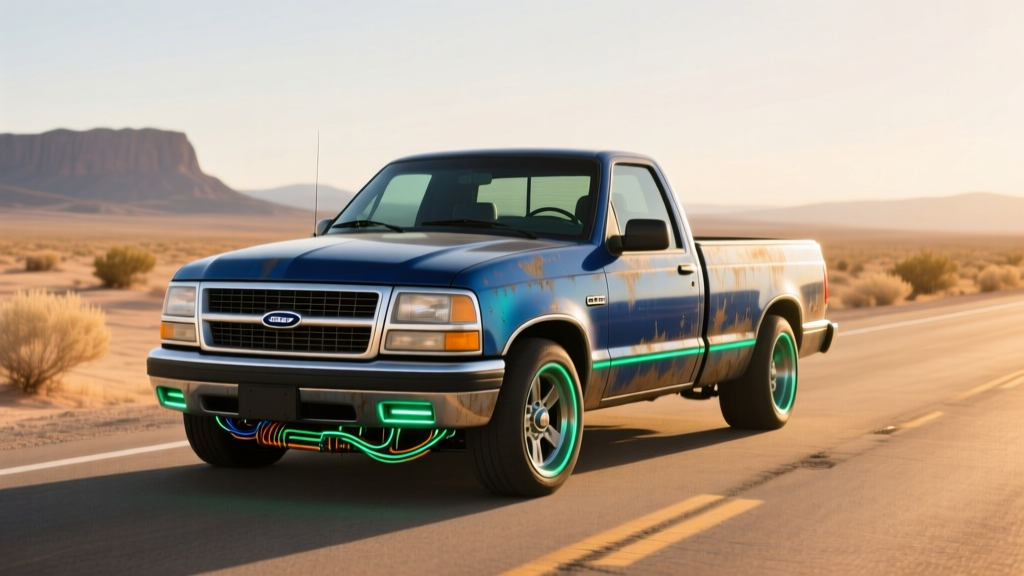
Long before the 2022 F-150 Lightning rewrote the rules for full-size electric pickups, Ford built a little-known battery-electric prototype based on its iconic SVT performance truck. The 1999 F-150 Lightning EV wasn't a production vehicle you could walk into a dealership and buy — it was an engineering mule, a proof-of-concept built during an era when General Motors' EV1 dominated headlines and California's ZEV mandate pushed automakers to experiment with battery-electric drivetrains.
If you've been searching for "1999 F-150 Lightning" and wondering whether Ford made an electric truck over two decades before the current model, the answer is both yes and no. Ford did convert at least one SVT F-150 Lightning to battery-electric power around 1999–2000, but it never reached consumers. Understanding this vehicle requires separating internet mythology from engineering reality — and appreciating how far EV truck technology has come since.
What the 1999 F-150 Lightning EV Actually Was
The SVT F-150 Lightning, produced from 1993 to 1995 (first generation) and 1999 to 2004 (second generation), was Ford's high-performance street truck — a supercharged 5.4L V8 monster with no electric intent whatsoever. However, during the late 1990s, Ford's Advanced Technology Group explored electrifying various platforms to comply with emerging zero-emission vehicle regulations and to develop internal expertise in battery-electric systems.
The electric conversion of an F-150 Lightning chassis used lead-acid or early nickel-metal hydride (NiMH) battery packs — the lithium-ion cells that power every modern EV were still years away from automotive viability. These prototype trucks were built for engineering evaluation, not sale.
1999 F-150 Lightning EV Prototype vs. Modern F-150 Lightning
| Specification | 1999 Prototype (Estimated) | 2026 F-150 Lightning (Extended Range) |
|---|---|---|
| Battery Chemistry | Lead-acid / NiMH | NMC lithium-ion |
| Battery Capacity | ~20–30 kWh (est.) | 131 kWh usable |
| EPA Range | ~50–70 miles (est.) | 320 miles |
| Motor Output | ~80–120 hp (est.) | 580 hp / 775 lb-ft |
| 0–60 mph | Not published | 3.8 seconds |
| DC Fast Charging | Not available | Up to 150 kW peak |
| Production Status | Prototype only | Mass production |
The Battery and Range Reality of a 1999 Electric Truck
Let's address the core question directly: there is no official EPA range figure for the 1999 F-150 Lightning EV prototype because the EPA's modern five-cycle testing methodology for electric vehicles didn't exist in its current form, and Ford never submitted the vehicle for certification. Any range claim you find online for this truck is either an estimate or a fabrication.
Estimated Range: 1999 Prototype vs. Reality
No official EPA sticker exists. Based on the battery technology of the era (lead-acid packs in the 20–30 kWh range) and the F-150's heavy curb weight (~4,800+ lbs), engineers at the time estimated 50–70 miles of range under ideal conditions. Highway driving at 70 mph, cold weather, or carrying payload would have reduced that figure substantially — likely into the 30–40 mile range. For context, GM's purpose-built EV1 (a lightweight, aerodynamic coupe with NiMH batteries) achieved only 75–95 miles of real-world range in the same era.
The battery chemistry matters enormously here. Lead-acid batteries — still used in 12V auxiliary systems today — have terrible energy density by weight (~30–40 Wh/kg compared to ~250 Wh/kg for modern NMC lithium-ion). Even NiMH, which powered the Toyota Prius and later the Honda Insight, offered only ~60–80 Wh/kg. Packing enough cells into a 5,000-pound truck to achieve meaningful range was physically impractical with 1999 technology.
Charging: A World Before DC Fast Charging
The concept of DC fast charging at 150 kW or 350 kW didn't exist in 1999. The CHAdeMO standard wouldn't arrive until 2010, CCS until 2013, and Tesla's Supercharger network until 2012. Ford's electric truck prototypes charged exclusively via AC Level 1 (120V household outlet) or early Level 2 (240V) equipment.
Charging Speeds: Then vs. Now
| Charging Method | 1999 Prototype (Est.) | 2026 F-150 Lightning |
|---|---|---|
| Level 1 (120V / 1.4 kW) | ~3–4 miles/hour | ~2–3 miles/hour |
| Level 2 (240V) | ~6.6 kW max (est.) | 19.2 kW (80A) — ~30 mi/hr |
| DC Fast Charge | Not supported | 150 kW peak; 15–80% in ~41 min |
| Full Charge Time (L2) | ~5–8 hours (est.) | ~8 hours (131 kWh at 19.2 kW) |
Even with a relatively small battery pack by modern standards, a full recharge on 1999-era Level 2 equipment would have taken the better part of a night. There was no public charging infrastructure to speak of — no Electrify America, no EVgo, no ChargePoint network. Electric vehicle charging in 1999 meant a dedicated home station, period.
Why Ford Built It — and Why It Never Reached Production
The late 1990s were a pivotal moment for EV development. California's Zero Emission Vehicle (ZEV) mandate, initially adopted in 1990, required that 2% of new vehicles sold in the state be zero-emission by 1998, rising to 10% by 2003. This regulation forced every major automaker to develop electric vehicles, resulting in the GM EV1, Toyota RAV4 EV, Honda EV Plus, Ford Ranger EV, and Ford Think (a small city car from a Norwegian subsidiary Ford acquired).
The F-150 Lightning EV prototype fit into this broader R&D push. However, several factors made a production electric truck impossible in 1999:
- Battery cost and weight: Achieving even 70 miles of range in a full-size truck required hundreds of pounds of lead-acid batteries, eating into payload and cargo capacity — the core purpose of a pickup.
- No consumer market: In 1999, gasoline cost roughly $1.15 per gallon. There was no economic case for an electric truck, and consumer awareness of EVs was near zero outside California.
- ZEV mandate rollback: Automakers successfully lobbied to weaken California's ZEV mandate throughout the late 1990s and early 2000s. By 2003, the mandate had been effectively gutted, removing the regulatory driver for production EVs.
- Charging infrastructure: With no public charging network and slow home charging, an electric truck with 50-mile range had no practical use case outside of a controlled fleet environment.
Ford did produce the Ranger EV in limited numbers (roughly 1,500 units from 1998–2002), mostly for fleet lease in California. But a full-size electric F-150 was a bridge too far for the technology of the time.
The Modern F-150 Lightning: What 25 Years of Battery Progress Looks Like
Fast-forward to 2026, and the F-150 Lightning is a mass-production, body-on-frame electric truck that would have been science fiction in 1999. Here's what the current model delivers:
2026 Ford F-150 Lightning Key Specifications
| Spec | Standard Range (98 kWh) | Extended Range (131 kWh) |
|---|---|---|
| Battery Chemistry | NMC lithium-ion | NMC lithium-ion |
| EPA Range | ~230 miles | 320 miles |
| Motor Output | 580 hp / 775 lb-ft | 580 hp / 775 lb-ft |
| Drivetrain | Dual-motor AWD | Dual-motor AWD |
| 0–60 mph | ~4.0 seconds | 3.8 seconds |
| Max DC Fast Charge | ~120 kW peak | 150 kW peak |
| 10–80% DC Charge | ~44 minutes | ~41 minutes |
| Level 2 Home Charge | 19.2 kW (80A) | 19.2 kW (80A) |
| MPGe (Combined) | ~68 MPGe | ~66 MPGe |
| Towing Capacity | 7,700 lbs | 10,000 lbs |
| Payload | ~2,000 lbs | ~1,800 lbs |
| Base MSRP | ~$55,000 | ~$70,000 |
The contrast is staggering. The modern Lightning carries roughly four to six times the battery energy of the 1999 prototype, delivers nearly five times the range, and produces close to five times the horsepower — while offering dual-motor all-wheel drive, a mega-power frunk (front trunk), Pro Power Onboard vehicle-to-load capability, and access to a nationwide DC fast-charging network with tens of thousands of stations.
Tax Credits and Pricing: What the 1999 Prototype Never Had
There was no federal EV tax credit in 1999. The modern IRS §30D Clean Vehicle Credit offers up to $7,500 for qualifying new EVs, but eligibility depends on several factors that change frequently:
Federal Tax Credit Eligibility (2026 Rules)
| Requirement | Detail |
|---|---|
| MSRP Cap (Trucks/Vans/SUVs) | ≤ $80,000 |
| Buyer Income Cap (Joint) | ≤ $300,000 AGI |
| Buyer Income Cap (Individual) | ≤ $150,000 AGI |
| Battery Component Sourcing | Must meet North American manufacturing thresholds |
| Critical Minerals Sourcing | Must meet FTA-country sourcing thresholds |
| Point-of-Sale Transfer | Eligible buyers can transfer credit to dealer at purchase |
Source: IRS.gov. Rules subject to change; consult a tax professional for your specific eligibility.
For the 2026 F-150 Lightning, the Standard Range trims (under the $80,000 MSRP cap for trucks) may qualify for the full $7,500 credit if battery sourcing requirements are met and buyer income is within limits. Extended Range trims that exceed $80,000 MSRP do not qualify. Ford has been working to source battery components and critical minerals from qualifying countries, but the specific credit amount available at any given time depends on the latest Treasury Department guidance on sourcing compliance.
Who Should Care About the 1999 F-150 Lightning EV?
The 1999 F-150 Lightning electric prototype is primarily of interest to three groups:
- EV historians and enthusiasts who want to understand the lineage of electric trucks and appreciate how battery technology constraints shaped early automaker decisions.
- Ford truck collectors researching the SVT Lightning nameplate, which carries significant enthusiast cachet (the supercharged V8 models from 1999–2004 are appreciating collector vehicles).
- Prospective F-150 Lightning EV buyers who encounter the "1999" keyword in searches and want clarity that the modern electric Lightning is an entirely different vehicle with no direct mechanical connection to the 1999 prototype.
What the 1999 Prototype Proved
- Ford had EV engineering capability decades before the modern Lightning
- Full-size truck electrification was identified as a goal as early as the late 1990s
- Early prototypes informed Ford's later EV strategy (Ranger EV, Focus Electric, Mustang Mach-E, F-150 Lightning)
- Historical significance for EV and truck enthusiasts
Why It Wasn't a Viable Product
- Range of ~50–70 miles was impractical for any truck use case
- Battery weight destroyed payload capacity
- No fast-charging capability or public infrastructure
- Lead-acid/NiMH batteries degraded rapidly and were expensive to replace
- Never sold to consumers — zero ownership data or long-term reliability information
- No safety certifications or crash testing for the electric conversion
Frequently Asked Questions
Was the 1999 F-150 Lightning ever sold as an electric vehicle?
No. The 1999 F-150 Lightning electric prototype was an internal Ford engineering vehicle, never offered for public sale. The SVT F-150 Lightning sold from 1999–2004 was exclusively a supercharged 5.4L V8 gasoline truck. The first production electric F-150 is the modern Lightning, launched for the 2022 model year.
How far could the 1999 F-150 Lightning EV drive on a charge?
There is no official EPA range figure. Based on the battery technology available in 1999 (lead-acid or NiMH cells in a ~20–30 kWh pack) and the truck's weight, a reasonable estimate is 50–70 miles under ideal conditions, dropping to 30–40 miles under highway or cold-weather driving. This is roughly one-fifth the range of the current F-150 Lightning Extended Range.
Does the 1999 F-150 Lightning EV qualify for any tax credits?
No. The vehicle was never a production model and cannot be purchased. The federal §30D Clean Vehicle Credit applies only to new, qualifying production EVs purchased from a manufacturer. Even the modern F-150 Lightning's credit eligibility depends on MSRP, buyer income, and battery sourcing rules per IRS guidelines.
What battery chemistry did the 1999 prototype use?
Ford's late-1990s EV prototypes typically used either lead-acid or nickel-metal hydride (NiMH) battery packs. Lithium-ion cells, which power all modern EVs, were not yet commercially viable for automotive use. NiMH offered roughly 60–80 Wh/kg energy density — compared to ~250 Wh/kg for modern NMC lithium-ion — making long-range electric trucks physically impractical.
Is the modern F-150 Lightning related to the 1999 prototype?
Only in name and spirit. The 2022+ F-150 Lightning shares the F-150 platform and the "Lightning" performance badge, but it is an entirely new vehicle engineered from the ground up as a battery-electric truck. There is no mechanical or electrical continuity between the 1999 prototype and the current production model.
Should I wait for a "retro" electric F-150 Lightning?
Ford has not announced any retro-styled electric truck paying homage to the 1999 SVT Lightning. If you want a classic SVT Lightning, the 1999–2004 supercharged V8 models are available on the collector market (typically $25,000–$50,000+ depending on condition and mileage). If you want a modern electric truck, the current F-150 Lightning, Rivian R1T, and Chevrolet Silverado EV are all in production now.