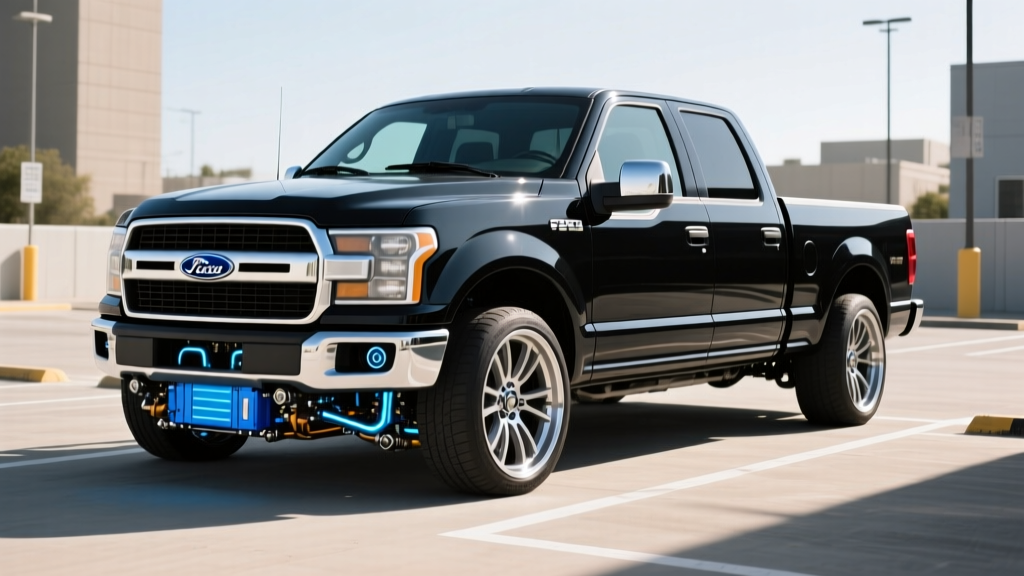
If you own a 1999 Ford F-150 and are considering an electric vehicle conversion, understanding the truck's bolt pattern is the first mechanical hurdle. The bolt pattern dictates which wheels, hub adapters, and drivetrain components will physically mate to your axles — a critical detail whether you're swapping in OEM-style wheels or engineering a custom EV powertrain. This guide covers the exact 1999 Ford F-150 bolt pattern, walks through the realities of converting this generation truck to electric, and examines whether a DIY EV swap makes financial and practical sense in 2026.
1999 Ford F-150 Bolt Pattern: Exact Specifications
The 1999 Ford F-150 uses a 5-lug bolt pattern measuring 5x139.7mm (also expressed as 5x5.5 inches). This pattern is shared across most F-150 model years from 1997 through 2003 (the tenth generation). Here are the full wheel-mounting specifications:
| Specification | Value |
|---|---|
| Bolt Pattern | 5x139.7mm (5x5.5") |
| Center Bore | 86.7mm (hub-centric) |
| Lug Nut Thread Size | 1/2"-20 UNF |
| Lug Nut Torque Spec | 100 lb-ft (135 Nm) |
| Stock Wheel Sizes | 15" to 17" diameter |
| Stock Offset Range | +0 to +20mm (varies by trim) |
For an EV conversion, this bolt pattern matters because many aftermarket EV hub motors and adapter plates are designed around common patterns. The 5x139.7mm pattern is shared with older Dodge Rams (1994–2001), some Toyota Land Cruisers, and various full-size SUVs, giving converters a wider pool of compatible wheel and hub components.
Why Convert a 1999 F-150 to Electric?
The tenth-generation F-150 is a popular conversion candidate for several reasons. The body-on-frame construction provides clear mounting points for battery enclosures. The engine bay is spacious enough to accommodate a large motor and inverter. And the truck's simple mechanical layout — no complex CAN-bus integration compared to modern vehicles — makes it one of the more approachable platforms for a first EV build.
However, a conversion is a significant engineering and financial undertaking. Before committing, consider what you're getting:
- Emissions-free daily driving in a truck with classic styling
- Instant torque from an electric motor (a major upgrade over the stock 4.6L or 5.4L V8)
- Simplified maintenance — no oil changes, spark plugs, or exhaust system
- Customizability — you choose the battery size, motor, and range target
Realistic EV Conversion Specs: What to Expect
Most 1999 F-150 EV conversions in 2026 fall into two categories: a budget-conscious commuter build or a higher-capability build targeting highway range and towing. Below is a data-driven comparison of what each approach typically delivers, based on common conversion kits and documented builds from shops like EV West and Zero EV.
| Specification | Budget Commuter Build | High-Capability Build |
|---|---|---|
| Battery Capacity | 40–60 kWh (LFP modules) | 80–120 kWh (NMC or LFP) |
| Estimated EPA-Equivalent Range | 80–120 miles | 150–220 miles |
| Motor Type | Single AC induction (NetGain Hyper9) | Dual-motor or Tesla drive unit |
| Horsepower | 120–180 HP | 250–400 HP |
| Torque | 200–300 lb-ft | 400–600 lb-ft |
| 0–60 mph | 9–12 seconds | 4.5–7 seconds |
| DC Fast Charge | Not typically included | 50–100 kW (CCS or CHAdeMO) |
| Level 2 Charging | 3.3–6.6 kW (~12–25 mi/hr) | 7.2–11.5 kW (~28–45 mi/hr) |
| 10–80% Charge Time (L2) | 5–8 hours | 6–10 hours |
| Drivetrain | RWD (stock rear axle retained) | RWD or AWD (custom transfer case) |
| Estimated Total Cost | $18,000–$30,000 | $40,000–$70,000+ |
Charging a Converted F-150: Home and Public Options
Charging infrastructure is where most first-time converters underestimate the challenge. Here's what to plan for:
| Charging Level | Power | Miles Added Per Hour | Typical Use Case |
|---|---|---|---|
| Level 1 (120V outlet) | 1.2–1.4 kW | 3–5 mi/hr | Emergency/overnight trickle |
| Level 2 (240V home) | 6.6–11.5 kW | 20–45 mi/hr | Daily home charging |
| DC Fast Charge (if equipped) | 50–100 kW | N/A (timed sessions) | Road trips (if CCS/CHAdeMO added) |
Home Level 2 installation for a 6.6 kW charger typically costs $800–$1,500 including equipment and electrician labor, assuming your electrical panel has capacity. Upgrading to an 11.5 kW charger may require a panel upgrade ($1,500–$3,000) if your home has a 100-amp service. Always consult a licensed electrician for final specifications.
DC fast charging is the biggest compromise in a conversion. Adding a CCS or CHAdeMO inlet and the required battery management system (BMS) communication protocol adds $3,000–$8,000 to the build cost. Many budget conversions omit DC fast charging entirely, limiting the truck to local use.
Cost Breakdown: Conversion vs. Buying a New EV Truck
The financial case for converting a 1999 F-150 is nuanced. You're not just comparing the conversion cost to a new EV — you're weighing it against the value of keeping a truck you may already own, love, or have invested in restoring.
| Cost Factor | 1999 F-150 EV Conversion | 2026 Ford F-150 Lightning (Base) | 2026 Rivian R1T (Base) |
|---|---|---|---|
| Vehicle/Build Cost | $18,000–$70,000 | ~$54,995 MSRP | ~$69,900 MSRP |
| Federal Tax Credit (§30D) | Not eligible (see below) | Up to $7,500 (if eligible) | Up to $7,500 (if eligible) |
| Effective Price (best case) | $18,000–$70,000 | ~$47,495 | ~$62,400 |
| Warranty | None (self-built) | 3yr/36k mi basic; 8yr/100k mi battery | 5yr/60k mi basic; 8yr/175k mi battery |
| Range (EPA) | 80–220 mi (build-dependent) | 240–320 mi | 270–420 mi |
| DC Fast Charging | Rarely included | Standard (up to 150 kW) | Standard (up to 220 kW) |
| Safety Features | None beyond original 1999 design | Ford Co-Pilot360 (Level 2 ADAS) | Driver+ (Level 2 ADAS) |
Battery Chemistry for Conversions: LFP vs. NMC
The battery pack is the single most expensive component in any EV conversion, and chemistry choice has real trade-offs:
| Factor | LFP (Lithium Iron Phosphate) | NMC (Nickel Manganese Cobalt) |
|---|---|---|
| Energy Density | Lower (~150–170 Wh/kg) | Higher (~220–260 Wh/kg) |
| Cycle Life | 3,000–5,000+ cycles | 1,000–2,000 cycles |
| Thermal Stability | Excellent (resistant to thermal runaway) | Good (requires active cooling) |
| Cold-Weather Performance | Poor (significant range loss below 32°F) | Better (but still loses 20–30%) |
| Cost per kWh (2026) | ~$80–$110 | ~$120–$160 |
| Best For | Daily commuter builds, safety-first | Range-critical builds, highway use |
For a 1999 F-150 conversion, LFP is the safer default choice for most builders. Its superior cycle life means the pack will likely outlast the truck's body, and its thermal stability reduces the need for complex liquid cooling systems. The trade-off is lower energy density — you'll need more physical space and weight for the same range. Given the F-150's large frame rails and bed, packaging is usually manageable up to about 80 kWh.
Who Should (and Shouldn't) Convert a 1999 F-150 to Electric?
Convert If:
- You already own the truck and want to keep it running indefinitely
- You enjoy hands-on mechanical/electrical projects
- Your daily commute is under 60 miles round-trip
- You value uniqueness over warranty and convenience
- You have access to a garage, tools, and 240V power
Skip the Conversion If:
- You need reliable long-distance range or towing capability
- You want warranty coverage, safety tech, or ADAS features
- You need DC fast charging for road trips
- Your budget is under $20,000 for the full build
- You want federal tax credit eligibility
Frequently Asked Questions
What is the real-world range of a 1999 F-150 EV conversion?
With a 60 kWh LFP battery pack, expect 80–100 miles in moderate weather with mixed city/highway driving. Highway-only driving at 70+ mph may drop that to 65–80 miles due to the truck's poor aerodynamics. In cold weather (below 35°F), plan for 60–75 miles unless your build includes battery heating.
How fast does a converted F-150 charge at home?
Most conversions use a 6.6 kW onboard charger, adding roughly 20–25 miles of range per hour on a 240V Level 2 circuit. A full charge from 10% to 100% on a 60 kWh pack takes approximately 8–9 hours. Upgrading to an 11.5 kW charger cuts that to about 5 hours but may require a 200-amp home electrical panel.
Does an EV conversion qualify for the federal EV tax credit?
No. The IRS §30D Clean Vehicle Credit applies only to qualifying new or used vehicles from certified OEMs. A DIY conversion of a 1999 F-150 does not meet the requirements. Some states offer separate rebates or incentives for EV conversions — check your state's energy or environmental agency.
Is converting a 1999 F-150 worth it versus buying a Lightning?
Financially, rarely. A well-executed conversion costs $25,000–$60,000 with no warranty, no tax credit, limited range, and no fast charging. A used F-150 Lightning often costs a similar amount with full OEM support, 230+ miles of range, and DC fast charging. The conversion makes sense as a passion project, a way to preserve a beloved truck, or a learning experience — not as a cost-saving measure.
What is the bolt pattern on a 1999 Ford F-150, and why does it matter for EV conversions?
The 1999 F-150 bolt pattern is 5x139.7mm (5x5.5 inches) with an 86.7mm center bore. For EV conversions, this determines which wheels and hub adapters are compatible. If you're using a Tesla drive unit or aftermarket hub motor, you'll likely need a custom adapter plate machined to match the 5x139.7mm pattern and 86.7mm bore.
Can I add DC fast charging to my conversion?
Yes, but it's expensive and complex. Adding CCS or CHAdeMO capability requires a compatible charge port, a high-voltage contactor system, and a BMS that can communicate the charge protocol. Budget $3,000–$8,000 for parts and significant integration time. Many converters skip this and rely on Level 2 home charging for daily use.
Sources: IRS Clean Vehicle Credits, fueleconomy.gov — F-150 Lightning, NHTSA vehicle specifications.