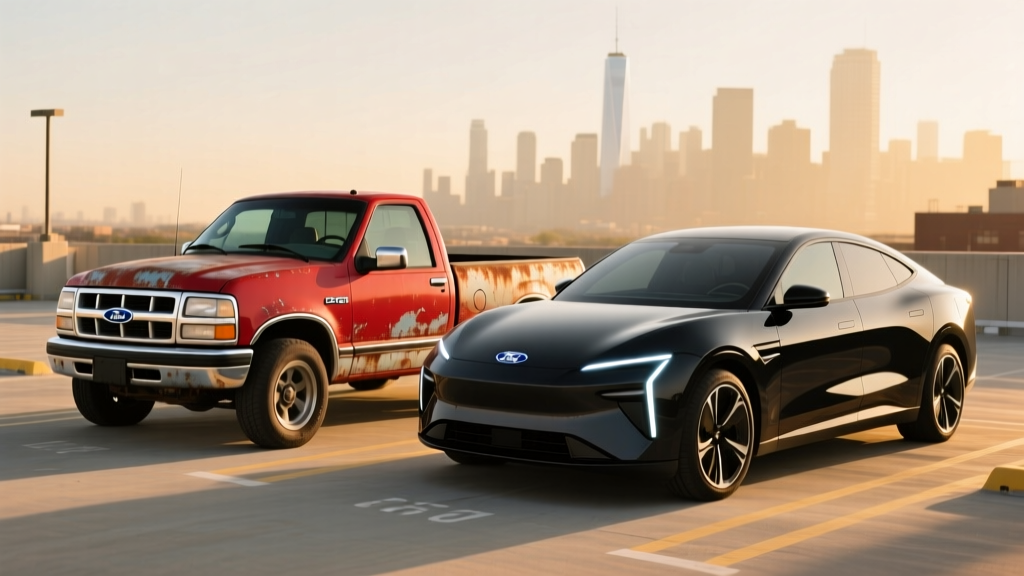
If you've been searching for 1999 F-150 SVT Lightning specs, history, or wondering how Ford's original performance truck stacks up against the modern electric F-150 Lightning, you've landed in the right place. The 1999 SVT Lightning was a watershed moment in American trucks — a supercharged, street-performance pickup that had no business being as fast as it was. More than two decades later, Ford revived the Lightning nameplate for an all-electric full-size pickup. This profile covers what made the 1999 original iconic, then puts it head-to-head with the current-generation EV Lightning on the metrics that matter to today's truck buyers.
The 1999 F-150 SVT Lightning: Original Specs and Legacy
Built by Ford's Special Vehicle Team (SVT), the 1999 F-150 SVT Lightning debuted as a 2000-model-year truck (though development and early press coverage ran through 1999). It was the spiritual successor to the first-generation Lightning (1993–1995) and far more aggressive in its execution.
| Spec | Value |
|---|---|
| Engine | 5.4L supercharged Triton V8 |
| Horsepower | 360 hp @ 4,750 rpm (later bumped to 380 hp for 2001–2004) |
| Torque | 440 lb-ft @ 2,500 rpm |
| 0–60 mph | ~5.8 seconds (Motor Trend tested) |
| Drivetrain | RWD, 4-speed automatic (4R100) |
| Curb Weight | ~4,670 lbs |
| Fuel Economy (EPA) | 12 city / 16 highway / 14 combined mpg |
| Bed Length | 6.5 ft (Flareside, step-side) |
| Towing Capacity | ~5,000 lbs (conventional) |
| Original MSRP | ~$30,835 (2000 model year) |
The supercharged 5.4L V8, built in partnership with Eaton (roots-type supercharger), gave the Lightning a raw, visceral character that no modern turbo-six or electric motor fully replicates in feel — though the numbers tell a different story. The Lightning was only available in a regular-cab, short-bed, step-side configuration, making it a pure performance toy rather than a workhorse. Only three colors were offered initially: Black, White, and Red.
Why the 1999 SVT Lightning Still Matters
The 1999-era SVT Lightning proved that a full-size American pickup could challenge sports cars at stoplights. It ran the quarter-mile in roughly 14.3 seconds at ~98 mph — numbers that embarrassed many V8 muscle cars of the era. Today, clean examples trade in the $25,000–$50,000+ collector market depending on mileage and condition, with the later 2003–2004 models (380 hp, 470 lb-ft) commanding premiums.
The Modern Ford F-150 Lightning EV: 2025 Specs at a Glance
Fast-forward to the current-generation Ford F-150 Lightning — an all-electric, four-door, full-size crew cab that carries the Lightning name into the battery-electric era. Below are the key specs for the 2025 model year.
| Attribute | Standard Range | Extended Range |
|---|---|---|
| EPA Range | 240 miles | 320 miles |
| Battery Capacity | 98 kWh usable (LFP) | 131 kWh usable (NMC) |
| Drivetrain | Dual-motor AWD | Dual-motor AWD |
| Horsepower | 452 hp | 580 hp |
| Torque | 775 lb-ft | 775 lb-ft |
| 0–60 mph | ~4.5 seconds | ~3.8 seconds |
| Max DC Fast Charge | 120 kW | 150 kW |
| 10–80% DC Charge Time | ~44 minutes | ~41 minutes |
| Level 2 Home Charge Rate | 11.3 kW (~23 mi/hr) | 19.2 kW (~36 mi/hr) |
| MPGe (Combined) | 68 MPGe | 70 MPGe |
| Max Towing | 7,700 lbs | 10,000 lbs |
| Payload | 2,235 lbs | 1,952 lbs |
| Frunk Volume | 14.1 cu ft | 14.1 cu ft |
| Bed Length | 5.5 ft | 5.5 ft |
| Rear Legroom | 43.6 in | 43.6 in |
| Battery/Powertrain Warranty | 8 years / 100,000 miles (70% capacity retention) | |
Real-World Range: What to Actually Expect
The EPA rates the Extended Range F-150 Lightning at 320 miles. In real-world highway driving at 70–75 mph, expect roughly 250–280 miles before needing to charge. In cold weather (below 32°F), range can drop an additional 20–30%, bringing effective winter highway range to 180–220 miles. The Standard Range model's 240-mile EPA figure translates to roughly 190–210 miles highway in fair weather and 150–175 miles in deep cold. Towing cuts range dramatically — expect a 40–55% reduction when pulling a loaded trailer.
Head-to-Head: 1999 SVT Lightning vs. 2025 EV Lightning
| Metric | 1999 SVT Lightning | 2025 EV Lightning (ER) |
|---|---|---|
| Powertrain | 5.4L supercharged V8, RWD | Dual-motor AWD, 131 kWh NMC |
| Horsepower | 360 hp | 580 hp |
| Torque | 440 lb-ft | 775 lb-ft |
| 0–60 mph | ~5.8 sec | ~3.8 sec |
| Range / Fuel Economy | 14 mpg combined (~280 mi on 20-gal tank) | 320 mi EPA (70 MPGe) |
| Energy/Fuel Cost per Mile | ~$0.24/mi (at $3.40/gal) | ~$0.06–$0.10/mi (home charging) |
| Cab / Doors | Regular cab, 2-door | SuperCrew, 4-door, 5-passenger |
| Towing Capacity | ~5,000 lbs | 10,000 lbs |
| Bed | 6.5 ft step-side | 5.5 ft + 14.1 cu ft frunk |
The EV Lightning is objectively the more capable truck: more power, more torque, faster to 60, higher towing, four full doors, and far lower per-mile operating cost. But the 1999 SVT Lightning offers something the EV cannot — analog character, supercharger whine, a live rear axle, and collector-car appreciation potential. They serve fundamentally different use cases.
Charging the F-150 Lightning: Speeds, Connectors, and Costs
Charging speed is a top concern for any EV truck buyer, especially one considering road trips or towing. Here's what the current F-150 Lightning delivers across charging levels.
| Level | Power (kW) | Miles Added per Hour | Connector | Typical Use |
|---|---|---|---|---|
| Level 1 (120V) | ~1.4 kW | ~2–3 mi/hr | NACS (Tesla plug, 2025+) | Emergency/trickle |
| Level 2 (240V home) | 11.3–19.2 kW | 23–36 mi/hr | NACS | Daily overnight charging |
| DC Fast Charge | 120–150 kW peak | ~150–230 mi/hr (peak) | NACS (Supercharger/CCS adapter) | Road trips |
Important nuance on the charge curve: The Extended Range Lightning peaks at 150 kW only between roughly 10–30% state of charge, then tapers progressively. By 60% SoC you're seeing ~90 kW, and above 80% it drops below 40 kW. That's why the 10–80% time is ~41 minutes — not the ~25 minutes you'd calculate from peak rate alone. Plan road-trip stops accordingly: it's faster to charge from 10–70% and go than to wait for 80%+.
Starting with the 2025 model year, Ford has adopted the NACS (North American Charging Standard) connector natively, giving the Lightning direct access to Tesla's Supercharger network — the most reliable DC fast-charging infrastructure in the U.S. For legacy CCS stations, Ford provides an adapter.
Home Charging Setup and Cost
To unlock the Extended Range model's full 19.2 kW Level 2 rate, you'll need a Ford Charge Station Pro (~$800–$1,200 for equipment) hardwired to a dedicated 100-amp circuit. Most homes require a panel upgrade (to 200A service) and professional installation, which runs $2,000–$5,000+ total depending on your electrical panel's current capacity and the run distance. A standard 48-amp Level 2 charger on a 60-amp circuit delivers ~11.5 kW — sufficient for most overnight needs and significantly cheaper to install. Always consult a licensed electrician for your specific setup.
Pricing, Trims, and Federal Tax Credit Eligibility
The 2025 F-150 Lightning is available in several trims. Pricing has shifted since the truck's 2022 launch, and federal tax credit eligibility depends on several factors under IRS §30D rules.
| Trim | Battery | Base MSRP | Est. After §30D Credit* |
|---|---|---|---|
| Pro (Standard Range) | 98 kWh LFP | ~$55,000 | ~$47,500 |
| XLT (Standard Range) | 98 kWh LFP | ~$60,000 | ~$52,500 |
| Lariat (Extended Range) | 131 kWh NMC | ~$72,000 | ~$64,500 |
| Platinum (Extended Range) | 131 kWh NMC | ~$85,000 | ~$77,500 |
*Tax credit estimates assume full $7,500 eligibility. Actual credit depends on your individual situation.
Federal EV Tax Credit (§30D) — Key Requirements
- MSRP Cap: Trucks/vans/SUVs must have an MSRP ≤ $80,000. The Lightning Platinum may exceed this depending on options — verify the specific build.
- Buyer Income Cap: Modified AGI must not exceed $150,000 (single), $225,000 (head of household), or $300,000 (joint filers).
- Battery Sourcing: Critical minerals and battery components must meet escalating domestic-content thresholds that tighten annually through 2030. Ford has worked to localize Lightning battery supply, but eligibility can shift — confirm at purchase.
- Point-of-Sale Transfer: As of 2024, eligible buyers can transfer the credit to the dealer for an immediate price reduction at purchase rather than waiting to claim it on their tax return.
Always verify current eligibility at fueleconomy.gov and consult a tax professional before relying on the credit.
Who Should Buy the F-150 Lightning (and Who Shouldn't)
Choose the F-150 Lightning If:
- You need a full-size crew-cab truck for family duty and weekend towing (up to 10,000 lbs)
- You have reliable home Level 2 charging and a daily commute under ~150 miles round-trip
- You want the lowest per-mile operating cost in a full-size truck (~$0.07/mi vs. ~$0.24/mi for gas)
- You value the 14.1 cu ft front trunk (frunk) for secure, weatherproof cargo
- You want Pro Power Onboard (up to 9.6 kW of 120V/240V output) for job-site power or tailgating
Look Elsewhere If:
- You regularly tow heavy loads over long distances — towing slashes range by 40–55%
- You live in an apartment or lack access to home/workplace charging
- You frequently drive in extreme cold with no garage — winter range loss is significant
- You want a compact bed for tight urban parking (the Lightning is 232+ inches long)
Standout Tech and Notable Drawbacks
Standout features:
- Pro Power Onboard: Available 9.6 kW system with 120V and 240V outlets in the bed and frunk — enough to run power tools, a welder, or your entire tailgate setup.
- Ford BlueCruise: Hands-free highway driving on pre-mapped divided highways. This is an SAE Level 2 driver-assistance system — you must remain attentive and eyes on the road at all times. It is not self-driving.
- SYNC 4A infotainment: 12-inch touchscreen (15.5-inch on Platinum) with wireless Apple CarPlay/Android Auto, over-the-air updates, and integrated navigation with real-time charge-station routing.
- Intelligent Backup Power: With the Ford Home Integration System, the Lightning can power your home during an outage (up to 9.6 kW), functioning as a backup generator.
Notable drawbacks:
- Towing range penalty: Pulling a 7,000-lb trailer at highway speeds can cut range to ~150–180 miles, making long-distance towing impractical without frequent stops.
- Charging speed vs. rivals: At 150 kW peak, the Lightning charges slower than the Rivian R1T (200+ kW) or GM Silverado EV (350 kW peak on certain trims).
- Weight: At ~6,500–6,800 lbs curb weight, the Lightning consumes tires faster than a gas F-150 and is harder on road surfaces.
- Insurance costs: EV truck insurance premiums run 15–25% higher than comparable gas trucks, per industry data.
Pros and Cons at a Glance
Pros
- 580 hp / 775 lb-ft in Extended Range — faster than the original SVT Lightning
- 14.1 cu ft frunk adds massive secure storage
- Pro Power Onboard turns the truck into a mobile generator
- Home backup power capability (V2H)
- NACS connector = direct Tesla Supercharger access (2025+)
- Low operating cost (~$0.07/mi at home)
- Smooth, quiet, instant torque — no turbo lag
Cons
- Towing range drops 40–55% — a real limitation
- 150 kW peak DC charge rate trails some rivals
- Heavy curb weight accelerates tire wear
- Higher insurance premiums than gas F-150
- Platinum trim may exceed $80K MSRP tax-credit cap
- Cold-weather range loss is significant (20–30%)
- 5.5 ft bed is shorter than the original SVT's 6.5 ft
Frequently Asked Questions
What is the real-world range of the F-150 Lightning?
The Extended Range model is EPA-rated at 320 miles, but expect roughly 250–280 miles in real-world highway driving and 180–220 miles in cold weather. The Standard Range model's 240-mile EPA rating translates to ~190–210 miles highway in fair conditions. Towing cuts range by roughly half.
How fast does the F-150 Lightning charge?
On a DC fast charger, the Extended Range model peaks at 150 kW and charges from 10–80% in approximately 41 minutes. At home on a Level 2 charger, the Extended Range model adds up to 36 miles of range per hour (19.2 kW), fully recharging overnight in about 8 hours. The Standard Range model charges at up to 120 kW DC and 11.3 kW Level 2.
How much does the F-150 Lightning cost after tax credits?
With the full $7,500 federal tax credit, the Pro trim starts around $47,500 and the Lariat Extended Range drops to roughly $64,500. However, eligibility depends on your income (≤$300,000 joint), the truck's MSRP (≤$80,000 for trucks), and battery-sourcing requirements. Always verify at fueleconomy.gov and with your tax professional.
Is the F-150 Lightning worth buying vs. the Rivian R1T or Chevy Silverado EV?
The Lightning wins on value (lower starting price), frunk space, and home backup power capability. The Rivian R1T offers superior off-road capability, faster charging (200+ kW), and a quad-motor option but starts at a higher price and is a mid-size truck. The Chevy Silverado EV boasts 350 kW peak charging and up to 400 miles of range (on certain trims) but is newer with less proven reliability. For a full-size work/family truck at the best price point, the Lightning remains the default choice.
Does the F-150 Lightning qualify for the federal EV tax credit?
Most Lightning trims qualify for the full $7,500 under current IRS §30D rules, provided you meet income caps and the specific vehicle build satisfies battery-sourcing requirements. The Platinum trim may push past the $80,000 MSRP cap with options. Check the specific VIN at fueleconomy.gov before purchasing.
Can I still buy a 1999 F-150 SVT Lightning?
The 1999 SVT Lightning is long out of production and only available on the used/collector market. Clean, low-mileage examples (under 50,000 miles) typically trade between $30,000 and $50,000+, with later 2003–2004 models (380 hp) commanding even higher prices. It's a collector vehicle, not a daily-driver proposition — parts are getting scarce, fuel economy is dismal, and it lacks modern safety features.
What's the battery warranty on the F-150 Lightning?
Ford covers the Lightning's high-voltage battery and electric powertrain for 8 years or 100,000 miles, whichever comes first. The warranty guarantees the battery will retain at least 70% of its original capacity during that period. If degradation exceeds 30% within the warranty window, Ford will repair or replace the battery at no cost.
The 1999 F-150 SVT Lightning and today's F-150 Lightning EV share a name and a mission — proving that a full-size truck doesn't have to be slow. The original did it with a supercharger and a live axle; the modern version does it with dual electric motors and a 131 kWh battery. One is a rising collector icon. The other is a genuinely practical daily-driver truck that happens to hit 60 mph in under four seconds. Which one you want depends entirely on whether you're chasing nostalgia or utility — and whether you have a 240-volt outlet in your garage.