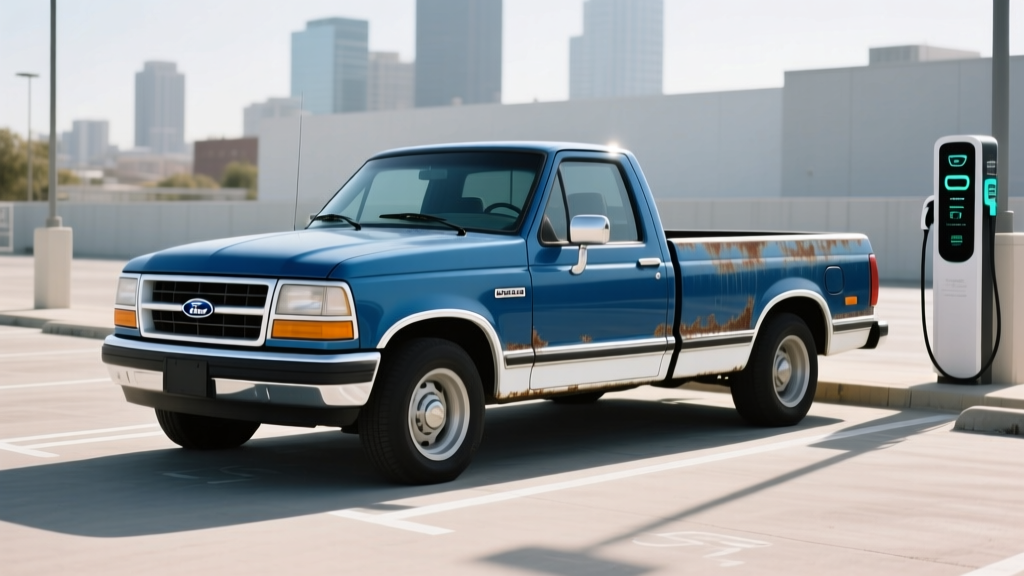
If you've been searching for 1995 Ford F-150 Lightning information, you might be surprised to learn that Ford's first electric pickup predates the modern EV era by decades. Long before the 2022 F-150 Lightning became a headline-grabbing, 580-horsepower dual-motor beast, Ford built a small fleet of electric F-150s in the mid-1990s to comply with California's Zero Emission Vehicle (ZEV) mandate. This is the story of that truck — its real specs, its severe limitations, and why it matters to anyone evaluating today's electric pickups.
To be clear upfront: the 1995 F-150 Lightning EV is not a vehicle you can walk into a dealership and buy new. It was a limited-production compliance and fleet vehicle, with roughly 1,500 units produced between 1994 and 1998. Most were leased to utilities and government fleets. But understanding what Ford achieved — and where it fell short — provides essential context for anyone comparing modern electric trucks like the current F-150 Lightning, Rivian R1T, or Chevrolet Silverado EV.
What Was the 1995 Ford F-150 Lightning EV?
The 1995 Ford F-150 Lightning EV was Ford's response to California Air Resources Board (CARB) regulations that required automakers to sell a percentage of zero-emission vehicles. Based on the F-150 short-bed regular-cab platform, Ford replaced the internal combustion engine with an electric motor and packed the truck bed with batteries.
Two battery chemistries were offered during the production run:
- Lead-acid (1994–1996): The initial configuration used a bank of lead-acid batteries providing approximately 27 kWh of usable capacity. Range was severely limited — roughly 50 to 65 miles depending on driving conditions.
- Nickel-metal hydride / NiMH (1996–1998): Ford later upgraded to NiMH battery packs, increasing capacity to roughly 35–40 kWh usable. This pushed the range to approximately 100–130 miles under ideal conditions — a significant improvement, but still modest by any modern standard.
| Specification | Lead-Acid (1994–96) | NiMH (1996–98) |
|---|---|---|
| Battery Chemistry | Lead-Acid | Nickel-Metal Hydride |
| Battery Capacity (usable) | ~27 kWh | ~35–40 kWh |
| EPA-Equivalent Range | ~50–65 miles | ~100–130 miles |
| Motor Power | ~60 kW (~80 hp) | ~85 kW (~114 hp) |
| Drivetrain | Rear-Wheel Drive (RWD) | Rear-Wheel Drive (RWD) |
| 0–60 mph | ~20+ seconds | ~15–18 seconds |
| Top Speed | ~75 mph | ~80 mph |
| DC Fast Charging | Not available | Not available |
| Level 2 (240V) Charge Time | ~8–10 hours (full) | ~6–8 hours (full) |
| Level 1 (120V) Charge Time | ~16–20 hours (full) | ~14–18 hours (full) |
| Payload Capacity | ~700 lbs (reduced by battery weight) | ~800 lbs |
| Curb Weight | ~5,800 lbs | ~5,600 lbs |
| Units Produced | ~1,500 total (1994–1998) | |
Real-World Range: What Owners Actually Experienced
Sticker range (NiMH): ~100–130 miles under ideal, low-speed city conditions.
Real-world range: Expect roughly 60–80 miles at highway speeds (55–65 mph) in moderate temperatures. In cold weather (below 40°F), range dropped by 30–40%, often to 40–55 miles.
The EPA did not rate EVs with the same standardized methodology in 1995 that it uses today, so these range figures are derived from fleet-operator reports, contemporary automotive press testing, and Ford's own published data. The lead-acid variant was particularly range-limited, making it viable only for short urban utility routes — think meter-reader trucks or campus maintenance vehicles.
Highway driving was the biggest enemy. The truck's aerodynamics (essentially a brick-shaped regular-cab F-150 with a tall bed cap) and heavy weight (~5,600–5,800 lbs) meant efficiency collapsed above 50 mph. Fleet operators quickly learned that the NiMH truck was best kept on routes under 60 miles round-trip with access to overnight Level 2 charging.
Cold weather was devastating. NiMH batteries, unlike today's thermally managed lithium-ion packs, had no active heating system. Below freezing, capacity loss of 30–40% was routine. This is a critical contrast to modern EVs: today's F-150 Lightning uses a liquid-cooled and heated lithium-ion pack with heat-pump HVAC, limiting cold-weather range loss to roughly 15–25%.
Charging: Level 1 and Level 2 Only — No DC Fast Charging
The 1995 F-150 Lightning EV had no DC fast-charging capability. The DCFC standards we know today (CCS, CHAdeMO, NACS) did not exist. Charging was limited to:
- Level 1 (120V household outlet): Approximately 1.4 kW charge rate. A full charge from empty took 14–20 hours depending on battery chemistry.
- Level 2 (240V): Using early inductive paddle chargers (Magne Charge / SAE J1773) or later conductive connectors, the truck accepted roughly 3.3–6.6 kW. A full charge took 6–10 hours.
For context, the 2026 F-150 Lightning accepts up to 150 kW on DC fast charging (extended-range battery), adding roughly 100 miles of range in 15 minutes and achieving a 10–80% charge in approximately 36 minutes. The generational leap in charging infrastructure and vehicle charge acceptance is staggering.
The 1995 truck's charging setup also predated standardized connectors. Ford used the Hughes/Magne Charge inductive paddle in some markets — a large, heavy paddle inserted into a slot on the vehicle. This system was eventually abandoned in favor of conductive connectors that evolved into today's J1772 (Level 2) and CCS/NACS (DC fast charge) standards.
Performance and Driving Impressions
By modern EV standards, the 1995 F-150 Lightning EV was slow. The lead-acid version produced roughly 60 kW (80 hp) and took over 20 seconds to reach 60 mph — leisurely even by 1990s truck standards. The NiMH upgrade brought output to approximately 85 kW (114 hp) and dropped 0–60 times to the 15–18 second range, which was more respectable but still far behind the 4.0–4.5 second times of today's dual-motor electric trucks.
What the truck did offer was instant torque at zero RPM — a characteristic that impressed drivers at the time and foreshadowed one of the key selling points of modern EVs. The electric motor's flat torque curve made the truck feel surprisingly responsive from stoplights and in low-speed urban driving, even if top-end acceleration was lacking.
The drivetrain was rear-wheel drive only, with a single-speed reduction gear (no multi-speed transmission). Regenerative braking was present but rudimentary compared to today's one-pedal driving systems — it provided mild deceleration but couldn't bring the truck to a full stop without using the friction brakes.
How It Compares to the 2026 F-150 Lightning
The contrast between 1995 and today illustrates three decades of battery and powertrain advancement. Here's a direct comparison with the current-generation F-150 Lightning (2025/2026 model year):
| Spec | 1995 F-150 Lightning EV (NiMH) | 2026 F-150 Lightning (Extended Range) |
|---|---|---|
| Battery Chemistry | NiMH | Lithium-Ion (NMC) |
| Battery Capacity | ~35–40 kWh | 131 kWh usable |
| EPA Range | ~100–130 mi | 320 mi |
| Horsepower | ~114 hp | 580 hp |
| Torque | ~200 lb-ft | 775 lb-ft |
| 0–60 mph | ~15–18 sec | ~3.8 sec |
| Drivetrain | RWD | Dual-Motor AWD |
| Max DC Fast Charge | None | 150 kW |
| 10–80% DC Charge | N/A | ~36 min |
| Level 2 Home Charge | ~3.3–6.6 kW | 11.5 kW (48A) |
| Towing Capacity | ~2,000 lbs (limited) | 10,000 lbs |
| Base MSRP | Fleet lease only (~$50,000 equiv.) | $54,995 (Lariat) |
| Efficiency | ~2.5–3.0 kWh/mi | ~2.0–2.3 kWh/mi (varies by trim) |
| Thermal Management | Passive (none) | Active liquid cooling + heat pump |
| Warranty (Battery) | Limited fleet warranty | 8 yr / 100,000 mi |
The data makes the advancement obvious: today's Lightning has roughly 3× the battery capacity, 5× the horsepower, 3× the range, and can tow five times the load — while charging in a fraction of the time and offering a full modern infotainment and driver-assist suite. Source: Ford F-150 Lightning official specs.
The 1995 Lightning's Legacy: What It Got Right
Despite its severe limitations, the 1995 F-150 Lightning EV validated several concepts that define today's electric truck market:
- Instant torque is ideal for trucks. Even with just ~200 lb-ft, the electric motor's zero-RPM torque delivery made the truck feel capable for low-speed hauling — a characteristic Ford now markets aggressively with the modern Lightning's 775 lb-ft.
- Fleet operators will adopt electric trucks for predictable routes. Utility companies and government fleets were the 1995 Lightning's primary users, mirroring today's early commercial EV truck adoption by companies like Amazon, FedEx, and municipal governments.
- Battery chemistry is the bottleneck. The jump from lead-acid to NiMH roughly doubled the truck's range. The subsequent leap to lithium-ion (and now LFP variants) has continued that trajectory, with energy density improving roughly 5–7% annually.
- Charging infrastructure must evolve with the vehicle. The 1995 truck's reliance on slow, proprietary charging connectors highlighted the need for standardized, fast public charging — a lesson still being applied today as the industry consolidates around NACS.
Should You Buy a 1995 F-150 Lightning EV Today?
The short answer: almost certainly not, unless you are a collector or museum.
Surviving examples are extremely rare. Most were crushed or recycled after their fleet leases expired. The NiMH and lead-acid batteries in any remaining units are almost certainly degraded to a fraction of their original capacity — replacement parts are essentially unavailable, and the battery packs are not compatible with any modern lithium-ion swap.
If you're interested in an electric Ford truck, the 2026 F-150 Lightning on fueleconomy.gov offers 320 miles of EPA range, 150 kW DC fast charging, a modern 8-year/100,000-mile battery warranty, and a starting MSRP around $54,995 — potentially eligible for up to $7,500 in federal tax credits under IRS §30D rules (subject to MSRP caps, buyer income limits, and battery component/critical mineral sourcing requirements).
Frequently Asked Questions
What was the real-world range of the 1995 Ford F-150 Lightning EV?
The NiMH-equipped version (1996–1998) achieved roughly 60–80 real-world miles at highway speeds and 100–130 miles in low-speed city driving. The earlier lead-acid version managed just 35–50 miles in real-world use. Cold weather reduced range by 30–40%.
How fast did the 1995 F-150 Lightning EV charge?
There was no DC fast charging. On a 240V Level 2 charger, a full charge took 6–10 hours. On a standard 120V outlet, it took 14–20 hours. For comparison, the 2026 F-150 Lightning charges from 10–80% in ~36 minutes at 150 kW on a DC fast charger.
How many 1995 F-150 Lightning EVs were made?
Ford produced approximately 1,500 electric F-150s between 1994 and 1998 across both battery chemistries. Most were leased to fleet operators and were not available to retail consumers.
Did the 1995 F-150 Lightning EV qualify for any tax incentives?
The federal EV tax credit as we know it (§30D) did not exist in 1995. Some early state-level incentives and fleet grants were available, but the modern $7,500 federal credit with income and MSRP caps was established decades later.
Is the 1995 F-150 Lightning EV related to the modern F-150 Lightning?
Only in name and spirit. The modern F-150 Lightning (introduced for the 2022 model year) is an entirely new ground-up electric platform with lithium-ion batteries, dual motors, and modern electronics. Ford chose the "Lightning" name to evoke the performance heritage, including the gas-powered F-150 Lightning of 1993–1995 (a high-performance V8 truck) and the earlier EV variant.
Can I still buy or find a 1995 F-150 Lightning EV?
Surviving examples are exceptionally rare. A handful exist in museums (such as The Henry Ford museum in Dearborn, Michigan) and private collections. They are not practical daily drivers due to degraded batteries, lack of parts support, and no fast-charging capability.
Key Takeaways for Today's EV Truck Buyers
The 1995 Ford F-150 Lightning EV is a fascinating artifact of early electric vehicle development — proof that the core appeal of electric trucks (instant torque, zero tailpipe emissions, low operating costs) was understood decades ago, even if the battery technology wasn't ready. For today's shoppers, the lesson is clear: battery chemistry, thermal management, and charging infrastructure have advanced to the point where a modern electric truck like the F-150 Lightning, Rivian R1T, or Chevrolet Silverado EV can serve as a genuine daily driver and work truck — something the 1995 original could only dream of.