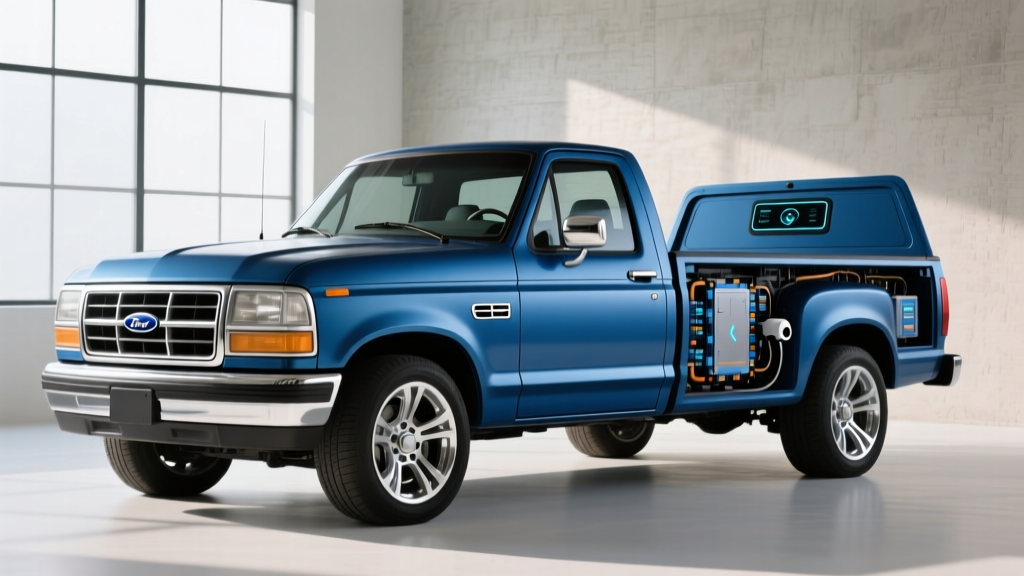
The original 1993–1995 Ford F-150 SVT Lightning was a street-performance truck built around a 5.8L V8 and a solid rear axle — a legend of the OBS (Old Body Style) era. But when enthusiasts search for a 1995 F150 Lightning in 2026, many aren't hunting for a carbureted relic. They're asking a different question: what would it take to build an electric one?
This isn't a factory vehicle. Ford never produced an electric F-150 in the 1990s, and the current F-150 Lightning (2022–present) shares nothing but a nameplate with the SVT original. What follows is a data-driven teardown of the EV-swap concept applied to the 1995 F-150 platform — battery options, realistic range, charging architecture, cost, and whether the math works against modern production EV trucks.
Why the 1995 F-150 Lightning Is the Ultimate EV-Swap Candidate
The ninth-generation F-150 (1992–1996) has three traits that make it attractive for electric conversion:
- Simple, spacious chassis. The ladder frame and flat floorpan offer generous room for battery enclosures without cutting structural members.
- Lightweight by truck standards. A regular-cab 1995 F-150 short-bed weighs roughly 4,100–4,400 lbs curb — nearly 1,500 lbs lighter than a 2025 F-150 Lightning. Less mass means more range per kWh.
- Cult status. The SVT Lightning and OBS trucks command $15,000–$45,000+ in the collector market, justifying the investment of a conversion for enthusiasts who want a daily-drivable classic.
Several high-profile shops — including EV West, Zelectric Motors, and smaller outfits — have completed OBS Ford truck conversions, proving the platform's viability. But "viable" doesn't mean "easy" or "cheap." Let's look at the numbers.
Battery, Range, and Efficiency: Realistic Numbers for a 1995 F-150 EV Build
Most 1995 F-150 EV conversions use salvaged or crate battery packs from Tesla Model S/X modules, Chevrolet Bolt modules, or Ford Mustang Mach-E packs. The chemistry is almost universally NMC (nickel manganese cobalt), which offers higher energy density than LFP but requires more careful thermal management and carries a lower cycle-life ceiling (~1,500–2,000 full cycles vs. LFP's 3,000+).
| Specification | Common Build Target |
|---|---|
| Battery Capacity (usable) | 60–85 kWh (NMC) |
| EPA-Equivalent Range (est.) | 140–210 mi (depending on pack size & aero) |
| Efficiency | 2.8–3.5 kWh/mi (35–28 kWh/100mi) |
| Motor Output | 250–450 HP (single or dual motor) |
| 0–60 mph | 4.5–7.0 sec (depending on motor config) |
| Drivetrain | RWD (most common) or AWD (dual-motor) |
| Curb Weight (post-conversion) | 4,800–5,500 lbs |
| Cargo Bed Length | 6.5 ft (short bed) / 8.0 ft (long bed) |
| Cab Passenger Capacity | 2–3 (regular cab) / 5–6 (extended cab) |
There is no EPA certification for a one-off conversion. However, based on completed builds and the truck's 0.45–0.50 Cd drag coefficient: a 75 kWh usable pack typically yields ~170 miles at 65 mph on a flat highway. Expect 130–140 miles in cold weather (below 35°F) due to cabin heating loads and increased battery internal resistance. City driving with regenerative braking can stretch range to 190–210 miles. These figures assume a single-motor RWD setup; dual-motor AWD builds consume roughly 10–15% more energy.
For context, the 2025 Ford F-150 Lightning Extended Range achieves an EPA-estimated 320 miles from a 131 kWh usable pack. The OBS truck will never match that — but it doesn't need to for most enthusiast use cases.
Charging Architecture: DC Fast Charge and Home Level 2
Charging is where EV-swap builds diverge most sharply from production vehicles. A 1995 F-150 conversion doesn't come with a factory-integrated charge controller, so the builder must select and integrate components.
| Charge Level | Equipment | Power (kW) | Rate (mi/hr added) | Notes |
|---|---|---|---|---|
| Level 1 (120V) | OEM-style EVSE | 1.4 kW | ~4 mi/hr | Emergency/trickle only |
| Level 2 (240V) | Aftermarket OBC (6.6–11.5 kW) | 6.6–11.5 kW | 18–32 mi/hr | Requires onboard charger integration |
| DC Fast Charge | CCS or NACS inlet + compatible BMS | 50–150 kW peak | ~120–280 mi/hr (at peak) | 10–80% in ~35–55 min (varies widely) |
The DC fast-charge challenge: Integrating CCS or NACS DC charging requires a BMS (Battery Management System) that can communicate with the charger via CAN bus protocol. Most conversion shops use an Orion BMS 2 or a Tesla-derived BMS with a CCS adapter module. Not all builds support DC fast charging — some budget conversions are Level 2 only, which limits the truck to home and destination charging.
If DC fast charging is included, expect a 10–80% session to take 35–55 minutes on a 150 kW station, constrained by the pack's C-rate (most salvaged NMC modules safely accept 1.0–1.5C charge rates, meaning a 75 kWh pack peaks around 75–112 kW). Above 80% SoC, charging tapers sharply to protect cell longevity — a universal trait of lithium-ion chemistry, not unique to conversions.
For home Level 2 charging, most builders install a 48A wall connector on a 60A dedicated circuit, delivering ~11.5 kW. This adds roughly 28–32 miles of range per hour and fully replenishes a 75 kWh pack in about 7 hours — sufficient for overnight charging. A licensed electrician should verify your panel has capacity; a 200A service panel is typically required, with installation costs ranging from $800–$2,500 depending on conduit run length.
Performance and Drivetrain: What the Electric Swap Delivers
The original 1995 SVT Lightning produced 240 HP and 340 lb-ft of torque from its 5.8L Windsor V8, hitting 0–60 mph in approximately 7.2 seconds. An EV conversion typically surpasses these figures substantially:
- Single-motor RWD (Tesla large drive unit): ~350 HP, 0–60 in 5.5–6.5 seconds
- Dual-motor AWD (Tesla front + rear): ~450+ HP, 0–60 in 4.0–5.0 seconds
- NetGain Hyper9 or similar AC motor: ~200–250 HP, 0–60 in 7.0–8.5 seconds (budget builds)
Instant torque delivery is the defining characteristic. Even a modest 250 HP EV-swap F-150 will feel substantially quicker off the line than the original V8, because peak torque arrives at 0 RPM. The tradeoff is top-end performance — most conversion motors are single-speed (no transmission), limiting top speed to 100–120 mph.
Towing and payload: The 1995 F-150's frame was rated for ~1,800 lbs payload and up to 7,500 lbs towing (with proper equipment). An EV conversion adds 600–1,000 lbs of battery and motor mass, reducing usable payload. Towing is technically possible but range drops dramatically — expect a 40–55% range reduction when towing a 4,000-lb trailer. This is physics, not a flaw: moving 9,000+ lbs of combined vehicle and trailer requires substantially more energy.
Cost Breakdown: Building vs. Buying a Production EV Truck
This is where the 1995 F-150 Lightning EV swap faces its hardest question. A quality conversion isn't cheap.
| Item | Estimated Cost |
|---|---|
| Donor 1995 F-150 (clean title, good condition) | $8,000–$25,000 |
| Battery pack (60–85 kWh, NMC, salvaged/crate) | $8,000–$18,000 |
| Motor + inverter (Tesla DU or equivalent) | $3,000–$8,000 |
| BMS, charger, DC-DC converter, wiring | $3,500–$7,000 |
| Fabrication, mounts, cooling, enclosure | $5,000–$15,000 |
| Labor (professional shop, 200–400 hours) | $20,000–$50,000 |
| Total conversion build | $47,500–$123,000 |
| 2025 F-150 Lightning XLT (MSRP) | ~$57,000 |
| 2025 Rivian R1T Dual-Motor (MSRP) | ~$75,000 |
A one-off 1995 F-150 EV conversion does not qualify for the IRS §30D Clean Vehicle Credit. The credit applies only to new vehicles from qualified manufacturers with VINs registered through the IRS portal, meeting MSRP caps ($80,000 for trucks), buyer income limits ($150K single / $300K joint), and battery-sourcing requirements. A custom conversion has no OEM certification path. Some states offer aftermarket conversion rebates (California's CVRP has historically included conversion incentives), but these are jurisdiction-specific — check your state's energy office for current programs.
Warranty, Safety, and Street Legality
There is no factory warranty on a conversion. The builder (or conversion shop) is responsible for the quality and safety of every weld, wire, and software parameter. Key considerations:
- Battery warranty: Salvaged packs carry zero warranty. New crate modules (e.g., from Thunderstruck Motors or similar suppliers) may include 1–3 year limited coverage.
- Safety systems: The 1995 F-150 has no airbags in early models (driver airbag became standard in 1994, passenger in 1997), no ABS on all trims, and no electronic stability control. You're driving a 30-year-old safety platform with modern powertrain speeds.
- Street legality: Most states allow EV conversions if the vehicle passes standard safety inspection and the builder properly documents the powertrain change with the DMV. California's BAR (Bureau of Automotive Repair) has a specific EV-conversion inspection pathway. Emissions testing is waived for EVs in all jurisdictions.
- Insurance: Specialty insurers like Hagerty and Grundy will cover converted classics, but expect agreed-value policies and premiums 20–40% higher than a stock 1995 F-150. Document every component with receipts and photos.
Who Should Build a 1995 F-150 Lightning EV — And Who Shouldn't
- Unique, head-turning classic with modern EV drivability
- Instant torque surpasses original SVT Lightning performance
- Zero tailpipe emissions, no smog checks
- Lower per-mile energy cost vs. gasoline (~$0.04–0.06/mi on home solar vs. $0.18–0.25/mi gas)
- Strong enthusiast community and parts support for OBS Fords
- $50K–$120K total investment, no federal tax credit
- 140–210 mile range — not a road-trip vehicle without planning
- No modern safety features (ADAS, crumple zones, curtain airbags)
- DC fast charging adds $3K–$8K and significant integration complexity
- Resale value is highly subjective — narrower buyer pool than production EVs
You're an enthusiast with a clean OBS truck, a $60K+ budget, and a clear-eyed understanding that this is a passion project — not a cost-saving alternative to a production F-150 Lightning. You want a weekend cruiser, car-show standout, or 40-mile commuter with vintage aesthetics and silent electric power.
Buy a Production EV Truck If:You need 300+ mile range, DC fast charging at every public station, a factory warranty, modern safety (AEB, blind-spot monitoring, lane-keep), and eligibility for the §30D tax credit. The 2025 F-150 Lightning, Rivian R1T, or Chevrolet Silverado EV delivers all of these with zero fabrication risk.
Frequently Asked Questions
What is the real-world range of a 1995 F-150 EV conversion?
With a 75 kWh usable NMC pack, expect approximately 170 miles at highway speeds (65 mph) and 190–210 miles in city driving with regenerative braking. Cold weather (below 35°F) reduces range by 20–30%, yielding 120–140 miles. These figures assume RWD with a single motor; AWD dual-motor builds consume 10–15% more energy.
How fast does a converted 1995 F-150 charge?
On a home Level 2 charger (11.5 kW, 48A), you'll add roughly 28–32 miles per hour, fully charging a 75 kWh pack in about 7 hours. DC fast charging (if integrated) peaks at 50–150 kW depending on the BMS and pack configuration, with a 10–80% session taking 35–55 minutes. Not all conversions include DC fast-charge capability.
Does a 1995 F-150 EV conversion qualify for the federal tax credit?
No. The IRS §30D Clean Vehicle Credit applies only to new vehicles from qualified manufacturers meeting MSRP, income, and battery-sourcing requirements. A custom conversion has no OEM certification path. Some state-level incentives may apply — consult your state energy office and a tax professional.
Is it worth building vs. buying a 2025 F-150 Lightning?
Not as a financial decision. A production F-150 Lightning offers 230–320 miles of EPA range, 150+ kW DC fast charging, full warranty, modern safety, and potential tax-credit eligibility — for $55K–$90K. The 1995 conversion is a passion project for enthusiasts who value the OBS aesthetic and don't need long-range capability.
What battery chemistry do most conversions use?
NMC (nickel manganese cobalt) is the standard choice, sourced from salvaged Tesla, Bolt, or Mach-E modules. NMC offers higher energy density than LFP, which matters in a truck with limited enclosure space. The tradeoff is lower cycle life (~1,500–2,000 cycles) and greater sensitivity to high-SoC storage and temperature extremes.
Can a converted 1995 F-150 tow?
Physically, yes — the frame and hitch can handle loads. But range drops 40–55% when towing a 4,000-lb trailer, reducing a 170-mile truck to roughly 80–100 miles. Towing with a conversion is viable for short, local hauls but impractical for longer trips without en-route charging (which itself is time-consuming at conversion charge rates).