Why Are People Searching for a 1994 Ford F-150 Lightning?
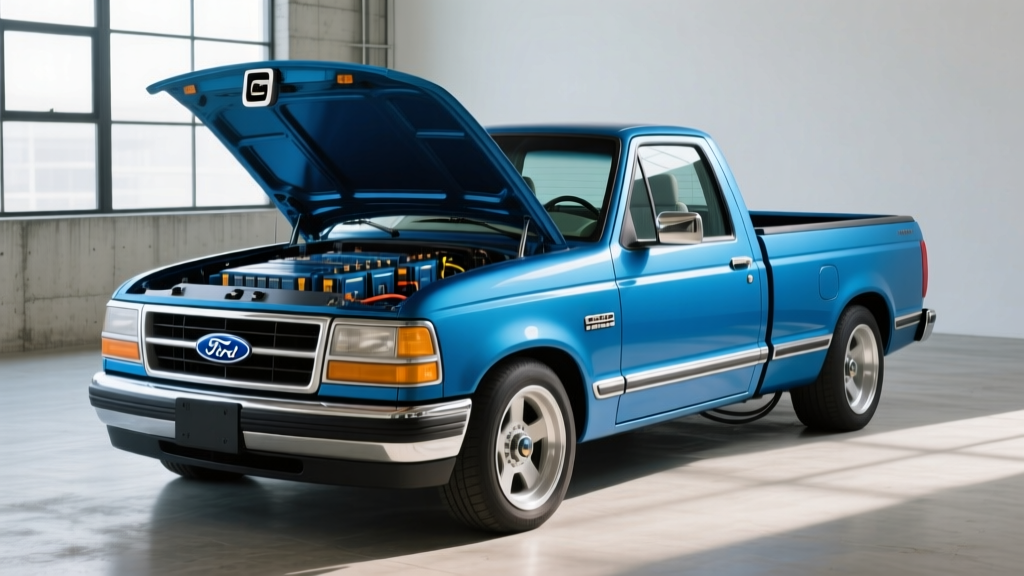
Type "1994 Ford F-150 Lightning" into any search bar and you'll find a curious corner of the internet: forum posts, YouTube thumbnails, and auction listings hinting at a battery-electric pickup from an era when most automakers were still debating fuel injection strategies. What you're looking at is not a mass-produced vehicle — it's one of the most obscure and fascinating prototypes in Ford's electrification history.
Between 1993 and 1998, Ford built a small fleet of electric F-150 pickups, sometimes referred to internally as the Ford Ecostar program vehicles and sometimes badged under the Lightning nameplate (which Ford officially used for its gas-powered SVT performance trucks). These were never offered for public sale. They were compliance-research vehicles, built in response to California's early Zero Emission Vehicle (ZEV) mandate — a regulation that required automakers to sell a percentage of zero-emission vehicles or face penalties.
If you've encountered a listing or reference to a "1994 Ford F-150 Lightning EV," you're almost certainly looking at either a prototype that escaped into private hands, a later conversion, or a misidentified SVT Lightning (the supercharged V8 gas truck Ford sold from 1993–1998 and again from 1999–2004). Let's sort out exactly what this vehicle was, what its specs actually looked like, and why it matters to anyone researching the lineage that leads to today's Ford F-150 Lightning.
What the 1994 Electric F-150 Actually Was
Ford's electric truck experiments in the mid-1990s were part of a broader industry response to California's 1990 ZEV mandate. GM built the EV1, Toyota fielded the RAV4 EV, and Ford developed several electric prototypes including the Ecostar van and an electric Ranger pickup (which later entered limited production as the 1998–2002 Ford Ranger EV).
The electric F-150 prototypes from this era were hand-built in very low numbers — estimates suggest fewer than two dozen were ever assembled. They used the body and chassis of the ninth-generation F-150 (the "OBS" or Old Body Style that ran from 1992–1997) but replaced the internal combustion drivetrain with an electric motor and a large, heavy battery pack.
Prototype Specs: What We Know About the Electric Drivetrain
Detailed factory documentation on the 1994 electric F-150 prototypes is sparse — Ford never published consumer-facing spec sheets because the vehicle was never intended for retail sale. However, based on period technical papers, fleet operator reports, and the closely related Ranger EV (which shared much of its drivetrain architecture), we can reconstruct the likely specifications.
| Specification | Estimated Value |
|---|---|
| Battery Chemistry | Lead-acid (flooded or AGM) |
| Battery Capacity | ~25–35 kWh (estimated usable) |
| Pack Weight | ~1,800–2,200 lbs |
| Motor Type | AC induction (single motor, RWD) |
| Motor Output | ~85–115 hp / ~150–200 lb-ft torque |
| 0–60 mph | Not officially published; estimated 18–25 seconds |
| Top Speed | ~70–75 mph (electronically limited) |
| EPA Range (estimated) | 40–60 miles |
| Charging | 120V AC Level 1 only; ~8–12 hours for full charge |
| DC Fast Charging | None (no standard existed) |
| Curb Weight | ~5,500–6,000 lbs (est.) |
| Public Availability | None — fleet/research only |
Battery Chemistry: Lead-Acid in a Pre-Lithium World
Lithium-ion batteries were not commercially viable for automotive use in 1994 — Sony had only begun mass-producing lithium-ion cells for camcorders and laptops in 1991, and the cost per kWh was astronomical. Ford, like GM with the EV1 and Toyota with the RAV4 EV, turned to lead-acid batteries. These were heavy, energy-dense by the standards of the time, and had a limited cycle life of roughly 300–500 deep discharge cycles before significant capacity loss.
The Ranger EV, which entered limited lease-only production in 1998, eventually upgraded to nickel-metal hydride (NiMH) batteries — a chemistry that offered roughly double the energy density of lead-acid. The 1994 F-150 prototypes predated this transition and almost certainly used lead-acid packs, which explains the punishing weight and limited range.
How the 1994 Prototype Compares to the 2024–2026 F-150 Lightning
The gap between Ford's 1994 electric truck experiment and the current-generation F-150 Lightning illustrates three decades of battery and powertrain evolution. The differences are staggering.
| Attribute | 1994 EV Prototype | 2025 F-150 Lightning (Lariat Ext. Range) |
|---|---|---|
| Battery Chemistry | Lead-acid | NMC lithium-ion |
| Usable Capacity | ~25–35 kWh | 131 kWh |
| EPA Range | ~40–60 mi (est.) | 320 mi |
| Horsepower | ~85–115 hp | 580 hp |
| 0–60 mph | ~18–25 sec | ~3.8 sec |
| DC Fast Charge | None | 150 kW peak (10–80% in ~41 min) |
| Level 2 Home Charging | None (120V only) | 19.2 kW / ~30 mi/hr |
| Drivetrain | Single motor, RWD | Dual motor, AWD |
| Max Towing | Minimal (heavy pack) | 7,700–10,000 lbs |
| MSRP | N/A (never sold) | $55,995–$96,874 |
| Federal Tax Credit | N/A | Up to $7,500 (§30D, rules apply) |
The 2025 F-150 Lightning's 131 kWh NMC extended-range pack holds roughly four to five times the energy of the 1994 prototype's lead-acid batteries — while weighing less. The modern truck's dual-motor AWD system produces 580 hp and 775 lb-ft of torque, delivering a 3.8-second 0–60 time that would embarrass most sports cars from 1994, let alone a two-ton truck. And the 320-mile EPA range (per fueleconomy.gov) means you can drive from Los Angeles to Las Vegas on a single charge — something the 1994 prototype couldn't manage from Los Angeles to Riverside.
Why the 1994 Electric F-150 Never Reached Production
Several converging factors killed Ford's 1990s electric truck before it ever saw a dealer lot:
1. Battery Technology Wasn't Ready
Lead-acid batteries offered an energy density of roughly 30–40 Wh/kg. For comparison, modern NMC lithium-ion cells deliver 250–300 Wh/kg. To achieve even 50 miles of range, the 1994 prototype needed a battery pack weighing over 1,800 pounds — which consumed much of the F-150's payload and towing capacity. The truck was, in practical terms, hauling its own batteries.
2. California's ZEV Mandate Was Relaxed
California's original 1990 ZEV mandate required that 10% of new vehicles sold in the state be zero-emission by 2003. Automakers pushed back hard, arguing the technology wasn't mature and consumer demand didn't exist. By 1996–1998, the California Air Resources Board (CARB) had significantly watered down the mandate, removing the hard percentage requirement and replacing it with a credit-based system. With the regulatory pressure relieved, Ford and most other automakers shelved their electric vehicle programs.
3. Cost Was Prohibitive
Even as a fleet vehicle, the electric F-150 prototype's cost per unit was estimated at well over $100,000 in 1994 dollars (roughly $200,000+ in 2025 dollars) when factoring in hand-assembly, custom battery packs, and low-volume engineering. There was no economic path to retail pricing anywhere near a conventional F-150's $15,000–$22,000 MSRP at the time.
4. No Charging Infrastructure Existed
In 1994, there were zero public DC fast-charging networks. The CCS standard wouldn't be published until 2011. Tesla's Supercharger network was still 18 years away. The only way to charge an electric vehicle was on a standard 120V household outlet — which, for a depleted lead-acid pack, meant 8–12 hours of charging for 40–60 miles of range. The concept of a road-trip-capable electric truck was physically impossible.
Can You Buy a 1994 Electric F-150 Today?
Almost certainly not through any official channel. Ford's prototype fleet was largely dismantled, crushed, or placed in museums after the programs ended. A small number of related vehicles — particularly the 1998–2002 Ranger EV — survived in private hands after Ford was required to offer some lease vehicles to their lessees (following public outcry over the crushing of GM's EV1 fleet, documented in the 2006 film Who Killed the Electric Car?).
If you encounter a listing for a "1994 Ford F-150 Lightning EV," exercise significant due diligence:
- Verify the powertrain: Is it an original Ford prototype (extremely rare, essentially a museum piece), a private EV conversion done by a third party, or simply a gas-powered SVT Lightning being mislabeled?
- Check the battery: If it's an original prototype with lead-acid batteries, those cells are almost certainly dead after 30 years and would need a complete pack replacement — a custom job that could cost $15,000–$30,000+ with modern lithium cells.
- Title and registration: Prototype vehicles may have unusual title status (manufacturer's certificate of origin, "parts only" titles, or experimental vehicle designations) that can complicate road registration depending on your state.
- No federal tax credit: The IRS §30D clean vehicle credit applies only to new qualifying vehicles purchased from a manufacturer. A 1994 prototype — or any used vehicle conversion — does not qualify for the new-vehicle credit. The used-EV credit (§25E, up to $4,000) requires the vehicle to be sold by a licensed dealer, have a sale price under $25,000, and meet model-year requirements that a 1994 vehicle would not satisfy.
What the 1994 Prototype Means for Today's EV Truck Buyers
If you landed on this article searching for the "1994 Ford F-150 Lightning" because you're researching electric trucks, here's the practical takeaway: the modern 2025 Ford F-150 Lightning is the spiritual successor to that 1994 experiment, and it's a fundamentally different machine. If you want an electric pickup you can actually buy, drive daily, and tow with, here's where the current market stands.
2025 F-150 Lightning — Quick Buyer's Summary
| Trim | Battery | EPA Range | HP / Torque | MSRP |
|---|---|---|---|---|
| Pro (Std. Range) | 98 kWh NMC | 240 mi | 452 hp / 775 lb-ft | ~$55,995 |
| XLT (Std. Range) | 98 kWh NMC | 240 mi | 452 hp / 775 lb-ft | ~$62,995 |
| Lariat (Ext. Range) | 131 kWh NMC | 320 mi | 580 hp / 775 lb-ft | ~$76,995 |
| Platinum (Ext. Range) | 131 kWh NMC | 300 mi | 580 hp / 775 lb-ft | ~$96,874 |
Federal tax credit note: The F-150 Lightning's eligibility for the full $7,500 §30D credit depends on current-year battery sourcing and critical mineral requirements, which have tightened significantly under IRS guidance. The MSRP cap for trucks is $80,000, meaning the Platinum trim may exceed the cap. Buyer income limits also apply ($150K single / $300K joint for modified AGI). Always verify eligibility with your tax professional before purchase. The credit can be transferred to the dealer at point of sale as an instant discount.
Who the Modern F-150 Lightning Suits Best
- Home-charging-capable truck owners who can install a Level 2 charger (240V, 48A circuit) and wake up to a full battery every morning — roughly 30 miles of range added per hour of charging on the 19.2 kW onboard charger.
- Worksite users who value the onboard Pro Power Onboard system (up to 9.6 kW of 120V/240V output) for running tools, welders, and equipment without a separate generator.
- Towing-conscious buyers who should note that towing at max capacity (7,700–10,000 lbs depending on configuration) cuts real-world range roughly in half — plan for 120–160 miles of range when towing heavy on the highway.
- Fleet operators who benefit from lower per-mile energy costs (~$0.04–$0.06/mile on home electricity vs. $0.18–$0.25/mile on diesel) and reduced maintenance (no oil changes, no transmission fluid, regenerative braking extends brake life).
Frequently Asked Questions
Did Ford actually make an electric F-150 in 1994?
Ford built a small number of electric F-150 prototypes in the 1993–1998 timeframe as part of its Ecostar/ZEV compliance research program. These were never offered for public sale and were not badged as "Lightning" in the consumer sense. The SVT Lightning nameplate in 1994 referred to a gas-powered performance truck with a supercharged 5.8L V8.
What was the range of the 1994 electric F-150 prototype?
Based on the lead-acid battery technology of the era and the comparable Ranger EV, the prototype's range was likely 40–60 miles under ideal conditions. Highway speeds, cold weather, and payload would reduce that significantly — possibly to 25–35 miles in demanding conditions.
How much would a 1994 electric F-150 cost today?
Original prototypes are essentially priceless collector/research items and rarely surface on the open market. Private EV conversions of 1990s F-150s vary wildly — typically $20,000–$60,000 depending on the conversion quality, battery chemistry, and range. None of these qualify for the federal new-vehicle tax credit.
What's the best electric truck to buy in 2025?
For a full-size electric pickup, the main contenders are the Ford F-150 Lightning (320 mi max range, $55,995+), the Rivian R1T (up to 420 mi, $69,900+), and the Chevrolet Silverado EV (up to 440 mi, $55,000+ for the Work Truck). The best choice depends on your budget, range needs, towing requirements, and charging access. The F-150 Lightning leads in value and dealership service network breadth; the Rivian leads in range and off-road capability; the Silverado EV leads in maximum range.
Is the 2025 F-150 Lightning eligible for the $7,500 tax credit?
Possibly, but eligibility depends on multiple factors under IRS §30D: the buyer's modified adjusted gross income must be under $150K (single) or $300K (joint), the vehicle MSRP must be under $80,000 (trucks), and the battery must meet critical mineral and component sourcing thresholds that change annually. The point-of-sale transfer option lets you apply the credit as an instant discount at the dealer. Consult IRS.gov and a tax professional for your specific situation.
What battery chemistry does the modern F-150 Lightning use?
The 2025 F-150 Lightning uses NMC (nickel manganese cobalt) lithium-ion cells in both the 98 kWh standard-range and 131 kWh extended-range packs. NMC offers higher energy density than LFP (lithium iron phosphate), which is important for maximizing range in a large, heavy truck. The trade-off is that NMC cells are more sensitive to sustained 100% state-of-charge storage — Ford recommends daily charging to 80–90% for battery longevity, charging to 100% only before long trips. The battery warranty covers 8 years / 100,000 miles with a minimum 70% capacity retention threshold.