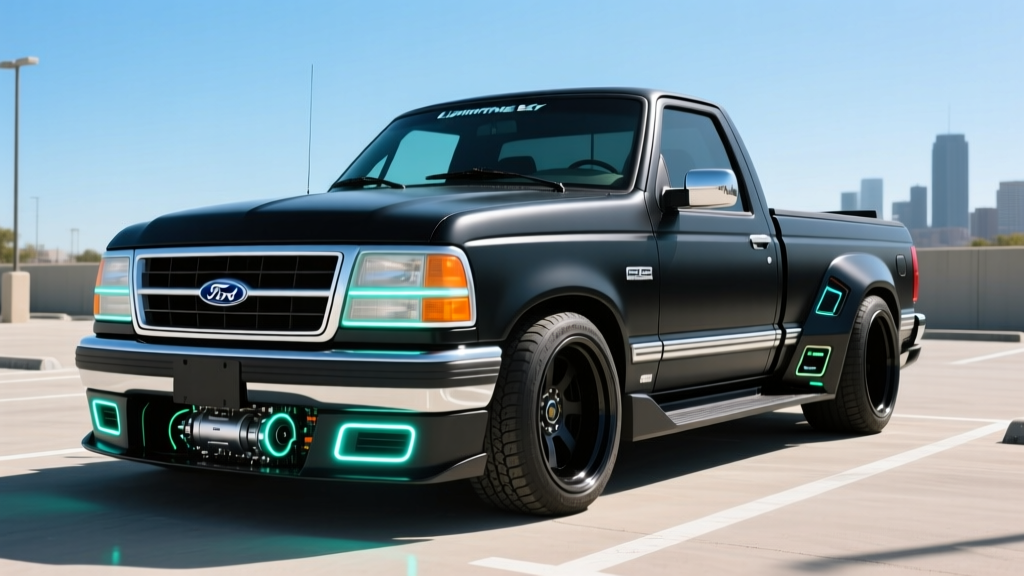
If you've been searching for a 1993 Ford F-150 Lightning with an electric powertrain, you're navigating one of the most interesting intersections in the EV world: classic truck restomodding meets modern battery technology. The original 1993 F-150 Lightning was Ford's first performance truck—a regular-cab, short-bed F-150 with a 5.8L V8 producing 240 horsepower and a sport-tuned suspension. Today, a growing number of specialty shops and DIY builders are converting these iconic OBS (Original Body Style) trucks into battery-electric vehicles, creating something that never existed from the factory: a zero-emission classic Lightning.
This guide breaks down what a 1993 Ford F-150 Lightning EV conversion actually looks like in 2026—the battery packs being used, realistic range expectations, charging infrastructure compatibility, total project costs, and whether this niche build makes sense compared to buying a modern electric truck like the Ford F-150 Lightning (2022–present) or a Rivian R1T.
What Is a 1993 Ford F-150 Lightning EV Conversion?
An EV conversion (sometimes called an "electric restomod" or "EV swap") involves removing the original internal combustion engine, fuel tank, exhaust, and transmission from a donor 1993 F-150 Lightning and replacing them with an electric motor, battery pack, inverter, and charging system. The result retains the truck's classic exterior and interior while gaining a modern electric drivetrain.
Several conversion shops specialize in classic Ford truck EV swaps, including EV West, Zero EV, and independent builders who document projects on forums like DIY Electric Car. No major automaker produces a factory-electric 1993 F-150 Lightning—every example on the road is a custom build or a shop-commissioned project.
Typical EV Conversion Specs: Battery, Motor, and Drivetrain
Because every 1993 F-150 Lightning EV conversion is custom, specifications vary significantly depending on the builder's budget, goals, and component choices. That said, most builds in 2026 converge on a fairly predictable set of components drawn from salvaged Tesla, Nissan Leaf, or Chevrolet Bolt battery modules, or new-purpose-built packs from suppliers like NetGain or Flux Power.
| Specification | Typical Build Range |
|---|---|
| Battery Capacity | 40–85 kWh (usable), NMC chemistry most common |
| Electric Motor | 150–400 HP (NetGain Hyper9, Tesla SDU, or Cascadia Motion) |
| Drivetrain | RWD (retains original rear axle) or AWD (dual-motor, rare) |
| 0-60 mph | 5.0–8.0 seconds (depending on motor and pack size) |
| EPA-Equivalent Range | 100–200 miles (no official EPA rating—builder estimated) |
| Efficiency | 35–50 kWh/100 mi (estimated, varies with aero and weight) |
| Curb Weight (converted) | 4,800–5,600 lbs (battery adds 600–1,200 lbs over ICE) |
Battery chemistry note: Most conversions use salvaged NMC (nickel manganese cobalt) modules from Tesla Model S/X packs or Chevrolet Bolt packs because of their high energy density, which matters when packaging batteries into a truck frame not originally designed for them. Some builders opt for LFP (lithium iron phosphate) packs for longer cycle life and safer thermal characteristics, but LFP's lower energy density means fewer kWh in the same physical space—typically limiting range to 100–130 miles in a 1993 F-150 chassis.
Real-World Range: What to Actually Expect
A well-built 1993 F-150 Lightning EV conversion with a 60 kWh usable NMC pack typically achieves 130–160 miles in mixed driving. Highway driving at 70+ mph drops this to 100–120 miles due to the truck's poor aerodynamics (drag coefficient ~0.45). In cold weather (below 32°F), expect a further 20–35% range loss depending on whether the build includes battery heating.
Range in a conversion is notoriously difficult to predict because the 1993 F-150 was never designed with EV efficiency in mind. The truck's boxy shape, heavy solid rear axle, and lack of regenerative braking optimization (many conversions retain the original brake system) all work against range. Builders who install a heat pump for cabin heating and use a liquid-cooled battery pack with active thermal management tend to see the best real-world numbers.
For context, a 60 kWh pack in a modern Hyundai Ioniq 5 (which is far more aerodynamic and has sophisticated thermal management) delivers an EPA-rated 303 miles. That same 60 kWh in a 1993 F-150 Lightning conversion might deliver 140 miles. The physics of a 30-year-old truck body are unforgiving.
Charging: DC Fast Charge and Home Level 2
Charging capability is where EV conversions vary most dramatically—and where many budget builds fall short for daily usability.
| Charging Level | Power (kW) | Miles Added Per Hour | Notes |
|---|---|---|---|
| Level 1 (120V household) | 1.2–1.4 kW | 3–4 mi/hr | All builds support this; overnight adds ~35–45 mi |
| Level 2 (240V, J1772) | 3.3–7.2 kW | 10–22 mi/hr | Depends on onboard charger; most builds use 6.6 kW |
| DC Fast Charge (CCS) | 25–50 kW (if equipped) | 75–150 mi/hr | Only premium builds; adds $4,000–$8,000 to cost |
The DC fast-charging reality: Many conversion builds skip DC fast charging entirely to save cost and complexity. A CCS-compatible DC fast-charge system requires a liquid-cooled battery pack, a high-voltage contactor system, and a CCS inlet—all of which add thousands of dollars. Budget conversions (under $40,000 total project cost) often rely solely on Level 2 charging, meaning a full charge from empty takes 8–12 hours on a 240V home charger.
If road trips or quick top-ups matter, insist on a build that includes DC fast charging at a minimum of 40–50 kW. That will get a 60 kWh pack from 10–80% in roughly 50–70 minutes. This is far slower than a modern F-150 Lightning's 150+ kW capability, but it's adequate for a truck with 140 miles of range.
Project Cost: What a Conversion Actually Costs in 2026
Converting a 1993 F-150 Lightning to electric is a significant financial undertaking. Here's how the costs break down:
| Cost Category | Budget Build | Mid-Range Build | Premium Build |
|---|---|---|---|
| Donor vehicle (1993 F-150 Lightning) | $8,000–$15,000 | $15,000–$25,000 | $25,000–$40,000 |
| Battery pack (40–85 kWh) | $6,000–$12,000 | $12,000–$20,000 | $20,000–$35,000 |
| Motor + controller | $3,000–$6,000 | $6,000–$10,000 | $10,000–$18,000 |
| Charging system (L2 + DCFC) | $1,500–$3,000 | $3,000–$6,000 | $6,000–$12,000 |
| Fabrication + labor | $5,000–$10,000 (DIY) | $15,000–$30,000 | $30,000–$60,000 |
| BMS, thermal mgmt, wiring, misc | $3,000–$5,000 | $5,000–$10,000 | $10,000–$20,000 |
| Total Project Cost | $26,500–$51,000 | $56,000–$101,000 | $101,000–$185,000 |
For comparison, a 2026 Ford F-150 Lightning XLT starts around $55,000 MSRP and delivers an EPA-estimated 240–320 miles of range, 150 kW DC fast charging, a full factory warranty, and modern safety features. The conversion route only makes financial sense if you value the classic truck's aesthetics and the uniqueness of the build.
Federal Tax Credit Eligibility for EV Conversions
Here's the critical question for cost-conscious buyers: does a 1993 F-150 Lightning EV conversion qualify for the IRS §30D federal EV tax credit?
Almost certainly not. The §30D credit applies to new clean vehicles purchased from a manufacturer. An aftermarket conversion of a 30-year-old truck does not meet the definition of a "new" vehicle, regardless of how thoroughly the powertrain has been replaced. The credit requires the vehicle to be manufactured by an OEM, have a valid VIN assigned by that manufacturer, and meet specific battery-sourcing and critical-mineral requirements that conversion shops cannot certify.
- Vehicle must be new from manufacturer: Conversions fail this requirement
- MSRP cap ($80,000 for trucks): Not applicable—conversion isn't a new vehicle sale
- Buyer income limits ($150K single / $300K joint): Not applicable
- Battery critical-mineral sourcing: Salvaged modules cannot be certified
- Final assembly in North America: Technically yes, but moot without meeting other criteria
If tax-credit eligibility is a priority, a new 2026 Ford F-150 Lightning or Chevrolet Silverado EV will likely qualify for at least a partial credit (depending on your income, the specific trim's MSRP, and current battery-sourcing rules). Consult a tax professional for your specific situation.
Pros and Cons of a 1993 F-150 Lightning EV Conversion
Pros
- Unique, head-turning classic truck with zero tailpipe emissions
- Instant electric torque transforms the driving experience (150–400 HP)
- Lower per-mile "fuel" cost: ~$0.04–$0.06/mi on home electricity vs. $0.18–$0.25/mi on gas
- No oil changes, spark plugs, or exhaust maintenance
- Preserves a collectible truck body while modernizing the drivetrain
- Regenerative braking reduces brake wear significantly
Cons
- Range of 100–160 miles limits practical use to local/commuter driving
- No federal tax credit eligibility ($0 from §30D)
- No factory warranty—every repair is out-of-pocket or builder-dependent
- DC fast charging is an expensive add-on; many builds lack it
- Safety: 1993 chassis lacks airbags (driver-side only in some), crumple zones, ABS (not standard), ESC
- Insurance can be difficult—specialty classic-car EV policies required
- Resale market is extremely thin; you may not recover conversion costs
- Project timelines often stretch 12–24 months at conversion shops
Who Should Consider This Build (And Who Shouldn't)
This conversion is best for: Enthusiasts who want a one-of-a-kind classic truck for weekend drives, car shows, and short commutes. If you already own a 1993 F-150 Lightning and want to keep it on the road while eliminating gas and oil, a well-executed conversion can be deeply satisfying. It's also a compelling project for hands-on builders who enjoy the engineering challenge.
Look elsewhere if: You need a daily-driver truck for commuting more than 80 miles round-trip, towing (most conversions are not rated for meaningful towing), or road trips. If you need reliability, warranty coverage, modern safety features, and tax-credit savings, a new Ford F-150 Lightning, Rivian R1T, or Chevrolet Silverado EV will serve you far better at a comparable or lower total cost.
How It Compares to Modern Electric Trucks
| Spec | 1993 Conversion (Mid-Range) | 2026 F-150 Lightning XLT | 2026 Rivian R1T Dual-Motor |
|---|---|---|---|
| EPA/Est. Range | ~140 mi (est.) | 240–320 mi (EPA) | 270–420 mi (EPA) |
| Battery | ~60 kWh, NMC (salvaged) | 98–131 kWh, NMC | 106–149 kWh, NMC/LFP |
| DC Fast Charge | 25–50 kW (if equipped) | 150 kW (peak) | 200+ kW (peak) |
| 0-60 mph | ~6.5 sec | ~4.0 sec | ~3.0 sec (tri-motor) |
| Horsepower | 200–300 HP | 580 HP | 665 HP (tri-motor) |
| Total Cost | $56,000–$101,000 | ~$55,000–$75,000 MSRP | ~$70,000–$100,000 MSRP |
| Warranty | None (builder-dependent) | 8 yr/100,000 mi battery | 8 yr/175,000 mi battery |
| Federal Tax Credit | Not eligible | Up to $7,500 (varies) | Up to $7,500 (varies) |
Frequently Asked Questions
What is the real-world range of a 1993 Ford F-150 Lightning EV conversion?
Most mid-range conversions with a 60 kWh NMC pack achieve 130–160 miles in mixed driving, dropping to 100–120 miles on the highway at 70+ mph and losing another 20–35% in freezing temperatures. The truck's boxy aerodynamics and heavy weight work against efficiency.
How fast does a 1993 F-150 Lightning EV conversion charge?
On a 240V Level 2 home charger at 6.6 kW, expect roughly 18–22 miles of range added per hour (a full charge in 7–10 hours). DC fast charging, if the build includes it, typically peaks at 25–50 kW, adding 75–150 miles per hour—but many budget builds omit DCFC entirely.
How much does a 1993 F-150 Lightning EV conversion cost after tax credits?
Since EV conversions are not eligible for the federal §30D tax credit, the total project cost is out-of-pocket: typically $26,500–$51,000 for a budget/DIY build, $56,000–$101,000 for a professional mid-range build, and $101,000–$185,000 for a premium shop build. There are no credits to subtract.
Is a 1993 F-150 Lightning EV conversion worth buying vs. a modern electric truck?
For daily driving, commuting, towing, and road trips—no. A 2026 Ford F-150 Lightning or Rivian R1T offers dramatically more range, faster charging, full warranties, modern safety systems, and tax-credit eligibility at a similar or lower price. The conversion only makes sense as an enthusiast project or collector vehicle where uniqueness and classic styling are the primary goals.
What are the biggest pros and cons?
Pros: unique classic styling, instant electric torque, low per-mile energy cost, zero tailpipe emissions, and the satisfaction of a custom build. Cons: limited range (100–160 mi), no tax credit, no factory warranty, poor safety by modern standards, slow charging without expensive DCFC upgrades, and a very thin resale market.
Does a 1993 F-150 Lightning EV conversion qualify for the federal EV tax credit?
No. The IRS §30D credit requires a new vehicle from a qualified manufacturer meeting battery-sourcing and assembly requirements. An aftermarket conversion of a 1993 truck does not meet any of these criteria. Check IRS.gov for current rules, and consult a tax professional for your specific situation.