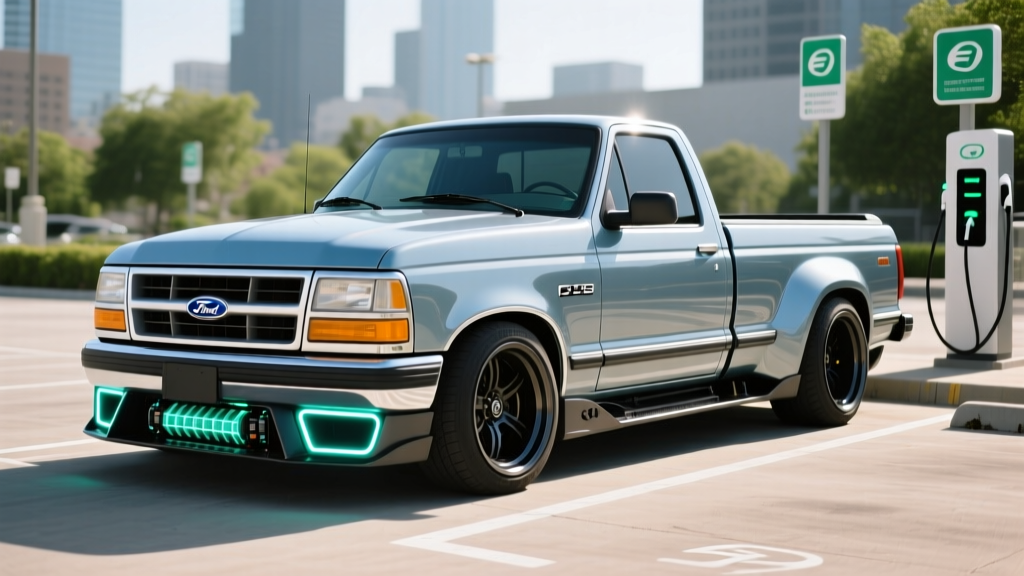
If you've been searching for 1993 F-150 Lightning information lately, you've probably noticed something unusual: the internet is split between two very different trucks sharing the Lightning nameplate. One is a 5.8L V8-powered, rear-wheel-drive muscle truck that Ford built in limited numbers in 1993 (part of the SVT Lightning's first generation, which ran from 1993–1995). The other is Ford's modern F-150 Lightning battery-electric pickup. This article is for the enthusiasts and researchers bridging both worlds — what the original 1993 SVT F-150 Lightning was, and what it takes (and costs) to convert one into a legitimate electric vehicle in 2026.
The Original 1993 SVT F-150 Lightning: What Ford Actually Built
The 1993 Ford SVT F-150 Lightning was never an electric vehicle. It was a high-performance, gas-powered variant of the ninth-generation F-150, developed by Ford's Special Vehicle Team (SVT). Here are the factory specifications for the truck as it left the assembly line:
| Specification | Value |
|---|---|
| Engine | 5.8L (351 ci) Windsor V8 |
| Horsepower | 240 hp @ 4,200 rpm |
| Torque | 340 lb-ft @ 2,800 rpm |
| Transmission | 4-speed automatic (E4OD) |
| Drivetrain | Rear-wheel drive |
| 0–60 mph | ~7.2 seconds (period tests) |
| EPA Fuel Economy | ~12 city / 16 highway mpg (est.) |
| Production (1993 MY) | ~5,276 units |
| Original MSRP | ~$19,845 (1993 dollars) |
The 1993 Lightning was a response to the Chevrolet 454 SS and GMC Syclone. It featured a heavy-duty suspension, unique front fascia, fog lamps, and a mono-tone paint scheme (available in Black, Red, and White). It was a straight-line performance truck before the term "sport truck" was fully mainstream.
Why People Search "1993 F-150 Lightning" in an EV Context
Three trends have driven EV-curious searches around the 1993 F-150 Lightning:
- Nameplate confusion: Ford revived the Lightning name for its 2022+ F-150 Lightning electric pickup. Google's search algorithms frequently blend results for both vehicles, pulling EV-curious searchers toward the classic truck and vice versa.
- EV conversion culture: Classic truck electrification has become a thriving niche. Companies like EV West, Zero EV, and independent shops routinely convert 1980s–1990s Ford trucks using Tesla drive units, NetGain Hyper9 motors, and modular battery packs.
- Restomod investment: Original 1993–1995 SVT Lightnings have appreciated significantly. Clean, low-mileage examples now trade for $25,000–$45,000+ in the collector market, making owners more deliberate about any drivetrain modification.
Converting a 1993 F-150 Lightning to Electric: Realistic Specs
If you're considering electrifying a 1993 SVT Lightning (or any ninth-gen F-150), here's what a well-executed, street-legal conversion looks like in 2026. These figures represent a typical build using commercially available components — not a factory product.
| Specification | Typical Conversion Value |
|---|---|
| Battery Capacity | 60–100 kWh (NMC modules, commonly from salvaged Tesla or Chevy Bolt packs) |
| Battery Chemistry | NMC (Nickel Manganese Cobalt) — most common in conversion-grade modules |
| EPA-Equivalent Range | Not EPA-rated; estimated 120–200 miles depending on pack size and driving style |
| Motor | NetGain Hyper9, Cascadia Motion, or Tesla rear drive unit |
| Horsepower | 150–400+ hp (motor-dependent) |
| 0–60 mph | 5.0–8.0 seconds (varies widely by motor and pack voltage) |
| Drivetrain | RWD (retaining original rear axle) or AWD with dual-motor setup |
| DC Fast Charging | 0–50 kW (most conversions lack DCFC; CCS adapter add-on possible) |
| Level 2 Charging | 6.6–11.5 kW onboard charger (25–45 miles of range per hour) |
| Level 1 Charging | 1.4–1.9 kW (4–7 miles of range per hour) |
| Efficiency | ~45–55 kWh/100 miles (estimated, equivalent to ~60–75 MPGe) |
| Cargo Bed | Retained — ~55–70 cu ft (depending on bed length, battery placement) |
| Warranty | None (aftermarket; individual component warranties from suppliers) |
EV Conversion Cost Breakdown: What You'll Actually Spend
Electrifying a classic truck is not a budget project. Here's a realistic cost breakdown for a competent, street-drivable 1993 F-150 Lightning EV conversion in 2026:
| Component / Service | Estimated Cost |
|---|---|
| Battery modules (60–100 kWh NMC) | $8,000–$18,000 |
| Motor + controller (Hyper9 / Cascadia / Tesla unit) | $4,000–$9,000 |
| BMS (Battery Management System) | $1,500–$3,500 |
| Onboard charger + DC-DC converter | $1,500–$3,000 |
| Throttle adapter, wiring, contactors | $1,500–$3,000 |
| Fabrication (motor mount, battery boxes) | $3,000–$8,000 |
| Professional labor (if not DIY) | $10,000–$25,000 |
| DC fast-charge system (optional CCS) | $3,000–$6,000 |
| Registration, inspection, titling (varies by state) | $500–$2,000 |
| Total Estimated Build Cost | $33,000–$77,500+ |
This does not include the cost of the donor truck itself ($15,000–$45,000+ for a clean 1993 SVT Lightning). Total investment for a converted example frequently lands between $50,000 and $120,000.
Federal Tax Credits and Conversion Vehicles: The §30D Reality
This is where conversion projects face a hard wall. Under IRS §30D rules, the federal EV tax credit of up to $7,500 applies only to new, qualifying electric vehicles purchased from a licensed dealer that meet MSRP caps ($80,000 for trucks/vans), buyer income limits ($300,000 joint / $150,000 single), and critical-mineral and battery-component sourcing requirements.
- A converted 1993 F-150 does NOT qualify for the §30D new-vehicle credit. It is not a new vehicle, not sold by a dealer, and its battery components almost certainly do not meet North American sourcing requirements.
- The used-EV credit (§25E, up to $4,000) requires the vehicle to be sold by a licensed dealer, priced under $25,000, and at least two model years old. A conversion sold privately does not qualify.
- State and local incentives for EV conversions exist in a few jurisdictions (California's CC4A program has occasionally covered conversions; check your state's current programs), but these are limited and change frequently.
Bottom line: plan to fund a 1993 F-150 Lightning EV conversion entirely out of pocket. No federal tax credit will offset the cost. Consult a tax professional for your specific situation.
1993 Lightning EV Conversion vs. Modern F-150 Lightning: Head-to-Head
If your goal is an electric Ford pickup, here's how a converted 1993 SVT stacks up against the 2025 Ford F-150 Lightning (the modern production EV that carries the nameplate):
| Specification | 1993 SVT (EV Conversion, Est.) | 2025 F-150 Lightning Ext. Range |
|---|---|---|
| EPA Range | N/A (est. 150–170 mi) | 320 miles (fueleconomy.gov) |
| Battery | ~80 kWh NMC (aftermarket) | 131 kWh usable (NMC) |
| DC Fast Charge | 0–50 kW (if equipped) | 150 kW peak, 10–80% in ~41 min |
| Level 2 Charging | 6.6–11.5 kW | 19.2 kW (80A) / ~30 mi/hr |
| Horsepower | 150–400 hp | 580 hp (dual motor) |
| 0–60 mph | 5.0–8.0 sec | 3.8 seconds |
| Towing Capacity | Not rated (likely 2,000–4,000 lb) | 10,000 lb (max tow pkg) |
| Safety (NHTSA) | Not crash-tested to modern stds | 5-star overall (NHTSA) |
| ADAS | None | Ford Co-Pilot360 2.0 (Level 2) |
| Tax Credit Eligible | No | Varies by trim/sourcing — check IRS §30D |
| Total Cost (truck + build) | $50,000–$120,000 | $69,995–$96,874 MSRP |
| Warranty | None | 8 yr / 100,000 mi battery |
Pros and Cons of a 1993 F-150 Lightning EV Conversion
Pros
- Unique, head-turning classic truck with zero tailpipe emissions
- Instant electric torque transforms the driving experience vs. the stock 5.8L V8
- Lower operating cost per mile (electricity vs. 12 mpg gasoline)
- Preserves a collectible body style while modernizing the drivetrain
- Strong enthusiast community and conversion knowledge base
- Potential appreciation as a one-of-one restomod
Cons
- $50,000–$120,000 total investment with no federal tax credit
- Limited range (120–200 mi) vs. 320 mi in a modern F-150 Lightning
- No DC fast charging in most builds — road trips require overnight stops
- 1993 safety standards: no modern airbags, ESC, or ADAS
- No warranty on the conversion; individual components may fail independently
- Destroys originality — hurts collector value of numbers-matching SVT examples
- Insurance can be difficult and expensive (specialty classic + EV modification)
- Registration and inspection hurdles vary by state; some make EV titling difficult
Who Should Consider a 1993 Lightning EV Conversion?
This project suits a very specific buyer:
- The restomod enthusiast who wants a unique, electrified classic truck for weekend cruises, shows, and short commutes — and who has the budget and patience for a custom build.
- The skilled DIY builder with fabrication, electrical, and programming experience who views this as a passion project, not a cost-saving measure.
- The collector who already owns a 1993 SVT Lightning with a blown engine or non-numbers-matching drivetrain and sees an EV swap as a creative second life.
This project does not suit:
- Anyone seeking a practical daily-driver EV with reliable range, fast charging, and modern safety.
- Buyers on a budget — a used Tesla Model Y or even a new base F-150 Lightning delivers far more utility per dollar.
- Anyone who values the collector originality of a clean SVT Lightning (the conversion destroys that value).
Choose the 1993 EV conversion if: You own or can acquire a 1993 SVT Lightning cheaply (or with a blown motor), you have $40K+ earmarked for the build, you want a one-of-one show truck, and you have a second vehicle for daily use.
Choose the modern F-150 Lightning if: You need a practical electric truck for daily driving, towing, road trips, family use, or fleet work — and you want EPA-rated range, DC fast charging, a warranty, safety ratings, and potential tax-credit eligibility.
Frequently Asked Questions
Was the 1993 F-150 Lightning ever an electric vehicle?
No. The 1993 Ford SVT F-150 Lightning was a gasoline-powered performance truck with a 5.8L V8 producing 240 hp. Ford did not produce an electric F-150 Lightning until the 2022 model year. Any electric 1993 Lightning is an aftermarket conversion.
What is the real-world range of a 1993 F-150 Lightning EV conversion?
With a typical 80 kWh NMC battery pack, expect 150–170 miles of mixed driving. Highway driving at 70+ mph drops this to 110–135 miles due to the truck's boxy aerodynamics. Cold weather (below 32°F) can reduce range by an additional 15–25%, yielding as little as 90–115 miles in winter highway conditions.
How fast does a converted 1993 Lightning charge?
Most conversions rely on Level 2 (240V) charging at 6.6–11.5 kW, adding roughly 25–45 miles of range per hour. A full charge from empty takes 7–12 hours. DC fast charging is rare in conversions; if equipped, it typically tops out at 50 kW — far below the 150+ kW speeds of modern factory EVs. Plan on overnight home charging as your primary fueling method.
Does a 1993 F-150 Lightning EV conversion qualify for the federal EV tax credit?
No. The IRS §30D credit applies only to new qualifying EVs purchased from dealers, and the §25E used-EV credit requires dealer sale under $25,000. An aftermarket conversion on a 30+ year-old truck meets neither criterion. You cannot claim any federal EV tax credit for this project. State incentives for conversions are rare but worth researching locally.
Is a 1993 Lightning EV conversion worth it vs. buying a modern F-150 Lightning?
From a purely practical standpoint, no. A 2025 F-150 Lightning offers 320 miles of EPA range, 150 kW DC fast charging, a 10,000-lb tow rating, 5-star NHTSA safety, Ford Co-Pilot360 driver assists, an 8-year/100,000-mile battery warranty, and potential federal tax-credit eligibility — all for $70,000–$97,000. A conversion costs a similar amount and delivers less range, no fast charging, no warranty, and 1993-era safety. The conversion only makes sense as a passion project, restomod, or collector piece — not as a rational transportation purchase.
Where can I find conversion kits or shops for a 1993 F-150?
Several companies supply EV conversion components compatible with classic Ford trucks: EV West, Zero EV, Thunderstruck Motors, and NetGain (for Hyper9 motors). Full-service conversion shops exist regionally, but most builds are DIY or semi-DIY with professional fabrication help. Join forums like the DIY Electric Car community and the EV Conversions subreddit for build threads specific to ninth-gen F-Series trucks.
What battery chemistry is used in conversions?
Most 1993 F-150 conversions use NMC (Nickel Manganese Cobalt) lithium-ion modules sourced from salvaged Tesla Model S/X packs, Chevy Bolt packs, or Nissan Leaf packs. LFP (Lithium Iron Phosphate) is gaining popularity for its longer cycle life and thermal stability, but NMC remains more common in the conversion market due to availability and higher energy density — important when packaging batteries into a truck not originally designed for them.