The 2008 Chevrolet Impala Bolt Pattern: Exact Specs
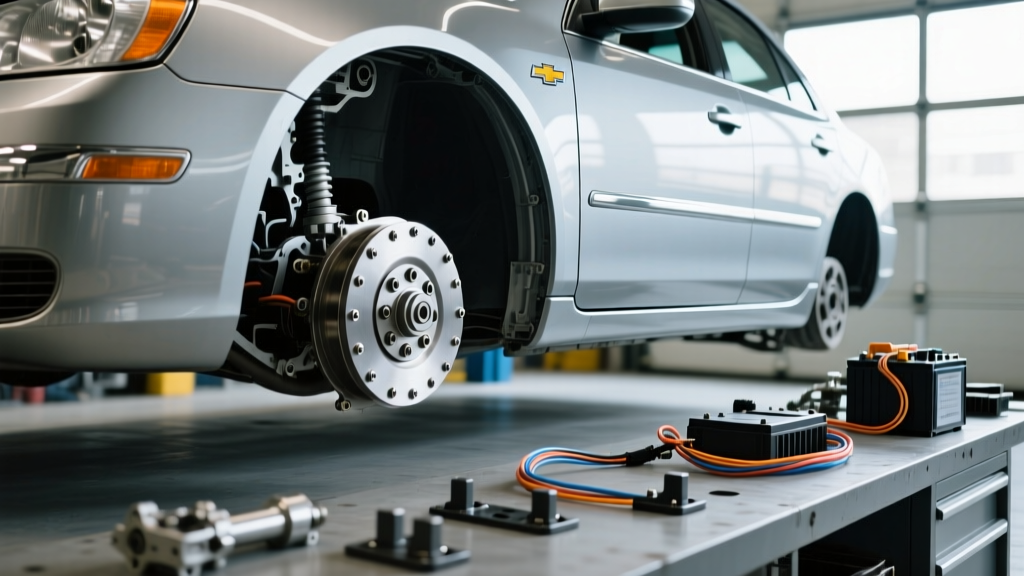
If you're researching the 08 Impala bolt pattern — whether for a wheel upgrade, hub-centric spacer install, or an ambitious EV drivetrain swap — the factory specification is straightforward:
| Specification | Value |
|---|---|
| Bolt Pattern (PCD) | 5 x 115 mm (5 x 4.53 in) |
| Center Bore | 70.3 mm |
| Lug Nut Thread Size | M12 x 1.5 |
| Lug Nut Type | Acorn / conical seat |
| Factory Wheel Sizes | 16" / 17" / 18" (trim-dependent) |
| Typical Offset (ET) | +38 to +42 mm |
The 5x115 pattern is shared across many General Motors vehicles of this era, including the Chevrolet Malibu (2004–2012), Pontiac Grand Prix, and Buick LaCrosse. This is not the same as the 5x114.3 (5x4.5) pattern common on many Asian-market vehicles — the 0.7 mm difference means wheels are not safely interchangeable without adapters, which introduce hub-centricity and load concerns.
Why EV Enthusiasts Look Up the 08 Impala Bolt Pattern
The 2008 Impala occupies a niche in the EV conversion community. It's a spacious, body-on-subframe sedan with a large engine bay (the SS trim shipped with a 5.3L V8), which makes it a candidate for DIY electric drivetrain swaps. Builders typically pull the 3.5L or 3.9L V6 (or the 5.3L V8) and replace it with a salvaged EV motor — commonly a Tesla large drive unit or a NetGain Hyper9 system — paired with a custom battery enclosure in the trunk or under the hood.
The 5x115 bolt pattern matters in these builds for two reasons:
- Wheel and tire selection for added weight: EV conversions add 300–800 lbs over stock, depending on battery capacity. You need load-rated wheels, and knowing your bolt pattern is step one.
- Hub adapter availability: If you're adapting a Tesla or Nissan Leaf drive unit, you may need custom axle adapters, and the wheel-end geometry (including bolt pattern, center bore, and offset) determines what's feasible without custom uprights.
Modern Production EVs: What the Impala's Spiritual Successors Offer
If you loved the Impala's roomy cabin (123.6 cu ft passenger volume, 18.6 cu ft trunk) and highway comfort but want electric, here's how current production EVs compare on the dimensions that matter:
| Model | EPA Range | Battery (kWh, usable) | Peak DC Charge (kW) | 10–80% Time | Cargo (cu ft) | Base MSRP |
|---|---|---|---|---|---|---|
| Chevrolet Blazer EV 2LT (AWD) | 279 mi | 102 kWh, NMC | 190 kW | ~28 min | 30.2 (rear seats up) | $47,600 |
| Hyundai Ioniq 6 SE (RWD) | 361 mi | 77.4 kWh, NMC | 240 kW | ~18 min | 12.3 (trunk) | $38,650 |
| Tesla Model 3 Long Range (AWD) | 341 mi | 79 kWh, NMC | 250 kW | ~22 min | 24.0 (trunk+frunk) | $42,490 |
| Honda Prologue EX (FWD) | 296 mi | 85 kWh, NMC | 150 kW | ~34 min | 25.2 (rear seats up) | $47,400 |
The Impala's 18.6 cu ft trunk was class-leading for a full-size sedan. Among EVs, the Tesla Model 3's combined trunk + frunk volume (24 cu ft) and the Blazer EV's crossover cargo area come closest to matching its practicality — though no current electric sedan replicates the Impala's bench-seat, six-passenger layout.
Real-World Range vs. EPA Stickers: What to Actually Expect
- Highway-only (70–80 mph): Subtract 15–25% from EPA. The Ioniq 6's 361 mi EPA drops to ~270–300 mi at sustained Interstate speeds.
- Cold weather (below 32°F / 0°C): Subtract 20–35%, depending on whether the vehicle has a heat pump. LFP chemistry vehicles tend to suffer more cold-range loss than NMC.
- City / stop-and-go: Often matches or exceeds EPA thanks to regenerative braking recapturing energy.
If your Impala commute was 40 miles round-trip in a Midwestern winter, any of the above EVs handle it trivially — even at 30% range loss, you're looking at 190+ miles remaining on the Blazer EV or Prologue.
Charging Speed: Home and DC Fast Charging Explained
One area where production EVs leave DIY conversions far behind is charging infrastructure compatibility. Here's what to expect from a modern EV on a daily basis:
| Level | Power (kW) | Miles Added per Hour | Use Case |
|---|---|---|---|
| Level 1 (120V household) | 1.0–1.4 kW | 3–5 mi/hr | Overnight top-up, low-mileage commuters |
| Level 2 (240V home/public) | 7.2–11.5 kW | 25–44 mi/hr | Daily home charging, workplace, shopping centers |
| DC Fast Charge (public) | 50–350 kW | 150–1,000+ mi/hr (peak) | Road trips, quick top-ups; tapers above 80% SoC |
A critical nuance: peak DC charge rate is not sustained. A vehicle rated at 240 kW (like the Ioniq 6) will hit that peak only between roughly 10–40% state of charge, then taper progressively. The "10–80% time" is the more useful metric — it captures the entire usable charging window and the taper curve. The Ioniq 6's ~18-minute 10–80% time on a 350 kW charger is among the fastest in production; the Blazer EV's ~28 minutes is average for its battery size.
For home Level 2, most EVs charge fully overnight on a 48-amp (11.5 kW) circuit. Installation typically runs $800–$2,500 depending on panel proximity and whether your electrical panel needs an upgrade to 200A. Always get a quote from a licensed electrician — permit requirements vary by jurisdiction.
Federal EV Tax Credit (§30D): Current Rules and Caveats
The IRS §30D clean vehicle credit offers up to $7,500 for qualifying new EVs — but eligibility is far from universal. Key requirements as of the current tax year:
- MSRP caps: $80,000 for SUVs/pickups/vans; $55,000 for sedans.
- Buyer income caps (modified AGI): $300,000 joint / $225,000 head of household / $150,000 single.
- Battery sourcing: Increasingly strict percentages of critical minerals and battery components must be sourced from the U.S. or FTA partners — this disqualifies some models mid-year as supply chains shift.
- Final assembly: Must occur in North America.
- Point-of-sale transfer: Since 2024, buyers can transfer the credit to the dealer at purchase, reducing the sale price directly rather than waiting for a tax refund.
| Model | Base MSRP | Est. §30D Credit | Effective Price | Notes |
|---|---|---|---|---|
| Hyundai Ioniq 6 SE | $38,650 | $7,500 (if sourcing met) | ~$31,150 | Assembly in GA; verify current battery sourcing |
| Tesla Model 3 LR AWD | $42,490 | $7,500 (if sourcing met) | ~$34,990 | Fremont assembly; sourcing eligibility shifts — confirm at order |
| Chevrolet Blazer EV 2LT | $47,600 | $7,500 (if sourcing met) | ~$40,100 | Mexico assembly has affected eligibility in prior years — confirm |
Important: Battery sourcing and component rules tighten annually. A model that qualifies in January may not in July. Always verify on the fueleconomy.gov tax credit lookup before purchasing. This is not tax advice — consult a tax professional for your specific situation.
So: Convert the Impala or Buy a Production EV?
- You have fabrication and high-voltage electrical skills (or a trusted shop)
- The Impala has sentimental or project-car value to you
- You want a unique, one-off vehicle and accept no warranty, no crash-test validation, and limited range (typically 60–120 mi on DIY budgets)
- You understand it will not qualify for any federal or state EV incentive
- You need reliable daily transportation with 250+ miles of real range
- You want DC fast charging for road trips (10–80% in under 30 min)
- You value an 8-year/100,000-mile battery warranty and NHTSA/IIHS safety ratings
- You want to capture the $7,500 federal credit (if eligible) and lower fuel/maintenance costs
- You prefer a vehicle with OTA updates, modern ADAS, and resale-market liquidity
For the vast majority of former Impala owners, a production EV like the Ioniq 6 (for sedan buyers who value efficiency and range) or the Blazer EV / Prologue (for those who need crossover cargo space) delivers a dramatically better ownership experience at a comparable net cost after incentives.
Frequently Asked Questions
What is the exact bolt pattern on a 2008 Chevrolet Impala?
5 x 115 mm (also expressed as 5 x 4.53 inches). It has a 70.3 mm center bore and uses M12 x 1.5 lug nuts with a conical (acorn) seat.
Can I fit 5x114.3 wheels on my 08 Impala?
Not safely without hub-centric adapters, and even then it's not recommended. The 0.7 mm difference per stud can cause vibration, uneven load distribution, and stud fatigue. Stick with 5x115 or use quality adapters from a reputable manufacturer rated for your vehicle's curb weight plus conversion weight.
Will an EV conversion on a 2008 Impala qualify for the federal tax credit?
No. The IRS §30D credit applies only to new or qualified previously owned clean vehicles purchased from a licensed dealer, with OEM certification, North American final assembly, and battery-sourcing compliance. A DIY conversion does not meet any of these criteria.
What production EV has a similar bolt pattern to the Impala?
Many GM EVs (including the Blazer EV and Equinox EV) use 5x115 or 5x120 patterns — but wheel fitment involves offset, center bore, load rating, and brake clearance in addition to bolt pattern. Never cross-fit wheels based on bolt pattern alone.
How much does a 2008 Impala EV conversion cost?
Realistically, $12,000–$25,000 in parts (motor, controller, battery pack, BMS, onboard charger, DC-DC converter, custom motor mounts, battery enclosure, high-voltage wiring, and safety disconnects), plus 200–500 hours of labor if you're doing it yourself. Professional conversions can exceed $40,000. For context, a well-equipped Hyundai Ioniq 6 SE starts at $38,650 and may net ~$31,150 after the federal credit — with a full warranty, 361 mi EPA range, and 240 kW DC fast charging.