Why the 2007 Honda Civic Bolt Pattern Matters for Electrification Projects
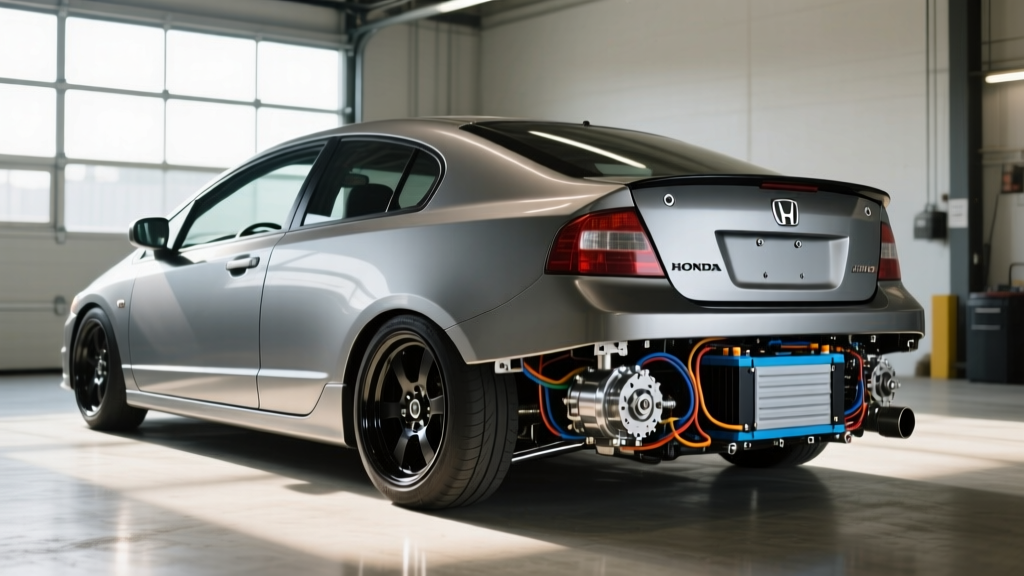
The 2007 Honda Civic bolt pattern — 5×114.3 mm (also written as 5×4.5 inches) — is one of the most common wheel mounting configurations in the aftermarket world. For EV enthusiasts scouting lightweight, affordable donor platforms for electric conversions, the eighth-generation Civic (2006–2011) is a recurring candidate. Its curb weight of roughly 2,600–2,800 lbs, compact dimensions, and widely available parts ecosystem make it appealing.
But before you pull the D17 or K20 engine and start pricing NetGain Hyper9 motors and Tesla drive units, you need to understand what this bolt pattern means for wheel and hub compatibility, how the Civic's chassis handles the weight redistribution of a battery pack, and whether the conversion math pencils out versus buying a purpose-built EV in 2026.
This guide covers the exact bolt pattern specifications, wheel fitment parameters, and a realistic assessment of the 2007 Civic as an EV-swap donor — with hard numbers on cost, range expectations, and the trade-offs versus a factory electric vehicle.
2007 Honda Civic Bolt Pattern: Exact Specifications
| Specification | Value |
|---|---|
| Bolt Pattern | 5×114.3 mm (5×4.5 in) |
| Center Bore | 64.1 mm |
| Lug Nut Thread Size | M12 × 1.5 |
| Lug Nut Type | Bulge acorn (ball-seat on some trims) |
| Stock Wheel Sizes | 15" (DX/LX), 16" (EX), 17" (Si) |
| Stock Offset Range | +42 to +45 mm |
| Tightening Torque | 80 lb-ft (108 Nm) |
The 5×114.3 pattern is shared across dozens of Honda and Acura models — including the Accord, CR-V, TSX, and TL — as well as vehicles from Toyota, Nissan, Ford, and Hyundai. This cross-compatibility is a significant advantage for conversion builders sourcing lightweight forged wheels or hub adapters.
How to Measure and Verify the Pattern
With five lugs, you measure from the center of one stud to the far edge of the stud directly across from it. A digital caliper or dedicated bolt-pattern gauge eliminates guesswork. Confirming the 64.1 mm center bore is equally critical — a wheel with a smaller bore won't seat, and a larger bore requires hub-centric rings to prevent vibration above 60 mph.
EV Conversion Feasibility: Can the 2007 Civic Platform Handle a Battery Pack?
The 2007 Civic was engineered around a 1.8L inline-four producing 140 hp (DX/LX/EX) or a 2.0L making 197 hp (Si). Curb weight sits between 2,586 lbs (DX coupe) and 2,771 lbs (EX sedan with automatic). The unibody chassis was never designed to carry 500–800 lbs of lithium cells concentrated in a single area.
Weight Distribution Challenges
A typical DIY EV conversion using a 30–40 kWh battery pack adds 600–900 lbs. In the Civic, builders typically split packs between the engine bay (replacing the ICE) and the trunk or rear seat area. This creates a front-heavy or rear-heavy imbalance depending on placement:
- Front-only pack: Overloads the MacPherson strut front suspension beyond its designed spring rate, causing premature ball-joint and bushing wear
- Trunk-mounted pack: Shifts weight rearward, reducing front-axle grip under braking — problematic given the Civic's already modest 10.3-inch front brake rotors
- Split configuration: Best balance but requires custom battery boxes, high-voltage cabling through the cabin, and reinforced mounting points on a chassis not designed for them
Suspension and Braking Upgrades Required
Any Civic EV conversion pushing past 3,200 lbs curb weight needs stiffer front springs (Eibach or Tein units rated for ~15–20% higher spring rate), upgraded rear shocks, and — critically — a brake system that can handle the increased kinetic energy. The stock brakes were marginal for the ICE Civic; they're inadequate for a heavier EV without regenerative braking handling most deceleration.
Typical EV Conversion Specs: What a 2007 Civic EV Swap Actually Looks Like
| Component | Common Choice | Spec / Notes |
|---|---|---|
| Motor | NetGain Hyper9 or Tesla small drive unit | 88–150 kW (118–201 hp) |
| Battery | Salvaged Nissan Leaf modules or Tesla 50 kWh pack | 30–50 kWh usable, NMC chemistry |
| Controller | Sevcon Gen4 or Cascadia Motion | Programmed for regen, throttle mapping |
| Charger (onboard) | Elcon or TC Charger | 3.3–6.6 kW Level 2 |
| DC Fast Charge | Rarely included in DIY builds | CHAdeMO/CCS retrofit adds $3,000–$5,000 |
| Estimated Range | Varies widely | 70–130 miles (see real-world callout) |
| 0–60 mph | Motor-dependent | 7.0–10.0 seconds typical |
| Conversion Cost | Full DIY | $8,000–$18,000 (parts only) |
Charging Realities for a Converted Civic
Most DIY Civic conversions rely on Level 2 (240V) charging only. A 6.6 kW onboard charger replenishes a 40 kWh pack from empty in roughly 6–7 hours. DC fast charging requires integrating a compliant charge port (CCS1 or CHAdeMO), high-voltage contactors, and CAN-bus communication between the charger and BMS — a complexity hurdle that eliminates most weekend-warrior builds.
Without DC fast-charge capability, the converted Civic is strictly a commuter and local-errand vehicle. There is no Tesla Supercharger access, and public Level 2 charging at 6.6 kW adds roughly 20–25 miles per hour of plug-in time.
Cost Comparison: Civic EV Conversion vs. a Purpose-Built EV in 2026
The economic case for converting a 2007 Civic hinges on whether you value the project experience over the finished product. Here's how the numbers stack up against buying a factory EV:
| Factor | Civic EV Conversion | 2026 Nissan Leaf S | 2026 Chevy Equinox EV LT |
|---|---|---|---|
| Acquisition / Build Cost | $12,000–$22,000 (donor + parts) | ~$28,140 MSRP | ~$33,600 MSRP |
| Federal Tax Credit (§30D) | $0 (conversions ineligible) | Up to $7,500 (if sourcing rules met) | Up to $7,500 (if sourcing rules met) |
| Effective Cost | $12,000–$22,000 | ~$20,640–$28,140 | ~$26,100–$33,600 |
| EPA Range | N/A (no EPA certification) | ~212 miles | ~319 miles |
| DC Fast Charging | Rarely available | Standard (CHAdeMO/CCS) | Standard (CCS/NACS) |
| Warranty | None (DIY) | 8 yr/100,000 mi battery | 8 yr/100,000 mi battery |
| Insurance | Difficult to insure; specialty carriers | Standard carriers | Standard carriers |
| Safety (airbags, ABS) | May be compromised by conversion | Full OEM safety systems | Full OEM safety systems |
The conversion can cost less than a new EV, but only if you already own the Civic, source used battery modules cheaply, and do all labor yourself. Once you factor in the §30D federal tax credit on a qualifying new EV — which can be transferred at the point of sale under current IRS rules — the gap narrows dramatically. And a factory EV comes with EPA-certified range, DC fast charging, a full warranty, and standard insurance.
Bolt Pattern Compatibility: Wheel Options for Your Civic EV Build
The 5×114.3 bolt pattern opens up an enormous aftermarket wheel catalog. For an EV conversion, wheel weight matters more than with an ICE car — unsprung weight directly impacts the energy consumed per mile. Here's what fits:
Lightweight Wheel Options (5×114.3, 64.1mm Bore)
- Enkei RPF1 (15×7 or 16×7): ~9.9–11.2 lbs per wheel. Widely used in motorsport, reduces unsprung mass significantly
- Volk Racing CE28N (16×7): ~12.5 lbs. Forged, extremely strong, premium price (~$500+ per wheel)
- Konig Dekagram (16×7.5): ~13.5 lbs. Flow-formed, affordable (~$200/wheel), good balance of weight and cost
- OEM Honda 15" alloys: ~17–18 lbs. Free if you keep the donor wheels, but heaviest option
Stick with offsets between +35 and +45 mm to avoid fender rubbing and bearing wear. Any wheel with a center bore larger than 64.1 mm requires hub-centric rings (approximately $20–$40 for a set of four) — skipping these causes steering-wheel vibration at highway speeds and accelerates wheel-bearing failure.
Tire Selection for EV Weight
The added weight of a battery pack means you need tires with a higher load rating than stock. The OEM Civic used 195/65R15 or 205/55R16 tires with a load index of 89–91 (1,279–1,356 lbs per tire). A converted Civic at ~3,400 lbs with 60/40 weight distribution puts roughly 2,040 lbs on the front axle — 1,020 lbs per tire minimum. Choose tires with a load index of 91 or higher and look for low-rolling-resistance (LRR) compounds to maximize range. The Michelin Energy Saver A/S or Continental EcoContact 6 are proven LRR options in the Civic's tire sizes.
Federal Tax Credit & Registration: The Legal Reality
A critical point that many conversion forums gloss over: EV conversions do not qualify for the §30D federal clean vehicle credit. The IRS requires the vehicle to be new (or, for the used-EV credit under §25E, a qualifying pre-owned EV originally manufactured by an OEM as an electric vehicle). A 2007 Civic with an aftermarket drivetrain swap meets neither criterion.
State incentives vary. Some states offer rebates for EV conversions (California's CC4ALL program has occasionally included conversion provisions), but these are rare and change frequently. Always check your state's current incentive database before budgeting for a conversion.
Registration and Inspection Hurdles
Registering a converted EV varies wildly by state. California requires a BAR (Bureau of Automotive Repair) inspection and certification. Texas and Florida are more permissive. Some states require a rebuilt-title designation after an engine removal, which crushes resale value. Before starting a conversion, contact your local DMV and confirm:
- Whether EV conversions require a special inspection or certification
- Whether the title must be rebranded ("rebuilt" or "converted")
- Whether the vehicle can still pass safety inspection with modified high-voltage systems
- Insurance availability — major carriers like GEICO and Progressive may decline converted vehicles, requiring specialty insurers like Hagerty or Grundy
Verdict: Is the 2007 Civic a Good EV Conversion Donor?
Choose the Civic EV Conversion If:
- You already own a clean-title 2007 Civic and want a learning project
- You're building a sub-100-mile commuter for local driving only
- You have fabrication skills (battery boxes, motor mounts, wiring)
- You value the process and knowledge gained over the end product's practicality
- You understand you'll have no warranty, limited insurance options, and no tax credits
Buy a Factory EV Instead If:
- You need reliable daily transportation with 200+ miles of range
- You want DC fast charging for road trips
- You want the §30D tax credit (up to $7,500 on qualifying new EVs)
- You need standard insurance, a warranty, and OEM safety systems
- Your budget is $20,000–$35,000 after incentives — this buys a new Leaf, Equinox EV, or used Model 3
The 2007 Honda Civic's 5×114.3 bolt pattern and lightweight chassis make it a mechanically interesting conversion candidate, but the economics and practicality heavily favor a factory EV for anyone who needs a real daily driver. The conversion path is best understood as a hobbyist engineering project — rewarding to build, limited to live with.
Frequently Asked Questions
What is the bolt pattern on a 2007 Honda Civic?
The 2007 Honda Civic uses a 5×114.3 mm bolt pattern (5 lugs, 114.3 mm circle diameter), also expressed as 5×4.5 inches. The center bore is 64.1 mm, and lug nuts are M12 × 1.5 thread.
Will wheels from a Honda Accord fit a 2007 Civic?
Many Accord model years share the 5×114.3 bolt pattern and 64.1 mm center bore, making them physically compatible. However, check the offset — Accord wheels tend to have higher offsets (+45 to +55 mm), which may sit too far inward on the Civic's narrower fenders. Verify fitment with a test-mount before committing.
How much does an EV conversion on a 2007 Civic cost?
A realistic budget for a DIY EV conversion is $8,000–$18,000 in parts alone (motor, controller, battery pack, charger, wiring, fabrication materials). Professional conversions run $25,000–$45,000. This does not include the donor vehicle cost or suspension/brake upgrades needed for the added weight.
Can I get a federal tax credit for converting a Civic to electric?
No. The IRS §30D clean vehicle credit applies only to new EVs manufactured by an OEM that meet MSRP caps, buyer income limits, and battery-sourcing requirements. Aftermarket EV conversions are not eligible for any federal EV tax credit.
What range can I expect from a 2007 Civic EV conversion?
With a 30–40 kWh battery pack, expect 70–110 miles of real-world mixed driving. Highway speeds and cold weather reduce this significantly — potentially to 50–70 miles in winter at 70 mph. Factory EVs like the 2026 Nissan Leaf offer 212 EPA miles with active thermal management that a conversion cannot replicate.
Is the 5×114.3 bolt pattern common?
Yes — 5×114.3 is one of the most common bolt patterns globally, shared by Honda, Acura, Toyota, Nissan, Ford, Hyundai, Kia, and Mazda. This means an enormous selection of aftermarket wheels in every price range fits the 2007 Civic, provided the center bore (64.1 mm) and offset (+35 to +45 mm) are correct.