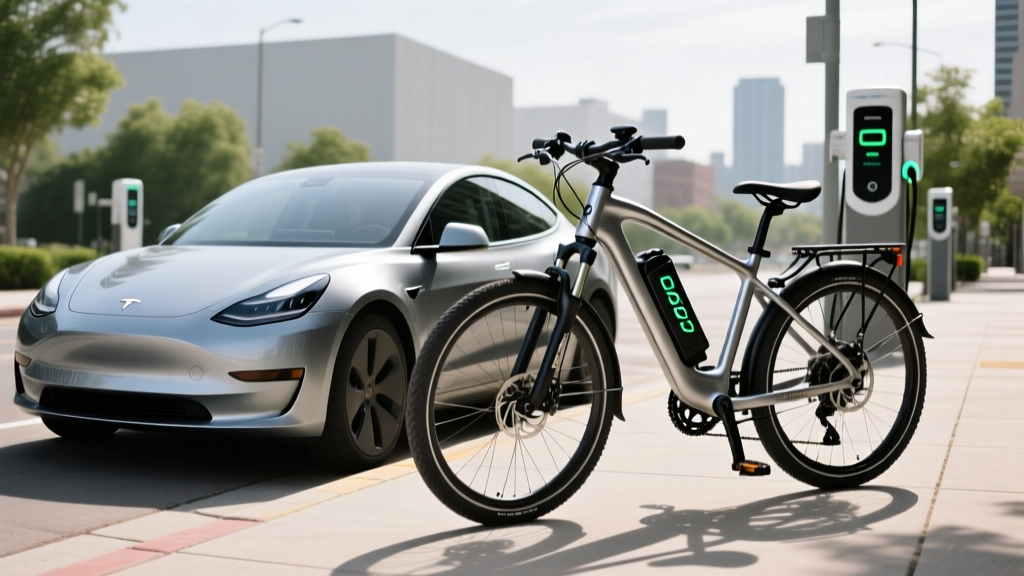
If you're searching for Zugo electric bikes and wondering whether an e-bike or a budget electric car makes more financial sense for your daily commute, here is the direct answer: a Zugo e-bike will almost always cost less upfront and per mile than even the cheapest new EV, but it only replaces a car if your commute is under ~15 miles one-way, you live in a climate that allows year-round cycling, and you don't regularly carry passengers or cargo beyond a backpack and groceries. A used EV like a 2023 Chevrolet Bolt EV still wins on range (259 mi EPA), weather protection, and safety — but at 5–8× the purchase price. The right choice depends entirely on your trip distance, climate, and whether you need a vehicle that can do more than commute.
What Zugo Electric Bikes Actually Offer (2026 Specs)
Zugo Bikes is a US-based e-bike brand best known for the Rhinoceros (a moped-style, step-through commuter) and the Zugo Rhino utility model. These are Class 2 e-bikes with a 750W rear-hub motor, throttle-assist, and a top assisted speed of 20 mph — meaning they are street-legal in most US jurisdictions without a license or registration, though local rules vary.
| Spec | Value |
|---|---|
| Motor | 750W brushless rear hub |
| Top Speed (throttle) | 20 mph (Class 2) |
| Battery | 48V 14Ah (672 Wh), removable lithium-ion |
| Range (pedal-assist) | 40–60 mi (varies by assist level, terrain, rider weight) |
| Range (throttle-only) | 20–30 mi |
| Charge Time (0–100%) | ~4–5 hours (standard 2A charger) |
| Weight | ~75 lbs |
| MSRP | ~$1,899 |
| Warranty | 1 year (frame, motor, battery) |
A 672 Wh battery is roughly equivalent to 0.672 kWh — about 1/100th the usable capacity of a typical EV battery. That's why the e-bike charges from a standard 120V wall outlet in hours, not days, but also why its range is measured in tens of miles, not hundreds.
Zugo E-Bike vs Budget EV: Commuting Cost Breakdown
To make this comparison fair, we're stacking the Zugo Rhinoceros against one of the most affordable new EVs on the US market: a base-trim compact EV in the ~$28,000–$30,000 range (think Chevrolet Bolt–successor class, 250+ mi EPA range). We'll also include a used Bolt EV for buyers open to the pre-owned market.
| Cost Category | Zugo Rhinoceros | New Budget EV (~$29k MSRP) | Used 2023 Bolt EV (~$18k) |
|---|---|---|---|
| Purchase Price | $1,899 | $29,000 | $18,000 |
| Federal Tax Credit (§30D) | N/A (e-bikes excluded) | Up to $7,500 (if eligible*) | Up to $4,000 (used EV credit) |
| Net Purchase | $1,899 | ~$21,500 | ~$14,000 |
| Annual Electricity (3,000 mi/yr) | ~$9/yr ($45 total) | ~$150/yr ($750 total)** | ~$150/yr ($750 total)** |
| Insurance (5 yr) | $0–$600 (optional) | $6,000–$9,000 | $5,000–$7,500 |
| Maintenance (5 yr) | $300–$600 (tires, brakes, chain) | $800–$1,500 (tires, cabin filter, wipers) | $1,000–$2,000 |
| Registration / Title | $0 (most states) | $500–$1,500 | $500–$1,500 |
| 5-Year Total | ~$2,250–$3,150 | ~$29,550–$34,250 | ~$21,250–$25,750 |
* §30D credit eligibility depends on MSRP caps ($55k cars), buyer income limits ($150k single / $300k joint), and battery critical-mineral sourcing. Verify at irs.gov and consult a tax professional. E-bikes do not qualify for §30D.
** Home charging at $0.14/kWh national average; public DC fast charging costs 2–3× more. EV efficiency assumed at ~3.5 mi/kWh (per fueleconomy.gov).
Where the E-Bike Wins — and Where It Doesn't
- Commute is ≤15 mi round-trip
- You have secure bike storage at home and work
- You live in a mild or dry climate (or will ride in rain with gear)
- You already own a car for longer trips / bad weather
- You want near-zero fuel and insurance cost
- You want to avoid EV home charger installation ($500–$2,000+)
- Commute exceeds 15–20 mi one-way
- You need highway speeds (e-bikes cap at 20 mph)
- You carry passengers or large cargo regularly
- You live in an area with harsh winters or frequent heavy rain
- You need crash protection (e-bikes have none — NHTSA does not rate them)
- You want one vehicle to handle all trips, including road trips
Charging Compared: 120V Outlet vs Level 2 vs DC Fast
One reason Zugo e-bikes appeal to apartment dwellers is the removable battery. You pull it off the frame, carry it inside, and plug it into any standard 120V outlet. No electrician, no permit, no panel upgrade. A full 0–100% charge takes 4–5 hours and costs about $0.09 at the national average electricity rate.
For context, here is how that compares to EV charging levels:
| Level | Power (kW) | Zugo E-Bike (672 Wh) | EV (65 kWh battery) |
|---|---|---|---|
| Level 1 (120V wall outlet) | ~1.4 kW | ~30 min (full charge) | ~46 hours (full); ~3–5 mi/hr added |
| Level 2 (240V home/public) | 7.2–11.5 kW | N/A (e-bike charger is ~0.15 kW) | 6–9 hours (full); ~25–40 mi/hr added |
| DC Fast Charging | 50–350 kW | N/A | 10–80% in ~18–35 min (varies by peak kW and taper) |
The Zugo's included charger outputs roughly 150W (0.15 kW). That's trivially low — you could run it off a portable power station. But it also means you are entirely dependent on that one charger. Lose it, and you're buying a $60–$100 replacement from Zugo or a compatible supplier.
Real-World Range: What the Sticker Doesn't Tell You
The claimed 40–60 mile range assumes moderate pedal-assist (Level 2–3 of 5), flat terrain, a ~170 lb rider, and mild temperatures (60–80°F). In practice:
• Throttle-only, hilly, or 200+ lb rider: expect 20–30 mi
• Cold weather (below 40°F): lithium-ion batteries lose 15–30% capacity; expect 25–40 mi on pedal-assist
• Headwinds and stop-and-go: further reduce range by 10–15%
This mirrors EV cold-weather range loss (typically 20–30% below 20°F per AAA testing), just on a smaller absolute scale.
For an EV, the same principle applies at higher numbers. A compact EV rated at 259 mi EPA may deliver 190–210 mi in sustained 75 mph highway driving or 180–200 mi in sub-20°F weather. The percentage loss is similar; the remaining buffer is just much larger on an EV.
Myths and Misconceptions: E-Bikes and EVs
| Myth | Fact |
|---|---|
| "An e-bike can fully replace my car." | Only for solo, short, fair-weather commutes. Most US households still need a car for groceries, passengers, highway trips, and bad-weather days. An e-bike works best as a second-vehicle replacement. |
| "E-bikes don't need insurance." | Most states don't require it for Class 2 e-bikes, but your homeowner's or renter's policy may not cover theft or liability. Dedicated e-bike insurance (e.g., through Velos or Sundae) runs $100–$300/year. |
| "EVs are too expensive to charge." | At $0.14/kWh (US residential average), charging a 65 kWh EV from 10–80% costs about $6.40 — roughly equivalent to 2 gallons of gas for 50–60 miles of driving. Public DC fast charging is more expensive ($0.30–$0.50/kWh) but still typically cheaper per mile than gas. |
| "The e-bike battery will die in 2 years." | Quality lithium-ion e-bike batteries are rated for 500–800 full charge cycles before dropping to 80% capacity. At one charge per day, 5 days/week, that's roughly 3–4 years before noticeable degradation — though Zugo's 1-year warranty is shorter than ideal. |
| "I can get a $7,500 tax credit on any EV." | The §30D credit has strict rules: MSRP caps ($55k for cars, $80k for SUVs/trucks), buyer income limits ($150k single/$300k joint for new; $75k/$150k for used), and battery sourcing requirements. Many EVs qualify for $0–$3,750, not the full $7,500. E-bikes are excluded entirely. Check current rules at irs.gov. |
Decision Framework: Should You Buy a Zugo E-Bike or an EV?
- If your one-way commute is under 10 miles, you have secure bike parking, and you already own or can share a car → buy the Zugo Rhinoceros (~$1,899) and use it for 80%+ of your daily trips.
- If your commute is 10–25 miles one-way but includes bike lanes or paths → consider a longer-range e-bike (look for a dual-battery setup with 1,000+ Wh, $2,500–$3,500) or a used EV if weather is a concern.
- If your commute exceeds 25 miles, involves highways, or you live in a region with harsh winters → buy an EV. The Zugo's 20 mph top speed and 20–30 mi throttle-only range make it impractical for this use case.
- If you're an apartment dweller with no EV charging access and a short commute → the Zugo's removable battery is a genuine advantage. You avoid the $500–$2,000+ cost of Level 2 home charger installation (and potential $1,500–$3,000 panel upgrade).
- If you want one vehicle to do everything — commute, road trips, grocery runs, kid drop-offs → an EV is the only option. No e-bike replaces a car for multi-role use.
First-Time Buyer Checklist: What to Know Before You Buy Either
If You're Buying a Zugo E-Bike:
- Test the weight: At ~75 lbs, the Rhinoceros is heavy. Can you carry it up stairs to your apartment? Can you lift it onto a car rack?
- Check local e-bike laws: Class 2 e-bikes (throttle, 20 mph cap) are legal on most roads and bike paths, but some municipalities restrict them. Check your city/county regulations.
- Budget for accessories: A quality U-lock ($60–$120), helmet ($50–$150), front/rear lights ($30–$80), and fenders ($40–$60) add $200–$400 to the real cost.
- Understand the warranty: Zugo's 1-year warranty is shorter than premium e-bike brands (Rad Power, Lectric offer 1–2 years). A replacement battery costs $400–$600 out of warranty.
- Secure storage is non-negotiable: E-bike theft is rampant. A ground-floor garage or in-unit storage is strongly recommended. GPS trackers (Apple AirTag, $29) are cheap insurance.
If You're Buying Your First EV:
- Confirm home charging feasibility first: Do you have a garage or dedicated parking spot with access to a 240V outlet (or room to install one)? If not, map your nearest reliable public chargers before purchasing. Use AFDC's station locator.
- Check §30D eligibility before you buy: Not every EV qualifies for the full $7,500 credit, and not every buyer meets the income threshold. The point-of-sale transfer option (available since 2024) lets you apply the credit as a down-payment reduction at the dealer — but only if the specific VIN qualifies.
- Understand kW vs kWh: kW is power (how fast energy flows — like a hose's flow rate). kWh is energy (how much is stored — like a tank's size). A 65 kWh battery charged at 11.5 kW takes ~5.6 hours from empty. A 150 kW DC fast charger can refill that same battery to 80% in ~25 minutes.
- Budget for insurance: EV insurance premiums average 15–25% higher than comparable gas cars, according to industry data. Get quotes before you commit.
- Real-world range rule of thumb: Expect ~80–85% of the EPA sticker for mixed highway driving, and ~70–75% in sustained sub-30°F cold weather. A 259 mi EPA rating means ~210–220 mi in realistic summer highway use.
Frequently Asked Questions
Do Zugo electric bikes qualify for any federal tax credit?
No. The §30D Clean Vehicle Credit applies only to four-wheeled motor vehicles. E-bikes are classified as consumer products (CPSC jurisdiction), not motor vehicles. Some states and local utilities offer e-bike rebates (Colorado's e-bike rebate program, for example, offered up to $450 in 2024–2025), but there is no federal incentive as of 2026. Check your state energy office or local utility for current programs.
Can I ride a Zugo e-bike in the rain and winter?
Zugo rates the Rhinoceros for light rain (IPX4-level splash resistance on the motor and controller), but the battery and display connectors are vulnerable to sustained water exposure. In winter, lithium-ion performance drops 15–30% below 40°F, and you'll face cold wind at 15–20 mph without the enclosed, heated cabin a car provides. Many e-bike commuters ride April–October and switch to a car or transit in winter.
How does e-bike electricity cost compare to gas?
At the US average residential rate of ~$0.14/kWh, fully charging the Zugo's 0.672 kWh battery costs about $0.09. Over a year of 3,000 commuting miles, that's roughly $9 in electricity. A gas car averaging 28 MPG at $3.30/gallon would spend about $354 on the same miles. Even a budget EV at ~3.5 mi/kWh would cost about $120/year. The e-bike's energy cost is essentially negligible.
Is a Zugo e-bike safer than an electric car?
No. E-bikes offer zero crash protection — no airbags, crumple zones, or stability control. NHTSA does not crash-test e-bikes. In a collision with a car, the e-bike rider is extremely vulnerable. EVs, by contrast, consistently earn top ratings from IIHS and NHTSA, and their lower center of gravity (battery pack in the floor) reduces rollover risk. Safety is the single biggest trade-off when choosing an e-bike over a car.
How long will the Zugo battery last before I need to replace it?
Zugo uses standard lithium-ion cells rated for approximately 500–800 full charge cycles to 80% remaining capacity. If you charge once per day, 5 days a week, that's roughly 2–3 years before you notice a meaningful range reduction (e.g., 40 mi dropping to 32 mi). A replacement battery costs $400–$600. Store the battery at 40–60% charge if you won't ride for weeks, and avoid leaving it fully charged in hot environments — both practices extend lifespan.
Can a Zugo e-bike replace my second car?
Yes — conditionally. If your second car is used primarily for short solo commutes, errands within 10 miles, and fair-weather trips, a Zugo e-bike can absorb most of those miles. You'll save $3,000–$6,000+ annually on insurance, fuel, registration, and maintenance for that second vehicle. But you still need the primary car for highway driving, bad weather, passengers, and longer trips. Think of the e-bike as a commute-specific tool, not a car replacement.
Sources: EPA fueleconomy.gov for EV efficiency data; IRS §30D Clean Vehicle Credit for tax credit rules; Zugo Bikes manufacturer specifications. E-bike range and cost figures based on manufacturer data and real-world rider reports. Always verify current pricing, specs, and incentive eligibility before purchasing.