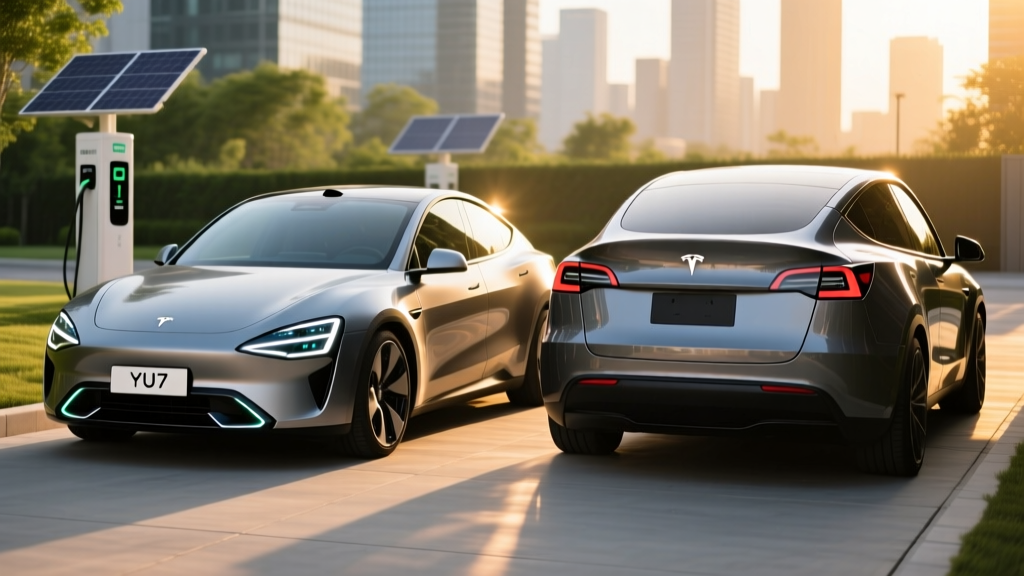
The midsize electric SUV segment just got a new contender. Xiaomi's YU7 — the tech giant's second vehicle after the SU7 sedan — enters the arena aimed squarely at the best-selling EV on the planet: the Tesla Model Y. For buyers weighing a Xiaomi YU7 vs Tesla Model Y comparison, the decision isn't straightforward. Tesla offers a mature charging ecosystem, proven efficiency, and federal tax-credit eligibility in the US. Xiaomi counters with aggressive pricing, smartphone-integrated tech, and a design that punches above its weight class — but with significant availability and support caveats outside China.
This head-to-head breaks down every metric that matters: real-world range, charging speed, performance, interior tech, total ownership cost, and the incentive landscape that can shift the value equation by thousands of dollars.
Side-by-Side Specs: Xiaomi YU7 vs Tesla Model Y
Before we dissect each category, here are the headline numbers. Note: Xiaomi YU7 specs reflect announced Chinese-market configurations as of early 2026. US availability remains unconfirmed, and EPA certification has not been published. Tesla Model Y figures reflect the refreshed 2025/2026 Long Range AWD sold in the US, with EPA data from fueleconomy.gov.
| Specification | Xiaomi YU7 (Long Range AWD) | Tesla Model Y LR AWD |
|---|---|---|
| Battery Capacity (usable) | ~96 kWh (CATL NMC) | ~75 kWh (NMC) |
| Range (CLTC / EPA) | ~508 mi CLTC (~340-360 mi est. EPA equiv.) | 320 mi EPA |
| Efficiency | ~290 Wh/mi (est.) | ~235 Wh/mi (EPA) |
| Peak DC Fast Charge | ~230 kW (est., 800V architecture) | 250 kW (Supercharger) |
| 10–80% DC Charge Time | ~22 min (est.) | ~25 min |
| Level 2 AC Charge Rate | 11 kW | 11.5 kW |
| 0–60 mph | ~4.5 sec (est.) | 4.8 sec |
| Horsepower | ~500 hp (dual motor, est.) | 384 hp |
| Cargo Volume (rear seats up) | ~23 cu ft (est.) | 26 cu ft (+ 4 cu ft frunk) |
| Base MSRP (US equiv.) | ~$38,000 (China pricing converted; US TBD) | $44,990 |
| Federal Tax Credit (§30D) | Not eligible (no US sales) | Up to $7,500 (eligibility varies) |
| Drivetrain | Dual Motor AWD | Dual Motor AWD |
| Battery/Powertrain Warranty | 8 yr / 160,000 km (China) | 8 yr / 120,000 mi |
Range and Efficiency: Who Goes Further on a Charge?
Tesla's efficiency advantage is significant. The Model Y Long Range extracts roughly 4.3 miles per kWh, one of the best figures in the midsize SUV class. Xiaomi's heavier platform (the YU7 rides on a larger, more sedan-derived architecture with a ~96 kWh pack) delivers an estimated 3.4–3.5 miles per kWh. That means the YU7 carries more raw energy but burns it faster.
In practical terms, the gap narrows. On a 250-mile highway trip in 65°F weather, both vehicles arrive with roughly 60–80 miles of remaining range. In winter, the Model Y's heat pump (standard equipment) helps it retain efficiency better than many competitors, though Xiaomi has confirmed a heat pump in the YU7 as well.
Verdict: The YU7 likely edges out total range on paper; the Model Y wins on efficiency per kWh, which matters more for charging cost and long-term energy spend.
Charging Speed and Network Access
Charging is where the Tesla ecosystem creates a tangible ownership advantage — particularly in North America.
| Level | Xiaomi YU7 | Tesla Model Y |
|---|---|---|
| Level 1 (120V, 1.4 kW) | ~4 mi/hr | ~4 mi/hr |
| Level 2 (240V, 11–11.5 kW) | ~33 mi/hr | ~35 mi/hr |
| DC Fast (peak) | ~230 kW / ~180 mi in 15 min | 250 kW / ~200 mi in 15 min |
The Model Y's access to Tesla's Supercharger network — over 6,500 stations and 30,000+ stalls in North America as of 2026 — remains the gold standard for reliability and coverage. While other networks (Electrify America, EVgo, ChargePoint) have expanded, real-world uptime and plug-and-charge simplicity still favor Superchargers.
Xiaomi's YU7 uses a GB/T connector in China. For any hypothetical international market, it would require CCS2 (Europe) or NACS (North America) adaptation. Without confirmed US sales, there is no Xiaomi-branded charging network, and the YU7 would rely entirely on third-party public infrastructure.
On raw charging speed, both vehicles are competitive. The YU7's 800V architecture enables strong sustained charge rates, though the larger battery means a full 10–80% session takes slightly longer in absolute minutes despite comparable peak kW. The Model Y's charge curve tapers noticeably above 80% SoC, so the practical fast-charging window is 10–80% for both.
Performance and Driving Dynamics
The YU7's dual-motor AWD setup is tuned for performance, with an estimated ~500 hp and a 0–60 mph time around 4.5 seconds. That puts it ahead of the Model Y Long Range (384 hp, 4.8 seconds) but behind the Model Y Performance variant (510 hp, 3.5 seconds).
On-road behavior differs in philosophy. Tesla's steering is quick and direct, with firm suspension tuning that prioritizes handling over ride comfort. Xiaomi, based on early SU7 reviews and YU7 previews, leans toward a more comfort-oriented setup with adaptive dampers on higher trims — a deliberate choice to differentiate from Tesla's sporty character.
Regenerative braking on the Model Y is aggressive and effectively enables one-pedal driving. Xiaomi offers adjustable regen levels, which some drivers prefer for a more traditional driving feel.
More horsepower and a marginally quicker 0–60 in base AWD form. However, the Model Y Performance (sold at a higher price point) still outruns it.
More mature platform, proven ride quality, and calibrated suspension tuning refined over multiple model years.
Interior, Tech, and Smart Driving
This is where the Xiaomi YU7 makes its strongest case. Xiaomi's HyperOS ecosystem integrates the vehicle natively with Xiaomi smartphones, tablets, smart home devices, and wearables. The center display runs a full app ecosystem, and the voice assistant handles complex multi-step commands with smartphone-grade responsiveness. Build quality on the SU7 sedan has been praised as premium, with soft-touch materials, ambient lighting, and a minimalist but well-executed dashboard.
The Model Y's interior remains polarizing: ultra-minimalist, with virtually all controls routed through the 15.4-inch center touchscreen. The 2025/2026 refresh added ventilated front seats, power-folding second-row seats, improved sound insulation, and ambient lighting — addressing the most common complaints from owners. Tesla's infotainment is fast and reliable, but the lack of Apple CarPlay or Android Auto continues to frustrate some buyers.
On driver-assistance technology, Tesla offers Autopilot (standard) and Full Self-Driving (Supervised) as an $8,000 add-on or $99/month subscription. FSD (Supervised) is an SAE Level 2 system — it handles steering, acceleration, and braking on highways and some city streets, but the driver must remain fully engaged and hands on the wheel at all times. It is not autonomous driving.
Xiaomi's ADAS uses a lidar-equipped sensor suite (on higher trims) combined with cameras and radar, offering adaptive cruise, lane-keeping, and automated parking. In China, Xiaomi's city-level assisted driving has shown competitive performance in reviews, but it has no regulatory approval or operational mapping for US roads.
HyperOS integration, lidar availability, and a richer app ecosystem — if you're in Xiaomi's device ecosystem.
FSD (Supervised) is the most widely deployed Level 2+ system on American roads, with continuous OTA improvements and extensive mapping.
Pricing, Tax Credits, and the Real Cost to Buy
This is the category where context matters most. Xiaomi's YU7 pricing in China starts at approximately ¥259,900 (~$38,000 USD converted), undercutting the Model Y substantially in that market. But US buyers face a fundamentally different equation.
| Factor | Xiaomi YU7 | Tesla Model Y LR AWD |
|---|---|---|
| Base MSRP | Not available in US | $44,990 |
| Federal §30D Tax Credit | N/A | Up to $7,500 (point-of-sale transfer available) |
| Effective Price After Credit | N/A | From ~$37,490 (if eligible) |
| Income Cap (§30D) | N/A | $150K single / $300K joint AGI |
| MSRP Cap (SUVs) | N/A | $80,000 (Model Y qualifies) |
| Battery Sourcing Req. | N/A | Must meet critical minerals + battery component rules |
The IRS §30D credit has strict eligibility requirements in 2026: buyer income caps, MSRP caps, and battery component/critical mineral sourcing thresholds that change annually. The Tesla Model Y, assembled in Fremont, CA, has historically qualified for the full $7,500 — but battery sourcing rules tighten each year, and eligibility can shift. Always verify current status on the IRS website or with a tax professional before purchasing.
With the full credit applied, the Model Y Long Range AWD drops to approximately $37,490 — essentially matching the YU7's Chinese-market price but with US warranty coverage, Supercharger access, and established service infrastructure.
Ownership Costs: Efficiency, Insurance, and Maintenance
Electric vehicles eliminate oil changes, transmission fluid, and exhaust repairs. But ownership costs diverge in other areas:
- Energy cost: At the US average electricity rate of ~$0.16/kWh, the Model Y costs roughly $3.76 per 100 miles to charge at home. The YU7, with its higher consumption (~290 Wh/mi), would cost approximately $4.64 per 100 miles. Over 15,000 annual miles, that's a ~$132/year advantage for Tesla.
- Insurance: Tesla insurance premiums tend to run 15–30% above segment average due to repair cost data. The Model Y LR AWD averages ~$2,400–$2,800/year nationally. Xiaomi has no US insurance data; if imported, premiums would be unpredictable and likely high due to limited parts availability.
- Maintenance: Tesla's service network is established but can involve long wait times in some metro areas. Cabin air filter replacement, tire rotation, and brake fluid checks run ~$300–$500/year. Xiaomi would have no US service centers, making any maintenance a significant logistical challenge.
- Depreciation: The Model Y holds value reasonably well for an EV (~55–60% retention at 3 years), bolstered by brand recognition and Supercharger access. An unsupported import would depreciate steeply.
Tax credit eligibility, established service, Supercharger access, and predictable insurance make the Model Y the only rational choice for American buyers in 2026.
Aggressive pricing, strong domestic charging infrastructure, and full warranty support make the YU7 a compelling Model Y alternative at home.
Decision Framework: Which Should You Choose?
Choose the Tesla Model Y if:
- You live in the US or Canada and need reliable public charging access today
- You want to claim the §30D federal tax credit (up to $7,500)
- You value an established service network and predictable ownership costs
- You want FSD (Supervised) for highway and city driver assistance
- Resale value and long-term parts availability matter to you
Choose the Xiaomi YU7 if:
- You live in China or a market where Xiaomi officially sells and services vehicles
- You're already deep in the Xiaomi/HyperOS device ecosystem
- You prioritize raw performance specs and a larger battery at a lower price point
- You have reliable home charging and don't depend on public DC fast charging
- You want lidar-equipped ADAS (available on higher trims in China)
Final Recommendation
The Xiaomi YU7 vs Tesla Model Y comparison ultimately depends on geography and infrastructure access. For US buyers in 2026, the Model Y remains the default choice: it's purchasable, tax-credit eligible, backed by the most reliable charging network in North America, and supported by an established service footprint. The effective post-credit price of ~$37,490 makes it competitive with the YU7's Chinese sticker price — but with none of the import, warranty, or support risk.
For buyers in China, the YU7 is a legitimate disruptor. It undercuts the Model Y on price, matches or exceeds it on performance, and leverages Xiaomi's tech ecosystem in ways Tesla cannot replicate in that market. As Xiaomi expands internationally — likely starting with Europe and Southeast Asia — the YU7 could become a serious Model Y rival in markets with robust CCS/NACS charging infrastructure.
Until Xiaomi confirms US market entry with EPA certification, NACS or CCS compatibility, and a service network, American buyers should keep the YU7 on their watchlist — not their shopping list.
Frequently Asked Questions
Is the Xiaomi YU7 available to buy in the United States?
No. As of 2026, Xiaomi has not announced US sales for the YU7 or any vehicle. The YU7 is currently sold in China, with potential European expansion under discussion. US buyers cannot purchase, register, or service a YU7 through official channels.
Which has better real-world range: the YU7 or Model Y?
The YU7's larger ~96 kWh battery likely gives it a modest range advantage in absolute miles (est. 340–360 mi EPA-equivalent vs. the Model Y's 320 mi EPA). However, the Model Y is significantly more efficient per kWh, meaning lower charging costs and less energy waste. In cold weather, both will lose 15–25% of rated range.
Does the Tesla Model Y still qualify for the $7,500 federal tax credit in 2026?
The Model Y has historically qualified for the full §30D credit, but eligibility depends on battery sourcing requirements that tighten annually, plus buyer income limits ($150K single / $300K joint AGI) and the $80,000 SUV MSRP cap. Always check the IRS clean vehicle credit page for current eligibility before purchasing.
Can I charge the Xiaomi YU7 on Tesla Superchargers?
No. In China, the YU7 uses the GB/T standard. Tesla Superchargers in North America use NACS; in Europe, CCS2. Even if the YU7 were sold internationally, adapter compatibility and software authentication would need to be confirmed by Xiaomi.
Which is cheaper to own over 5 years?
For US buyers, the Model Y wins by default — it's the only one you can buy, insure, and service. Among Chinese-market buyers, the YU7's lower purchase price and competitive efficiency give it a likely edge in 5-year total cost, though long-term depreciation data isn't yet available for Xiaomi vehicles.