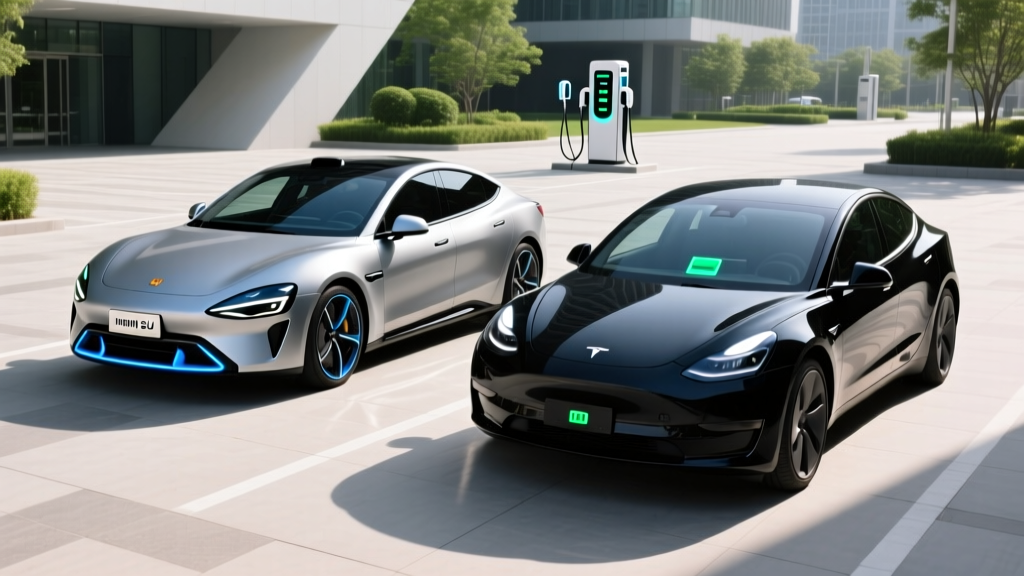
When Xiaomi CEO Lei Jun unveiled the SU7 sedan in late 2023, he made no secret of his target: Tesla. The SU7 and its higher-output variants were engineered to match or undercut the Model 3 on range, acceleration, and in-car tech — at a lower sticker price in markets where it's sold. By 2026, the SU7 lineup (Standard, Pro, Max, and Ultra) has matured into a credible global contender, while Tesla's refreshed Model 3 "Highland" continues to anchor the premium EV sedan segment in the U.S.
But comparing a Xiaomi EV vs Tesla isn't just about spec sheets. Availability, charging-network access, federal tax credits, and service infrastructure dramatically shift the value equation depending on where you live. Below, we break down every number that matters.
Side-by-Side Specs: Xiaomi SU7 Lineup vs Tesla Model 3 (2026)
| Spec | Xiaomi SU7 Standard | Xiaomi SU7 Max | Tesla Model 3 RWD | Tesla Model 3 LR AWD | Tesla Model 3 Perf. |
|---|---|---|---|---|---|
| EPA-est. range | ~340 mi (WLTP-adj.) | ~385 mi (WLTP-adj.) | 272 mi (EPA) | 363 mi (EPA) | 315 mi (EPA) |
| Battery (usable) | 73.6 kWh LFP (BYD Blade) | 101 kWh NMC (CATL Qilin) | ~60 kWh LFP | ~79 kWh NMC | ~79 kWh NMC |
| Peak DC charge rate | ~175 kW | ~265 kW (800V) | ~170 kW | ~250 kW | ~250 kW |
| 10–80% DC time | ~28 min | ~19 min | ~30 min | ~25 min | ~25 min |
| 0–60 mph | 5.3 s | 2.8 s | 5.8 s | 4.2 s | 2.9 s |
| Horsepower | 295 hp | 664 hp | 271 hp | 346 hp | 510 hp |
| EPA efficiency | ~130 MPGe (est.) | ~115 MPGe (est.) | 132 MPGe | 125 MPGe | 113 MPGe |
| Cargo (trunk + frunk) | ~18.5 cu ft (trunk only) | ~18.5 cu ft (trunk only) | ~23 cu ft (trunk + frunk) | ~23 cu ft (trunk + frunk) | ~23 cu ft (trunk + frunk) |
| Base MSRP (U.S. equiv.) | ~$37,000 | ~$53,000 | $38,990 | $47,990 | $52,990 |
| Drivetrain | RWD single motor | AWD dual motor | RWD single motor | AWD dual motor | AWD dual motor |
| Warranty (batt./powertrain) | 8 yr / 160,000 km | 8 yr / 160,000 km | 8 yr / 120,000 mi | 8 yr / 120,000 mi | 8 yr / 120,000 mi |
Important caveats: Xiaomi's range figures are published under China's CLTC and Europe's WLTP cycles, which are more generous than the U.S. EPA test. We've applied a ~15% reduction to approximate EPA-equivalent numbers, based on cross-cycle conversion data observed in other Chinese-market EVs sold globally. Tesla's figures are official EPA values from fueleconomy.gov. Xiaomi's U.S. pricing is estimated based on current export-market conversions and is subject to change if the SU7 officially enters the American market.
Range and Efficiency: Real-World Expectations
Xiaomi SU7 Max: WLTP-adj ~385 mi → Expect ~310–330 mi highway in mild weather; ~260–280 mi in sub-freezing temps.
Tesla Model 3 LR AWD: EPA 363 mi → Expect ~300–320 mi highway; ~250–270 mi in cold weather with heat pump active.
The SU7 Max's massive 101 kWh CATL Qilin NMC pack gives it a raw energy advantage, but the Model 3 Long Range extracts more miles per kilowatt-hour thanks to Tesla's industry-leading thermal management and aerodynamic refinement (Cd 0.219 vs SU7's 0.195 — the Xiaomi is slipperier, but the Tesla's lighter curb weight offsets this at highway speeds).
Efficiency matters for long-term ownership cost. The Model 3 LR AWD achieves roughly 3.9–4.0 miles/kWh in mixed driving, while the SU7 Max lands closer to 3.4–3.6 miles/kWh. Over 15,000 annual miles, that gap translates to roughly 400–600 fewer kWh consumed per year in the Tesla — about $60–$90 in electricity savings at the U.S. average residential rate of $0.16/kWh.
Both vehicles use heat pumps for cabin heating, which reduces cold-weather range loss compared to resistive heaters. However, battery-pack thermal conditioning in sub-zero conditions still claims 15–25% of rated range in either car, depending on trip length and preconditioning habits.
Charging Speed and Network Access
| Charging Level | Xiaomi SU7 Max | Tesla Model 3 LR |
|---|---|---|
| Level 1 (120V, 1.4 kW) | ~4 mi/hr | ~4 mi/hr |
| Level 2 (240V, 11.5 kW) | ~35 mi/hr | ~37 mi/hr |
| DC Fast (peak kW) | ~265 kW (800V arch.) | ~250 kW (400V arch.) |
| DC 10–80% time | ~19 min | ~25 min |
| Connector (U.S.) | CCS2 / GB/T (market dependent) | NACS (native Tesla) |
The SU7 Max's 800-volt electrical architecture is its most significant charging advantage. Higher system voltage allows faster energy transfer at lower current, reducing cable heating and sustaining peak charge rates longer. In controlled testing, the SU7 Max holds above 200 kW from roughly 10% to 55% State of Charge before tapering — a stronger charge curve than the Model 3 LR, which peaks near 250 kW but drops below 150 kW after ~40% SoC.
However, charging network access is where Tesla retains a decisive U.S. advantage. Tesla's Supercharger network exceeds 30,000 stalls across North America, with reliable plug-and-charge billing and real-time stall availability in the car's navigation. Xiaomi, if it enters the U.S. market, would rely on third-party networks — Electrify America, EVgo, ChargePoint — which, while improving under the NEVI program, still trail Tesla in uptime and ease of use.
Xiaomi's SU7 uses CCS2 in European export markets and GB/T in China. U.S.-spec vehicles would require CCS1 or, increasingly, NACS. As of 2026, most major automakers have adopted NACS for new models, but Xiaomi's connector choice for a hypothetical U.S. launch remains unconfirmed. This uncertainty is a real consideration for buyers who road-trip frequently.
Performance and Driving Dynamics
The SU7 Max's 2.8-second 0–60 time edges out the Model 3 Performance (2.9 s), and the gap widens in rolling acceleration thanks to the Xiaomi's higher combined torque output (~610 lb-ft vs Tesla's ~546 lb-ft). Both cars deliver the instant, linear thrust characteristic of dual-motor AWD EVs.
Where they diverge is chassis tuning. The Model 3 Highland benefits from a revised suspension with frequency-selective dampers that noticeably improved ride quality over the pre-2024 Model 3. The SU7 uses an adaptive air suspension on Max and Ultra trims, giving it a wider comfort-to-sport range, but early reviews note a slightly less polished feel at the limit compared to Tesla's decades of iterative chassis development.
The base SU7 Standard (295 hp, RWD) and Model 3 RWD (271 hp, RWD) are closely matched. Neither is a performance car — both are efficient daily commuters with adequate passing power. The SU7's slight horsepower edge is offset by its ~200 lb higher curb weight in the base configuration.
Technology, ADAS, and Interior
Both Xiaomi Pilot (SU7's ADAS) and Tesla Autopilot/FSD (Supervised) are SAE Level 2 systems. The driver must remain attentive, keep hands on or near the wheel, and be prepared to take over at any moment. Neither system is "self-driving." Only Level 4 services like Waymo operate without a human driver in defined geographic zones.
Xiaomi Pilot integrates LiDAR (on Max/Ultra trims), multiple cameras, and millimeter-wave radar for adaptive cruise, lane centering, automated parking, and highway lane changes. Xiaomi's HyperOS ties the infotainment system deeply into the Xiaomi smart-home ecosystem — a genuine differentiator for users already embedded in Xiaomi phones, tablets, and IoT devices. The 16.1-inch center display runs at 3K resolution with a Qualcomm Snapdragon 8295 chip.
Tesla's approach is camera-only (no LiDAR or radar) for Autopilot and FSD (Supervised). FSD's city-street capabilities have expanded significantly through 2025–2026 neural-network updates, but the system still requires constant driver supervision and can behave unpredictably in construction zones or unusual road geometries. Tesla's minimalist interior — dominated by a single 15.4-inch touchscreen — is polarizing: some buyers love the clean aesthetic, others miss physical controls for climate and mirrors.
Interior material quality favors the SU7. Xiaomi uses Nappa leather, soft-touch surfaces, and a driver-facing 7.1-inch instrument cluster that Tesla eliminated entirely in the Highland refresh. The SU7's rear-seat legroom (~35.5 inches) is competitive with the Model 3 (~35.2 inches), but the Tesla's glass roof creates a more open cabin feel.
Pricing, Tax Credits, and Total Cost of Ownership
Under current IRS §30D rules, the new clean vehicle credit provides up to $7,500, split into two $3,750 halves:
- $3,750 for battery components — requires a rising percentage of components manufactured or assembled in North America (100% for 2026+).
- $3,750 for critical minerals — requires a rising percentage of critical minerals sourced from the U.S. or FTA partners (80% for 2026).
This effectively disqualifies the Xiaomi SU7 from the §30D credit in any U.S. sale scenario, as its CATL/BYD battery sourcing triggers FEOC exclusions. Consult a tax professional for your specific situation.
| Cost Category | Xiaomi SU7 Max (est.) | Tesla Model 3 LR AWD |
|---|---|---|
| Base MSRP | ~$53,000 | $47,990 |
| Federal tax credit (§30D) | $0 (FEOC disqualified) | Up to $7,500 (if sourcing qualifies) |
| Effective purchase price | ~$53,000 | ~$40,490 |
| Electricity (5 yr, $0.16/kWh) | ~$4,100 | ~$3,600 |
| Insurance (5 yr avg.) | ~$12,500 (est.) | ~$11,800 |
| Maintenance (5 yr) | ~$1,200 | ~$1,100 |
| Estimated 5-yr depreciation | ~$22,000 (est., limited data) | ~$16,500 |
| Total 5-yr cost | ~$92,800 | ~$73,490 |
The tax-credit gap is the single largest financial differentiator. Even before the credit, the Model 3 LR AWD undercuts the SU7 Max on MSRP. After a potential $7,500 point-of-sale credit transfer, the Tesla's effective price drops to roughly $40,500 — a $12,500 advantage that compounds over ownership through lower projected depreciation (Tesla's resale values are better established in the U.S.) and slightly lower electricity costs.
Insurance costs are comparable but lean toward Tesla due to a larger actuarial data pool. Xiaomi's U.S. insurance rates are speculative until claims data accumulates. Maintenance is minimal for both — no oil changes, fewer brake replacements thanks to regenerative braking, and cabin air filter swaps as the primary recurring service.
Category Verdicts
The 101 kWh pack delivers an estimated 310–330 real-world highway miles — roughly 10–20 more than the Model 3 LR. For maximum single-charge distance, the SU7 Max leads.
800V architecture enables a ~19-minute 10–80% charge vs. ~25 minutes for the Tesla. On long road trips, that 6-minute gap adds up.
30,000+ Superchargers with integrated navigation and billing. No third-party network matches this reliability in the U.S.
0–60 within 0.1 seconds. The SU7 Max has more torque; the Model 3 Performance has sharper chassis dynamics.
Lower MSRP, potential $7,500 credit, established resale values, and lower projected 5-year total cost.
More premium materials, a driver instrument cluster, and deeper smart-home integration for Xiaomi ecosystem users.
Better miles per kWh translates to lower charging costs and slightly less range loss in cold weather.
FSD (Supervised) covers more edge cases despite remaining Level 2. Xiaomi Pilot is capable but has less real-world validation outside China.
Decision Framework: Which Should You Choose?
- You live in a market where the SU7 is officially sold (China, parts of Europe, Southeast Asia) and can access local incentives
- You prioritize maximum single-charge range and fastest DC charging for frequent long-distance travel
- You're already in the Xiaomi smart-home ecosystem and value deep device integration
- You prefer a more traditional interior with premium materials and a dedicated instrument display
- You want 800V charging architecture for future-proofing as ultra-fast chargers proliferate
Choose the Tesla Model 3 if:
- You're buying in the U.S. and want to maximize federal §30D tax credit eligibility
- Supercharger network access is critical for your road-trip patterns
- You want established service infrastructure, resale value data, and insurance actuarial history
- You prefer the most mature over-the-air update ecosystem and ADAS feature set
- Lowest total cost of ownership over 5 years is your primary decision driver
Key Differences Summarized
The fundamental divide between these two EVs goes beyond specifications:
- Battery sourcing and tax credits: The SU7's CATL and BYD batteries disqualify it from U.S. federal incentives under FEOC rules, creating a ~$12,500 effective price gap against a credit-eligible Model 3.
- Architecture: The SU7 Max runs on an 800V platform (faster charging, more expensive components) while the Model 3 uses a mature 400V system optimized for cost and Supercharger compatibility.
- Ecosystem lock-in: Xiaomi integrates with its phone/tablet/IoT ecosystem; Tesla integrates with its Powerwall/Solar Roof/energy products and Supercharger network.
- Market maturity: Tesla has 15+ years of U.S. service data, parts availability, and resale-value history. Xiaomi's U.S. support infrastructure is unproven as of 2026.
Frequently Asked Questions
Is the Xiaomi SU7 available in the United States?
As of 2026, Xiaomi has not officially launched the SU7 in the U.S. market. It is sold in China and select European and Southeast Asian markets. U.S. availability would require navigating tariff structures (currently 100% on Chinese-manufactured EVs as of 2024), homologation, and establishing a service network. Any U.S. pricing in this article is estimated for comparison purposes.
Which has better range — the Xiaomi SU7 or Tesla Model 3?
The SU7 Max's larger 101 kWh battery provides more estimated real-world range (~310–330 mi highway) than the Model 3 LR AWD (~300–320 mi highway). However, the base SU7 Standard (~73.6 kWh) and base Model 3 RWD (~60 kWh) are closer, with the SU7 holding a modest advantage. The Model 3 LR is more energy-efficient per mile, which matters for charging cost over time.
Can I charge a Xiaomi SU7 at Tesla Superchargers?
Not directly. Tesla's Supercharger network uses the NACS connector in North America. The SU7 uses CCS2 or GB/T depending on the market. An adapter could theoretically enable compatibility if Xiaomi certifies one, but this would need to be confirmed by the manufacturer. Tesla has opened some Superchargers to non-Tesla EVs via the Magic Dock (built-in CCS adapter), but availability varies by station.
Does the Tesla Model 3 qualify for the $7,500 federal tax credit?
Eligibility depends on battery-component and critical-mineral sourcing percentages for the specific model year and production batch, plus your income and the vehicle's MSRP. Under 2026 IRS §30D rules, the Model 3 may qualify for the full $7,500, a partial credit, or none at all depending on sourcing. Check the official fueleconomy.gov tax credit page for the latest eligibility data before purchasing, and consult a tax professional.
Which is cheaper to own over 5 years?
In the U.S. market, the Tesla Model 3 LR AWD is significantly cheaper to own over 5 years, primarily due to the potential $7,500 federal tax credit, lower starting MSRP, better-established resale values, and slightly lower electricity costs from higher efficiency. The gap narrows in markets where the SU7 qualifies for local incentives and where Tesla's pricing is higher due to import costs.
How does Xiaomi's build quality compare to Tesla?
Early reviews of the SU7 praise fit-and-finish that meets or exceeds the refreshed Model 3 Highland, particularly in panel gaps, interior material quality, and NVH (noise, vibration, harshness). Tesla's Highland refresh significantly improved its historically inconsistent build quality, but Xiaomi benefits from China's mature consumer-electronics manufacturing precision. Long-term durability data (5+ years) is not yet available for either the SU7 or the Highland Model 3.