The Short Answer: What Is the "Wrangler EV" in 2026?
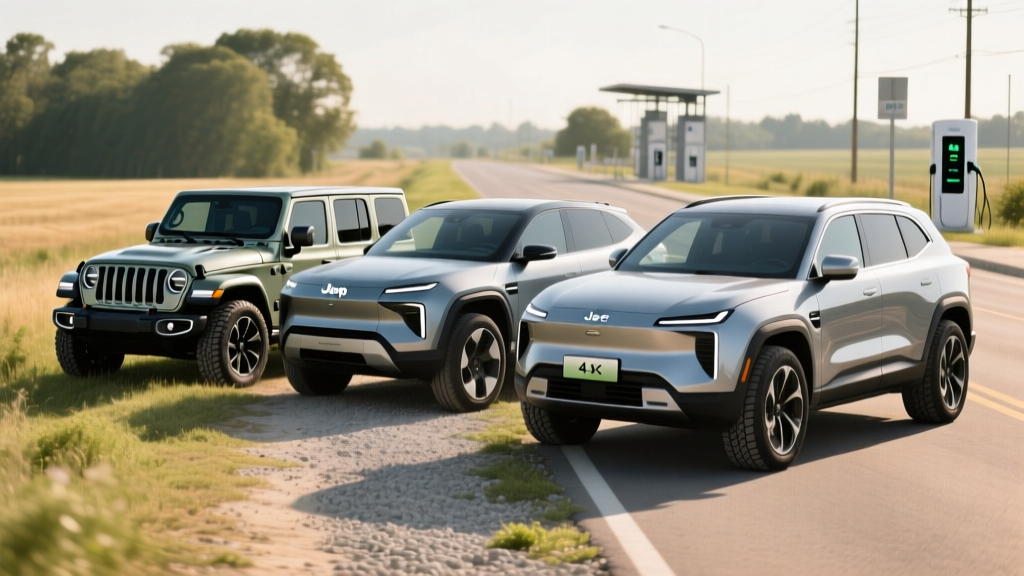
There is no vehicle officially badged "Wrangler EV." Shoppers searching for a wrangler ev are typically weighing two real options from Jeep: the 2026 Jeep Recon, an all-electric midsize SUV built on the STLA Large platform with a removable roof and doors and an EPA-estimated range of roughly 300 miles, and the 2026 Jeep Wrangler 4xe, a plug-in hybrid with 21 miles of electric-only range and a combined 375 hp. The Recon starts near $55,000 and may qualify for partial federal incentives depending on battery sourcing; the 4xe starts around $51,000 and qualifies for the $3,750 credit under current §30D rules. If your priority is zero-tailpipe-electric daily driving with real off-road chops, the Recon is the closer analog to a "Wrangler EV." If you want electric commuting flexibility without range anxiety on remote trails, the 4xe PHEV remains the pragmatic pick.
2026 Jeep Recon: The Closest Thing to a Wrangler EV
The Recon is Jeep's first purpose-built electric off-roader, riding on Stellantis' STLA Large BEV architecture. It carries the Wrangler's design DNA—seven-slot grille, removable doors and roof panels, solid rear axle—but ditches the internal combustion engine entirely.
| Spec | 2026 Jeep Recon (Estimated/Preliminary) |
|---|---|
| Battery Capacity | ~100 kWh usable (NMC chemistry) |
| EPA Range | ~300 mi (Overland trim); ~280 mi (Moab trim, larger tires) |
| Drivetrain | Dual-motor AWD, Selec-Terrain, electronic locking diffs |
| Horsepower | ~400 hp combined |
| 0-60 mph | ~5.0 sec (est.) |
| Max DC Fast Charge | ~175 kW peak (10-80% in ~28 min) |
| Level 2 Charge Rate | 11.5 kW (~30 mi/hr added) |
| Ground Clearance | ~10.5 in (est.) |
| Towing Capacity | ~3,500 lbs (est.) |
| Base MSRP | ~$55,000 (before incentives) |
| Battery/Powertrain Warranty | 8 yr / 100,000 mi |
Real-World Range Reality: The EPA-estimated 300-mile figure assumes moderate temperatures and mixed driving. Expect 240–260 miles on sustained 70-mph highway runs, and as low as 190–210 miles in sub-freezing weather where battery preconditioning and cabin heat draw heavily from the pack. Boxier aero profiles like the Recon's suffer disproportionate highway efficiency loss compared to sleeker crossovers.
Charging speed matters off-road. The Recon's ~175 kW peak DC rate is adequate but not class-leading. Expect a sustained rate closer to 120–140 kW through the 20–60% state-of-charge window before the curve tapers sharply past 80%. On a road trip to Moab or the Rubicon Trail, plan 30-minute charge stops rather than the 18-minute stops that Hyundai/Kia's 800V architecture enables.
2026 Jeep Wrangler 4xe: The PHEV Alternative
The Wrangler 4xe pairs a 2.0L turbocharged four-cylinder with two electric motors and a 17.3 kWh battery pack. It delivers 21 miles of EPA-rated electric-only range—enough for most daily commutes—plus a total system range exceeding 350 miles when the gas engine kicks in.
| Metric | 2026 Jeep Recon (BEV) | 2026 Wrangler 4xe (PHEV) | 2026 Wrangler Gas (3.6L V6) |
|---|---|---|---|
| Powertrain | Dual-motor BEV | 2.0L Turbo + 2 e-motors | 3.6L V6 Mild Hybrid |
| Electric-Only Range | ~300 mi | 21 mi | 0 mi |
| Total Range | ~300 mi | ~370 mi combined | ~330 mi |
| Combined Efficiency | ~85 MPGe | 49 MPGe (elec+gas) / 20 MPG (gas-only) | 20 MPG |
| HP / Torque | ~400 hp / ~450 lb-ft | 375 hp / 470 lb-ft | 285 hp / 260 lb-ft |
| 0-60 mph | ~5.0 sec | 6.0 sec | 7.3 sec |
| Starting MSRP | ~$55,000 | ~$51,000 | ~$37,000 |
| Federal Tax Credit (2026) | Up to $7,500 (sourcing-dependent) | $3,750 (§30D PHEV) | None |
| Home Charging Need | Strongly recommended | Helpful but not essential | N/A |
The 4xe's 17.3 kWh battery charges fully on a standard 120V outlet overnight (Level 1 at ~1.4 kW takes roughly 12 hours), or in about 2 hours on a Level 2 home charger. For a buyer without home charging access, the 4xe's gas fallback eliminates the dependency on charging infrastructure that the Recon demands.
Cost of Ownership: Recon BEV vs Wrangler 4xe vs Gas Wrangler
Purchase price is only the entry point. The table below models five-year total cost of ownership assuming 15,000 miles per year, a national average electricity rate of $0.16/kWh, and a gas price of $3.40/gallon.
| Cost Category (5 Years) | Recon BEV | Wrangler 4xe PHEV | Wrangler Gas V6 |
|---|---|---|---|
| Purchase Price (base) | $55,000 | $51,000 | $37,000 |
| Federal Tax Credit | -$7,500 (if eligible) | -$3,750 | $0 |
| Net Purchase | $47,500 | $47,250 | $37,000 |
| Fuel/Energy (75,000 mi) | ~$5,400 | ~$7,200 (mixed EV/gas) | ~$12,750 |
| Maintenance | ~$1,800 | ~$3,500 | ~$4,200 |
| Insurance (est.) | ~$12,500 | ~$11,000 | ~$9,500 |
| Estimated Resale Value | -$22,000 | -$23,000 | -$20,000 |
| 5-Year Net Cost | ~$45,200 | ~$45,950 | ~$43,450 |
The BEV and PHEV converge on five-year cost despite the gas Wrangler's lower sticker, largely thanks to fuel savings and tax credits. The Recon's higher insurance premiums (common for BEVs due to battery replacement costs in collision claims) narrow the gap. According to fueleconomy.gov, the Wrangler gas V6's 20 MPG combined yields an annual fuel cost near $2,550; the 4xe running 70% of miles on electricity drops to roughly $1,440/year.
Home Charging Installation Reality
Most Recon buyers will want a Level 2 home charger. Budget $800–$1,500 for a quality 48-amp hardwired unit (ChargePoint Home Flex, Emporia V2, or Wallbox Pulsar Plus) plus $600–$2,000 for electrician labor depending on panel proximity. If your home has a 100-amp service panel and it's already near capacity, a panel upgrade to 200 amps can add $1,500–$3,500. The 4xe, by contrast, charges adequately on a standard 120V outlet for its small 17.3 kWh pack, sidestepping the installation cost entirely for budget-conscious buyers.
Common Misconceptions About a Wrangler EV
| Myth | Fact |
|---|---|
| "The Wrangler EV is called the Recon and it's already on sale." | The Recon is a separate model sharing Wrangler DNA but not the Wrangler badge. Check jeep.com for current availability and ordering status. |
| "An electric Jeep can't handle real off-road trails." | Electric motors deliver instant torque at zero RPM—ideal for rock crawling. The Recon is expected to offer electronic locking differentials, Selec-Terrain modes, and comparable ground clearance. The challenge isn't capability; it's range depletion on technical trails and remote charging access. |
| "I'll get the full $7,500 federal tax credit." | The §30D credit requires meeting critical-mineral and battery-component sourcing thresholds, MSRP caps ($80,000 for SUVs), and buyer income limits ($300K joint / $150K single). Per IRS guidelines, eligibility varies by vehicle build date and supply chain. Consult a tax professional. |
| "EV batteries need replacing every 5 years." | Modern NMC and LFP packs are warrantied for 8 years/100,000 miles with a 70% capacity retention floor. Real-world data from high-mileage BEVs shows 10–15% degradation at 150,000 miles—far from replacement territory. |
| "The 4xe is basically the same as a gas Wrangler." | The 4xe's instant electric torque (470 lb-ft) transforms low-speed trail manners and daily acceleration. Its 21-mile EV range covers most commutes silently and emissions-free at home. |
Real-World Ownership: What First-Time EV Buyers Should Know
If you're considering the Recon as your first BEV, these practical factors will shape your experience more than any spec sheet:
- Charging deserts are real. Rural trailheads in Utah, Colorado, and the Sierras may have zero DC fast chargers within 50 miles. Plan off-road trips around charging maps (PlugShare, A Better Routeplanner) and carry a portable Level 1/2 EVSE for emergency top-ups at campgrounds with 240V dryer outlets.
- Cold weather cuts range 20–35%. The Recon's boxy shape and heavy weight amplify this. If you live in the Mountain West or Northeast, size your expectations for 200–230 miles in January, not 300.
- Towing obliterates range. Pulling a 3,000-lb trailer can reduce range by 40–50%. A Recon rated at 300 miles solo may deliver 150–170 miles while towing at highway speeds.
- Off-road driving drains batteries faster. Low-range crawling, sand, and mud demand sustained high-current draw. Expect 1.5–2.0 kWh/mile on technical trails versus 0.33 kWh/mile on pavement.
- Public charging reliability varies. Electrify America and EVgo networks average 85–90% uptime. Always have a backup charging location within 15 miles of your primary option.
Decision Framework: Which "Wrangler EV" Is Right for You?
Choose the Jeep Recon (BEV) If:
- You have reliable Level 2 home charging (garage or driveway with a 240V circuit)
- Your daily driving is under 100 miles round-trip and you want zero gas expenses
- You're committed to reducing tailpipe emissions and can accept range planning on road trips
- You want the latest drivetrain tech with instant torque and one-pedal driving on trails
- Your household has a second gas or hybrid vehicle for remote trips
Choose the Wrangler 4xe (PHEV) If:
- You lack home charging access or live in an apartment without EV infrastructure
- You regularly drive to remote trailheads far from charging stations
- You want electric commuting but need 370+ mile total range for weekend adventures
- You want to avoid the higher insurance premiums and steeper depreciation uncertainty of a full BEV
- Your budget tops out near $50,000 after credits and you need a proven platform with years of Wrangler aftermarket support
Stick With the Gas Wrangler If:
- You live in a region with sparse public charging and no feasible home charging option
- You tow frequently and need maximum range flexibility without planning charge stops
- Your budget prioritizes lowest purchase price over long-term operating costs
Frequently Asked Questions
Is there a Jeep Wrangler that is fully electric?
Not under the Wrangler badge. The closest equivalent is the Jeep Recon, an all-electric SUV on the STLA Large platform that shares Wrangler styling cues and off-road hardware but is a distinct model. Stellantis has not announced a battery-electric variant wearing the Wrangler nameplate as of early 2026.
Can the Jeep Recon handle the Rubicon Trail?
Jeep has engineered the Recon with off-road intent—locking differentials, high ground clearance, and underbody protection are expected. The limiting factor on remote trails like the Rubicon is energy, not capability. Completing the trail (roughly 22 miles of extreme terrain) will consume significant battery. You'll need a charge strategy to reach and depart the trailhead, as DC fast chargers are scarce in the Sierra Nevada backcountry.
Does the Wrangler 4xe qualify for the $7,500 federal tax credit?
As of 2026, the Wrangler 4xe qualifies for a $3,750 credit under §30D, reflecting partial compliance with battery sourcing requirements. The full $7,500 requires meeting both critical-mineral and battery-component thresholds. Income caps ($300K joint, $150K single) and the $80,000 SUV MSRP cap also apply. Verify current eligibility on fueleconomy.gov before purchasing, as sourcing rules shift with supply chain changes.
How much does it cost to charge the Recon at home vs. public fast chargers?
At $0.16/kWh (national residential average), a full 100 kWh charge costs about $16 and delivers ~300 miles—roughly $0.053/mile. Public DC fast charging at $0.40–$0.55/kWh raises that to $40–$55 per full charge, or $0.13–$0.18/mile. For context, the gas Wrangler at 20 MPG and $3.40/gallon costs $0.17/mile. Home charging is the economic sweet spot; frequent public fast charging narrows the cost advantage over gas.
Will the Recon's removable doors and roof affect efficiency?
Yes. Removing doors and roof panels increases aerodynamic drag, which can reduce highway range by 5–10%. At 70 mph, aero losses dominate energy consumption. For maximum range on road trips, keep the roof and doors installed. For around-town summer cruising, the open-air experience trades a modest amount of range for the classic Jeep experience.