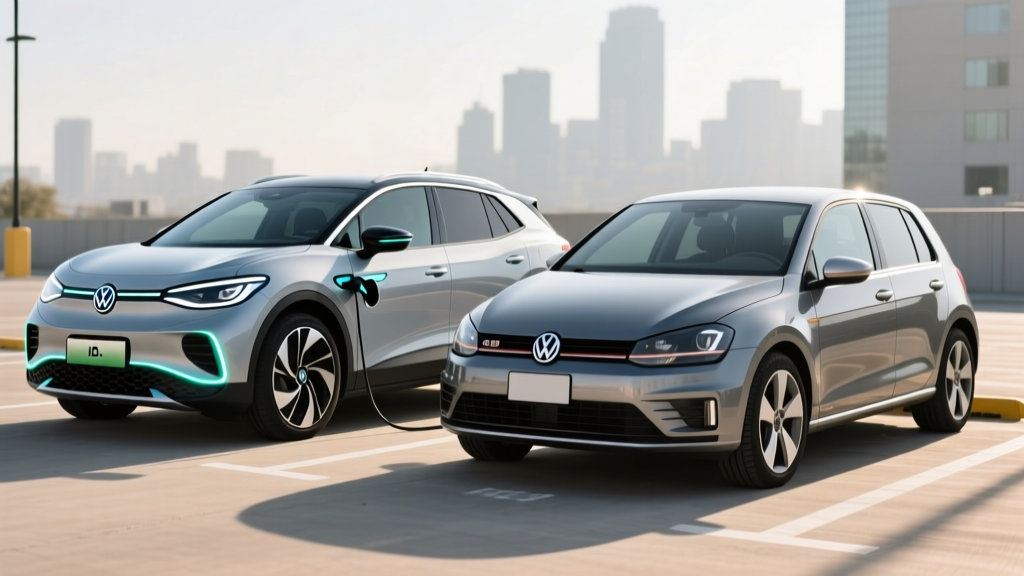
The short answer: If you're searching for a "golf electric" equivalent in 2026, Volkswagen no longer sells a battery-electric Golf in the United States. The closest VW EV in spirit and price is the 2026 Volkswagen ID.4, a compact crossover starting at $38,995 with an EPA-estimated 291 miles of range (Pro trim, RWD). Compared to a used gas Golf or a new compact hatchback, the ID.4 costs more upfront but can save $800–$1,400 per year in fuel and maintenance if you charge mostly at home. If you specifically need a hatchback form factor, your best electric alternatives are the Chevrolet Equinox EV (319 mi EPA, from $33,600) or the Hyundai Ioniq 5 (318 mi EPA, from $42,600).
Why There's No Electric Golf in America (And What Replaced It)
Volkswagen discontinued the e-Globally after the 2019 model year. That car offered just 125 miles of EPA range and a 35.8 kWh battery — respectable for 2016, but thoroughly outclassed by 2026 standards. VW's global EV strategy pivoted to the MEB platform, producing the ID.3 hatchback (sold in Europe) and the ID.4 crossover (sold globally, built in Chattanooga, Tennessee for the US market).
The practical result: American buyers who want a VW electric vehicle in the Golf's approximate price class are steered toward the ID.4. It's larger, heavier, and more expensive than a Golf, but it delivers the range and DC fast-charging speed that modern EV buyers demand.
Spec Comparison: ID.4 vs Gas Golf vs Equinox EV
To understand the real trade-offs, here's how the ID.4 stacks up against the last gas Golf sold in the US (2021 model year) and a leading compact EV alternative:
| Spec | 2026 VW ID.4 Pro (RWD) | 2021 VW Golf 1.4T (Gas) | 2026 Chevy Equinox EV LT |
|---|---|---|---|
| Base MSRP | $38,995 | $23,195 (discontinued) | $33,600 |
| EPA Range | 291 miles | ~370 miles (14.5 gal × 26 MPG combined) | 319 miles |
| Energy Capacity | 82 kWh usable (NMC) | 14.5-gallon tank | 85 kWh usable (NMC) |
| Efficiency | 107 MPGe combined | 29 MPG combined | 117 MPGe combined |
| Horsepower | 282 hp | 147 hp | 213 hp |
| 0–60 mph | 7.3 sec | 7.7 sec | 7.9 sec |
| DC Fast Charge (peak) | 170 kW | N/A | 150 kW |
| 10–80% DC Charge | ~28 min | N/A | ~32 min |
| Level 2 Charge Rate | 11 kW (AC) | N/A | 11.5 kW (AC) |
| Cargo Volume | 30.3 cu ft | 19.9 cu ft | 26.4 cu ft |
| Battery Warranty | 8 yr / 100,000 mi | N/A | 8 yr / 100,000 mi |
Sources: fueleconomy.gov, Volkswagen USA, Chevrolet
Real-World Range: What the EPA Sticker Doesn't Tell You
EPA sticker: 291 miles (ID.4 Pro RWD)
Real-world highway (70–75 mph, moderate climate): ~235–255 miles
Real-world winter (30°F, highway): ~190–215 miles
Why the gap? EV efficiency drops at sustained highway speeds (aerodynamic drag scales with the square of velocity) and in cold weather (battery heating demands energy, and cabin heat draws from the pack unless a heat pump is equipped — the 2026 ID.4 Pro S includes one, the base Pro does not).
If your commute is under 60 miles round-trip and you can charge at home, even winter range is a non-issue — you'll start every morning with a full battery. The range gap matters primarily for road trips exceeding 200 miles between charging stops.
Cost Breakdown: 5-Year Ownership
The upfront price gap between an EV and a gas car is real, but operating costs tell a different story. Below is a 5-year / 75,000-mile projection assuming $3.50/gallon gas, $0.14/kWh home electricity (national average), and a mix of 80% home / 20% public DC charging:
| Cost Category | 2026 VW ID.4 Pro | Gas Compact Hatchback (30 MPG) |
|---|---|---|
| Purchase Price (base MSRP) | $38,995 | $26,000 |
| Federal Tax Credit (§30D) | Up to $7,500 (see eligibility below) | $0 |
| Effective Purchase Price | ~$31,495 | $26,000 |
| Fuel/Energy (75,000 mi) | $3,150 (home) – $4,800 (public-heavy) | $8,750 |
| Maintenance (oil, filters, brakes) | ~$800 | ~$2,900 |
| Insurance (5-yr avg) | ~$9,200 | ~$7,400 |
| 5-Year Total (est.) | $44,645 – $46,295 | $45,050 |
Key takeaway: With the full §30D credit and home charging, the ID.4 breaks even or beats a gas hatchback over five years. Without the credit or if you rely entirely on public DC fast charging ($0.35–$0.50/kWh), the EV costs more.
Federal Tax Credit Eligibility (§30D) — 2026 Rules
- MSRP cap: SUVs/crossovers must be under $80,000 (ID.4 qualifies)
- Buyer income cap: AGI ≤ $150,000 single / $300,000 joint
- Battery sourcing: Critical minerals and battery components must meet phased-in domestic/free-trade sourcing thresholds — the ID.4's Chattanooga-built pack currently meets partial requirements, yielding a variable credit amount ($3,750–$7,500 depending on VIN and sourcing)
- Point-of-sale transfer: You can apply the credit as a down-payment reduction at the dealer, rather than waiting for tax filing
Always verify eligibility with your tax professional and the IRS §30D guidance before purchasing — sourcing rules shift throughout the year.
Charging Reality: Home, Public, and Road Trips
Home Charging (Where 80%+ of Miles Are Added)
A Level 2 home charger (240V, 40-amp circuit) delivers roughly 11 kW to the ID.4, adding about 37 miles of range per hour. An overnight charge (8 hours) replenishes ~290 miles — effectively a full battery. Expect to pay $600–$1,500 for a quality Level 2 unit (ChargePoint Home Flex, Emporia Vue, or Tesla Universal Wall Connector with J1772 adapter) plus $500–$2,000 for electrician installation, depending on panel proximity and whether your home needs a 200-amp service upgrade.
DC Fast Charging (Road Trips)
The ID.4 peaks at 170 kW on a DC fast charger, but like all EVs, it does not sustain that rate. The charge curve tapers significantly above 80% state of charge (SoC). In practice:
- 10–80%: ~28 minutes at a 175+ kW station
- 80–100%: an additional ~25 minutes (rarely worth the wait on road trips)
On a 500-mile road trip, plan two 25-minute charging stops. The ID.4 has access to Electrify America's network (included free for a limited period with new purchases) and, via adapter, the Tesla Supercharger network (NACS connector).
What If You Can't Charge at Home?
This is the single biggest ownership variable. If you live in an apartment without charging access or park on-street, you'll rely on public Level 2 and DC chargers. Costs roughly triple ($0.35–$0.50/kWh vs $0.14 home), and convenience drops significantly. If you cannot install or access reliable home or workplace charging, a hybrid (like the Toyota Prius at 57 MPG combined) remains a more practical choice than any EV in 2026.
Common Misconceptions About Going Electric
| Myth | Fact |
|---|---|
| "EV batteries need replacing every few years." | The ID.4's NMC pack is warrantied for 8 years/100,000 miles at ≥70% capacity retention. Real-world degradation data from older MEB-platform VWs shows ~8–10% loss over 100k miles. Most packs outlast the car. |
| "EVs are worse in winter." | Range drops 20–30% in sub-freezing temps (real), but EVs start reliably, produce instant heat via heat pump (if equipped), and AWD models handle snow well due to low center of gravity and instant torque control. |
| "Charging takes too long." | Home charging is passive — plug in at night, wake up full. Road-trip DC stops take 25–30 min, which aligns with a meal/rest break every 3–4 hours of driving. |
| "EVs cost more to insure." | Generally true: ~15–25% higher premiums due to repair costs and parts pricing. Shop quotes before buying. |
| "The electric grid can't handle mass EV adoption." | Most charging occurs overnight during off-peak hours when grid capacity is underutilized. Managed/deferred charging programs (offered by many utilities) further reduce peak demand. |
Decision Framework: Should You Buy the ID.4 (or Another EV)?
Buy the VW ID.4 (or similar EV) if:
- You can install a Level 2 charger at home or have reliable workplace charging
- Your daily driving is under 150 miles round-trip
- You qualify for the §30D tax credit (income and sourcing requirements met)
- You take road trips 2–4 times per year and can tolerate 25-min charging stops
- You want lower per-mile energy costs and minimal scheduled maintenance
Stick with gas or choose a hybrid if:
- You rent an apartment with no charging access and no workplace charger
- You regularly drive 300+ miles in a single day in rural areas with sparse charging infrastructure
- Your budget is strictly under $28,000 and you need a new vehicle
- You live in an area with extreme cold (–20°F sustained) and limited garage access — a hybrid like the Prius or a PHEV like the Toyota RAV4 Prime (42 mi electric-only, then gas) offers more flexibility
Consider the Equinox EV or Ioniq 5 instead of the ID.4 if:
- You want a lower entry price (Equinox EV from $33,600 with available full credit)
- You prioritize faster DC charging (Ioniq 5 peaks at 240 kW, 10–80% in ~18 min on 350 kW stations)
- You prefer a hatchback-like driving position over a crossover ride height
First-Time EV Buyer Checklist
- Audit your charging access. Can you install a 240V outlet (NEMA 14-50 or hardwired) within 50 feet of your parking spot? Get an electrician quote before committing to a car.
- Check your electrical panel. A 200-amp service handles most Level 2 installs. Older homes with 100-amp panels may need a $1,500–$3,000 upgrade.
- Verify tax credit eligibility. Use the IRS VIN-lookup tool and confirm your AGI is within limits. The credit amount varies by battery sourcing — two identical-looking ID.4s on the lot may qualify for different credit amounts.
- Get insurance quotes before purchase. EV premiums are higher; know the real monthly cost.
- Test the route that matters. Don't just drive around the block. Take the EV on your actual commute and a sample road-trip segment to experience real-world range and charging logistics.
- Understand the charge curve. Peak kW is a marketing number. What matters is average kW from 10–80%. The ID.4 averages ~110–120 kW across that window — adequate but not class-leading.
Frequently Asked Questions
Is there an electric VW Golf available in the US?
No. Volkswagen discontinued the e-Golf after 2019 and has not replaced it with a US-market electric hatchback. The ID.3 is a Golf-sized EV sold only in Europe. American buyers looking for a "golf electric" equivalent should evaluate the VW ID.4, Chevy Equinox EV, or Hyundai Ioniq 5.
How much does it cost to charge the ID.4 at home vs. gas?
At the US average electricity rate of ~$0.14/kWh, fully charging the ID.4's 82 kWh battery costs roughly $11.50 for 291 miles of range — about $0.04 per mile. A gas compact at 30 MPG with $3.50/gallon fuel costs $0.12 per mile. That's a $0.08/mile savings, or ~$600 per year at 7,500 miles driven.
Does the ID.4 qualify for the $7,500 federal tax credit?
Partially. The ID.4 is assembled in Chattanooga, TN, and meets some but not all battery-sourcing thresholds under §30D as of early 2026. Depending on the specific VIN's battery cell origin, the credit may be $3,750 or $7,500. Always verify with the dealer and the IRS VIN tool before purchase.
How long does the ID.4 battery last?
VW warrants the battery for 8 years or 100,000 miles, whichever comes first, against capacity loss below 70%. Based on degradation data from early MEB-platform vehicles in Europe, expect roughly 8–12% capacity loss over 150,000 miles under normal use. Full battery replacement (rare) costs $12,000–$18,000 out of warranty.
Is the ID.4 good for road trips?
Adequate but not best-in-class. The 170 kW peak DC charge rate means 10–80% takes ~28 minutes. Competitors like the Ioniq 5 (240 kW, ~18 min) or the Tesla Model Y (250 kW, ~15 min on V3 Superchargers) spend less time charging. Plan stops around Electrify America or Tesla Supercharger locations (with adapter).