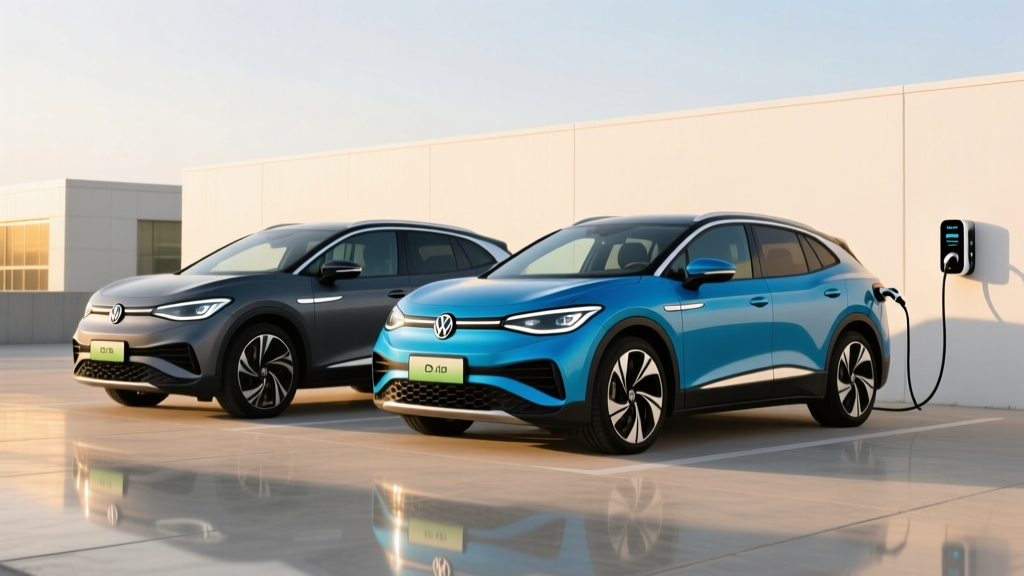
Quick Verdict: What Separates the ID.4 Pro from the Pro S?
The 2026 Volkswagen ID.4 Pro and Pro S share the same 82 kWh (usable) NMC battery pack, the same APP550 rear-mounted permanent-magnet motor producing 282 hp and 339 lb-ft of torque, and the same 170 kW peak DC fast-charging capability. The difference is packaging. The Pro is the value play — a well-equipped EV crossover starting in the low $40K range that maximizes federal tax credit utility. The Pro S layers on premium comfort and tech: panoramic fixed-glass roof, heated ventilated front seats, a heated steering wheel, power-adjustable front seats with memory, and upgraded interior trim, pushing the MSRP into the mid-$40Ks.
If you're cross-shopping the ID.4 Pro vs Pro S, you're really deciding how much you'll pay for creature comforts on top of an already solid electric platform. Below, we break down every spec, dollar, and ownership variable so you can pick the trim that fits your budget and priorities.
Side-by-Side Spec Table: ID.4 Pro vs Pro S
| Specification | 2026 ID.4 Pro (RWD) | 2026 ID.4 Pro S (RWD) |
|---|---|---|
| EPA Range | 291 miles | 291 miles |
| Battery (Usable / Gross) | 82 kWh / 91 kWh (NMC) | 82 kWh / 91 kWh (NMC) |
| Motor / Drivetrain | APP550 RWD | APP550 RWD |
| Horsepower / Torque | 282 hp / 339 lb-ft | 282 hp / 339 lb-ft |
| 0–60 mph | ~7.3 sec | ~7.3 sec |
| Peak DC Fast Charge | 170 kW | 170 kW |
| 10–80% DC Fast Charge | ~28 min | ~28 min |
| Level 2 Charge Rate (AC) | 11 kW (7.7 kW at 240V/32A) | 11 kW (7.7 kW at 240V/32A) |
| EPA Efficiency (Combined) | 104 MPGe (32 kWh/100 mi) | 104 MPGe (32 kWh/100 mi) |
| Cargo Volume (rear seats up / folded) | 30.3 / 64.2 cu ft | 30.3 / 64.2 cu ft |
| Curb Weight | ~4,682 lbs | ~4,735 lbs |
| Base MSRP | $41,995 | $46,495 |
| Battery / Powertrain Warranty | 8 yr / 100,000 mi | 8 yr / 100,000 mi |
| Bumper-to-Bumper Warranty | 4 yr / 50,000 mi | 4 yr / 50,000 mi |
Sources: fueleconomy.gov, Volkswagen USA
Range and Efficiency: Identical on Paper, Identical in Practice
EPA Range: 291 miles (both trims, RWD)
Real-World Expectation: Plan for 240–265 miles on mixed highway driving at 70+ mph. In winter temperatures below 30°F, expect 200–230 miles without preconditioning. The ID.4's battery thermal management is adequate but not class-leading — cold-soak range loss is real.
Because both trims use the same 82 kWh usable battery and the same single-motor powertrain, EPA-rated range is identical at 291 miles. The Pro S carries roughly 50 lbs more curb weight from its panoramic glass roof, power seats, and additional sound insulation — but that penalty is negligible in EPA testing and imperceptible in daily driving.
Efficiency for both trims is rated at 104 MPGe combined (32 kWh/100 mi) by the EPA. On a road trip at sustained 75 mph in moderate temperatures, you'll see closer to 3.0–3.3 mi/kWh, translating to roughly 245–270 miles before hitting a comfortable 10% State of Charge buffer. In city driving with frequent regenerative braking opportunities, hitting or slightly exceeding the 291-mile sticker is achievable.
The ID.4 does not offer a heat pump as standard equipment in all markets — check your specific build. Without a heat pump, cabin heating in cold weather draws directly from the traction battery, compounding range loss. This is a meaningful consideration for buyers in northern climates regardless of which trim you choose.
Charging Speed and Network Reality
Both the Pro and Pro S peak at 170 kW on a DC fast charger, a meaningful upgrade over the pre-2025 ID.4's 135 kW ceiling. Volkswagen quotes a 10–80% charge time of approximately 28 minutes under ideal conditions.
Here's the charging-curve reality that spec sheets omit: the ID.4 holds its peak rate briefly, typically between 10% and roughly 25% SoC, then tapers progressively. From 50% to 80%, you're pulling closer to 90–110 kW. The full 10–80% session averages around 120–130 kW sustained. This is competitive with the Hyundai Ioniq 5's broader curve but trails the Kia EV6 and Tesla Model Y in sustained charging throughput.
| Charging Level | Power (kW) | Approximate Rate |
|---|---|---|
| Level 1 (120V / 12A) | ~1.4 kW | ~4–5 miles per hour |
| Level 2 (240V / 32A) | 7.7 kW | ~25–28 miles per hour |
| Level 2 (240V / 48A, full 11 kW onboard) | 11 kW | ~35–38 miles per hour |
| DC Fast Charge (peak) | 170 kW | 10–80% in ~28 min |
On Level 2 AC power, both trims support an 11 kW onboard charger, but you need a 48-amp hardwired home charger to unlock it. Most residential NEMA 14-50 outlets on a 40-amp circuit deliver 32 amps continuous (7.7 kW), which refills the 82 kWh pack from empty in roughly 11–12 hours — fine for overnight top-ups.
Network considerations: The 2026 ID.4 comes equipped with the NACS (Tesla-style) charge port, granting native access to Tesla Supercharger V3 and V4 stalls without an adapter. Volkswagen also includes three years of complimentary charging on Electrify America's network (typically 800 kWh or a time-limited plan — confirm current terms at purchase). For road-trippers, NACS compatibility is a genuine advantage: the Supercharger network remains the most reliable DC fast-charging infrastructure in the U.S., with consistent uptime and plug-and-charge billing.
Category Winners: Where Each Trim Excels
Range & Efficiency: Tie
Same battery, same motor, same EPA rating. No practical difference.
Charging Speed: Tie
Identical 170 kW peak, identical 10–80% curve, identical NACS port.
Performance: Tie
282 hp and 7.3-second 0–60 times are shared. The Pro S's extra weight is negligible.
Value (Purchase Price): ID.4 Pro
$4,500 less at MSRP, same core EV hardware. The Pro delivers the best dollars-per-mile-of-range in the lineup.
Comfort & Features: ID.4 Pro S
Ventilated seats, panoramic roof, power seats with memory, heated steering wheel, and upgraded interior materials justify the premium for daily commuters and families.
Resale & Desirability: ID.4 Pro S (marginal)
Higher-trim EVs with premium packages tend to hold value slightly better in the used market, though the gap is narrow for the ID.4 specifically.
Pricing, Tax Credits, and True Cost to Buy
| Cost Factor | ID.4 Pro | ID.4 Pro S |
|---|---|---|
| Base MSRP | $41,995 | $46,495 |
| Destination Charge | $1,395 | $1,395 |
| Typical Dealer Adjustments | Varies | Varies |
| Federal §30D Tax Credit (max) | Up to $7,500* | Up to $7,500* |
| Effective Price After Max Credit | ~$35,890 | ~$40,390 |
*Federal EV tax credit eligibility depends on buyer income caps, battery critical-mineral and component sourcing requirements, MSRP caps ($80,000 for SUVs), and point-of-sale transfer availability. Confirm eligibility with your tax professional and the IRS §30D guidelines before purchasing.
Both trims fall well under the $80,000 MSRP cap for SUVs under §30D. The critical variable is whether Volkswagen's battery sourcing satisfies the critical-minerals and foreign-entity-of-concern (FEOC) requirements for the full $7,500 — or whether the ID.4 qualifies for only the $3,750 half-credit in the 2026 model year. This can shift with supply-chain changes, so verify the current status on the IRS eligible-vehicles list at the time of purchase.
Assuming the full $7,500 credit applies and is taken as a point-of-sale transfer (available under current rules), the Pro drops to roughly $35,890 and the Pro S to roughly $40,390. That $4,500 gap persists regardless of incentives — the tax credit does not close the trim spread, it just makes both more affordable proportionally.
Five-Year Ownership Cost Comparison
Because both trims share the same powertrain and efficiency rating, energy costs are effectively identical. The differences emerge in insurance and depreciation.
| 5-Year Cost Factor | ID.4 Pro | ID.4 Pro S |
|---|---|---|
| Purchase Price (after $7,500 credit) | ~$35,890 | ~$40,390 |
| Estimated Electricity (15K mi/yr, $0.14/kWh avg) | ~$3,360 | ~$3,360 |
| Estimated Insurance (national avg) | ~$8,500 | ~$9,200 |
| Maintenance (tires, cabin filter, fluid top-ups) | ~$1,800 | ~$1,800 |
| Estimated Depreciation (5 yr) | ~$16,000 | ~$18,500 |
| Estimated 5-Year Total Cost | ~$65,550 | ~$73,250 |
Insurance for the Pro S runs roughly $100–$150 more per year because the replacement cost of the panoramic glass roof, ventilated seat assemblies, and power-adjustable hardware is higher. Depreciation is estimated based on historical VW EV trends — the Pro S loses more in absolute dollars simply because it starts higher, though percentage depreciation is similar.
Maintenance is minimal for both: no oil changes, no transmission fluid. Budget for tire rotation every 7,500 miles, a cabin air filter every 20,000 miles, and brake fluid checks. The ID.4's regenerative braking preserves pad life — expect original brake pads to last 80,000+ miles under normal driving.
What's Standard on the Pro That You Don't Lose
The Pro trim is not a stripped-down base model. For $41,995, you get:
- 12.9-inch infotainment touchscreen with wireless Apple CarPlay and Android Auto
- Heated front seats (yes, heated seats are standard on the Pro)
- Adaptive cruise control with stop-and-go (Travel Assist, SAE Level 2)
- Lane-keeping assist and lane-centering
- Automatic emergency braking with pedestrian detection
- Wireless phone charging pad
- Power liftgate
- LED headlights with auto high beams
- 19-inch alloy wheels
- Roof rails
The Pro's interior uses VW's V-Tex leatherette, which is durable and easy to clean. The 12.9-inch screen runs VW's ID. Software 4.0, which is a meaningful improvement over earlier ID.4 infotainment — faster response, better voice recognition, and over-the-air update capability.
What the Pro S Adds — And Whether It's Worth $4,500
The Pro S's $4,500 premium buys:
- Panoramic fixed-glass roof with power sunshade — floods the cabin with light but does not open; adds weight and marginally reduces headroom
- Ventilated front seats — a genuine quality-of-life upgrade in hot climates; pairs with the standard heated function
- Power-adjustable front seats with driver memory — the Pro's seats are manually adjustable
- Heated steering wheel
- Leatherette with contrast stitching and upgraded door-panel materials
- Ambient interior lighting (30-color)
- 20-inch alloy wheels (may reduce range by 3–5 miles vs. 19-inch)
- Power-folding side mirrors
If you live in a hot-summer climate (Texas, Arizona, Florida, Southern California), ventilated seats alone can justify a significant portion of the premium. If you frequently carry passengers, the panoramic roof makes the rear seat feel substantially more open. If you share the car with a partner who drives it too, memory seats eliminate the daily seat-adjustment ritual.
One caveat: the 20-inch wheels on the Pro S may reduce real-world range by 3–5 miles compared to the Pro's 19-inch wheels due to increased rolling resistance and weight. This is small but worth noting if you regularly push the range envelope.
Real-World Ownership Considerations
Charging at home: Both trims benefit equally from a Level 2 home charger installation. Budget $800–$2,000 for a quality 48-amp hardwired unit (such as a ChargePoint Home Flex or Emporia Level 2) plus electrician labor, assuming your panel has capacity. A 200-amp service panel is usually sufficient; older homes with 100-amp panels may need a $1,500–$3,000 panel upgrade. Consult a licensed electrician for your specific situation.
ADAS capability: Both trims include Volkswagen's Travel Assist, which combines adaptive cruise control and lane-centering. This is an SAE Level 2 driver-assistance system — you must keep your hands on the wheel (or provide capacitive-touch confirmation) and remain fully engaged. It is not self-driving. It works well on divided highways but can struggle with faded lane markings, construction zones, and tight curves.
Software and OTA updates: VW's ID. Software 4.0 is a step forward from the laggy, buggy early ID.4 software. Both trims receive over-the-air updates. However, VW's infotainment still trails Tesla, Hyundai/Kia, and Rivian in responsiveness and menu logic. Test the interface during your test drive — specifically the climate controls, which are embedded in the touchscreen rather than physical buttons.
Towing: Both RWD trims are rated for 2,200 lbs of towing capacity (2,700 lbs for AWD trims). This is adequate for a small utility trailer or a pair of dirt bikes but not for a camper or boat. If you need more towing, look at the ID.4 AWD Pro S Plus or consider a different platform entirely.
Decision Framework: Which Trim Fits Your Situation?
Choose the ID.4 Pro if:
- You want the most range-per-dollar in a German-engineered EV crossover
- You plan to claim the full $7,500 federal tax credit and want to minimize your net purchase price
- Heated seats and a strong feature list are sufficient — you don't need ventilated seats or a glass roof
- You manually adjust your seat once and leave it
- You prefer 19-inch wheels for slightly better range and ride comfort over 20-inch aesthetics
- You're budget-conscious and want to allocate funds toward a home charger installation instead
Choose the ID.4 Pro S if:
- You live in a hot climate where ventilated seats are a daily necessity, not a luxury
- You share the vehicle with another driver and want memory-seat convenience
- The panoramic glass roof's open, airy cabin feel matters to you and your passengers
- You value premium interior materials and ambient lighting for daily satisfaction
- You plan to keep the vehicle 5+ years and believe the higher trim will retain resale value better
- The $4,500 premium is comfortable within your budget after incentives
Final Recommendation
The ID.4 Pro is the smarter financial decision for most buyers. It delivers 291 miles of EPA range, 170 kW DC fast charging, a comprehensive ADAS suite, and a well-equipped interior for under $36,000 after the maximum federal credit. The money you save over the Pro S can fund a high-quality home Level 2 charger, several years of public charging, or simply stay in your pocket.
The ID.4 Pro S is the right call if ventilated seats, the panoramic roof, and power memory seats will measurably improve your daily driving experience — and they will, especially in hot climates or for multi-driver households. The $4,500 gap is not trivial, but it's also not unreasonable for the feature content you receive.
Neither trim is a wrong choice. The powertrain, battery, charging, range, and efficiency are identical. Your decision comes down to whether $4,500 buys enough daily comfort to justify the spend. Test-drive both back-to-back, sit in the rear seat of each (the panoramic roof transforms the experience), and decide with your wallet and your climate in mind.
Is the ID.4 Pro S faster than the ID.4 Pro?
No. Both use the same APP550 rear motor producing 282 hp and 339 lb-ft. Both hit 0–60 mph in approximately 7.3 seconds. The Pro S weighs roughly 50 lbs more, but the difference is negligible in acceleration testing.
Does the Pro S get less range because of the glass roof?
Officially, both trims are EPA-rated at 291 miles. The panoramic roof and 20-inch wheels add weight and rolling resistance, but not enough to change the EPA sticker. In real-world driving, you might see 3–5 fewer miles on the Pro S with 20-inch wheels, but this is within normal variance.
Do both trims qualify for the $7,500 federal EV tax credit?
Both trims are under the $80,000 MSRP cap for SUVs and should qualify, assuming the buyer meets income limits and the battery meets critical-mineral and FEOC sourcing requirements for the 2026 model year. The credit amount ($3,750 or $7,500) depends on current IRS sourcing determinations. Verify at irs.gov and with your tax professional before purchase.
Can I get AWD on either trim?
Volkswagen offers AWD on higher trims (typically Pro S Plus and above). For the standard Pro and Pro S in 2026, RWD is the configuration. If AWD is essential for your climate, you'll need to step up to the Pro S Plus AWD or look at the ID.4 GTX variant, which carries a higher MSRP.
Which trim charges faster at home?
Both trims have the same 11 kW onboard AC charger. Home charging speed depends on your charger hardware and circuit, not the trim level. A 48-amp hardwired Level 2 charger will refill either trim at the same rate: roughly 35–38 miles of range per hour.
Is the ID.4's infotainment the same on both trims?
Yes. Both use the same 12.9-inch touchscreen running ID. Software 4.0 with wireless Apple CarPlay, Android Auto, and OTA update capability. The Pro S does not get a larger or faster screen — the hardware is identical.