Quick Answer: Is a VW EV SUV Right for You?
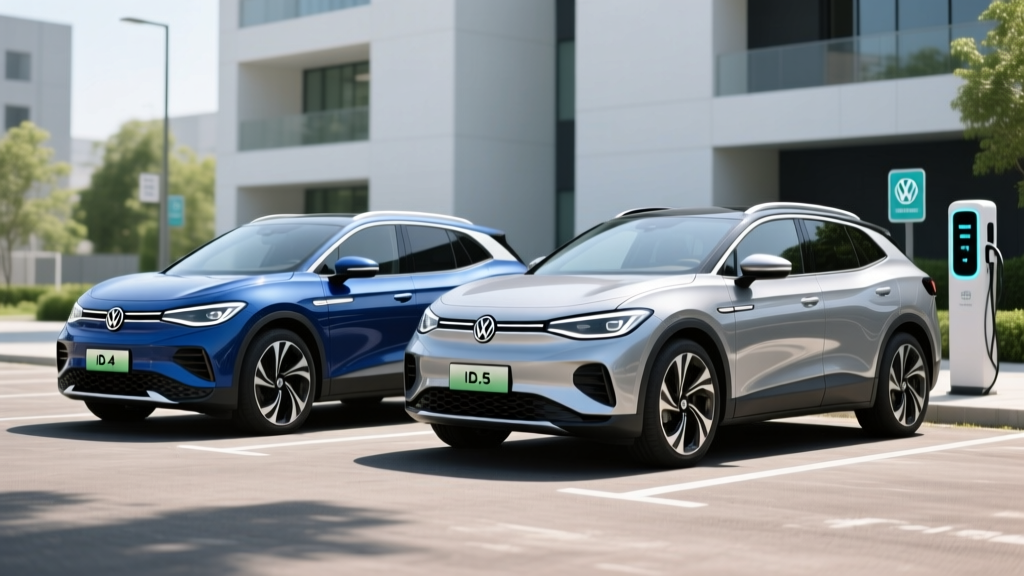
The 2026 Volkswagen ID.4 and ID.5 are VW's core electric SUV offerings for the U.S. market. The ID.4 (starting ~$39,990) delivers up to 291 miles EPA range with the 82 kWh battery pack and offers conventional SUV cargo space. The ID.5 (starting ~$46,990) is the coupe-SUV variant with slightly less rear headroom but a sportier profile and similar range (~285 miles EPA). Both use VW's MEB platform, support DC fast charging up to 175 kW (10–80% in roughly 28 minutes), and may qualify for a portion of the §30D federal tax credit depending on battery sourcing, your income, and point-of-sale transfer rules. If you need maximum cargo room and the lowest entry price, pick the ID.4. If you want a sportier look and don't mind paying a premium, the ID.5 fills that niche.
2026 VW EV SUV Models at a Glance
Volkswagen's U.S. electric SUV strategy in 2026 centers on two MEB-platform vehicles: the ID.4 compact crossover and the ID.5 coupe-SUV. VW has also announced the larger three-row ID.7 Tourer (wagon) and the next-generation ID.2/ID.3-based compact SUV for global markets, but as of early 2026, only the ID.4 and ID.5 are available for U.S. purchase. Here's how the lineup stacks up on paper:
| Spec | 2026 ID.4 Pro S (RWD) | 2026 ID.4 AWD Pro S | 2026 ID.5 Pro S (RWD) |
|---|---|---|---|
| EPA Range | 291 mi | 263 mi | 285 mi |
| Battery (usable) | 82 kWh (NMC) | 82 kWh (NMC) | 82 kWh (NMC) |
| Horsepower | 282 hp | 335 hp (dual motor) | 282 hp |
| 0–60 mph | ~7.3 sec | ~5.4 sec | ~7.4 sec |
| Max DC Charge Rate | 175 kW | 175 kW | 175 kW |
| 10–80% DC Fast Charge | ~28 min | ~28 min | ~28 min |
| Level 2 (AC) Charge Rate | 11 kW | 11 kW | 11 kW |
| Cargo Volume | 30.3 cu ft (rear seats up) | 30.3 cu ft | 26.7 cu ft |
| Base MSRP | $39,990 | $43,790 | $46,990 |
| Battery/Powertrain Warranty | 8 yr / 100,000 mi | 8 yr / 100,000 mi | 8 yr / 100,000 mi |
Sources: fueleconomy.gov, Volkswagen of America spec sheets.
Real-World Range Reality Check
The EPA sticker says 291 miles for the ID.4 Pro S RWD. Expect ~230–260 miles on a sustained highway trip at 70+ mph, and ~200–230 miles in freezing temperatures (32°F and below) due to cabin heating demands and reduced battery chemistry efficiency. The AWD model's heavier curb weight and dual-motor parasitic losses shave the real-world highway figure to roughly 210–240 miles. Preconditioning the battery before DC fast charging (available via the vehicle's navigation system or app) is essential to hitting the 175 kW peak — without it, cold-soak charging can start below 50 kW and take 45+ minutes for a 10–80% session.
VW EV SUV vs. Gas Compact SUV: The Cost Math
Most shoppers cross-compare the ID.4 against gas rivals like the Toyota RAV4, Honda CR-V, or even VW's own Tiguan. The upfront price gap is real, but so are the operating savings. Here's a five-year ownership comparison based on 15,000 miles/year, $3.50/gal regular unleaded, and $0.14/kWh home electricity (national average):
| Cost Category (5 yr / 75,000 mi) | 2026 VW ID.4 Pro S | 2026 VW Tiguan SE (Gas) |
|---|---|---|
| Base MSRP | $39,990 | $31,490 |
| Est. Federal Tax Credit (§30D) | Up to $7,500* | $0 |
| Effective Purchase Price | ~$32,490 | $31,490 |
| Fuel / Electricity (75k mi) | ~$3,150 (home charging) | ~$8,750 (28 MPG combined) |
| Maintenance (oil, filters, brakes) | ~$800 | ~$2,800 |
| Insurance (avg) | ~$9,500 | ~$7,800 |
| Est. Depreciation (5 yr) | ~$16,000 | ~$13,500 |
| Total 5-Year Cost | ~$61,940 | ~$64,340 |
*§30D credit eligibility depends on battery critical-mineral sourcing, buyer AGI ($150k single / $300k joint), and MSRP caps ($80k SUV). Rules change — verify at IRS.gov. Point-of-sale transfer available at participating dealers.
The ID.4 wins on fuel and maintenance — saving roughly $7,600 over five years in those categories alone. EV insurance premiums run 15–25% higher on average, and depreciation on EVs has been steeper than gas equivalents, though VW's 8-year battery warranty provides a floor. If you rely primarily on public DC fast charging at $0.35–$0.50/kWh, your "fuel" cost jumps to $6,000–$9,000, erasing much of the advantage.
Charging the VW ID.4 and ID.5: What You Actually Need
VW equips both models with a CCS1 connector (U.S. market). With VW's announced NACS adapter program, access to Tesla Superchargers is expanding, but native CCS remains the standard at Electrify America, EVgo, and ChargePoint stations.
| Charging Level | Power (kW) | Miles Added per Hour | Typical Use Case |
|---|---|---|---|
| Level 1 (120V outlet) | ~1.4 kW | ~4–5 mi/hr | Overnight top-up, emergencies |
| Level 2 (240V home charger) | 11 kW (max onboard) | ~35–40 mi/hr | Daily home charging (~8 hr for full) |
| DC Fast Charge | Up to 175 kW (peak) | ~500+ mi/hr (at peak) | Road trips, 10–80% in ~28 min |
Home Charging Installation: Budget Realistically
If you have a garage or driveway with panel capacity, a Level 2 home charger is the single biggest quality-of-life upgrade for EV ownership. Here's what to budget:
| Item | Low End | High End |
|---|---|---|
| Level 2 Charger (e.g., ChargePoint Home Flex, Emporia Vue) | $400 | $700 |
| Electrician Labor (240V/50A circuit run) | $600 | $2,000 |
| Panel Upgrade (if 200A panel is full or you have 100A service) | $1,500 | $4,000 |
| Permit & Inspection | $100 | $400 |
| Total Install | $1,100 | $7,100 |
Most homes with a modern 200-amp panel and a garage within 30 feet of the panel land in the $1,200–$2,500 total range. Always get a licensed electrician's assessment before purchasing equipment — panel capacity is the wildcard that can triple your cost.
Understanding the Charge Curve
VW advertises 175 kW peak charging. That number is real but not sustained. On a warm battery preconditioned via navigation to a DC fast charger, the ID.4 will pull roughly 170–175 kW from 10–30% SoC, taper to ~120 kW by 50%, and drop to ~50 kW above 80%. This is why the 10–80% time (~28 min) matters more than the peak kW figure. Charging from 80–100% on DC fast charge can add another 25+ minutes for the last 20%. On road trips, plan to charge to 80% and go — the time penalty for topping off is rarely worth it.
Federal Tax Credit: Does the VW ID.4 Qualify in 2026?
The §30D Clean Vehicle Credit offers up to $7,500 for eligible new EVs, split into two halves: $3,750 for battery component manufacturing and $3,750 for critical-mineral sourcing. As of the 2026 tax year, the ID.4's eligibility has fluctuated based on VW's supply-chain shifts. Key requirements:
- MSRP Cap: SUVs must be under $80,000 — all ID.4 and ID.5 trims qualify.
- Buyer Income Cap: AGI must not exceed $150,000 (single), $225,000 (head of household), or $300,000 (joint).
- Battery Sourcing: Critical minerals and battery components must meet escalating domestic/free-trade-agreement percentages. Check the current status at fueleconomy.gov's credit lookup tool.
- Point-of-Sale Transfer: You can transfer the credit to the dealer at purchase, reducing your out-of-pocket cost immediately — even if you owe less than $7,500 in federal taxes.
- Final Assembly: Must occur in North America. The ID.4 for the U.S. market is assembled in Chattanooga, Tennessee.
Always verify current eligibility before purchasing. Credit status can change quarterly as automakers adjust sourcing. Consult a tax professional for your specific situation.
Common Misconceptions About VW's EV SUVs
| Myth | Fact |
|---|---|
| "The ID.4 can't handle road trips." | With 291 mi EPA range and 175 kW charging, a 600-mile trip requires two ~25-minute stops. Comparable to gas-car rest breaks over 9+ hours of driving. |
| "The battery will need replacing in 5 years." | VW warranties the battery for 8 years/100,000 miles at 70% capacity retention. Industry data shows NMC packs losing ~10–15% over 150,000 miles under normal use. |
| "AWD doubles the range because of regen." | AWD adds weight and drivetrain losses. The AWD ID.4 rates 263 mi EPA vs. 291 mi for RWD — a 28-mile penalty, not a gain. |
| "I can charge on any 120V outlet quickly." | Level 1 adds ~4–5 miles per hour. A full charge from 10% takes 60+ hours. It's viable for low-mileage drivers (under 30 mi/day) but inadequate as a primary strategy for most. |
| "EVs are zero-emission everywhere." | Tailpipe emissions are zero, but upstream electricity generation varies. On a coal-heavy grid, lifecycle emissions are reduced but not eliminated. On renewables-heavy grids (CA, WA, NY), the advantage is dramatic. |
Decision Framework: Which VW EV SUV (or Alternative) Should You Choose?
Choose the VW ID.4 if:
- You want a practical compact EV SUV under $40,000 (before credit) with strong cargo space (30.3 cu ft).
- You have reliable home Level 2 charging access.
- Your daily commute is under 80 miles round-trip, and road trips are 1–3 times per month.
- You value the 8-year/100,000-mile battery warranty and domestic assembly (Chattanooga, TN).
Choose the VW ID.5 if:
- You prefer a coupe-SUV design and don't need maximum rear cargo volume.
- You're willing to pay a ~$7,000 premium for styling differentiation.
- Rear-seat passengers are occasional or small (reduced headroom vs. ID.4).
Choose the ID.4 AWD if:
- You live in a region with frequent snow/ice and need dual-motor traction.
- You're willing to trade ~28 miles of EPA range for the 335 hp / 5.4-sec 0–60 performance bump.
Consider a PHEV alternative (e.g., Toyota RAV4 Prime) if:
- You lack home charging access and can't install Level 2.
- You regularly drive 300+ miles in rural areas with sparse DC fast-charging infrastructure.
- You want 42 miles of electric-only commuting plus a gas engine for unlimited range.
Consider a Hyundai Ioniq 5 or Kia EV6 if:
- DC fast-charge speed is your top priority — both support 800V architecture with 10–80% in ~18 minutes at 240+ kW.
- You want NACS native compatibility without an adapter for Tesla Supercharger access.
First-Time EV Buyer Checklist
- Verify home charging feasibility. Check your electrical panel (200A preferred), outlet proximity, and landlord/HOA rules before purchasing. Get an electrician quote.
- Calculate your real daily mileage. Most Americans drive 30–40 miles/day. The ID.4's 291-mile range covers 95%+ of daily needs with nightly Level 2 top-ups.
- Map your road-trip routes. Use apps like PlugShare or A Better Routeplanner to confirm DC fast-charger density along your most common long drives.
- Understand the §30D credit. Check IRS.gov and fueleconomy.gov for current ID.4 eligibility. Ask the dealer about point-of-sale transfer.
- Budget for insurance. Get quotes before buying. EV premiums average 15–25% higher than equivalent gas models.
- Test-drive in conditions you'll actually face. Highway merging, cold-weather cabin comfort, and one-pedal regenerative braking all feel different than a gas car. Spend at least 30 minutes behind the wheel.
Frequently Asked Questions
What is the real-world range of the VW ID.4?
EPA-rated at 291 miles (Pro S RWD), expect 230–260 miles on highway trips at 70+ mph, and 200–230 miles in freezing weather. The AWD model delivers roughly 210–240 miles in real-world highway driving.
How long does it take to charge the ID.4 at home?
On a Level 2 (240V) home charger at 11 kW, a full charge from 10% to 100% takes approximately 8 hours. Most owners plug in nightly and wake up to a full battery, adding 35–40 miles of range per hour of charging.
Does the VW ID.4 qualify for the $7,500 federal tax credit?
Eligibility varies based on current battery-sourcing rules under §30D. The ID.4 is assembled in Chattanooga, TN (meeting final-assembly requirements), and its MSRP is under the $80,000 SUV cap. Verify current credit status at fueleconomy.gov before purchasing, as sourcing compliance can change.
How does the ID.4 compare to the Hyundai Ioniq 5?
The Ioniq 5 charges significantly faster (800V architecture, 10–80% in ~18 min vs. the ID.4's ~28 min) and offers NACS native access. The ID.4 counters with a slightly lower base price, more conventional SUV styling, and a strong dealer network. Both are strong choices — prioritize charge speed (Ioniq 5) or value/familiarity (ID.4).
What happens if the ID.4 battery degrades?
VW warranties the high-voltage battery at 70% capacity retention for 8 years or 100,000 miles. Real-world data from MEB-platform vehicles in Europe shows ~10–12% degradation over 100,000 miles under normal use. Out-of-warranty replacement costs are estimated at $12,000–$18,000, though module-level repair may reduce that figure.
Can I tow with the VW ID.4?
The ID.4 is rated for up to 2,700 lbs of towing capacity (with factory hitch). Towing significantly reduces range — expect a 30–50% reduction depending on trailer weight and aerodynamics. Plan charging stops accordingly.
Is the ID.4 self-driving?
No. The ID.4 comes equipped with VW's IQ.DRIVE suite, which includes adaptive cruise control, lane-keeping assist, and Travel Assist. This is SAE Level 2 driver assistance — you must keep your hands on the wheel and eyes on the road at all times. It is not autonomous driving.