The Short Answer: Your VW Electric Tiguan Replacement
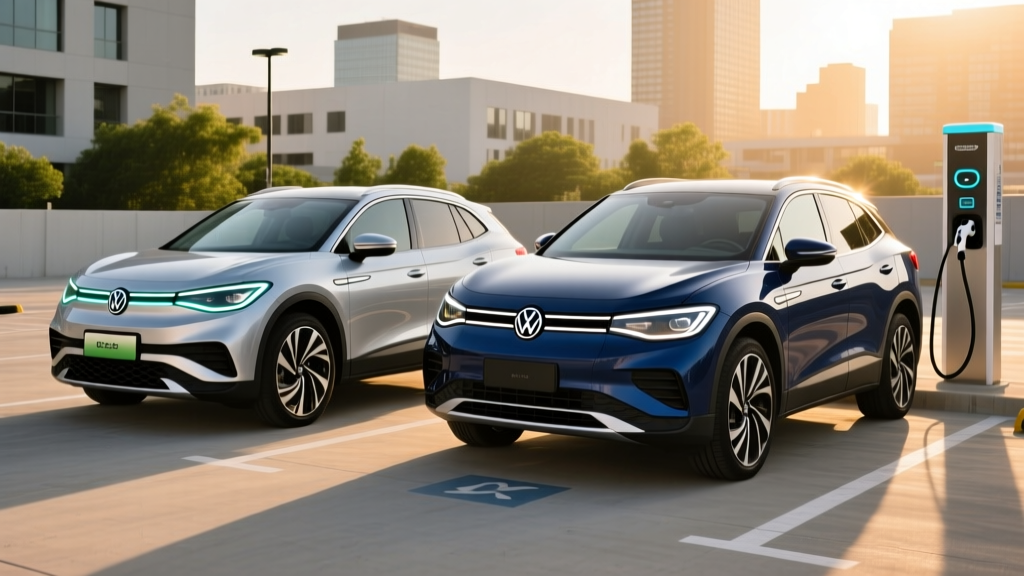
If you're looking for a VW electric Tiguan replacement, the closest current option is the 2026 Volkswagen ID.4. It's a compact electric crossover built on VW's MEB platform with an EPA-estimated range of up to 291 miles (Pro S AWD trim), a starting MSRP around $39,735, and eligibility for up to $7,500 in federal tax credits (subject to income, MSRP caps, and battery-sourcing rules). The gas Tiguan starts lower (~$29,000) but costs more per mile to fuel and maintain. The ID.4 wins on running costs if you have home charging; the Tiguan still makes sense for buyers who regularly tow, drive 400+ miles between stops, or lack reliable charging access.
Why There's No Direct "Electric Tiguan" — And What VW Offers Instead
Volkswagen has not released a battery-electric vehicle badged as a Tiguan. The Tiguan nameplate remains exclusive to VW's internal-combustion compact SUV lineup. Instead, VW positioned the ID.4 as its electric compact crossover — similar in footprint and purpose to the Tiguan, but built from the ground up as a battery-electric vehicle (BEV) on the dedicated MEB platform.
The distinction matters for buyers cross-shopping the two. The ID.4 isn't a Tiguan with a battery bolted in. It has a longer wheelbase (108.9 in vs. the Tiguan's 109.9 in for the three-row variant), a flat floor, a rear-mounted or dual-motor drivetrain, and packaging that prioritizes interior volume over engine-bay space. Think of it as VW's electric answer to the Tiguan segment — not a literal electrified Tiguan.
For 2026, the ID.4 lineup includes rear-wheel-drive (RWD) Pro and Pro S trims plus all-wheel-drive (AWD) Pro S and Pro S Plus variants. VW has also introduced an updated infotainment system with a larger 12.9-inch display and improved software responsiveness over earlier model years.
2026 ID.4 vs Gas Tiguan: Spec-for-Spec Comparison
| Spec | 2026 VW ID.4 Pro S AWD | 2026 VW Tiguan SE (2.0T AWD) |
|---|---|---|
| Powertrain | Dual-motor AWD, 295 hp | 2.0L turbo I4, 184 hp |
| EPA Range / Fuel Economy | 263 mi (EPA); ~220 mi real-world highway | 25 MPG combined (22 city / 29 hwy) |
| Battery / Fuel Tank | 82 kWh usable (NMC chemistry) | 15.3-gallon tank |
| 0–60 mph | 5.7 seconds | ~7.8 seconds |
| Max DC Fast Charge | 175 kW peak (10–80% in ~28 min) | N/A (gas fill-up ~3 min) |
| Level 2 Home Charge Rate | 11 kW (~37 mi/hr at 48A) | N/A |
| Cargo Volume (behind rear seats) | 30.3 cu ft | 33.0 cu ft (2-row) / 12.0 cu ft (3-row) |
| Towing Capacity | 2,700 lbs (AWD) | 1,500 lbs |
| Starting MSRP | $45,235 (Pro S AWD) | ~$33,500 (SE AWD) |
| Federal Tax Credit (§30D) | Up to $7,500 (see eligibility below) | None |
| Powertrain Warranty | 8 yr / 100,000 mi (battery & drive units) | 4 yr / 50,000 mi (bumper-to-bumper); 6 yr / 72,000 mi (powertrain) |
Sources: EPA / fueleconomy.gov, Volkswagen USA ID.4 specs.
Real-World Range: What the EPA Sticker Doesn't Tell You
The EPA rates the 2026 ID.4 Pro S AWD at 263 miles. The RWD Pro trim achieves up to 291 miles EPA. But EPA testing uses a mix of city and highway cycles at moderate temperatures — conditions that rarely match a long road trip or a January commute in Minnesota.
Real-World Range Expectations — ID.4 Pro S AWD
- Mild weather, mixed driving: 240–260 miles
- Highway-only at 70–75 mph: 210–230 miles (EVs lose efficiency at sustained high speed; no regenerative braking to recover energy)
- Cold weather (below 30°F) with cabin heat: 175–210 miles (battery chemistry slows and cabin heating draws significant energy; the ID.4's standard heat pump helps mitigate this vs. resistive heating)
- Cold + highway combined: 160–190 miles — plan charging stops accordingly
The ID.4 uses NMC (nickel manganese cobalt) lithium-ion cells supplied by SK On. NMC offers higher energy density than LFP (lithium iron phosphate), which keeps the pack size manageable for the vehicle's footprint. The trade-off is that NMC degrades slightly faster over time and prefers not to sit at 100% state of charge for extended periods — VW's battery management system includes a top-end buffer to help protect longevity.
Charging the ID.4: Home, Public, and the Curve Reality
Charging is the single biggest ownership variable. Here's what ID.4 buyers actually need to know:
Home Level 2 Charging (Where Most Miles Are Added)
The ID.4 accepts up to 11 kW on Level 2 AC (48 amps on a 60-amp circuit). At this rate, you recover roughly 37 miles of range per hour. A full overnight charge (8 hours) adds about 290 miles — more than enough to replenish a full day's driving for nearly all commuters.
| Charging Level | Power | Miles Added/Hour | Full Charge Time (0–100%) | Typical Use Case |
|---|---|---|---|---|
| Level 1 (120V outlet) | ~1.4 kW | ~4–5 mi/hr | ~60+ hours | Emergency/trickle only |
| Level 2 (240V, 48A) | 11 kW | ~37 mi/hr | ~8–9 hours | Daily home charging |
| DC Fast Charge | Up to 175 kW | ~190 mi/hr (peak) | 10–80% in ~28 min | Road trips |
DC Fast Charging — and the Curve Taper
The ID.4 AWD peaks at 175 kW on a compatible DC fast charger. Volkswagen quotes a 10–80% charge in approximately 28 minutes under ideal conditions (preconditioned battery, warm ambient temperature, station capable of delivering sustained power).
Here's what marketing materials gloss over: 175 kW is a peak, not a sustained rate. The charge curve tapers significantly above 70–75% state of charge to protect battery health. You might see 170+ kW from 10–40%, then a gradual decline to 80–100 kW through the 50–70% range, and a steep drop to 40–50 kW above 80%. Charging from 80–100% on DC fast charge can take nearly as long as 10–80%. On road trips, plan to charge to 80% and go — the last 20% isn't worth the wait.
The ID.4 uses the CCS1 connector (Combined Charging System). VW has committed to adopting the NACS (Tesla-style) connector on future models, and adapters are becoming available for accessing Tesla Supercharger stations. Check VW's latest compatibility guidance before relying on an adapter for a specific trip.
Home Charging Installation Costs
Budget for a Level 2 home charger installation. Costs vary widely depending on your electrical panel's capacity and the distance from the panel to your parking spot:
| Item | Low Estimate | High Estimate |
|---|---|---|
| Level 2 charger hardware (e.g., ChargePoint Home Flex, Wallbox Pulsar Plus) | $350 | $700 |
| Electrician labor (standard install, panel nearby) | $500 | $1,200 |
| Electrical panel upgrade (200A service, if needed) | $1,500 | $3,500 |
| Permit and inspection | $50 | $300 |
| Total (no panel upgrade) | $900 | $2,200 |
| Total (with panel upgrade) | $2,400 | $5,700 |
Always get a quote from a licensed electrician before committing. If your home has a 100-amp panel and you're already running central AC and an electric dryer, you may need an upgrade to support a 48-amp EV circuit.
True Cost of Ownership: ID.4 vs Gas Tiguan Over 5 Years
Upfront price favors the gas Tiguan. Running costs favor the ID.4 — often by a wide margin. Here's a realistic 5-year / 75,000-mile comparison assuming $3.50/gallon gas, $0.14/kWh home electricity (national average), and 80% home / 20% public DC charging for the ID.4:
| Cost Category | 2026 ID.4 Pro S AWD | 2026 Tiguan SE AWD |
|---|---|---|
| MSRP | $45,235 | $33,500 |
| Federal Tax Credit (§30D) | –$7,500 (if eligible) | $0 |
| Effective Purchase Price | $37,735 | $33,500 |
| Fuel / Electricity (75k mi) | ~$3,360 | ~$10,500 |
| Maintenance (5 yr) | ~$1,200 (tire rotations, cabin filter, fluid top-offs) | ~$3,800 (oil changes, brake pads, transmission fluid) |
| Insurance (avg 5 yr) | ~$9,500 | ~$7,800 |
| Estimated Depreciation | ~$16,000 | ~$12,500 |
| 5-Year Total Cost | ~$67,795 | ~$68,100 |
Insurance and depreciation are estimates based on national averages. Actual costs vary by ZIP code, driving record, and market conditions. Tax credit eligibility depends on your modified adjusted gross income, the vehicle's MSRP, and battery-component/critical-mineral sourcing requirements per IRS §30D rules. Consult a tax professional.
The ID.4's electricity cost assumes ~3.2 kWh/mile (the ID.4 AWD achieves roughly 104 MPGe combined per EPA). At $0.14/kWh, that's about $0.045/mile. The Tiguan at 25 MPG combined and $3.50/gallon costs $0.14/mile — roughly three times more per mile.
Federal Tax Credit Eligibility (§30D): What You Actually Need to Know
The ID.4 has been assembled at VW's Chattanooga, Tennessee plant, which has historically helped it qualify for portions of the §30D new clean vehicle credit. However, eligibility is not guaranteed and depends on several moving targets:
- Buyer income cap: MAGI must not exceed $150,000 (single), $225,000 (head of household), or $300,000 (joint filing).
- MSRP cap: SUVs must have an MSRP at or below $80,000. All ID.4 trims clear this.
- Battery components: A percentage of battery components must be manufactured or assembled in North America (threshold increases annually).
- Critical minerals: A percentage of critical minerals must be sourced from the US or a free-trade-agreement country (threshold also increases annually).
- Point-of-sale transfer: As of 2024, eligible buyers can transfer the credit to the dealer at purchase, reducing the sale price directly rather than waiting to claim it on their tax return.
The credit is split into two halves — $3,750 for meeting the battery-component requirement and $3,750 for meeting the critical-minerals requirement. Depending on the model year and current thresholds, the ID.4 may qualify for the full $7,500, a partial $3,750, or potentially less as sourcing rules tighten. Always verify current eligibility on the IRS clean vehicle credit page and confirm with your dealer before signing.
Myths vs Facts: Common Misconceptions About Switching from a Tiguan to an EV
| Myth | Fact |
|---|---|
| "EV batteries need replacing every few years and cost $20,000." | The ID.4's battery is warrantied for 8 years / 100,000 miles with a minimum 70% capacity retention threshold. Real-world degradation data from earlier MEB-platform vehicles suggests ~8–12% loss over 100,000 miles. Full replacement is rare and costs $10,000–$18,000 if out of warranty — but most owners will never need one. |
| "I'll be stranded because charging stations are unreliable." | Public charging reliability has improved, but it's a legitimate concern on some networks. VW includes three years of complimentary charging on Electrify America (typically 1,000 kWh). For road trips, plan routes with PlugShare or A Better Routeplanner and always have a backup station identified. |
| "EVs are worse in winter." | Range drops 20–35% in sub-freezing temperatures — that's real. But the ID.4's AWD provides confident traction, and preconditioning the battery while plugged in (using grid power to warm the pack before departure) recovers much of the efficiency loss. Remote preconditioning via the VW app is a genuine cold-weather advantage over gas cars. |
| "I can't tow with an EV." | The ID.4 AWD is rated for 2,700 lbs — enough for a small utility trailer, a pair of dirt bikes, or a light pop-up camper. Note that towing significantly reduces range (expect a 30–50% drop depending on trailer weight and aerodynamics). |
| "The Tiguan has three rows; the ID.4 doesn't." | True. The ID.4 is strictly a two-row, five-passenger vehicle. If you need a third row in a VW electric vehicle, you'd need to look at the ID. Buzz (three-row electric minivan) or wait for VW's upcoming larger electric SUVs. For three-row gas needs, the Tiguan still fills that role. |
Decision Framework: Should You Choose the ID.4 or Stick with the Tiguan?
Choose the ID.4 (VW Electric Tiguan Replacement) If:
- You can install a Level 2 charger at home or have reliable Level 2 access at work.
- Your daily driving is under 150 miles round-trip (covers ~95% of US commutes).
- You want lower per-mile operating costs and less routine maintenance.
- You qualify for the §30D tax credit, narrowing the price gap significantly.
- You value instant torque, quiet operation, and one-pedal regenerative driving.
- You don't regularly need a third row or tow more than 2,700 lbs.
Stick with the Gas Tiguan If:
- You live in an apartment or condo without charging access and public infrastructure is sparse in your area.
- You frequently drive 350+ miles between stops in rural areas or charging deserts.
- You need a third-row seat for children or occasional passengers.
- Your budget is firmly under $30,000 and you can't wait to accumulate savings from lower fuel costs.
- You regularly tow near maximum capacity and can't accept the range penalty of EV towing.
Consider a PHEV Alternative If:
- You want electric daily commuting but gas flexibility for long road trips. VW doesn't currently offer a Tiguan PHEV in the US, but competitors like the Toyota RAV4 Prime (42 miles electric-only, 38 MPG gas, ~$44,000 MSRP) or the Hyundai Tucson PHEV (33 miles electric-only, 35 MPG gas) bridge the gap.
What First-Time EV Buyers Should Know Before Switching from a Tiguan
If the ID.4 is your first electric vehicle, a few ownership realities differ meaningfully from your gas-car experience:
Plan charging into your routine, not as an afterthought. With home Level 2 charging, you'll start every morning with a "full tank" — typically 200+ miles of real-world range. That's more than enough for daily life. The mindset shift: you charge where you park, not where you stop.
Understand kW vs kWh. Kilowatts (kW) measure power — how fast energy flows into the battery, like water pressure from a hose. Kilowatt-hours (kWh) measure energy capacity — how much the battery holds, like the size of the tank. The ID.4 has an 82 kWh battery and accepts up to 175 kW of charging power. Confusing these is the most common mistake new EV buyers make when comparing vehicles.
Insurance may cost more. EVs typically carry 15–25% higher insurance premiums than comparable gas vehicles due to higher repair costs, specialized parts, and battery replacement risk. Get quotes from your insurer before purchasing — the premium difference can partially offset fuel savings.
Regenerative braking changes how you drive. The ID.4 offers adjustable regen levels via steering-wheel paddles (or a B-mode on the shifter for stronger regen). In daily driving, you'll use the brake pedal far less — lifting off the accelerator slows the car and recovers energy. It takes a week or two to adapt, then most drivers prefer it.
Tire wear is higher. EVs are heavier (the ID.4 AWD weighs ~4,680 lbs vs. the Tiguan AWD at ~3,860 lbs) and deliver instant torque. Expect to replace tires every 25,000–35,000 miles instead of 40,000–50,000. Budget for EV-rated tires with higher load ratings.
Frequently Asked Questions
Will VW ever make an electric Tiguan?
VW has not announced a vehicle badged "Tiguan EV." The ID.4 serves as the brand's electric compact crossover. VW's future electric SUV roadmap includes larger models (potentially an ID.6 or ID.8 for the US market), but a Tiguan-branded EV is not in confirmed plans as of early 2026.
How does the ID.4's cargo space compare to the Tiguan?
The two-row Tiguan offers 33.0 cu ft behind the rear seats; the ID.4 provides 30.3 cu ft. The difference is modest and partly offset by the ID.4's flat load floor and under-floor storage. Neither vehicle has a frunk (front trunk) of meaningful size.
Is the ID.4 eligible for the full $7,500 federal tax credit in 2026?
Eligibility depends on current-year battery-component and critical-mineral sourcing thresholds under §30D, plus your personal income. The ID.4's US assembly in Chattanooga helps, but the critical-minerals requirement has tightened annually. Check the IRS clean vehicle credit page for the latest qualifying vehicle list and consult a tax professional for your specific situation.
Can I charge the ID.4 at Tesla Superchargers?
VW has announced NACS adoption for future models, and CCS-to-NACS adapters are entering the market. As of early 2026, check VW's official guidance on adapter compatibility and approved Supercharger access before relying on it for a trip. Electrify America remains the primary fast-charging partner for VW ID.4 owners.
What happens if the ID.4 battery degrades?
VW warranties the high-voltage battery for 8 years or 100,000 miles against capacity loss below 70%. If your battery falls below that threshold within the warranty period, VW will repair or replace it at no cost. Real-world data from MEB vehicles in Europe and the US suggests typical degradation of 8–12% over 100,000 miles — meaning most owners retain 88–92% of original capacity and never trigger a warranty claim.
How does the ID.4 perform in snow and ice?
The AWD ID.4 uses dual motors for independent front and rear torque delivery, providing strong traction in slippery conditions. The low center of gravity (battery pack mounted under the floor) contributes to stable handling. Combined with winter tires, the ID.4 AWD is a capable winter vehicle — and the ability to precondition the cabin and battery while plugged in means you enter a warm car without idling an engine.