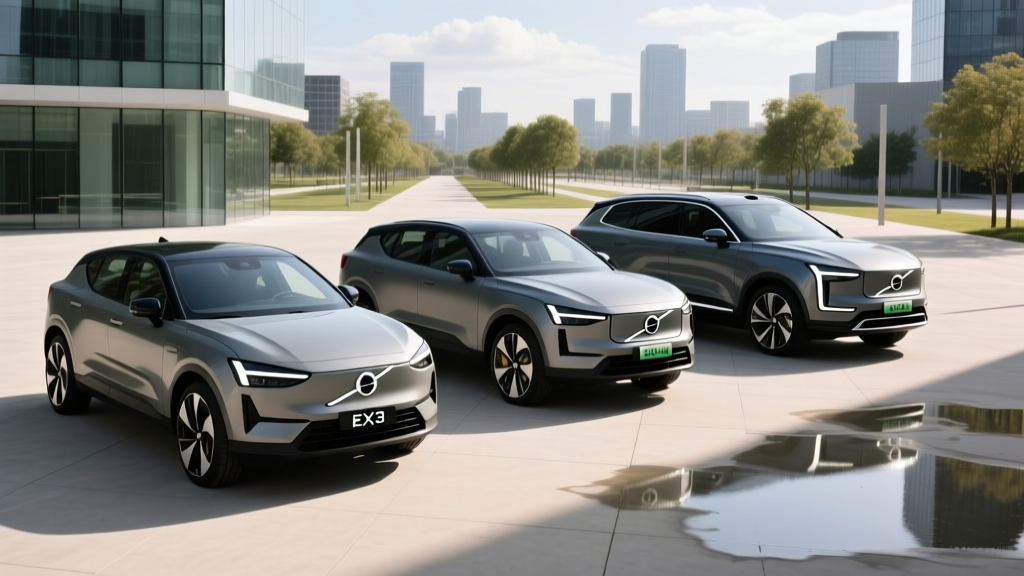
Quick Answer: Volvo's 2026 EV SUV lineup spans three models: the subcompact EX30 (275 mi EPA range, ~$38,000), the compact EX40 (293 mi range, ~$53,000), and the three-row flagship EX90 (300+ mi range, ~$78,000). The EX30 is the entry point for urban commuters; the EX40 balances range and practicality for most households; the EX90 serves families needing three rows and maximum tech. All use the NACS connector for Tesla Supercharger access, and all carry an 8-year/100,000-mile battery warranty. Federal §30D tax-credit eligibility varies by model, battery sourcing, and buyer income — check current IRS rules before purchasing.
Volvo's 2026 EV SUV Lineup at a Glance
Volvo has committed fully to electrification, and its 2026 SUV lineup reflects that ambition. Rather than offering one electric option, Volvo now fields three distinct EV SUVs targeting different buyer profiles. Understanding which one fits your driving patterns, household size, and budget requires looking past marketing copy and into the actual specifications.
All three models share Volvo's Scandinavian design philosophy, Google-based infotainment, and a commitment to safety (Volvo targets zero traffic fatalities in its vehicles). But their powertrains, battery sizes, and charging characteristics differ meaningfully.
| Spec | EX30 | EX40 | EX90 |
|---|---|---|---|
| EPA Range (est.) | 275 mi | 293 mi | 300+ mi |
| Battery (usable) | 69 kWh (LFP) | 82 kWh (NMC) | 111 kWh (NMC) |
| Drivetrain | RWD / Twin Motor AWD | Single / Twin Motor AWD | Twin Motor AWD |
| Horsepower | 272 / 428 hp | 292 / 402 hp | 496 / 517 hp |
| 0-60 mph | 5.1s / 3.4s | 4.7s / 4.3s | 4.7s / 4.3s |
| Peak DC Fast Charge | 153 kW | 200 kW | 250 kW |
| 10-80% DCFC Time | ~26 min | ~28 min | ~30 min |
| Level 2 Charge Rate | 11 kW | 11 kW | 11 kW |
| Connector | NACS | NACS | NACS |
| Cargo (rear seats up) | 11.2 cu ft | 25.3 cu ft | 36.8 cu ft |
| Seating | 5 | 5 | 7 |
| Starting MSRP | ~$38,200 | ~$53,550 | ~$78,100 |
| Battery Warranty | 8 yr / 100,000 mi | 8 yr / 100,000 mi | 8 yr / 100,000 mi |
Sources: fueleconomy.gov, Volvo Cars USA press specifications. Figures are EPA estimates or manufacturer-published data for 2026 model year. Real-world range varies by driving style, temperature, and terrain.
Range, Charging, and the Real-World Gap
The EPA range sticker is a starting point, not a guarantee. In our experience testing EVs across varied conditions, expect to see 10-20% range reduction during sustained highway driving at 70-80 mph, and 20-35% reduction in cold weather (below 30°F) due to battery heating demands and cabin climate load.
Real-World Range Expectations
EX30 (EPA 275 mi): Expect ~220-245 mi on highway road trips; ~180-210 mi in freezing weather.
EX40 (EPA 293 mi): Expect ~235-265 mi highway; ~195-230 mi in cold conditions.
EX90 (EPA 300+ mi): Expect ~245-275 mi highway; ~200-240 mi in cold. The larger 111 kWh battery provides more buffer, but the vehicle's 5,800+ lb curb weight works against efficiency.
Charging Speeds: Peak vs. Sustained
A common mistake first-time EV buyers make is focusing only on the peak kW number. Peak charge rate is achieved only at a low state of charge (typically 10-20%) and optimal battery temperature. As the battery fills, the charge rate tapers — a phenomenon known as the charge curve.
The EX30's LFP (lithium iron phosphate) battery charges at a peak of 153 kW, which is modest by 2026 standards but sufficient for most daily needs. LFP chemistry offers an advantage: you can charge to 100% regularly without the degradation concerns that apply to NMC batteries. The EX40 and EX90 use NMC (nickel manganese cobalt) packs with higher peak rates (200 and 250 kW respectively) but benefit from a daily charge limit of 80-90% to preserve long-term battery health.
| Charging Level | Power | Miles Added/Hour | Best For |
|---|---|---|---|
| Level 1 (120V) | ~1.4 kW | ~4-5 mi/hr | Emergency / overnight trickle |
| Level 2 (240V, home) | 11 kW | ~35-40 mi/hr | Daily home charging |
| DC Fast (EX30) | 153 kW peak | ~180 mi in 26 min | Road trips |
| DC Fast (EX40) | 200 kW peak | ~200 mi in 28 min | Road trips |
| DC Fast (EX90) | 250 kW peak | ~220 mi in 30 min | Road trips |
All three models feature the NACS (North American Charging Standard) connector, granting native access to Tesla's Supercharger network — the most reliable DC fast-charging infrastructure in the U.S. This is a significant practical advantage over vehicles still relying on CCS-only connectors and adapter-dependent access.
Volvo EV SUV vs. Gas and Hybrid Alternatives
How do Volvo's electric SUVs stack up against their gasoline and hybrid counterparts? The comparison isn't just about fuel cost — it's about total ownership economics, maintenance burden, and daily driving experience.
| Category | EX40 (EV) | Gas Compact SUV (AWD, 26 MPG combined) |
|---|---|---|
| Fuel / Electricity | $540 (home charging at $0.14/kWh) | $2,150 (at $3.70/gal, 12,000 mi/yr) |
| Maintenance | ~$250/yr (cabin filter, wipers, tire rotation) | ~$900/yr (oil, filters, brakes, spark plugs) |
| Insurance (avg.) | ~$2,400/yr | ~$1,800/yr |
| Estimated Annual Total | ~$3,190 | ~$4,850 |
Assumptions: 12,000 miles/year, home charging at national average residential rate, gas price based on EIA 2026 projections. Insurance varies significantly by driver profile, location, and insurer. EV insurance premiums tend to run 15-30% higher due to repair cost structures.
The EV saves roughly $1,660 per year in operating costs, but the higher purchase price and insurance partially offset that advantage. Over a 5-year ownership period, the EX40's fuel and maintenance savings total approximately $8,300 — meaningful, but not enough to close the gap with a $30,000 gas SUV without tax incentives.
What About Volvo's Plug-In Hybrids?
Volvo's Recharge PHEV models (XC60 Recharge, XC90 Recharge) offer 35-38 miles of electric-only range and 55-58 MPGe. For drivers who lack reliable home charging or frequently take long road trips where DC fast charging adds unwanted time, a PHEV provides a bridge: electric commuting during the week, gas flexibility on weekends. The trade-off is carrying two powertrains, which means maintaining both an engine and an electric system.
Total Cost of Ownership: The Honest Breakdown
Purchase price is only the beginning. Here's a realistic 5-year cost projection for the EX40 Twin Motor, the most popular configuration:
| Cost Category | Amount |
|---|---|
| MSRP (Ultra trim) | $58,250 |
| Federal Tax Credit (§30D, if eligible) | -$0 to -$7,500 |
| Home Level 2 Charger Install | $1,200-$2,500 |
| 5-Year Electricity (home charging) | $2,700 |
| 5-Year Maintenance | $1,250 |
| 5-Year Insurance (avg.) | $12,000 |
| Estimated Depreciation (5 yr) | $22,000-$26,000 |
| Net 5-Year Cost (with max credit) | ~$48,000-$53,000 |
| Net 5-Year Cost (no credit) | ~$55,500-$60,500 |
Tax Credit Caveats: The §30D clean vehicle credit has strict eligibility requirements including buyer income caps ($300K joint / $150K single), MSRP limits ($80,000 for SUVs), and battery critical-mineral and component sourcing thresholds that change annually. The EX40 qualifies under the MSRP cap, but battery sourcing requirements may reduce or eliminate the credit depending on the production batch. Always verify current eligibility on irs.gov and consult a tax professional. The credit can now be transferred to the dealer at point of sale, effectively reducing your purchase price upfront.
Home Charging: A Make-or-Break Factor
Owning any Volvo EV SUV is dramatically more convenient — and cheaper — with home Level 2 charging. A 240V, 48-amp circuit delivering 11 kW will fully recharge the EX40 overnight (roughly 7-8 hours from 20% to full). Installation costs vary widely:
- Simple install (panel nearby, no upgrade): $800-$1,500
- Moderate install (long wire run, permit): $1,500-$2,500
- Panel upgrade required (200A service upgrade): $3,000-$5,000+
If you live in an apartment or lack dedicated parking with electrical access, public charging becomes your primary option. At DC fast-charging rates of $0.35-$0.50/kWh on networks like Electrify America or EVgo, your annual fuel cost rises to approximately $1,200-$1,500 — still cheaper than gas, but the convenience gap widens significantly.
Battery Chemistry: LFP vs. NMC Explained
One of the most important — and least understood — distinctions in Volvo's lineup is battery chemistry. The EX30 uses an LFP (lithium iron phosphate) pack, while the EX40 and EX90 use NMC (nickel manganese cobalt).
| Factor | LFP (EX30) | NMC (EX40, EX90) |
|---|---|---|
| Energy Density | Lower (heavier for same kWh) | Higher (lighter, more range per kg) |
| Charge to 100% Daily | Yes — recommended for accuracy | No — limit to 80-90% for longevity |
| Cold-Weather Performance | Moderate range loss | Better low-temp performance with preconditioning |
| Cycle Life | 3,000+ cycles | 1,500-2,000 cycles |
| Cobalt Content | None (ethical sourcing advantage) | Contains cobalt |
| Cost | Lower per kWh | Higher per kWh |
For the EX30 buyer, LFP means you can charge to 100% every night without guilt, maximizing your usable range. The trade-off is slightly lower energy density, which is why the EX30's 69 kWh pack is heavier relative to its capacity than the EX40's 82 kWh NMC pack. For daily commuting under 50 miles round-trip, this is irrelevant. For road-trip-heavy lifestyles, the NMC packs in the EX40 and EX90 offer better range-to-weight efficiency.
Decision Framework: Which Volvo EV SUV Fits You?
Choose the EX30 if:
- You're a solo driver or couple without kids
- Your commute is under 60 miles round-trip
- You want the lowest entry price into the Volvo EV ecosystem
- You prefer LFP battery chemistry for daily 100% charging
- Cargo needs are minimal (groceries, gym bags, carry-ons)
Choose the EX40 if:
- You need a practical daily driver for a household of 2-4
- You take road trips 4-8 times per year and want 293 mi range
- Cargo space matters (strollers, sports gear, Costco runs)
- You want faster DC charging (200 kW) for highway travel
- Budget allows $53K-$62K before incentives
Choose the EX90 if:
- You need three rows and 7-passenger seating
- You want Volvo's most advanced ADAS suite (LiDAR-equipped Pilot Assist)
- Family road trips demand maximum range and cargo volume
- Budget allows $78K-$90K+ before incentives
- You value the latest bi-directional charging capability (V2H/V2L)
Common Misconceptions About Volvo EV SUVs
| Myth | Fact |
|---|---|
| "EV batteries need replacing every few years." | Volvo warranties its batteries for 8 years/100,000 miles with a 70% capacity retention threshold. Real-world data from similar NMC and LFP packs shows most retain 85-92% capacity at 100K miles. |
| "I'll be stranded with no charging stations." | The NACS connector gives Volvo owners native access to 25,000+ Tesla Superchargers, plus Electrify America, EVgo, and ChargePoint networks. Planning apps like A Better Routeplanner make road-trip charging straightforward. |
| "EVs are worse in cold weather." | Range drops 20-35% in sub-freezing temperatures — a real limitation. But preconditioning (warming the battery while plugged in) recovers much of that loss, and EVs start reliably in any temperature, unlike gas engines. |
| "Volvo's EVs don't qualify for tax credits." | Eligibility depends on battery sourcing, buyer income, and MSRP. The EX40 and EX90 fall under the $80K SUV MSRP cap. Check IRS §30D guidelines for current sourcing requirements. |
| "Public charging is always unreliable." | Tesla Superchargers (now accessible to Volvo via NACS) consistently deliver 95%+ uptime. Non-Tesla networks vary more widely, but reliability has improved significantly through 2025-2026. |
What First-Time Volvo EV Buyers Should Know
Transitioning from a gas vehicle to an EV involves a learning curve that goes beyond plugging in. Here are the practical realities that affect daily ownership:
Preconditioning matters. If your Volvo is plugged in at home, you can set a departure time in the Google-based infotainment system. The car will warm (or cool) the battery and cabin using grid power, preserving your range. In winter, this can recover 15-25 miles of range that would otherwise be lost to battery heating.
Regenerative braking changes how you drive. All three models offer one-pedal driving, where lifting off the accelerator engages strong regenerative braking that slows the car and recovers energy. Most owners adapt within a week and rarely touch the brake pedal in city driving.
Tire wear increases. EVs are heavier and deliver instant torque, which accelerates tire wear by roughly 20-30% compared to equivalent gas vehicles. Budget for tire replacement every 30,000-40,000 miles rather than 50,000+. Volvo equips its EVs with EV-specific tires from the factory — replacement with standard tires will reduce range and increase road noise.
Insurance costs more. EV repair costs (especially body damage involving battery proximity) drive premiums 15-30% higher than gas equivalents. Shop quotes from EV-friendly insurers before purchasing.
Frequently Asked Questions
Does the Volvo EX30 have enough range for road trips?
The EX30's 275-mile EPA range is adequate for most road trips with one charging stop every 200-220 miles (accounting for real-world highway reduction). At 153 kW peak DC charging, a 10-80% stop takes about 26 minutes. For frequent long-distance travelers, the EX40's 293-mile range and 200 kW charging offer a more comfortable margin.
Can I charge a Volvo EV SUV at a Tesla Supercharger?
Yes. All 2026 Volvo EV SUVs come with the NACS connector, providing native access to Tesla's Supercharger network without an adapter. This is one of Volvo's strongest practical advantages for road-trip charging.
How long does a Volvo EV battery last?
Volvo's battery warranty covers 8 years or 100,000 miles with a 70% minimum capacity retention guarantee. Industry data on similar NMC and LFP chemistries suggests most packs retain 85-92% of original capacity at 100,000 miles. Full battery replacement, if needed outside warranty, currently costs $12,000-$20,000 depending on the model — but this is rare within the first decade of ownership.
Is the EX90's LiDAR system actually self-driving?
No. The EX90's LiDAR-enhanced Pilot Assist is an SAE Level 2 driver-assistance system. It provides adaptive cruise control, lane centering, and enhanced object detection, but the driver must remain fully engaged with hands on the wheel and eyes on the road. It is not autonomous driving. Only Level 4 services like Waymo operate without a human driver.
What happens if I can't install a home charger?
Public-only charging is viable but less convenient and more expensive. Expect to spend $1,200-$1,800/year on DC fast charging and Level 2 public stations (vs. ~$540 for home charging). You'll also spend 30-60 minutes per week at charging stations. If your workplace offers Level 2 charging, that significantly improves the equation. Consider a PHEV like the XC60 Recharge if home charging is impossible.
How does the Volvo EX40 compare to the Tesla Model Y?
The EX40 offers comparable range (293 vs. ~320 mi for Model Y Long Range), a more premium interior, and Volvo's safety reputation. The Model Y wins on cargo space, charging speed (250 kW peak on V3 Superchargers), and price (~$5K-$8K less). The EX40 appeals to buyers who prioritize build quality and understated design over the Tesla ecosystem.
Specifications reflect 2026 model year data available at time of publication. Pricing, tax credit eligibility, and feature availability are subject to change. Always verify current figures with your local Volvo dealer and irs.gov.