Quick Answer: Is a Volvo Electric Excavator Worth It?
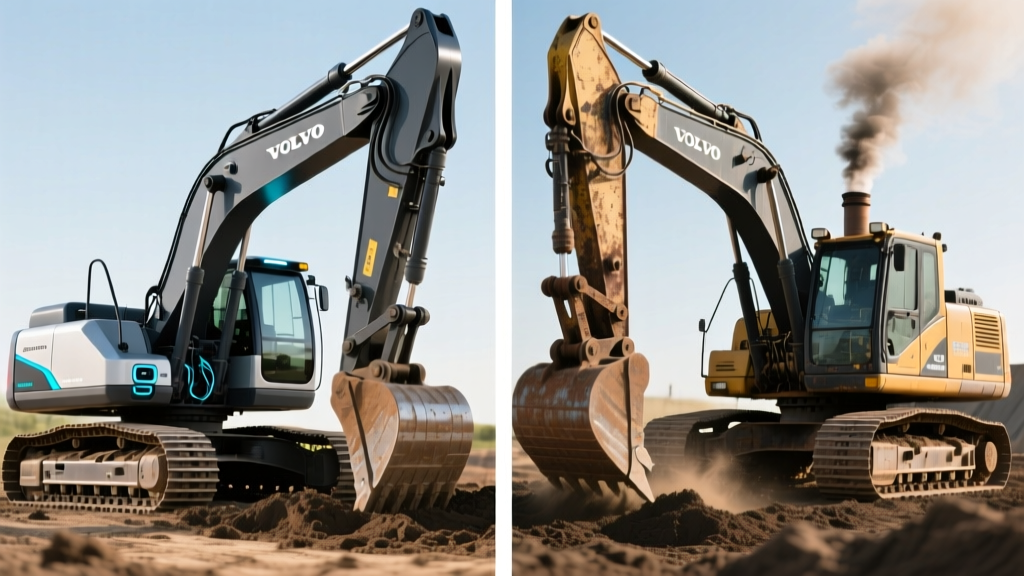
Volvo CE's compact electric excavators (ECR25 Electric, ECR18 Electric) deliver zero tailpipe emissions, dramatically lower fuel and maintenance costs, and near-silent operation — ideal for urban job sites, indoor demolition, and noise-restricted zones. Expect to pay 2-3x the upfront cost of a comparable diesel machine, but recoup through ~70-80% lower energy costs per operating hour and near-zero engine maintenance. However, these are compact construction machines, not road vehicles, and they fall entirely outside the consumer EV tax credit (§30D) framework. Charging requires 32A/400V three-phase site power or mobile battery packs — not standard Level 2 infrastructure.
If you've landed here searching for a "Volvo electric excavator," you're likely a contractor, fleet manager, or procurement specialist weighing electrification for heavy equipment. This is not a consumer car review — Volvo Construction Equipment (Volvo CE) makes electric compact excavators for professional use, and the ownership calculus is fundamentally different from buying an EV sedan or SUV. Let's break down what these machines actually cost, how they charge, and where they make financial sense versus diesel equivalents.
What Volvo Electric Excavators Actually Exist
Volvo CE's electric excavator lineup focuses on the compact segment — machines in the 1.8 to 2.5 metric ton operating weight class. These are not the 30-ton mining excavators you see in quarries; they're the small machines used for utility trenching, basement excavation, landscaping, and indoor demolition work.
| Model | Operating Weight | Battery Capacity | Estimated Runtime | Charge Time (0-100%) | Approx. Base Price |
|---|---|---|---|---|---|
| ECR18 Electric | 1.8 metric tons | 20 kWh (lithium-ion) | 4-5 hours (typical duty cycle) | ~6 hours (standard); ~1 hour (DC fast option) | ~$50,000-$60,000 |
| ECR25 Electric | 2.5 metric tons | 48 kWh (lithium-ion) | 5-8 hours (typical duty cycle) | ~6 hours (standard); ~1-1.5 hours (DC fast option) | ~$70,000-$85,000 |
Important context: Pricing for construction equipment is rarely published as MSRP the way consumer vehicles are. Final cost depends on dealer, attachments (buckets, breakers, augers), and regional availability. Contact your local Volvo CE dealer for firm quotes. Volvo CE has indicated plans to expand the electric range, but larger electric excavators (e.g., 5-14 ton class) remain in pilot or announced status as of 2026 — not yet widely available for purchase.
Electric Excavator vs Diesel: The Cost Breakdown
The core question for any fleet buyer: does the higher purchase price pay for itself? Here's a realistic comparison based on typical compact excavator usage (roughly 1,000 operating hours per year).
| Cost Category | Diesel (e.g., Volvo ECR25) | Electric (ECR25 Electric) | Notes |
|---|---|---|---|
| Purchase price (approx.) | $30,000-$40,000 | $70,000-$85,000 | Electric premium: ~2-2.5x |
| Energy/fuel cost per hour | $6-$10 (diesel at ~$4/gal, 0.6-0.8 gal/hr) | $1.50-$3.00 (electricity at $0.15-$0.25/kWh) | Varies heavily by local utility rates and diesel prices |
| Annual energy/fuel (1,000 hrs) | $6,000-$10,000 | $1,500-$3,000 | Electric saves ~$4,500-$7,000/year |
| Engine maintenance (oil, filters, coolant, DEF) | $800-$1,500/year | $0 | No engine = no engine maintenance |
| Hydraulic system maintenance | $500-$1,000/year | $500-$1,000/year | Both use hydraulic systems — similar costs |
| Estimated annual total operating cost | $7,300-$12,500 | $2,000-$4,000 | Electric saves ~$5,300-$8,500/year |
Payback estimate: At $5,300-$8,500 in annual savings and a $30,000-$45,000 purchase premium, simple payback runs roughly 4-8 years depending on utilization, local energy costs, and diesel prices. High-utilization fleets running 1,500+ hours/year will see faster payback. Low-utilization machines may never fully recoup the premium on fuel savings alone — the business case often hinges on non-fuel factors (see below).
Where Electric Excavators Win Beyond Fuel Savings
The pure cost-per-hour calculation misses several advantages that often drive the actual purchase decision:
- Noise restrictions: Electric excavators operate at roughly 70-75 dB(A) at the operator position versus 85-95 dB(A) for diesel. This enables work in noise-sensitive environments — hospitals, schools, residential areas with ordinance limits, and night-shift urban construction — without acoustic barriers or work-hour restrictions.
- Indoor and enclosed-space work: Zero tailpipe emissions means no ventilation requirements for basement demolition, tunnel work, or warehouse construction. Diesel machines in enclosed spaces require costly exhaust extraction systems and carry carbon monoxide risk.
- Emissions compliance: Cities and municipalities increasingly require zero-emission equipment for public works contracts. An electric excavator may be the only way to bid on certain projects, making it a revenue enabler rather than just a cost center.
- Operator comfort: Dramatically reduced vibration and noise fatigue over an 8-hour shift. This is not trivial for labor retention and productivity.
- No DEF, no DPF regeneration: Modern Tier 4 Final diesel engines require diesel exhaust fluid (DEF) and periodic diesel particulate filter (DPF) regeneration cycles that can interrupt work. Electric eliminates both.
Charging Requirements: What Job Sites Actually Need
This is where many first-time electric equipment buyers hit a wall. You cannot simply plug a Volvo ECR25 Electric into a standard 120V outlet and expect useful charging.
| Charge Method | Power Supply Required | Charge Time (ECR25, 48 kWh) | Practical Use Case |
|---|---|---|---|
| Standard onboard charger | 32A / 400V three-phase | ~6 hours (0-100%) | Overnight charging at a fixed yard or shop with industrial power |
| DC fast charge option (if equipped) | CCS-compatible DC supply | ~1-1.5 hours (0-80%) | Mid-day top-up on larger sites with temporary power infrastructure |
| Mobile battery pack / power bank | Portable lithium battery unit (e.g., Volvo's own mobile power solutions) | Varies by pack capacity | Remote sites with no grid connection; adds $20,000-$50,000+ in equipment |
Real-world ownership reality: Most compact excavator job sites do not have 400V three-phase power available. Contractors typically need to either (a) charge overnight at their yard/shop and transport the machine to site each morning, (b) invest in a mobile battery pack or towable generator-battery hybrid, or (c) arrange temporary power drops with the local utility — which can take weeks and cost thousands. Plan your charging logistics before purchasing. According to Volvo CE's electric machine resources, the company offers mobile power solutions to address off-grid sites, but these add significant cost.
Common Misconceptions About Electric Excavators
| Myth | Fact |
|---|---|
| "Electric excavators are weak — they can't match diesel digging force." | The ECR25 Electric delivers comparable bucket breakout force and swing torque to its diesel counterpart. Electric motors produce instant peak torque — no turbo lag or RPM ramp-up. In real trenching work, operators report equivalent or better responsiveness. |
| "The battery won't last a full shift." | With a 48 kWh battery, the ECR25 Electric achieves 5-8 hours of runtime depending on duty cycle. Intermittent use (dig, swing, idle, repeat) is far less demanding than continuous heavy load. Most compact excavator work patterns fit within a single charge, with opportunity charging during lunch. |
| "I'll get the $7,500 federal EV tax credit." | The IRS §30D Clean Vehicle Credit applies to on-road light-duty vehicles (cars, trucks, vans). Construction equipment like excavators does not qualify. However, some state and local air quality districts offer grants or rebates for zero-emission off-road equipment — check with your state's environmental agency or EPA clean diesel programs that increasingly cover electric alternatives. |
| "Battery replacement will cost more than the machine." | Volvo CE designs its electric excavator batteries for the machine's operational life. Lithium-ion degradation in industrial applications with proper thermal management typically retains 80%+ capacity after thousands of cycles. Warranty terms vary — confirm with your dealer, but industrial battery warranties commonly cover 5+ years. |
Decision Framework: Should You Buy a Volvo Electric Excavator?
Choose the Volvo Electric Excavator If:
- You regularly work in noise-restricted zones (urban residential, hospitals, schools) and need equipment that complies without work-hour limitations.
- You do indoor or enclosed-space demolition, tunneling, or basement work where diesel exhaust requires costly ventilation.
- You're bidding on municipal or corporate contracts that mandate zero-emission equipment.
- Your machines run 1,000+ hours/year and you have reliable access to three-phase power at your yard for overnight charging.
- You plan to keep the machine 6+ years, allowing the fuel and maintenance savings to offset the purchase premium.
Stick With Diesel (For Now) If:
- Your work is primarily on remote or rural sites with no grid power access and you don't want to invest $20,000-$50,000+ in mobile battery infrastructure.
- You run the machine fewer than 500 hours/year — the fuel savings won't justify the purchase premium in a reasonable timeframe.
- You need larger excavators (5+ metric tons) — Volvo CE's electric lineup currently covers only the compact segment, and larger electric excavators from any manufacturer remain limited in availability.
- Your local dealer doesn't stock or service electric construction equipment — downtime waiting for specialized parts can kill productivity.
Frequently Asked Questions
Can I charge a Volvo electric excavator from a standard outlet?
No. These machines require 32A/400V three-phase power for standard charging, or a compatible DC fast-charge supply. A standard 120V/15A household outlet delivers roughly 1.8 kW — it would take over 26 hours to charge the ECR25's 48 kWh battery, making it entirely impractical. Plan for proper industrial electrical infrastructure.
How does cold weather affect an electric excavator's battery?
Lithium-ion batteries lose capacity and charge acceptance rate in cold temperatures. Expect 15-30% runtime reduction in sustained sub-freezing conditions (below 32°F / 0°C). Volvo CE equips its electric machines with battery thermal management systems, but extreme cold still impacts performance. If you operate in Minnesota winters, factor this into your runtime planning — you may need mid-day charging in January that you wouldn't need in July.
Are there any tax credits or incentives for electric construction equipment?
Not at the federal level for off-road equipment under §30D. However, several states and air quality management districts offer grants, rebates, or voucher programs for zero-emission off-road equipment. California's CARB programs, for example, have funded electric construction equipment deployments. Check with your state environmental agency and local utility — some utilities offer commercial EV/equipment charging rate programs or demand-response incentives that reduce electricity costs.
What happens when the battery reaches end of life?
Industrial lithium-ion batteries are recyclable, and Volvo CE has indicated commitment to battery lifecycle management including second-life applications (stationary storage) and recycling partnerships. Replacement cost is significant — expect $10,000-$20,000+ for a full battery pack replacement — but with proper thermal management and charge-cycle care, the battery should last the majority of the machine's productive life. Confirm warranty specifics with your dealer.
How does the Volvo ECR25 Electric compare to competitors?
The compact electric excavator market includes machines from Volvo CE, JCB (19C-1E), Kubota, and others. Key differentiators include battery capacity, available attachments, dealer service network for electric equipment, and charging ecosystem support. Request side-by-side demos from multiple manufacturers — real digging performance and operator feel matter more than spec-sheet comparisons for this equipment class.
Sources: Volvo CE Electric Machines, EPA Clean Diesel Funding, IRS §30D Clean Vehicle Credit Rules.