The Short Answer on Buying an Electric Volkswagen SUV
If you're shopping for an electric Volkswagen SUV in 2026, you have two realistic choices: the ID.4 compact crossover (EPA range up to 291 miles, starting around $39,735) and the larger ID.7 (EPA range up to 340 miles, starting around $47,995). Both use the MEB platform, accept NACS charging natively for Tesla Supercharger access, and qualify for partial or full §30D federal tax credits depending on your income, sourcing, and trim. For most two-row buyers, the ID.4 Pro S offers the best value-to-range ratio. Choose the ID.7 if you need more interior volume and highway comfort on long road trips. Neither is the fastest-charging EV in its class, but both deliver predictable, practical electric ownership.
Which Electric Volkswagen SUV Models Can You Actually Buy?
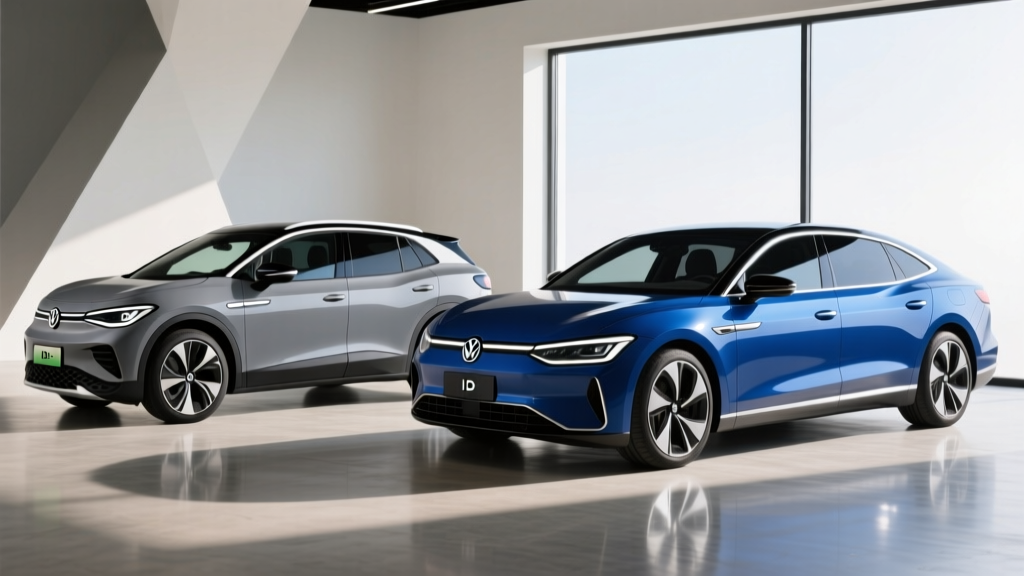
Volkswagen's North American electric lineup centers on two models built on the same MEB architecture but targeting different buyers:
- ID.4 (2026) — Compact crossover, 5-passenger, available in RWD (single motor, 282 hp) and AWD (dual motor, 335 hp). Battery options: 62 kWh (Standard Range) and 82 kWh (Pro/Pro S).
- ID.7 (2026) — Midsize crossover/liftback, 5-passenger, RWD (282 hp) and AWD variants. Uses the 86 kWh (usable) MEB+ battery pack with improved thermal management.
Both models ship with the NACS (J3400) charge port as standard for 2026, eliminating the need for a CCS-to-NACS adapter that earlier ID.4 buyers had to carry. This is a significant ownership convenience upgrade if you rely on Tesla Superchargers for road trips.
EPA Range, Real-World Range, and What Changes It
Volkswagen publishes conservative EPA figures, but real-world results depend heavily on your climate and driving style. Here's what testing and owner data show:
| Model / Trim | Battery (usable kWh) | EPA Range (mi) | Real-World Highway (mi) | Cold-Weather Est. (mi) | MPGe Combined |
|---|---|---|---|---|---|
| ID.4 Standard Range | 62 | 223 | ~185–195 | ~155–170 | 104 |
| ID.4 Pro (RWD) | 82 | 291 | ~245–260 | ~200–220 | 107 |
| ID.4 Pro S AWD | 82 | 263 | ~220–235 | ~180–195 | 98 |
| ID.7 Pro (RWD) | 86 | 340 | ~285–305 | ~235–255 | 112 |
| ID.7 AWD | 86 | 305 | ~260–275 | ~215–230 | 101 |
Why the gap matters: EPA range assumes a mix of city and highway driving at moderate temperatures. Sustained 75+ mph highway driving typically reduces range by 10–15%. In sub-freezing conditions without preconditioning, expect an additional 15–25% loss due to battery chemistry resistance and cabin heating demands. The ID.7's heat pump (standard on Pro trims) mitigates some of this cold-weather penalty compared to the ID.4 Standard Range, which lacks one.
Charging Speeds: Home and DC Fast Charging
Charging speed is where VW's MEB platform shows its age relative to Hyundai/Kia's 800V architecture. Neither the ID.4 nor ID.7 matches the Ioniq 5's 10–80% times, but both are adequate for daily ownership.
| Charging Level | Power (kW) | ID.4 Pro (82 kWh) | ID.7 Pro (86 kWh) |
|---|---|---|---|
| Level 1 (120V household) | ~1.4 kW | ~3 mi/hr | ~3 mi/hr |
| Level 2 (240V, 48A home charger) | 11.5 kW | ~32 mi/hr, full in ~8.5 hr | ~34 mi/hr, full in ~9 hr |
| DC Fast Charge (peak) | 175 kW (ID.4) / 200 kW (ID.7) | 10–80% in ~30 min | 10–80% in ~26 min |
Charge curve reality: The ID.4 peaks at 175 kW only between roughly 10–30% state of charge. By 60% SoC, it tapers to around 80 kW, and above 80% it drops below 40 kW. This is why the 10–80% metric is more useful than peak kW alone. On a road trip, expect 25–30 minutes at a 150+ kW charger to go from 15% to 80%.
The ID.7's MEB+ platform bumps peak DC charging to 200 kW with a slightly flatter curve, shaving roughly 4 minutes off the 10–80% time. It's an improvement, but not transformative.
Total Cost of Ownership: VW Electric SUV vs. Gas Compact SUV
Let's compare the ID.4 Pro ($42,735 MSRP before incentives) against a popular gas alternative, the 2026 Volkswagen Tiguan SEL ($36,500 MSRP), over 5 years and 75,000 miles.
| Category | ID.4 Pro (Electric) | Tiguan SEL (Gas) |
|---|---|---|
| Purchase Price | $42,735 | $36,500 |
| Federal Tax Credit (§30D) | −$3,750 to −$7,500* | $0 |
| Effective Purchase | $35,235–$39,000 | $36,500 |
| Fuel / Electricity (75k mi) | $2,800–$3,900** | $7,500*** |
| Maintenance (5 yr) | $1,200 | $3,500 |
| Insurance (5 yr avg) | $8,500 | $7,200 |
| Estimated Depreciation | $18,000 | $14,500 |
| 5-Year Total | $65,735–$70,600 | $69,200 |
* §30D credit amount depends on battery sourcing compliance, buyer income caps ($150k single / $300k joint), and point-of-sale transfer election. Check current eligibility at irs.gov.
** Electricity cost assumes $0.14/kWh average (home charging dominant). Public DC fast charging at $0.35–$0.48/kWh raises this figure.
*** Gas cost assumes 28 MPG combined, $3.50/gallon national average.
The ID.4 breaks even or beats the Tiguan over 5 years primarily through fuel and maintenance savings — no oil changes, fewer brake replacements (regen braking extends pad life), and no transmission fluid. Insurance runs higher on the ID.4 due to repair-cost data, and EV depreciation has been steeper than gas counterparts in recent years, though this is stabilizing.
Home Charging: What Installation Actually Costs
Most EV ownership satisfaction hinges on home charging. If you can install a Level 2 charger, daily "refueling" takes seconds — plug in at night, wake up full. Here's what a typical 240V / 48A home charger installation costs:
| Item | Cost Range |
|---|---|
| Level 2 EVSE hardware (ChargePoint, Emporia, Wallbox) | $350–$700 |
| Electrician labor (run 60A circuit, NEMA 14-50 or hardwire) | $800–$2,500 |
| Permit and inspection | $100–$400 |
| Electrical panel upgrade (if needed, 200A service) | $1,500–$4,000 |
| Total (no panel upgrade) | $1,250–$3,600 |
| Total (with panel upgrade) | $2,750–$7,100 |
Key consideration: If your home has a 100A electrical panel and you already run electric dryer, stove, and A/C, you may need a panel upgrade to support a 48A continuous EV load. Get a licensed electrician to evaluate your panel capacity before committing to hardware.
If you cannot install home charging (apartment, condo, street parking), public-only charging adds cost ($0.35–$0.48/kWh at DC stations) and time. In that scenario, a PHEV like the VW Tiguan eHybrid may be a more practical electrified option until charging access improves.
Federal Tax Credit Eligibility for 2026 VW Electric SUVs
The §30D Clean Vehicle Credit offers up to $7,500, but eligibility hinges on several requirements that change annually. Here's the 2026 checklist:
§30D Credit Requirements (2026)
- MSRP cap: SUVs must be under $80,000 — both ID.4 and ID.7 qualify on all trims.
- Buyer income cap: AGI ≤ $150,000 (single) / $225,000 (head of household) / $300,000 (joint).
- Battery sourcing: Critical minerals and battery components must meet phased-in percentages from US or FTA partners. VW has been working to localize supply, but not all trims qualify for the full $7,500 — some may receive $3,750.
- Point-of-sale transfer: You can transfer the credit to the dealer at purchase for an immediate price reduction, rather than waiting to claim it on your tax return.
- Final assembly: Vehicle must be assembled in North America. The ID.4 is built in Chattanooga, TN. The ID.7 is assembled in Emden, Germany — this may disqualify the ID.7 from §30D depending on final assembly verification.
Critical note: The ID.4's US assembly in Chattanooga gives it a structural advantage for §30D eligibility. The ID.7, imported from Germany, may not qualify for the federal credit at all under current final-assembly rules. Always verify the specific VIN on fueleconomy.gov before purchasing.
Myths vs. Facts About Owning a VW Electric SUV
| Myth | Fact |
|---|---|
| "The battery will need replacing in 5 years." | VW warranties the battery for 8 years / 100,000 miles with ≥70% capacity retention. Real-world degradation data from MEB vehicles shows ~8–12% loss over 100k miles. |
| "EVs are worse in cold weather." | Range drops 15–25% in sub-freezing temps, but preconditioning while plugged in recovers much of this. The EV still starts instantly with no cold-start issues — unlike gas engines. |
| "I'll be stranded with no charging stations." | With NACS on the 2026 ID.4/ID.7, you access Tesla's 25,000+ Supercharger network plus Electrify America, EVgo, and ChargePoint. Rural gaps exist, but interstate coverage is robust. |
| "Charging takes too long." | Home Level 2 charging takes 8–9 hours overnight — you never wait. Road-trip DC stops are 25–30 minutes, roughly a meal or restroom break. |
| "EVs cost more to insure." | Typically 10–20% more than equivalent gas models due to repair costs and parts pricing. Get quotes before buying — the gap varies by insurer and zip code. |
Decision Framework: Which VW Electric SUV Fits You?
Choose the ID.4 Pro if:
- You want the best value in VW's electric lineup (~$42k before credits)
- You primarily commute under 60 miles round-trip and road-trip 2–4 times per year
- You need guaranteed §30D eligibility (US-built in Chattanooga)
- You want a compact footprint for city parking and tight garages
Choose the ID.4 Pro S AWD if:
- You live in a snow-belt state and need all-wheel drive
- You accept ~28 miles less EPA range for the traction trade-off
- You tow occasionally (2,700 lb max towing capacity)
Choose the ID.7 Pro if:
- You regularly drive 300+ mile highway trips and want fewer charge stops
- You prioritize interior space and ride comfort over price
- You've confirmed §30D eligibility for the German-built VIN (or don't need the credit)
- You want the MEB+ platform's improved 200 kW charging and thermal management
Skip the VW electric SUV and consider a PHEV or competitor if:
- You have no home charging access and rely entirely on street parking
- You tow over 3,000 lbs regularly (consider a gas/hybrid SUV)
- You need the fastest DC charging available — Hyundai Ioniq 5 (10–80% in ~18 min at 350 kW) significantly outpaces VW
- You need 3-row seating — neither VW electric SUV offers it
What First-Time EV Buyers Must Know Before Signing
If this is your first electric vehicle, these ownership realities don't always surface in the showroom:
- Plan your home charging before delivery day. Schedule the electrician 3–4 weeks ahead. You don't want a $42,000 EV sitting in the driveway with only a 120V trickle charger adding 3 miles per hour.
- Download the charging apps before your first road trip. PlugShare, Electrify America, EVgo, and the Tesla app (for Supercharger access via NACS) all require account setup and payment info. Do it at home on Wi-Fi, not at a charger in the rain.
- Learn preconditioning. Set your departure time in the VW Car-Net app while plugged in. The car warms the battery and cabin using grid power, preserving range and enabling faster DC charging when you hit the road.
- Don't obsess over 100% charges. For daily driving, set your charge limit to 80%. This reduces stress on the NMC battery cells and extends long-term health. Charge to 100% only before road trips.
- Check your insurance rate before committing. Call your insurer with the specific VIN. EV premiums vary wildly — some companies charge 5% more, others 25%.
Frequently Asked Questions
Does the 2026 VW ID.4 qualify for the full $7,500 federal tax credit?
The ID.4 is assembled in Chattanooga, TN, meeting the final-assembly requirement. However, the credit amount ($3,750 or $7,500) depends on battery-component and critical-mineral sourcing percentages, which vary by model year and batch. Your income must also fall under §30D caps. Verify the specific VIN on fueleconomy.gov and consult a tax professional.
Can I charge a VW ID.4 at Tesla Superchargers?
Yes. The 2026 ID.4 ships with a native NACS charge port, meaning you can plug directly into any V3 or V4 Tesla Supercharger without an adapter. Access requires linking your VW vehicle to the Tesla app for payment.
How long does the VW ID.4 battery last?
VW warranties the high-voltage battery for 8 years or 100,000 miles, whichever comes first, with a minimum 70% state-of-health retention. Based on MEB fleet data, most packs retain 88–92% capacity at 100,000 miles under normal charging habits (avoiding frequent 100% charges and DC fast charging exclusively).
Is the ID.7 worth the premium over the ID.4?
The ID.7 adds roughly 50 miles of EPA range, 25 kW faster peak DC charging, a larger interior, and MEB+ thermal improvements. If you drive over 20,000 highway miles annually or take frequent long trips, the range and charging gains justify the ~$5,000–$8,000 premium. For commuters with home charging, the ID.4 Pro delivers nearly identical daily usability at lower cost.
What happens if I can only charge on Level 1 (120V)?
Level 1 adds roughly 3 miles of range per hour — about 35–40 miles overnight. This works only if your daily driving is under 30 miles and you park for 10+ hours. For anything beyond minimal commuting, Level 1 is frustratingly slow and should be considered temporary, not a primary strategy.