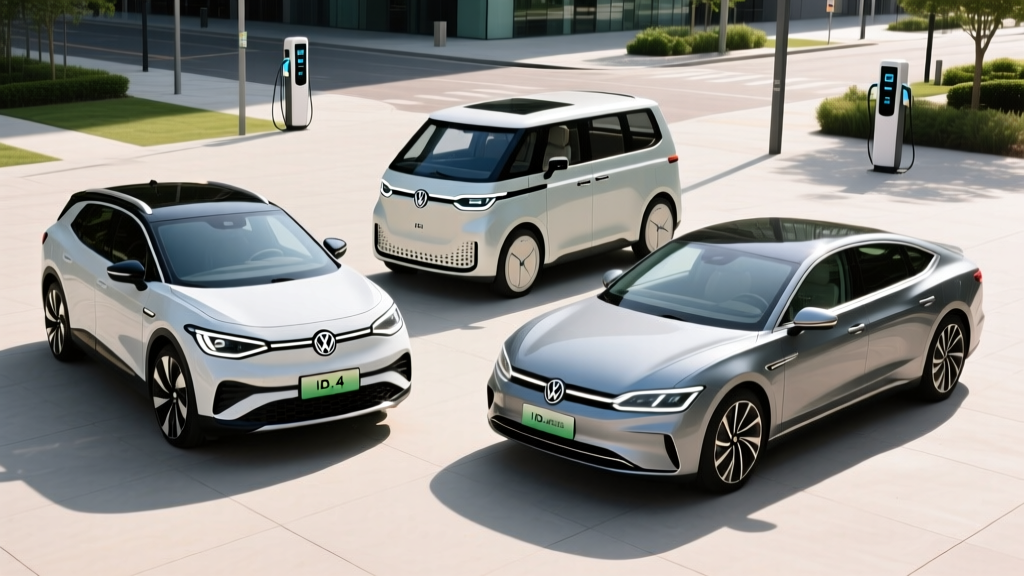
Quick Answer: Volkswagen's 2026 EV lineup for the U.S. market includes three models: the ID.4 compact SUV (EPA range up to 291 miles, starting ~$40,790), the ID. Buzz retro-styled minivan (EPA range up to 234 miles, starting ~$59,995), and the ID.7 sedan (EPA range up to 340 miles, starting ~$49,995). All three use the MEB platform, support DC fast charging up to 175–200 kW, and qualify for varying levels of the federal §30D tax credit depending on battery sourcing. The ID.4 is the volume seller and best value entry point; the ID.7 targets highway commuters needing max range; the ID. Buzz serves families who need three rows and cargo flexibility.
The Current Volkswagen EV Lineup at a Glance
Volkswagen's electrification strategy for the U.S. has narrowed into a practical three-model spread built on the shared MEB (Modular Electric Drive Matrix) platform. Unlike the sprawling lineups from Hyundai/Kia or Tesla, VW is betting on doing a few body styles well rather than flooding every segment. Here is how the 2026 models stack up on the numbers that matter most to buyers.
| Spec | 2026 ID.4 (Pro S AWD) | 2026 ID. Buzz (Pro S Plus) | 2026 ID.7 (Pro S) |
|---|---|---|---|
| Body Style | Compact SUV | 3-Row Minivan | Midsize Sedan |
| Battery (usable) | 82 kWh (NMC) | 91 kWh (NMC) | 86 kWh (NMC) |
| EPA Range | 291 mi (RWD) / 263 mi (AWD) | 234 mi (RWD) / 231 mi (AWD) | 340 mi (est.) |
| Drivetrain | RWD or AWD | RWD or AWD | RWD |
| Horsepower | 282 hp (RWD) / 335 hp (AWD) | 282 hp (RWD) / 330 hp (AWD) | 282 hp |
| 0–60 mph | 7.7s (RWD) / 5.4s (AWD) | 7.9s (RWD) | 6.5s (est.) |
| Peak DC Fast Charge | 175 kW | 175 kW | 200 kW |
| 10–80% DCFC Time | ~28 min | ~30 min | ~26 min |
| Level 2 (240V) Rate | 11 kW | 11 kW | 11 kW |
| MPGe (combined) | 104 MPGe | 87 MPGe | ~115 MPGe (est.) |
| Cargo Volume | 30.3 cu ft (rear up) | 18.2 / 75.5 cu ft (behind 3rd / folded) | ~17.0 cu ft (trunk) |
| Base MSRP | $40,790 | $59,995 | $49,995 (est.) |
| Battery/Powertrain Warranty | 8 yr / 100,000 mi | 8 yr / 100,000 mi | 8 yr / 100,000 mi |
Sources: fueleconomy.gov, Volkswagen ID.4 specs. ID.7 figures are preliminary estimates based on VW's announced U.S. specifications; final EPA certification pending at time of publication.
Real-World Range: What the EPA Sticker Doesn't Tell You
EPA vs. Reality: The ID.4 Pro S RWD carries a 291-mile EPA rating, but real-world highway driving at 70–80 mph typically yields 240–260 miles in mild weather. In sub-freezing conditions (below 32°F), expect a 20–30% reduction, dropping usable range to approximately 190–220 miles. The ID.7's superior aerodynamics (lower drag coefficient) help it hold range better at highway speeds compared to the boxier ID.4 and especially the ID. Buzz.
Volkswagen's MEB platform uses liquid-cooled NMC (nickel manganese cobalt) battery packs across all three models. NMC chemistry offers higher energy density than LFP (lithium iron phosphate), which translates to more range per kilogram — but it also means VW recommends keeping the state of charge (SoC) between 20% and 80% for daily use to minimize long-term degradation. Charging to 100% should be reserved for road trips.
The charging curve on the ID.4 and ID. Buzz peaks at 175 kW but only sustains that rate between roughly 10–40% SoC. From 40–80%, the rate tapers to approximately 100–120 kW. This is why the 10–80% time of ~28 minutes is a more useful metric than the peak kW number alone. The ID.7's upgraded thermal management system allows it to sustain higher charge rates for longer, which is why it achieves a slightly quicker 10–80% time despite a larger battery.
Cost of Ownership: Volkswagen EVs vs. Gas Alternatives
The purchase price is only the opening move. The real question is what you spend over five years of ownership. Below, we compare the ID.4 Pro S AWD against its closest gas-powered rival, the Volkswagen Tiguan SEL 4MOTION (MSRP ~$38,500), over 5 years and 75,000 miles.
| Cost Category (5 yr / 75k mi) | 2026 ID.4 Pro S AWD | 2026 Tiguan SEL 4MOTION |
|---|---|---|
| Purchase Price (MSRP) | $44,590 | $38,500 |
| Federal Tax Credit (§30D) | Up to $7,500* | $0 |
| Effective Purchase Price | ~$37,090 | $38,500 |
| Fuel / Electricity (75k mi) | ~$3,200 (home charging) | ~$8,100 (gasoline at $3.50/gal, 25 MPG combined) |
| Maintenance | ~$1,200 | ~$3,500 |
| Insurance (avg.) | ~$9,500 | ~$7,800 |
| Estimated Depreciation | ~$18,000 | ~$16,500 |
| Total 5-Year Cost | ~$68,990 | ~$74,400 |
*Federal §30D tax credit eligibility depends on MSRP caps (SUVs/vans: $80,000; sedans: $55,000), buyer income limits ($150k single / $300k joint AGI), and battery critical-mineral and component sourcing requirements that change annually. Verify current-year eligibility at IRS.gov or use the point-of-sale transfer at a participating dealer. The ID.7 sedan faces the $55,000 MSRP cap, making certain trims ineligible.
The ID.4 wins on total cost primarily through fuel and maintenance savings. Electricity at the national average of ~$0.16/kWh costs about $0.04 per mile in the ID.4, versus $0.14 per mile for the Tiguan on gas. Maintenance savings come from eliminating oil changes, spark plugs, transmission fluid, and exhaust system repairs — EVs have far fewer wear items. However, EV insurance premiums run 15–25% higher on average due to specialized repair requirements and higher parts costs.
Home Charging, Public Networks, and the Access Reality
Owning any Volkswagen EV is dramatically cheaper and more convenient if you can charge at home. A Level 2 home charger (240V, 40–48 amp circuit) delivers approximately 11 kW to all three VW models, adding roughly 30–37 miles of range per hour. A full overnight charge from 20% to 80% takes about 5–6 hours — more than enough for daily driving needs.
| Home Charging Install Item | Cost Range |
|---|---|
| Level 2 Charger (ChargePoint Home Flex, Emporia, Wallbox) | $400–$700 |
| Electrician Labor (240V/50A circuit run) | $800–$2,500 |
| Permit & Inspection | $50–$300 |
| Electrical Panel Upgrade (if needed, 100A→200A) | $1,500–$4,000 |
| Total (no panel upgrade) | $1,250–$3,500 |
| Total (with panel upgrade) | $2,750–$7,500 |
If you cannot charge at home — apartment dwellers, street-parkers, or those without garage access — VW's EVs become significantly harder to live with. Public DC fast charging costs $0.30–$0.50/kWh on networks like Electrify America, roughly doubling or tripling your per-mile energy cost versus home charging. Relying exclusively on public charging also means 2–4 weekly stops of 25–40 minutes each. Before purchasing, honestly assess your charging access.
All 2026 Volkswagen EVs come with the CCS1 connector standard and include access to Electrify America's network (typically 2 years of complimentary or discounted charging). VW has also announced NACS adapter availability, enabling access to Tesla Supercharger stations — expanding the public charging footprint considerably for road trips.
Federal Tax Credit Eligibility: What Actually Applies to VW's EVs
§30D Federal Tax Credit Checklist for 2026:
- MSRP Cap: SUVs and vans (ID.4, ID. Buzz) must be ≤$80,000; sedans (ID.7) must be ≤$55,000
- Buyer Income Cap: Modified AGI ≤$150,000 (single) / ≤$225,000 (head of household) / ≤$300,000 (married filing jointly)
- Battery Sourcing: Critical minerals and battery components must meet escalating domestic/free-trade-partner thresholds — percentages increase each year through 2032
- Assembly: Vehicle must undergo final assembly in North America (ID.4 is assembled in Chattanooga, TN; ID. Buzz and ID.7 are assembled in Europe — this may affect eligibility)
- Point-of-Sale Transfer: Eligible buyers can apply the credit as an instant rebate at the dealer rather than waiting for tax filing
Always verify eligibility at IRS.gov or consult a tax professional. Rules change annually and vary by VIN.
The ID.4, assembled in Tennessee, has the strongest path to the full $7,500 credit, though battery sourcing requirements must still be met for each model year. The ID. Buzz and ID.7, assembled in Germany, may face partial or full ineligibility depending on how the North American final assembly rule is applied and whether any sourcing exceptions are granted. This is a critical factor that can shift the effective price by thousands of dollars — confirm with your dealer before signing.
Myths vs. Facts: Common VW EV Misconceptions
| Myth | Fact |
|---|---|
| "VW EV batteries need replacing after 5 years" | VW warranties the battery for 8 years/100,000 miles against degradation below 70% capacity. Real-world data from MEB-platform vehicles in Europe shows ~5–8% degradation at 60,000 miles. Full battery replacement costs $12,000–$18,000 but is rarely needed within the vehicle's normal lifespan. |
| "You can't drive VW EVs in cold weather" | All 2026 VW EVs include a heat pump (standard or available), which reduces cold-weather range loss compared to resistive heating. Expect 20–30% range reduction below freezing — manageable if you precondition the battery while plugged in at home. |
| "The ID.4 charges as fast as a Tesla Model Y" | The ID.4 peaks at 175 kW; the Model Y peaks at ~250 kW. The Model Y charges 10–80% in approximately 20 minutes vs. the ID.4's ~28 minutes. The gap matters on road trips with multiple charging stops. |
| "All VW EVs get the full $7,500 tax credit" | Credit eligibility depends on assembly location, battery sourcing, buyer income, and MSRP caps. The European-built ID. Buzz and ID.7 may not qualify for the full credit. Always verify by VIN at the point of sale. |
| "VW's software is still broken" | The 2026 models run VW's ID.Software 4.0, which has significantly improved responsiveness and stability over the problematic 2021–2023 releases. Wireless Apple CarPlay/Android Auto, over-the-air updates, and improved voice control are now standard. |
Decision Framework: Which Volkswagen EV Fits Your Situation?
Choose the ID.4 if:
- You want the most affordable entry point into VW's EV lineup (~$33,290 after max tax credit)
- You need a practical compact SUV for commuting, school runs, and weekend trips
- Your daily driving is under 80 miles round-trip (covers ~95% of U.S. commutes)
- You value North American assembly for stronger tax credit eligibility
Choose the ID.7 if:
- Highway commuting is your primary use case and you need maximum range (340 mi EPA)
- You prefer a sedan's driving dynamics and aerodynamic efficiency over SUV ride height
- You regularly drive 200+ mile stretches between charging stops
- The $55,000 sedan MSRP cap doesn't eliminate your preferred trim from credit eligibility
Choose the ID. Buzz if:
- You need three rows of seating and minivan cargo flexibility
- You're replacing a Honda Odyssey or Toyota Sienna and want to go electric
- Range requirements are modest (school runs, activities, local driving under 150 mi/day)
- You can absorb the higher purchase price and potentially reduced tax credit
Look elsewhere if:
- You need 350+ miles of range — consider the Hyundai Ioniq 6 (361 mi) or Lucid Air
- You need the fastest DC charging available — Hyundai/Kia's E-GMP platform (800V architecture) charges 10–80% in ~18 minutes
- You tow frequently — VW's EVs have limited towing ratings (ID.4: ~2,700 lbs; consider the Ford F-150 Lightning or Rivian R1S for heavy towing)
- You have no access to any form of home or workplace charging
What First-Time VW EV Buyers Should Know Before Signing
Beyond the spec sheet, several ownership realities shape the daily experience with a Volkswagen EV:
Preconditioning matters. All three models allow you to set a departure time in the vehicle's app or infotainment system. This warms or cools the battery to optimal temperature before you drive (and before DC fast charging), which preserves range in extreme temperatures and enables faster charging speeds. Use this feature every time — it's the single highest-impact habit for EV efficiency.
Regenerative braking is customizable. VW offers multiple regen levels selectable via steering wheel paddles (on the ID.4 and ID.7) or the shifter. Unlike some competitors, VW does not offer true one-pedal driving that brings the car to a complete stop — you will still use the brake pedal at low speeds. This is a deliberate engineering choice, but it surprises buyers coming from a Nissan Leaf or Tesla.
Over-the-air (OTA) updates are standard. VW pushes periodic software updates that can add features, improve efficiency, or fix bugs. However, major updates sometimes require a dealer visit. The update process takes 1–2 hours and renders the vehicle inoperable during installation — plan accordingly.
Dealer experience varies widely. VW's EV sales training has improved since the ID.4 launch, but not every dealership has dedicated EV specialists or functioning demo chargers. Test-drive the specific trim you intend to buy, and verify that the dealer can process the §30D point-of-sale credit transfer before committing.
Does the Volkswagen ID.4 qualify for the full $7,500 federal tax credit?
The ID.4 is assembled in Chattanooga, Tennessee, satisfying the North American final assembly requirement. However, full credit eligibility also depends on battery component and critical-mineral sourcing thresholds (which increase each year), buyer income caps, and the $80,000 MSRP cap for SUVs. Most ID.4 trims fall under the MSRP cap. Verify your specific VIN's eligibility at IRS.gov or through the dealer's point-of-sale system.
How long does it take to charge a VW ID.4 at home?
On a Level 2 home charger (240V, 48A), the ID.4 charges at up to 11 kW, adding approximately 33 miles of range per hour. A 20–80% charge takes roughly 5 hours. On a standard 120V household outlet (Level 1), expect approximately 3–4 miles per hour — adequate only for topping off if your daily driving is under 30 miles.
Is the VW ID. Buzz practical as a daily driver?
The ID. Buzz excels for families needing three rows and cargo space, but its 231–234 mile EPA range is the shortest in VW's EV lineup. For daily commutes under 100 miles with home charging, it works well. For frequent 200+ mile road trips, the limited range and ~30-minute DC fast charge stops require more planning than the ID.4 or ID.7.
What happens if the battery degrades significantly?
Volkswagen warranties the high-voltage battery for 8 years or 100,000 miles, whichever comes first, against capacity loss below 70% of original. If degradation exceeds this threshold during the warranty period, VW will repair or replace the battery at no cost. Outside of warranty, a full replacement pack costs approximately $12,000–$18,000 depending on the model, though individual module replacement may be possible at lower cost.
Can I use Tesla Superchargers with a Volkswagen EV?
Volkswagen has announced NACS adapter compatibility for its MEB-platform vehicles, enabling access to Tesla's Supercharger network. Availability and included adapter pricing vary by model year and trim. Confirm adapter availability with your dealer at the time of purchase. The native CCS1 port also provides access to Electrify America, EVgo, and other major networks.