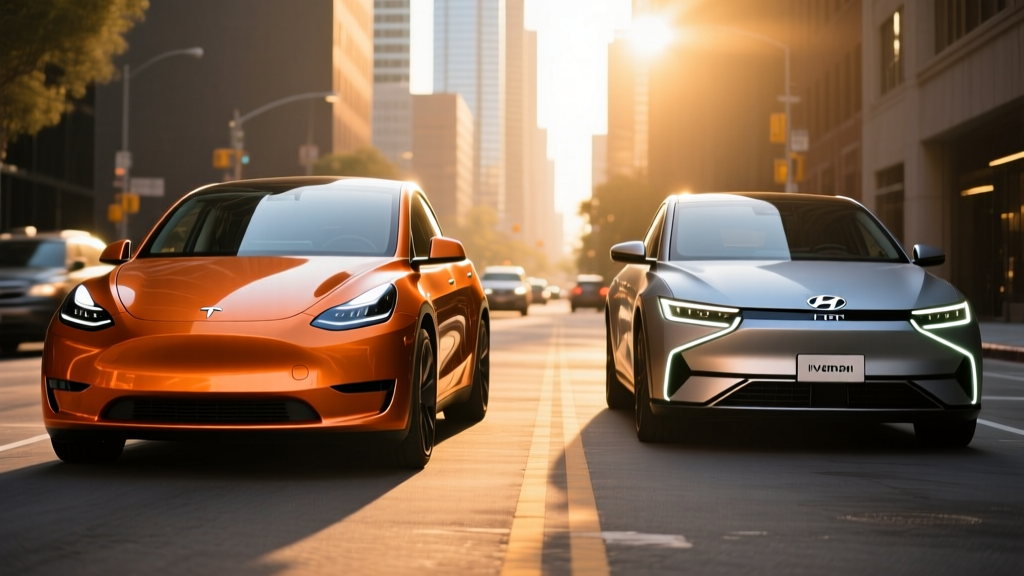
The short answer: US automakers like Tesla, Ford, and GM are competing against a wave of affordable, tech-rich Chinese EVs that are reshaping global pricing. However, due to 100%+ US tariffs on Chinese-made EVs, most China-built models (BYD, NIO, XPeng, Zeekr) are not sold directly to US consumers in 2026. What this means for you: US-market EVs are getting cheaper and better as automakers respond to the threat of Chinese competition, with models like the Tesla Model 3 ($38,990), Chevy Equinox EV ($33,600), and Ford Mustang Mach-E ($42,995) offering stronger value than ever. Your buying decision should focus on EPA range, charging speed, §30D tax credit eligibility, and real-world ownership costs — not on waiting for a BYD to hit US showrooms.
Why China's EV Competition Matters to US Buyers
China produces over 60% of the world's electric vehicles, led by BYD — which surpassed Tesla in global BEV deliveries in late 2023 and has continued scaling aggressively through 2025-2026. Models like the BYD Seagull (starting around $10,000 in China) and the BYD Seal (a Model 3 competitor with ~340 miles of CLTC range) have forced legacy automakers worldwide to slash prices and accelerate platform development.
For US shoppers, the impact is indirect but real. Tesla cut Model 3 and Model Y prices multiple times throughout 2024-2025. GM launched the Equinox EV at $33,600 — a price point that was unthinkable for a 315-mile-range crossover just two years prior. Ford restructured its EV division to cut costs. This is the China competition effect: even if you can't buy a BYD in Ohio, BYD's existence is driving down the price of the EV you can buy.
US-Market EVs: How They Compare on Price, Range, and Charging
Here's a snapshot of the most relevant US-market EVs competing in the segments where Chinese automakers are strongest globally — compact sedans and crossovers under $50,000.
| Model | Base MSRP | EPA Range | Battery (kWh) | Peak DC Charge (kW) | 10-80% Time | 0-60 mph |
|---|---|---|---|---|---|---|
| Tesla Model 3 RWD | $38,990 | 272 mi | 60 kWh (LFP) | 170 kW | ~25 min | 5.8 sec |
| Tesla Model 3 Long Range | $45,990 | 363 mi | 79 kWh (NMC) | 250 kW | ~18 min | 4.2 sec |
| Chevy Equinox EV 2LT | $33,600 | 315 mi | 85 kWh (NMC) | 150 kW | ~32 min | 7.4 sec |
| Ford Mustang Mach-E Select | $42,995 | 250 mi | 75.7 kWh (NMC) | 150 kW | ~30 min | 5.8 sec |
| Hyundai Ioniq 5 SE | $42,600 | 303 mi | 77.4 kWh (NMC) | 240 kW | ~18 min | 5.1 sec |
Sources: fueleconomy.gov, manufacturer spec sheets. Real-world highway range is typically 10-20% below EPA; cold-weather (below 32°F) can reduce range an additional 15-30%.
Real-world range reality check: A Tesla Model 3 Long Range rated at 363 miles EPA will typically deliver 290-320 miles on a highway road trip at 70+ mph, and as low as 240-260 miles in freezing temperatures. The Chevy Equinox EV at 315 miles EPA translates to roughly 250-275 miles highway. Plan your road trips around these numbers, not the sticker.
What About Chinese EVs — Can You Buy One in the US?
As of 2026, the answer is essentially no — at least not a China-built vehicle. The US imposes a combined tariff of 100%+ on Chinese-made EVs (raised from 25% in 2024 under updated Section 301 trade actions). This effectively doubles the import price, making a $12,000 BYD Seagull cost over $24,000 before dealer margins, compliance modifications, and logistics.
Some Chinese brands are exploring workarounds:
- BYD has announced plans for a Mexico-based factory, but US-Mexico-Canada Agreement (USMCA) rules of origin and potential additional tariffs make US export uncertain.
- Polestar (Geely-backed, China-headquartered) sells the Polestar 3 and 4 in the US, but production for the US market has shifted to South Korea to avoid tariffs.
- Volvo (also Geely-owned) builds the EX30 for the US market in Belgium and China, with tariff implications that have shifted pricing and availability.
Net result: US buyers are choosing from Tesla, GM, Ford, Hyundai/Kia, Volkswagen, BMW, and a handful of others. The competition from China keeps these brands honest on pricing, but you're still buying from established US-market brands with dealer networks, warranty support, and NACS/CCS charging compatibility.
Cost Breakdown: What You'll Actually Spend
Whether you're comparing a US EV against another US EV or a hybrid alternative, the total cost picture matters more than the sticker price. Here's a 5-year ownership comparison for a typical driver (15,000 miles/year, home charging available, $0.14/kWh electricity, $3.40/gallon gas).
| Cost Category | Chevy Equinox EV 2LT | Toyota RAV4 Hybrid (AWD) | Toyota RAV4 Gas (AWD) |
|---|---|---|---|
| MSRP (base) | $33,600 | $33,425 | $30,425 |
| Est. §30D Tax Credit | Up to $7,500* | $0 | $0 |
| Effective Price After Credit | ~$26,100 | $33,425 | $30,425 |
| 5-Year Fuel/Energy Cost | ~$3,150 | ~$6,375 | ~$9,180 |
| 5-Year Maintenance (est.) | ~$1,500 | ~$3,200 | ~$3,800 |
| 5-Year Insurance (est. avg) | ~$9,500 | ~$7,800 | ~$7,200 |
| 5-Year Total Cost | ~$40,250 | ~$50,800 | ~$50,605 |
*§30D tax credit eligibility depends on MSRP caps ($55,000 for sedans, $80,000 for SUVs/trucks), buyer income limits ($150K single / $300K joint), and battery critical-mineral/battery-component sourcing rules. Verify current-year rules at IRS.gov. Point-of-sale transfer is available at participating dealers.
The Equinox EV's lower effective price (after the tax credit) and dramatically cheaper "fueling" cost give it a 5-year advantage of roughly $10,000 over the RAV4 Hybrid — if you qualify for the full credit and have home charging access. Insurance is the notable headwind: EV insurance premiums run 15-25% higher on average due to higher repair costs and battery replacement exposure.
EV vs Hybrid vs Gas: Which Makes Sense for You?
The US automakers vs China EV competition debate sometimes obscures the more practical question: should you go fully electric, plug-in hybrid, or conventional hybrid? Here's a data-driven framework.
| Factor | Battery EV (e.g., Equinox EV) | PHEV (e.g., RAV4 Prime) | HEV (e.g., RAV4 Hybrid) |
|---|---|---|---|
| EPA Range / MPGe | 315 mi / 95 MPGe | 42 mi electric + 38 MPG gas | 39 MPG combined |
| Home Charging Needed? | Strongly recommended | Recommended for EV mode | No |
| Road-Trip Convenience | 30-min DC fast stops | Gas stops (5 min) | Gas stops (5 min) |
| Cold-Weather Impact | 15-30% range loss | Reduced EV range; gas engine fills gap | Minimal |
| Maintenance Cost | Lowest (no oil, fewer moving parts) | Moderate (two powertrains) | Moderate |
| Federal Tax Credit | Up to $7,500 (§30D) | Up to $7,500 (§30D, if eligible) | None |
Your decision framework:
- Choose a BEV if: You have home charging (Level 2, 240V), your daily commute is under 80 miles round-trip, you take road trips fewer than 6 times per year, and you qualify for the §30D credit. You'll save the most over 5 years.
- Choose a PHEV if: You have home charging but frequently drive 200+ miles in a day, live in an apartment without reliable charging access for road trips, or want electric commuting with gas flexibility. The RAV4 Prime (42 miles EV) is a strong pick.
- Choose an HEV if: You have no home charging option, live in a region with sparse DC fast charging infrastructure, or want the lowest upfront cost and zero behavior change. Hybrids still save significantly on fuel without any plug-in requirement.
Common Misconceptions About the China EV Threat
| Myth | Fact |
|---|---|
| "I should wait for BYD to launch in the US — it'll be way cheaper." | 100%+ tariffs make Chinese-built EVs uncompetitive at US retail. BYD has no announced US launch timeline. Waiting means missing current price drops driven by competition fear. |
| "Chinese EVs are low quality." | BYD, NIO, and XPeng score well in Chinese NCAP and Euro NCAP testing. Build quality and software on the BYD Seal and NIO ET7 rival European competitors. The gap is real — it's access, not quality, that limits US availability. |
| "US EVs are overpriced because there's no competition." | US EV prices have dropped 15-25% since 2023, driven by Tesla's price cuts, GM's Ultium cost reductions, and the looming threat of Chinese brands entering via Mexico or Korea. The Equinox EV at $33,600 is direct evidence of competitive pressure. |
| "All EV batteries are made in China, so it doesn't matter what brand I buy." | §30D tax credit rules specifically restrict battery components and critical minerals from "foreign entities of concern" (FEOC), primarily Chinese firms. By 2025-2026, vehicles using Chinese-sourced battery components lose credit eligibility. This is pushing US automakers toward domestic and allied supply chains — and it's why some trims qualify for the credit while others don't. |
What First-Time EV Buyers Should Know in 2026
If the global competition landscape has pushed you toward your first EV purchase, here are the practical realities that spec sheets don't always highlight:
Charging at Home Is the Whole Game
Over 80% of EV charging happens at home. A Level 2 home charger (240V, 32-48 amps) adds 25-40 miles of range per hour of charging and costs $500-$2,000 installed depending on your electrical panel. If your panel needs an upgrade to 200 amps, add $1,500-$3,000. Without home charging, EV ownership becomes significantly less convenient and more expensive (public DC fast charging costs 2-3x more per kWh than home electricity).
Charging Speed Is Not a Single Number
When a manufacturer says "250 kW peak charging," that's the maximum rate at a low state of charge (SoC) under ideal thermal conditions. Real charging follows a curve: a Tesla Model 3 Long Range peaks near 250 kW around 10-20% SoC, then tapers to ~100 kW by 60% and ~40 kW above 80%. The 10-80% time is the number that matters for road trips. Always precondition your battery (the car does this automatically when you navigate to a Supercharger or DC fast station) to hit peak rates.
The NACS Connector Won
As of 2025-2026, nearly every major automaker has adopted Tesla's North American Charging Standard (NACS) for new vehicles. Ford, GM, Rivian, Volvo, and others now ship with NACS ports and access to Tesla's Supercharger network (17,000+ stalls in North America). If you're buying a 2025-2026 model, confirm the connector: NACS gives you the widest fast-charging access. CCS1 vehicles can use a NACS adapter, but native NACS is simpler.
Battery Degradation Is Slower Than You Think
Modern EV batteries (both LFP and NMC chemistries) typically lose 5-10% capacity over 100,000 miles. Tesla's fleet data shows Model 3/Y batteries retaining ~90% capacity at 100,000 miles. LFP batteries (used in the Model 3 RWD) tolerate daily 100% charging better than NMC and may degrade even slower. All major manufacturers warranty the battery for 8 years/100,000 miles with a minimum 70% capacity retention threshold.
Insurance Will Cost More
Budget 15-25% more for insurance compared to an equivalent gas vehicle. EVs have higher repair costs (specialized body shops, battery safety protocols) and higher total-loss thresholds. Get quotes before buying — the difference between insurers can be $500-$1,000/year for the same EV.
Frequently Asked Questions
Will Chinese EV brands like BYD be available in the US soon?
No imminent US launch is announced. The 100%+ tariff on Chinese-made EVs makes direct import economically unviable. BYD is building factories in Thailand, Brazil, Hungary, and potentially Mexico, but US market entry faces additional regulatory and political hurdles. Don't delay your purchase waiting for BYD.
Are US-made EVs actually competitive on price now?
Yes, increasingly so. The Chevy Equinox EV at $33,600 (315 miles range) and Tesla Model 3 RWD at $38,990 (272 miles) represent price points that compete directly with gas and hybrid crossovers once you factor in the §30D tax credit and lower fueling costs. Chinese competition is a major driver of these price reductions.
Does the §30D tax credit apply to all US-market EVs?
No. Eligibility depends on three factors: (1) MSRP caps — $55,000 for sedans, $80,000 for SUVs, vans, and trucks; (2) buyer income limits — $150,000 single filer, $225,000 head of household, $300,000 joint; (3) battery sourcing — critical minerals and battery components must meet escalating thresholds of US/free-trade-agreement sourcing, with FEOC (Chinese entity) restrictions tightening yearly. Check the latest qualified vehicle list at fueleconomy.gov and verify with a tax professional.
What's the cheapest way to own an EV in 2026?
Buy a credit-eligible model like the Equinox EV or base Model 3, install a Level 2 home charger, charge on a time-of-use electricity plan (off-peak rates of $0.08-$0.12/kWh), and keep the car for 5+ years. At $0.12/kWh and 3.5 miles/kWh efficiency, your "fuel" cost is roughly $0.034/mile — versus $0.10-$0.14/mile for a gas car at $3.40/gallon.
Should I be concerned about resale value given Chinese competition?
EV depreciation has been steep — 30-50% over 3 years for some models — partly due to Tesla's price cuts triggering market-wide repricing. However, this is largely priced into current new-EV values. Going forward, vehicles with strong range (300+ miles), NACS compatibility, and over-the-air update capability should hold value better. The risk of Chinese imports flooding the US market is low given current tariff policy.