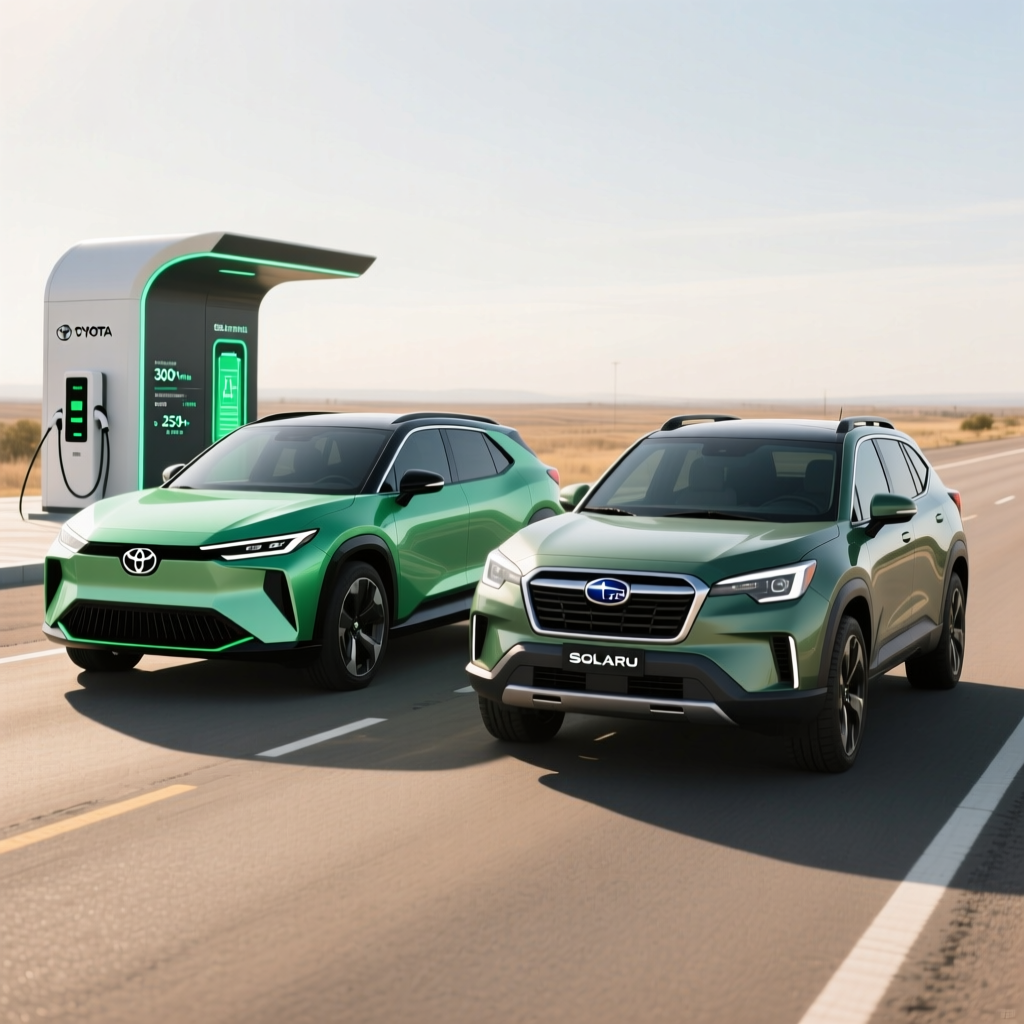
The Toyota bZ4X and Subaru Solterra share the same bones. Built on the co-developed e-TNGA platform, these two electric SUVs are essentially fraternal twins—mechanically similar but dressed in different sheet metal and tuned with distinct brand philosophies. If you are shopping for a compact electric crossover from a mainstream Japanese automaker, you have likely noticed how closely related these two vehicles are. The real question is not whether one is dramatically better than the other, but which one aligns more closely with your priorities.
In this comprehensive comparison, we will dissect every meaningful difference between the Toyota bZ4X and the Subaru Solterra, from EPA-estimated range and charging speeds to interior comfort and warranty coverage. Whether you lean toward Toyota's reputation for reliability or Subaru's adventure-oriented identity, this guide will help you make an informed decision. For more options in this segment, be sure to explore our best electric SUVs rankings.
Overview: Same Platform, Different Personalities
The Toyota bZ4X and Subaru Solterra were born from a collaborative engineering effort between the two Japanese automakers. Both ride on the e-TNGA (electric Toyota New Global Architecture) platform, share identical wheelbases, use the same battery pack options, and offer similar powertrain configurations. However, each brand has applied its own styling language, suspension tuning, feature packaging, and pricing strategy to create a distinct ownership experience.
The Toyota bZ4X positions itself as a practical, efficiency-focused electric crossover with a futuristic design and a strong emphasis on everyday usability. It carries Toyota's brand equity of dependability and broad dealer network support. You can read our full take in the Toyota bZ4X review.
The Subaru Solterra leans heavily into the brand's outdoor-lifestyle image. With standard all-wheel drive on every trim, higher ground clearance, and Subaru's X-MODE traction management system, the Solterra targets buyers who plan to venture beyond paved roads. Check out our in-depth Subaru Solterra review for a standalone assessment.
Side-by-Side Specification Comparison
| Specification | Toyota bZ4X | Subaru Solterra |
|---|---|---|
| Platform | e-TNGA | e-TNGA |
| Drivetrain | FWD or AWD | AWD (standard) |
| Battery Capacity | 71.4 kWh (usable) | 71.4 kWh (usable) |
| Horsepower (FWD / AWD) | 201 hp / 214 hp | N/A / 214 hp |
| Torque (AWD) | 248 lb-ft | 248 lb-ft |
| EPA Range (FWD) | Up to 252 miles | N/A |
| EPA Range (AWD) | Up to 228 miles | Up to 227 miles |
| DC Fast Charging (max) | ~150 kW | ~150 kW |
| Ground Clearance | 7.0 inches | 8.3 inches |
| Cargo Volume (behind rear seats) | 27.7 cu ft | 23.8 cu ft |
| Wheelbase | 112.2 inches | 112.2 inches |
| Length | 184.6 inches | 184.6 inches |
| Towing Capacity | Not rated | Not rated |
| Basic Warranty | 3 years / 36,000 miles | 3 years / 36,000 miles |
| Battery Warranty | 8 years / 100,000 miles | 8 years / 100,000 miles |
Range & Efficiency: A Marginal Difference
When it comes to driving range, the Toyota bZ4X holds a slight edge—primarily because it offers a front-wheel-drive configuration that the Subaru Solterra does not. The bZ4X FWD model achieves an EPA-estimated 252 miles of range in its most efficient trim, making it the more road-trip-friendly option of the two.
When comparing the dual-motor all-wheel-drive variants—the only configuration Subaru offers—the numbers become nearly identical. The bZ4X AWD is rated at approximately 228 miles, while the Solterra AWD comes in at roughly 227 miles. In real-world driving, independent testing by Edmunds has shown that both vehicles can fall short of their EPA estimates in cold weather and at highway speeds, a common trait among EVs. Expect roughly 190 to 210 miles of real-world range in mixed driving for the AWD models.
Efficiency ratings also track closely. Both vehicles deliver around 100 MPGe combined in AWD form, which is respectable but not class-leading. Competitors like the Hyundai Ioniq 5 and Tesla Model Y offer notably more range per kilowatt-hour. If maximizing range is your top priority, check our best long-range electric vehicles list for alternatives.
Pricing & Value: Where the Details Matter
Pricing for both vehicles starts in a similar ballpark, but the packaging strategies differ meaningfully. The Toyota bZ4X typically opens at a slightly lower MSRP because its base trim comes with front-wheel drive. This makes the bZ4X more accessible to budget-conscious buyers who do not need all-wheel drive. Mid-range and fully loaded bZ4X trims climb into territory that overlaps directly with the Solterra.
The Subaru Solterra, with standard AWD on every trim, starts at a higher base price but includes capabilities that would cost extra on the Toyota. Subaru also tends to bundle more features as standard equipment rather than offering them as standalone options. This approach simplifies the buying process and can make the Solterra a better value on a feature-for-feature basis.
Both vehicles have been eligible for federal and state EV incentives depending on where they are assembled and current tax credit rules. Always verify current eligibility on fueleconomy.gov before making a purchase decision. When incentives apply, the effective price of either vehicle drops significantly, improving the value proposition against rivals.
Depreciation is another factor worth considering. Toyota and Subaru both enjoy strong resale value reputations in the broader market, though EV depreciation curves remain less predictable than those of internal combustion vehicles. Historically, Toyota's brand strength has given it a slight advantage in long-term retained value.
Charging Speed: Neither Leads the Pack
Charging performance is one area where both the bZ4X and Solterra draw criticism—and deservedly so. Both vehicles support DC fast charging at a maximum rate of approximately 150 kW, which translates to a 10-80% charge in roughly 30 to 35 minutes under ideal conditions. While this is adequate for most use cases, it trails behind competitors like the Hyundai Ioniq 5 and Kia EV6, which support charging speeds above 235 kW on 800-volt architectures.
On Level 2 AC charging (240V), both vehicles accept up to 6.6 kW, which means a full charge from empty takes approximately 11 to 12 hours. This is typical for the class and works well for overnight home charging. Both vehicles come with a dual-voltage charging cable that supports standard 120V Level 1 charging as well, though at that rate, a full charge can take several days.
One notable distinction: early owner reports and testing by Car and Driver have indicated that the bZ4X and Solterra can exhibit conservative charging curves, meaning the peak 150 kW rate is only sustained for a brief window before tapering. This makes real-world fast-charging sessions slightly longer than the headline numbers suggest. For buyers who plan to road-trip frequently, this is worth factoring into your decision. Browse our best EVs for road trips roundup for vehicles with faster charging capabilities.
Performance & Driving Dynamics
In AWD form, both the bZ4X and Solterra produce 214 horsepower and 248 pound-feet of torque, delivered through dual electric motors—one on each axle. Acceleration from 0 to 60 mph takes approximately 5.8 to 6.5 seconds depending on the source and testing conditions, which is adequate for daily driving but not particularly thrilling compared to sportier EV rivals.
The FWD-only Toyota bZ4X sends 201 horsepower to the front wheels and achieves a 0-60 time closer to 7.0 seconds. This configuration prioritizes efficiency over performance and will appeal to commuters who value range over acceleration.
Where the two vehicles diverge most noticeably is in ride and handling tuning. The Subaru Solterra benefits from 8.3 inches of ground clearance—1.3 inches more than the bZ4X. This extra height, combined with Subaru's X-MODE traction system and hill descent control, gives the Solterra genuine off-road credibility that the Toyota cannot match. On gravel roads, snowy passes, and light trail duty, the Solterra feels more composed and capable.
On pavement, the bZ4X rides slightly lower and feels marginally more carlike in corners. Neither vehicle will be mistaken for a performance SUV, but the Toyota's tuning leans a bit more toward comfort and composure on highways. Steering feel in both is light and somewhat numb, a common trait in electric crossovers focused on efficiency rather than engagement.
Regenerative braking in both vehicles is adjustable through paddle shifters or settings menus, though neither offers true one-pedal driving with a complete stop-and-hold function as seamlessly as some competitors. This is a frequent point of criticism in professional reviews and is something to test during a dealership visit.
Interior Space, Comfort & Cargo
Step inside either vehicle and you will find a cabin that is modern, functional, and slightly quirky. Both share the same fundamental interior architecture, but Toyota and Subaru have applied different material choices, color palettes, and trim accents to give each a unique atmosphere.
Front-seat comfort is excellent in both vehicles. The seats are well-padded, and the driving position is elevated and commanding. The center console design incorporates a large floating touchscreen, physical climate controls, and a rotary gear selector. Both vehicles offer heated front seats as standard or widely available, with ventilated seats and a heated steering wheel on higher trims.
Rear-seat space is adequate for adults on shorter trips, though the sloping roofline cuts into headroom for taller passengers. Legroom is competitive with the segment but falls short of the generous dimensions found in the Hyundai Ioniq 5 or Volkswagen ID.4. The rear seats do recline slightly, which improves comfort on longer journeys.
Cargo capacity is where a measurable difference emerges. The Toyota bZ4X offers 27.7 cubic feet behind the rear seats, while the Subaru Solterra provides 23.8 cubic feet. This roughly four-cubic-foot gap is partly attributable to the Solterra's higher load floor, which accommodates its off-road-oriented underbody components. With the rear seats folded flat, both vehicles offer roughly 56 to 60 cubic feet of total cargo space—sufficient for weekend gear but not class-leading.
Neither vehicle offers a front trunk (frunk), which is a missed opportunity given that competitors like the Ford Mustang Mach-E and Tesla Model Y include useful front storage. The absence of a frunk is a shared shortcoming rooted in the platform's design.
Technology & Infotainment
Both the bZ4X and Solterra feature a 12.3-inch touchscreen infotainment system as the centerpiece of the dashboard. The interface is shared between the two vehicles, though each brand applies its own graphics and branding. The system supports wireless Apple CarPlay and Android Auto, Bluetooth connectivity, and built-in navigation on higher trims.
The infotainment system has drawn mixed reviews from owners and critics. While the screen is large and responsive, the menu structure can feel cluttered, and some commonly used functions are buried in submenus. Physical buttons for volume and tuning are present, which is appreciated, but the reliance on touchscreen controls for climate and vehicle settings can be distracting while driving.
Both vehicles come equipped with a comprehensive suite of driver-assistance features. Toyota's Safety Sense and Subaru's EyeSight systems include adaptive cruise control, lane-keeping assist, automatic emergency braking, blind-spot monitoring, and rear cross-traffic alert. These systems perform well in everyday driving, though some owners have noted that the lane-centering feature can feel overly aggressive in its steering corrections.
A digital instrument cluster sits behind the steering wheel in both vehicles, though the bZ4X places it unusually high and far forward on the dashboard—a design choice intended to function almost like a head-up display. This arrangement works well for some drivers but requires an adjustment period for others. The Solterra uses a more conventional instrument cluster placement.
Over-the-air software updates are supported on both vehicles, allowing Toyota and Subaru to push improvements and bug fixes remotely. This capability is increasingly important in the EV space and helps ensure the vehicles remain up to date long after purchase.
Warranty & Ownership Costs
Warranty coverage is virtually identical between the two vehicles, which should come as no surprise given their shared engineering. Both the Toyota bZ4X and Subaru Solterra include:
- Basic Warranty: 3 years or 36,000 miles
- Powertrain Warranty: 5 years or 60,000 miles
- Battery Warranty: 8 years or 100,000 miles (with a capacity retention guarantee, typically 70%)
- Corrosion Warranty: 5 years or unlimited miles
- Roadside Assistance: 2 years or 25,000 miles (Toyota) / 3 years or 36,000 miles (Subaru)
The battery warranty is the most critical coverage item for EV buyers, and both automakers stand behind their packs with the industry-standard 8-year, 100,000-mile term. This should provide peace of mind for the vast majority of owners.
Insurance costs for both vehicles tend to be moderate for the EV segment. According to data from major insurance aggregators, the bZ4X and Solterra fall in a similar range, though the Subaru may carry a slightly higher premium due to its standard AWD system and marginally higher repair cost estimates. Always obtain personalized quotes before purchasing.
Maintenance costs for both vehicles are low compared to gasoline-powered counterparts. EVs eliminate oil changes, spark plugs, and many other routine service items. Brake wear is also reduced thanks to regenerative braking. Toyota's extensive dealer network gives the bZ4X a slight advantage in service accessibility, particularly in rural areas where Subaru dealerships may be less common.
The Verdict: Which Twin Is Right for You?
The Toyota bZ4X and Subaru Solterra are remarkably similar vehicles, and choosing between them ultimately comes down to lifestyle priorities rather than any dramatic performance or quality gap.
Choose the Toyota bZ4X if:
- You want the longest possible range and prefer a front-wheel-drive configuration for maximum efficiency
- You prioritize a slightly lower starting price and a broader dealer network for service
- Your driving is predominantly on paved roads and in urban or suburban environments
- You prefer Toyota's design language and brand positioning
- Cargo space is a priority—the bZ4X offers nearly four more cubic feet behind the rear seats
Choose the Subaru Solterra if:
- You need standard all-wheel drive and plan to drive in snow, mud, or on unpaved roads regularly
- Higher ground clearance (8.3 inches) is important for your lifestyle
- You value Subaru's X-MODE traction system and hill descent control
- You prefer a vehicle with a more rugged, adventure-ready aesthetic
- You want a simplified trim structure with more features included as standard
For most buyers who live in mild climates and drive primarily on pavement, the Toyota bZ4X is the marginally better choice thanks to its FWD option, superior cargo volume, and slightly better range. For outdoor enthusiasts, ski-town residents, and anyone who regularly encounters low-traction surfaces, the Subaru Solterra is the clear winner—its standard AWD and off-road hardware make it one of the most capable compact electric SUVs available.
Neither vehicle is the range leader or charging-speed champion in its class, so if those metrics are dealbreakers, consider exploring the Hyundai Ioniq 5, Kia EV6, or Tesla Model Y. You can compare all of these options in our best electric SUVs guide.
Frequently Asked Questions
Are the Toyota bZ4X and Subaru Solterra the same vehicle?
They share the same e-TNGA platform, battery pack, powertrain components, and fundamental dimensions. However, they differ in exterior styling, suspension tuning, ground clearance, feature packaging, and available drivetrain configurations. Think of them as fraternal twins—closely related but not identical. The Toyota bZ4X offers a front-wheel-drive option that the Solterra does not, while the Solterra includes standard AWD and off-road features that the bZ4X lacks.
Which has better real-world range, the bZ4X or the Solterra?
In their AWD configurations, both vehicles deliver nearly identical real-world range, typically between 190 and 210 miles in mixed driving conditions. The Toyota bZ4X FWD model can achieve closer to 230 miles in real-world use, giving it an advantage for buyers who do not need all-wheel drive. Cold weather, highway speeds, and aggressive acceleration will reduce range in both vehicles, as is typical for all electric vehicles.
Can the Subaru Solterra handle off-road trails?
Yes, within reason. The Solterra's 8.3 inches of ground clearance, standard dual-motor AWD, X-MODE traction management, and hill descent control make it capable on gravel roads, snow-covered passes, and moderate dirt trails. It is not a dedicated off-roader like a lifted truck, but it is genuinely more capable off-pavement than most electric crossovers. The Toyota bZ4X, with lower ground clearance and no dedicated off-road modes, is less suited for anything beyond well-maintained dirt roads.
Do the bZ4X and Solterra support fast charging on road trips?
Both vehicles support DC fast charging at up to approximately 150 kW, which can add roughly 150 miles of range in about 30 minutes under ideal conditions. While this is adequate, it is slower than competitors built on 800-volt architectures, such as the Hyundai Ioniq 5 and Kia EV6. For frequent road-trippers, planning charging stops with slightly longer dwell times is advisable. Both vehicles are compatible with major charging networks including Electrify America and EVgo.