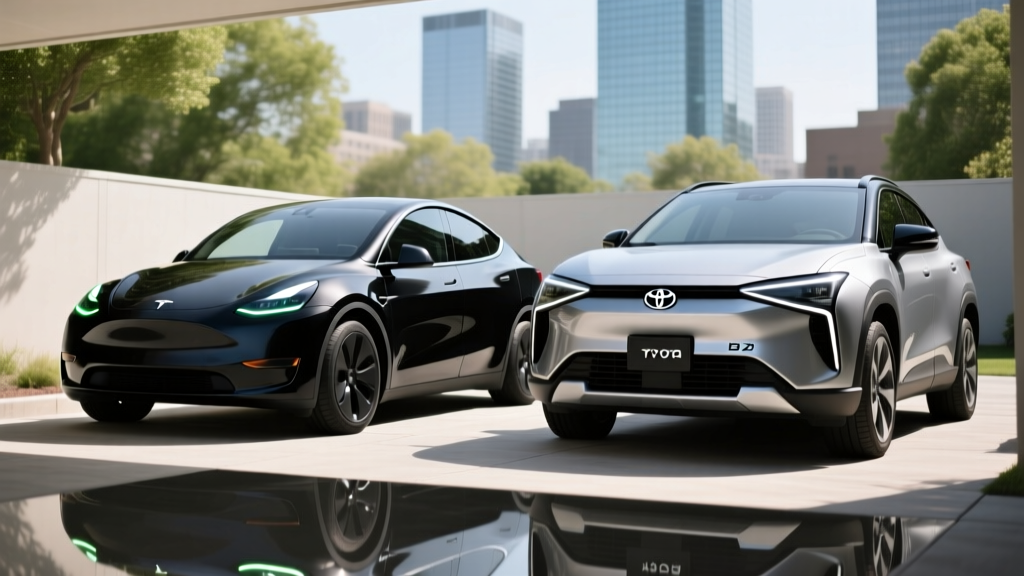
Choosing between Tesla and Toyota in 2026 means choosing between two fundamentally different philosophies of electrification. Tesla remains a pure battery-electric (BEV) automaker with a vertically integrated charging network and software-first design. Toyota, the world's largest automaker, offers a sprawling lineup of hybrids (HEV), plug-in hybrids (PHEV), and a growing but limited selection of full EVs like the bZ4X. This comparison isn't about declaring one brand universally superior — it's about matching each automaker's strengths to your specific driving habits, charging access, and budget.
Below, we compare the most relevant models head-to-head: the Tesla Model Y (Long Range AWD) against the Toyota bZ4X (XLE AWD) for the pure-EV buyer, and the Tesla Model 3 against the Toyota RAV4 Prime (PHEV) for those weighing a BEV against a plug-in hybrid. All specs reflect 2026 model-year data.
Side-by-Side Spec Table: Tesla Model Y vs Toyota bZ4X
| Spec | 2026 Tesla Model Y LR AWD | 2026 Toyota bZ4X XLE AWD |
|---|---|---|
| Powertrain | BEV (Dual Motor) | BEV (Dual Motor) |
| EPA Range | 320 miles | 252 miles |
| Battery (usable) | ~75 kWh (NMC) | ~64 kWh (NMC) |
| Peak DC Fast Charge | 250 kW | 150 kW |
| 10–80% DCFC Time | ~25 min | ~30 min |
| Level 2 Charge Rate | 11.5 kW (48A) | 6.6 kW (32A) |
| 0–60 mph | 4.8 sec | 6.5 sec |
| Horsepower | 384 hp | 214 hp |
| Efficiency (MPGe) | 122 MPGe combined | 102 MPGe combined |
| Cargo Volume | 76 cu ft (rear seats folded) | 56.9 cu ft |
| Base MSRP | $44,990 | $43,070 |
| Battery Warranty | 8 yr / 120,000 mi | 8 yr / 100,000 mi |
Side-by-Side Spec Table: Tesla Model 3 vs Toyota RAV4 Prime (PHEV)
| Spec | 2026 Tesla Model 3 LR AWD | 2026 Toyota RAV4 Prime XSE |
|---|---|---|
| Powertrain | BEV (Dual Motor) | PHEV (2.5L 4-cyl + Dual Motors) |
| EPA Range / EV Range | 341 miles (all-electric) | 42 miles electric + 600+ mi total |
| Battery (usable) | ~75 kWh (NMC) | ~14.9 kWh (NMC) |
| Peak DC Fast Charge | 250 kW | N/A (Level 2 only, 6.6 kW) |
| 10–80% DCFC Time | ~25 min | N/A (~2.5 hr on Level 2) |
| 0–60 mph | 4.2 sec | 5.7 sec |
| Combined Horsepower | 346 hp | 302 hp |
| Efficiency | 131 MPGe | 94 MPGe (EV) / 38 MPG (gas) |
| Cargo Volume | 68 cu ft | 63.2 cu ft |
| Base MSRP | $42,490 | $46,075 |
| Powertrain Warranty | 8 yr / 120,000 mi (battery) | 8 yr / 100,000 mi (hybrid system) |
Category Verdicts: Who Wins Where?
The Model Y delivers 320 EPA miles at 122 MPGe — 68 miles more than the bZ4X and 20 MPGe better. The Model 3's 341 miles and 131 MPGe lead the compact EV segment. Tesla's superior thermal management and heat pump are the key differentiators.
Tesla's 250 kW peak DC fast-charging rate and the Supercharger network's reliability outpace the bZ4X's 150 kW peak on third-party networks (Electrify America, EVgo). The Model Y adds roughly 200 miles of range in 15 minutes; the bZ4X adds about 125 miles in the same window.
Both the Model Y and Model 3 qualify for the §30D federal tax credit (up to $7,500 at point of sale) for eligible buyers meeting income and sourcing requirements. The bZ4X also qualifies, but the RAV4 Prime's eligibility depends on battery-component sourcing — verify current status on fueleconomy.gov. After credit, the Model 3 can drop below $35,000 — a price the RAV4 Prime cannot match.
The RAV4 Prime's gas engine eliminates charging-dependency entirely. If you lack home charging or drive in areas with sparse DCFC infrastructure, the PHEV's 42-mile electric commute plus 600+ mile total range is a practical advantage no BEV can match.
Tesla's over-the-air updates, integrated navigation with real-time Supercharger routing, battery preconditioning, and app ecosystem remain class-leading. Toyota's infotainment has improved (12.3-inch screen, wireless CarPlay/Android Auto on bZ4X), but it lacks Tesla's depth of energy-management features.
Toyota operates over 1,500 US dealerships with established service departments. Tesla's service network is growing but remains thinner in rural areas, and mobile-service wait times can stretch weeks in some regions.
Charging Network Reality: Supercharger vs Public Networks
Tesla's Supercharger network is the single largest competitive advantage in EV ownership. As of early 2026, there are over 6,500 Superchargers across North America, consistently delivering their rated power with minimal downtime. Tesla's navigation system automatically preconditions the battery en route to a charger, which means you arrive at the stall with the pack at optimal temperature — this alone can shave 5–8 minutes off a 10–80% session compared to arriving cold.
The bZ4X relies on CCS1-compatible public networks: Electrify America, EVgo, ChargePoint, and others. While the open CCS ecosystem has expanded significantly, real-world reliability remains inconsistent. A 150 kW-rated bZ4X session may throttle to 90–110 kW depending on station load, ambient temperature, and battery state. Plan for 30–40 minutes on a road trip where a Tesla would spend 20–25 minutes.
Important note: Tesla has opened portions of its Supercharger network to non-Tesla EVs via the NACS connector and Magic Dock adapters, but availability varies by station and peak-hour pricing applies. The bZ4X uses CCS1 and cannot natively access NACS-only Supercharger stalls without an adapter (if supported).
Price & Tax Credit Comparison: What You'll Actually Pay
| Cost Factor | Tesla Model Y LR | Toyota bZ4X XLE | Tesla Model 3 LR | Toyota RAV4 Prime |
|---|---|---|---|---|
| Base MSRP | $44,990 | $43,070 | $42,490 | $46,075 |
| §30D Federal Credit (est.) | $7,500 | $7,500 | $7,500 | $7,500* |
| Effective Price (after credit) | ~$37,490 | ~$35,570 | ~$34,990 | ~$38,575 |
| Est. Home Charger Install | $800–$2,000 (Level 2) | $800–$2,000 (Level 2) | $800–$2,000 | $500–$1,200 (lower kW OK) |
*RAV4 Prime §30D eligibility depends on current battery-component and critical-mineral sourcing requirements. Verify at IRS.gov before purchasing. Income caps apply: $150K single / $300K joint for new vehicles. MSRP caps: $55,000 for SUVs (Model Y, bZ4X, RAV4 Prime qualify); $55,000 for sedans (Model 3 qualifies). Point-of-sale transfer is available at participating dealers.
5-Year Ownership Cost Breakdown
| Cost Category | Tesla Model Y LR | Toyota bZ4X XLE | Tesla Model 3 LR | Toyota RAV4 Prime |
|---|---|---|---|---|
| Fuel/Energy (5 yr, 75K mi) | ~$3,800 (electric) | ~$4,500 (electric) | ~$3,400 (electric) | ~$5,200 (mix electric + gas) |
| Maintenance (5 yr) | ~$1,500 | ~$2,200 | ~$1,400 | ~$3,500 |
| Insurance (avg/yr) | ~$2,400 | ~$1,900 | ~$2,200 | ~$1,800 |
| Depreciation (est. 5 yr) | ~$18,000 | ~$16,000 | ~$16,500 | ~$14,000 |
| Est. Total 5-Yr Cost | ~$25,700 + purchase | ~$24,600 + purchase | ~$23,500 + purchase | ~$24,500 + purchase |
Key takeaways: Tesla insurance premiums run 15–30% higher than Toyota equivalents due to repair-cost data and parts availability. However, Tesla's zero-maintenance powertrain (no oil changes, minimal brake wear from regen) saves $1,500–$2,000 over five years vs. the RAV4 Prime's gas-engine upkeep. The RAV4 Prime holds resale value exceptionally well — Toyota's brand strength in the used market is a real financial advantage.
Driver Assistance: Autopilot vs Toyota Safety Sense
Tesla's Autopilot includes adaptive cruise, lane centering, and automatic emergency braking standard. Full Self-Driving (Supervised) is an $8,000 option (or $99/mo subscription) that adds automatic lane changes, traffic-light recognition, and city-street navigation — but it still requires constant supervision. FSD performs well on highways but remains inconsistent in complex urban environments.
Toyota Safety Sense 3.0 (standard on both the bZ4X and RAV4 Prime) includes adaptive cruise, lane tracing, pre-collision braking, and road-sign assist. It's less ambitious than FSD but highly reliable and predictable. Toyota does not currently offer a hands-off or advanced navigation-guided system comparable to GM's Super Cruise or Ford's BlueCruise.
Decision Framework: Which Should You Choose?
Choose Tesla If:
- You can install a Level 2 home charger (240V / 48A circuit)
- You take regular road trips and want the most reliable fast-charging network
- Range and charging speed are top priorities (320+ miles, 250 kW DCFC)
- You value OTA software updates and integrated energy management
- You want the lowest per-mile energy cost and minimal maintenance
Choose Toyota (BEV or PHEV) If:
- You lack reliable home or workplace charging access (RAV4 Prime eliminates this concern)
- You prefer a traditional dealership service experience with nationwide coverage
- You want strong resale value and lower insurance premiums
- Your daily commute is under 40 miles and you want electric driving without range anxiety (RAV4 Prime)
- You live in an area with limited public DCFC infrastructure
Final Recommendation
For buyers with home charging access and road-trip habits, the Tesla Model Y or Model 3 remains the default EV recommendation in 2026 — the Supercharger network, superior efficiency, and faster charging are tangible daily advantages that compound over years of ownership. The bZ4X is a competent EV but trails on range, charging speed, and energy efficiency, making it harder to recommend unless Toyota's dealer network and warranty give you peace of mind Tesla cannot.
For buyers without home charging, or those in apartments, rural areas, or regions with unreliable public charging, the Toyota RAV4 Prime is arguably the most practical electrified vehicle on the market. Its 42-mile electric range covers most commutes, the gas engine handles everything else, and you never need to think about charging infrastructure. It's the bridge vehicle that works today, everywhere, with no compromises on daily usability.
The right answer depends entirely on your charging situation, driving patterns, and service expectations. Neither brand is wrong — they're optimized for different owners.
Frequently Asked Questions
Does the Toyota bZ4X qualify for the $7,500 federal tax credit?
As of early 2026, the bZ4X is listed as eligible for the full §30D credit, but eligibility depends on battery-component and critical-mineral sourcing requirements that can change. Always verify the specific VIN at fueleconomy.gov before purchasing. Buyer income caps also apply ($150K single / $300K joint).
Can I charge a Toyota bZ4X at a Tesla Supercharger?
Some Tesla Supercharger stations now serve non-Tesla EVs via the built-in Magic Dock (NACS connector). However, the bZ4X uses a CCS1 port and requires the station to support CCS or provide an adapter. Not all Supercharger locations offer this — check the Tesla app for compatible stations before planning a trip.
Is the RAV4 Prime cheaper to own than a Tesla Model 3?
Over 5 years, the Model 3's lower energy and maintenance costs give it a slight edge in total operating cost (~$23,500 vs ~$24,500). However, the RAV4 Prime's stronger resale value and lower insurance premiums narrow the gap significantly. If you factor in the cost of installing a home Level 2 charger ($800–$2,000), the RAV4 Prime may actually cost less in the first 3 years for buyers who already have a 120V outlet and don't need fast home charging.
Which has better real-world winter range?
Tesla's heat pump gives the Model Y and Model 3 a meaningful advantage in cold weather. Expect 15–25% range loss in freezing temperatures on a Tesla vs. 25–35% on the bZ4X, which uses a less efficient resistive heating system in some configurations. The RAV4 Prime sidesteps this entirely — its gas engine provides heat with no electric-range penalty beyond the usual cold-weather battery reduction (~20% on the 42-mile EV range).
How do Tesla and Toyota battery warranties compare?
Tesla guarantees 70% battery capacity retention over 8 years / 120,000 miles. Toyota guarantees 70% retention over 8 years / 100,000 miles for the bZ4X and 10 years / 150,000 miles for the RAV4 Prime's hybrid battery. Toyota's hybrid battery warranty is notably longer, reflecting decades of hybrid-system experience.