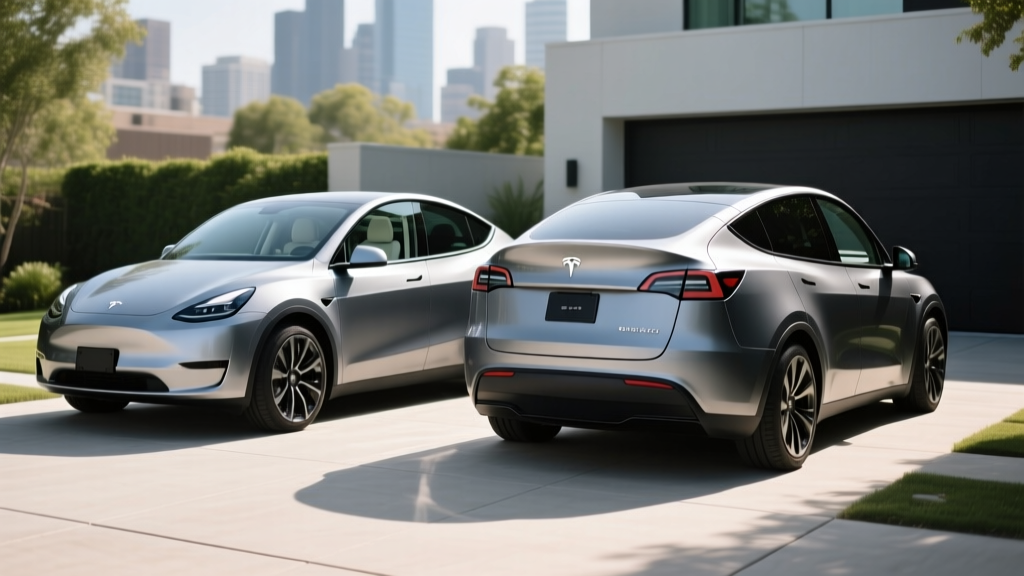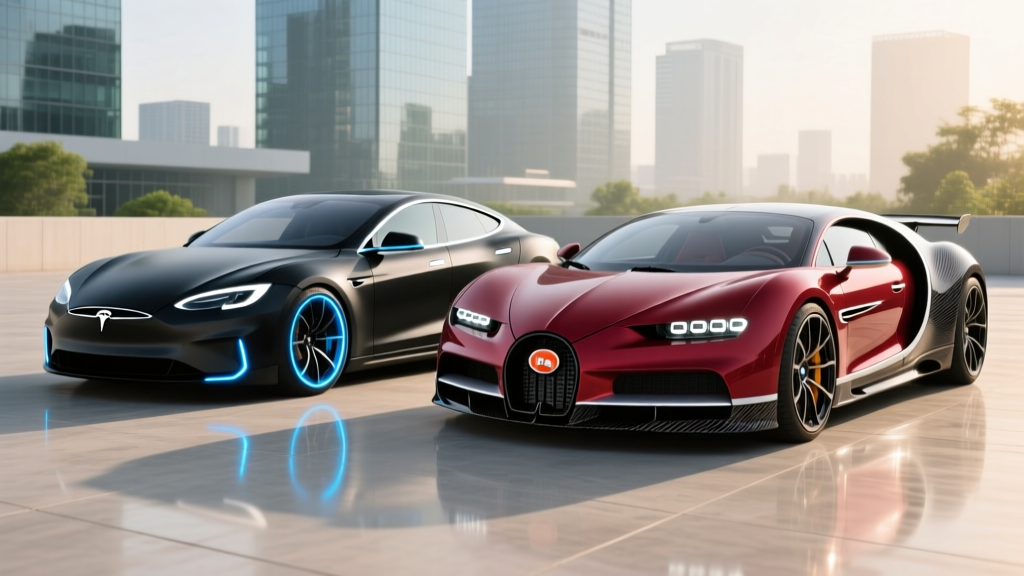
Comparing Tesla and Bugatti is less a traditional head-to-head and more a study in two radically different philosophies of electrified performance. Tesla's Model S Plaid represents the accessible, software-defined electric sedan that democratized supercar-rivaling acceleration. Bugatti's Tourbillon, the V16 hybrid hypercar succeeding the Chiron, brings electrified assist motors to a hand-built, seven-figure masterpiece. Both use electric power in fundamentally different ways — one as a pure battery-electric daily driver, the other as a hybrid halo machine.
This comparison breaks down the Tesla Model S Plaid and the Bugatti Tourbillon across every metric that matters to an electrified-vehicle buyer: real-world range, charging infrastructure, performance data, total cost of ownership, and tax-credit eligibility. The goal isn't to declare a universal winner — it's to map which machine serves which buyer.
Side-by-Side Spec Comparison
Before any narrative analysis, here are the hard numbers. The Model S Plaid is a pure BEV; the Tourbillon is a plug-in hybrid hypercar pairing an 8.3-liter naturally aspirated V16 with three electric motors. These are fundamentally different powertrains.
| Specification | 2026 Tesla Model S Plaid | 2026 Bugatti Tourbillon |
|---|---|---|
| Powertrain Type | Battery Electric (BEV) | Plug-in Hybrid (PHEV) — V16 + 3 e-motors |
| Horsepower | 1,020 hp | 1,800 hp (combined) |
| 0-60 mph | 1.99 seconds | ~2.0 seconds |
| Top Speed | 200 mph | 277 mph (electronically limited) |
| Battery Capacity | ~100 kWh usable (NMC) | ~25 kWh (e-motor assist pack) |
| EPA-Est. Electric Range | 396 miles | ~37 miles (electric-only, est.) |
| Total Range (with fuel) | 396 miles | ~400+ miles (combined fuel + electric) |
| DC Fast Charge (peak) | 250 kW (Supercharger V3) | N/A (no DC fast-charge port confirmed) |
| 10-80% Charge Time | ~27 minutes | Level 2 AC charge (several hours est.) |
| Efficiency (MPGe / kWh) | 120 MPGe combined | Not EPA-rated; hypercar consumption |
| Cargo Volume | 28 cu ft (trunk + frunk) | Minimal (rear shelf only) |
| Curb Weight | ~4,766 lbs | ~4,400 lbs (est.) |
| Base MSRP | $89,990 | ~$4,600,000 (€3.8M) |
| Federal Tax Credit (§30D) | Not eligible (MSRP/income caps) | Not eligible (MSRP cap exceeded) |
| Production Volume | Mass production | 250 units total |
| Warranty (Battery) | 8 yr / 150,000 mi | Bespoke program (not publicly detailed) |
Range, Charging, and Infrastructure Reality
This category reveals the widest gap between the two vehicles, and it's where Tesla's core advantage lives.
Tesla Model S Plaid: The Supercharger Advantage
The Model S Plaid taps into the Tesla Supercharger network — over 6,000 stations and 60,000+ stalls across North America. At a V3 Supercharger, the Plaid peaks at 250 kW, adding up to 200 miles of range in roughly 15 minutes under ideal conditions. Real-world charging curves tell a more nuanced story: the Plaid sustains peak rate only up to approximately 40% state of charge (SoC), then tapers progressively. A 10-80% session typically takes 27-32 minutes depending on battery temperature and preconditioning status.
For road trips, this means a San Francisco-to-Los Angeles run requires one 20-minute stop. Cross-country travel is viable with strategic Supercharger routing, and Tesla's built-in navigation handles charge planning automatically. The Plaid also supports CCS charging via adapter, opening access to Electrify America and other networks — though reliability on non-Tesla networks remains inconsistent based on owner surveys.
Bugatti Tourbillon: Bespoke Energy Management
The Tourbillon's hybrid system isn't designed for EV road-tripping. Its ~25 kWh battery pack powers three electric motors that supplement the V16, providing instant torque fill and a short electric-only driving mode for urban environments and silent neighborhood departures. Bugatti has not published DC fast-charging capability for the Tourbillon; owners will charge via Level 2 AC at home or at the dealership, with full charges taking an estimated 2-4 hours.
For Tourbillon owners, "charging infrastructure" means a dedicated home garage circuit — likely a 60-amp Level 2 installation costing $1,500-$3,000. Public charging is irrelevant; this is a vehicle that will be trailered to events, stored in climate-controlled facilities, and driven sparingly. Total electric-only range is negligible for any practical commute.
Performance: Acceleration, Handling, and Track Capability
Both vehicles deliver otherworldly acceleration, but the character of that performance diverges sharply.
The Model S Plaid's tri-motor all-wheel-drive system produces 1,020 hp and achieves a manufacturer-claimed 1.99-second 0-60 mph time (with rollout subtracted, per industry convention). Independent testing by outlets like Car and Driver and Motor Trend has recorded 0-60 times in the 2.1-2.3 second range under real-world conditions — still astonishing for a four-door sedan weighing nearly 4,800 pounds. The Plaid's carbon-sleeve rotors and thermal management system allow repeated launch-control starts without the power derating that plagued earlier Tesla performance models.
The Tourbillon's 1,800 combined horsepower (V16 producing ~1,000 hp plus three electric motors contributing ~800 hp) targets a ~2.0-second 0-60 mph sprint. The critical difference is character: the Tourbillon delivers a naturally aspirated V16 screaming to 9,000 RPM with electric torque fill eliminating any turbo lag. It's a sensory experience no pure EV can replicate — exhaust note, mechanical vibration, and the progressive power delivery of an internal-combustion engine paired with instantaneous electric torque.
On track, the Plaid's ~4,766-pound curb weight works against sustained lap performance, though Tesla's adaptive air suspension and torque-vectoring rear motors manage mass competently. The Tourbillon, at an estimated 4,400 pounds with a carbon-fiber monocoque and active aerodynamics, is engineered for circuit use with cooling systems designed for sustained high-speed operation.
Both achieve ~2.0-second 0-60 times. The Plaid does it for $89,990; the Tourbillon for $4.6 million. Value goes to Tesla.
Lower weight, bespoke aerodynamics, V16 character, and purpose-built cooling give the Tourbillon the edge for sustained track use and sensory engagement.
Pricing, Tax Credits, and Acquisition Cost
This is where the comparison becomes almost surreal — and where tax-credit rules require precise explanation.
| Cost Factor | Tesla Model S Plaid | Bugatti Tourbillon |
|---|---|---|
| Base MSRP | $89,990 | ~$4,600,000 |
| Typical Options/Config | +$5,000-$10,000 | Bespoke; six-to-seven-figure customization |
| Destination Fee | $1,990 | White-glove delivery included |
| §30D Federal Tax Credit | $0 (MSRP exceeds $55,000 sedan cap) | $0 (MSRP exceeds cap by orders of magnitude) |
| Estimated Out-the-Door | ~$95,000-$105,000 | ~$4,800,000-$6,000,000+ |
Under current IRS §30D rules, neither vehicle qualifies for the up-to-$7,500 federal clean vehicle credit. The Model S fails because its MSRP exceeds the $55,000 cap for sedans (the cap is $80,000 for SUVs/pickups/vans). The Tourbillon fails the same MSRP test by a factor of roughly 80x. Additionally, both vehicles would likely exceed the buyer income caps ($150,000 single / $300,000 joint for §30D) for most Plaid buyers, while Tourbillon buyers operate in an entirely different financial stratum.
For the Model S Plaid buyer, the relevant incentive landscape is state-level: California's CVRP, Colorado's innovative motor vehicle credit, or utility-company rebates for home charger installation. Check your state's energy office for current programs.
Total Cost of Ownership: Efficiency, Insurance, and Maintenance
Five-year ownership costs reveal the practical chasm between these vehicles.
Energy and Fuel Costs
The Model S Plaid consumes approximately 30 kWh per 100 miles (EPA combined). At the U.S. average residential electricity rate of ~$0.17/kWh, that's roughly $0.051 per mile — or about $765 per year for 15,000 miles of driving. Supercharger rates vary ($0.25-$0.45/kWh depending on location and time), pushing road-trip costs higher but still well below gasoline equivalents.
The Tourbillon's fuel consumption during spirited driving will be extreme — expect 8-12 mpg under hard use, with the V16's 8.3 liters of displacement consuming premium fuel at a prodigious rate. At $5.00/gallon for premium and 10 mpg average, that's $0.50 per mile, or roughly $7,500 annually for 15,000 miles — though most Tourbillon owners will drive far fewer miles per year.
Insurance
The Model S Plaid carries elevated insurance premiums due to its performance classification and Tesla's repair-cost history (structural battery pack, aluminum-intensive body). Expect $3,500-$5,500 annually depending on driver profile and state. The Tourbillon requires specialized collector-car or high-value-asset insurance through brokers like Hagerty or Chubb, with annual premiums estimated at $30,000-$60,000+ depending on agreed value, storage conditions, and mileage restrictions.
Maintenance and Depreciation
Tesla's maintenance needs are minimal: cabin air filters, wiper fluid, tire rotation, and brake fluid checks. Tesla recommends no scheduled annual service. Expect $500-$800 per year in routine maintenance. The Tourbillon, as a hand-built hypercar with a V16 engine, hybrid system, and bespoke components, will require dedicated Bugatti technician service at intervals — with annual maintenance running into the tens of thousands of dollars.
Depreciation favors the Tourbillon in percentage terms: limited-production hypercars (250 units) historically hold or appreciate in value. The Model S Plaid will follow typical luxury-sedan depreciation curves, losing an estimated 40-55% of value over five years.
~$0.05/mile energy, minimal maintenance, and standard insurance make the Plaid economically rational as a daily driver.
250-unit production and hypercar collectibility mean the Tourbillon may appreciate, while the Plaid depreciates like a production sedan.
Technology, Safety, and Daily Usability
Tesla: Software-Defined Daily Driver
The Model S Plaid features a 17-inch central touchscreen, 12.3-inch driver display, 22-speaker audio, and Tesla's Autopilot driver-assistance suite. Note that Autopilot and FSD (Supervised) are SAE Level 2 systems — the driver must remain fully engaged with hands on the wheel and eyes on the road at all times. These are not autonomous driving systems.
Over-the-air updates continuously add features. The Plaid includes adaptive air suspension, a yoke or traditional steering wheel option, ventilated front seats, and a 28-cu-ft cargo capacity (trunk plus front trunk) that makes it a legitimate family vehicle. NHTSA has awarded the Model S a 5-star overall safety rating.
Bugatti: Bespoke Engineering Art
The Tourbillon's technology is mechanical and materials-focused rather than software-defined. Its analog-digital instrument cluster is a horological masterpiece — Swiss-watch-grade mechanical gauges integrated with digital displays. The infotainment system is deliberately minimal; Bugatti's philosophy is that a hypercar driver should be engaged with the machine, not a screen. Advanced driver-assistance features are absent — no adaptive cruise, no lane-keeping, no automatic emergency braking in the traditional sense. This is a driver's machine, not a commuter appliance.
Daily usability is essentially zero: no meaningful cargo space, no rear seats (the Tourbillon is a two-seat hypercar), ground clearance suited for smooth surfaces only, and visibility optimized for track awareness rather than parking-lot practicality.
Full ADAS suite, OTA updates, practical cargo space, and five-seat comfort make the Plaid a genuine daily vehicle.
The Tourbillon's mechanical watch-inspired cluster, V16 engineering, and bespoke materials exist in a category Tesla doesn't attempt to enter.
Decision Framework: Which Should You Choose?
Choose the Tesla Model S Plaid if:
- You want supercar-rivaling 0-60 performance in a four-door sedan under $100,000
- You need a daily driver with 300+ real-world miles of range and DC fast charging
- Road-trip capability via the Supercharger network is a priority
- You want over-the-air software updates and a modern ADAS suite
- Practicality matters: five seats, 28 cu ft of cargo, and a usable frunk
- You want to minimize per-mile energy costs (~$0.05/mile on home charging)
Choose the Bugatti Tourbillon if:
- You have a multi-million-dollar vehicle budget and seek a collector-grade hypercar
- The sensory experience of a naturally aspirated V16 paired with electric torque is your priority
- You want a limited-production (250 units) asset that may appreciate in value
- You already own practical daily vehicles and need a weekend/track/event machine
- Mechanical artistry, bespoke craftsmanship, and exclusivity matter more than software features
- You have access to specialized storage, transport, and service infrastructure
Key Differences Summarized
The fundamental distinction: the Tesla Model S Plaid is an electric vehicle that happens to be fast. The Bugatti Tourbillon is a hypercar that happens to use electric motors. One optimizes for daily transportation with performance as a bonus; the other optimizes for peak automotive experience with electric assist as an engineering enhancement.
The Plaid can be your only car. The Tourbillon cannot. The Plaid charges at 250 kW on a highway corridor. The Tourbillon doesn't need to — it has a V16 and a fuel tank. The Plaid costs less than most luxury SUVs. The Tourbillon costs more than most homes. These aren't competing products; they're parallel demonstrations of what electrification enables at opposite ends of the automotive spectrum.
Frequently Asked Questions
Is the Tesla Model S Plaid faster than the Bugatti Tourbillon?
In straight-line 0-60 mph acceleration, they're effectively tied at approximately 2.0 seconds. The Tourbillon's advantage emerges at higher speeds — its 277 mph top speed and V16 power delivery give it a massive advantage in rolling acceleration and track lap times. The Plaid's advantage is achieving comparable launch performance at 2% of the price.
Can I use a Bugatti Tourbillon as a daily driver?
Practically, no. The Tourbillon is a two-seat hypercar with minimal ground clearance, no meaningful cargo space, no driver-assistance features, and bespoke maintenance requirements. It's designed for curated driving experiences, events, and track use. Daily transportation is what your other vehicles are for.
Does either vehicle qualify for the federal EV tax credit?
No. Under current IRS §30D rules, the Model S Plaid's MSRP exceeds the $55,000 sedan cap, and the Tourbillon's MSRP exceeds all caps by orders of magnitude. Neither vehicle's buyers will typically qualify. State-level incentives may apply to the Tesla depending on your jurisdiction — consult your state energy office.
What's the real-world range of the Tesla Model S Plaid?
EPA-rated at 396 miles, expect approximately 300-330 miles in sustained 75-mph highway driving and 270 or fewer miles in sub-freezing temperatures. Battery preconditioning before Supercharger stops helps maintain charge speed. The Tourbillon's electric-only range is approximately 37 miles — essentially a short urban EV mode, not a transportation solution.
How much does it cost to charge the Model S Plaid vs. fueling the Tourbillon?
Home-charging the Plaid at the U.S. average rate of $0.17/kWh costs roughly $0.05 per mile. Fueling the Tourbillon's V16 with premium gasoline at an estimated 10 mpg costs approximately $0.50 per mile — ten times more per mile driven. However, Tourbillon owners typically drive very few annual miles, making total fuel cost manageable relative to the vehicle's acquisition price.