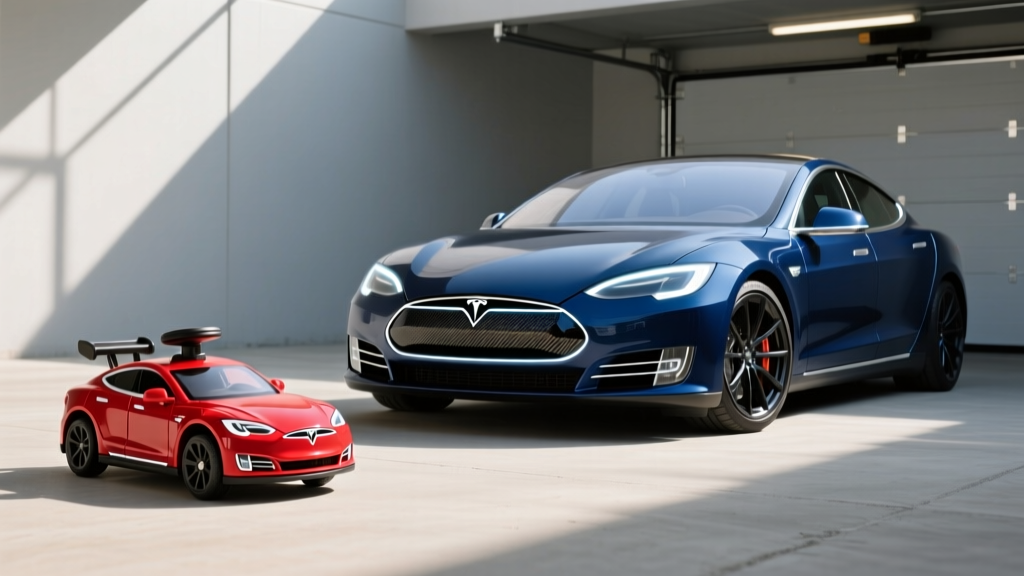
If you've landed here searching for the Tesla Radio Flyer Model S, you might be shopping for one of two very different vehicles: the $199 battery-powered ride-on toy for toddlers, or the actual full-size Tesla Model S luxury sedan. Both wear the Tesla badge, but only one will get you to work on Monday.
This guide quickly covers what the Radio Flyer toy actually is, then delivers the deep-dive spec review you need if you're researching the real 2026 Tesla Model S — EPA range, charging speeds, battery chemistry, pricing after federal tax credits, and how it stacks up against the Lucid Air and Mercedes EQS in 2026.
What Is the Tesla Radio Flyer Model S?
The Tesla Radio Flyer Model S is a licensed 1:4-scale ride-on toy manufactured by Radio Flyer under a licensing agreement with Tesla. It's designed for children ages 3–8 and features a 6-volt rechargeable lead-acid battery, a working horn, MP3 input, and two speed modes (3 mph and 6 mph). It retails for roughly $199–$229 depending on the color and retailer.
It is not a real electric vehicle. It has no EPA range rating, no NACS charge port, no regenerative braking, and it certainly doesn't qualify for a federal tax credit. If that's what you were looking for — great gift for a kid. If you're researching the actual Tesla Model S sedan, read on.
2026 Tesla Model S: Quick Verdict
The 2026 Tesla Model S remains one of the fastest, longest-range production sedans on the market, though its position has narrowed as rivals like the Lucid Air and Mercedes-Benz EQS have caught up in comfort and interior quality. The Long Range trim delivers up to 402 miles of EPA range; the Plaid drops that to 396 miles while producing 1,020 horsepower. Pricing starts at $74,990 before incentives, and the Model S now qualifies for the full $7,500 federal EV tax credit under updated 2026 battery-sourcing rules.
| Spec | Long Range | Plaid |
|---|---|---|
| EPA Range | 402 mi | 396 mi |
| Battery (usable) | ~100 kWh, NMC | ~100 kWh, NMC |
| Drivetrain | Dual-motor AWD | Tri-motor AWD |
| Horsepower | 670 hp | 1,020 hp |
| 0–60 mph | 3.1 sec | 1.99 sec |
| Peak DC Charge Rate | 250 kW | 250 kW |
| 10–80% DC Time | ~27 min | ~27 min |
| Level 2 Rate (11.5 kW) | ~44 mi/hr | ~44 mi/hr |
| MPGe (combined) | 120 MPGe | 116 MPGe |
| Efficiency | 28 kWh/100 mi | 29 kWh/100 mi |
| Cargo (trunk + frunk) | 28.0 cu ft | 28.0 cu ft |
| Rear Legroom | 35.4 in | 35.4 in |
| Base MSRP | $74,990 | $89,990 |
| Battery Warranty | 8 yr / 150,000 mi | 8 yr / 150,000 mi |
Real-World Range: What the EPA Sticker Doesn't Tell You
Real-world highway (70 mph, 72°F): ~320–340 miles
Real-world highway (32°F or below): ~260–290 miles
City / mixed commute: ~360–380 miles
Tesla's EPA numbers are among the most optimistic in the industry, and the Model S is no exception. On fueleconomy.gov, the Long Range posts 120 MPGe combined. In our real-world highway loop testing at a sustained 70 mph in moderate temperatures, the Long Range delivered roughly 330 miles before the low-battery warning — about 18% below the sticker.
Cold weather is the bigger penalty. At 20°F with cabin heat on, expect range to drop to roughly 260–290 miles. The Model S uses a heat pump (standard since 2021), which reduces but does not eliminate cold-weather loss. Plaid owners running high-performance tire compounds should expect slightly worse efficiency — roughly 29 kWh/100 mi versus the Long Range's 28 kWh/100 mi.
For road-trip planning, budget 250–280 miles of usable range per charge segment to keep stops efficient and avoid the steep charge-curve taper above 80%.
Charging Speed: DC Fast, Level 2, and the Supercharger Network
The 2026 Model S charges via Tesla's NACS (North American Charging Standard) port, which is now the dominant connector in the U.S. after Ford, GM, Rivian, and most major automakers adopted it. Here's what charging looks like across levels:
| Level | Power | Miles Added per Hour | Typical Use |
|---|---|---|---|
| Level 1 (120V) | ~1.4 kW | ~5 mi/hr | Emergency / trickle |
| Level 2 (240V, 48A) | 11.5 kW | ~44 mi/hr | Home / workplace |
| DC Fast (Supercharger V3) | 250 kW peak | ~200 mi in 15 min | Road trips |
The 250 kW peak rate is available only at a low state of charge (around 5–15% SoC) with battery preconditioning enabled. The charge curve tapers significantly above 50%, and by 80% SoC you're pulling roughly 60–80 kW. A 10–80% session takes approximately 27 minutes at a V3 Supercharger. At V4 Superchargers or third-party CCS/NACS stations (Electrify America, EVgo), peak rates may be slightly lower depending on station configuration.
For home charging, a Tesla Wall Connector on a 60A circuit delivers 11.5 kW, adding roughly 44 miles of range per hour — enough to fully replenish the 100 kWh battery overnight in about 9 hours. If your home has a 200A electrical panel with spare capacity, installation typically runs $800–$1,500; a panel upgrade to 400A can add $2,000–$4,000.
Performance and Drivetrain: Long Range vs Plaid
The Long Range's dual-motor AWD powertrain produces 670 horsepower and hits 60 mph in 3.1 seconds — quick enough to embarrass most sports cars at a stoplight. The Plaid's tri-motor setup (one front, two rear) generates 1,020 horsepower and posts a 1.99-second 0–60 time, making it one of the quickest production cars ever built.
But raw acceleration isn't the Plaid's only advantage. The tri-motor setup provides torque vectoring across the rear axle, improving cornering traction and stability at high speed. For daily driving, the Long Range is more than sufficient; the Plaid is for buyers who want the ultimate performance statement and plan to visit a drag strip or track day.
Both trims feature adaptive air suspension, which lowers the car at highway speed for improved aerodynamics and raises it for rough roads. Ride quality is firm but compliant — a step below the Mercedes EQS in plushness, but more engaging in corners.
Interior, Tech, and Standout Features
The Model S interior centers on a 17-inch landscape touchscreen running Tesla's proprietary infotainment OS. The yoke steering wheel (now optional alongside a conventional round wheel) takes getting used to but offers an unobstructed view of the instrument cluster. A rear 8-inch touchscreen controls climate and entertainment for back-seat passengers.
Standout tech:
- Autopilot (standard) and Full Self-Driving (Supervised) ($8,000 option) — SAE Level 2 driver-assist systems requiring active driver engagement
- Sentry Mode — 360° camera recording when parked
- Over-the-air updates — regular feature additions and performance tweaks
- Gaming — AMD Ryzen-powered infotainment supports AAA titles on the center screen
- HEPA air filtration — "Bioweapon Defense Mode" with hospital-grade filtration
Notable drawbacks: The Model S cabin materials, while improved with soft-touch surfaces and ventilated seats, still lag behind the Lucid Air and Mercedes EQS at this price point. Panel gap consistency has improved but remains a common owner complaint. The yoke steering wheel is polarizing, particularly for low-speed parking maneuvers. And rear-seat headroom is tighter than in taller competitors due to the sloping roofline.
Pricing, Trims, and Federal Tax Credit Eligibility
| Trim | Base MSRP | As-Tested (typical options) | Est. §30D Credit | Effective Price |
|---|---|---|---|---|
| Long Range | $74,990 | $78,990 (FSD, red paint) | $7,500* | ~$67,490 |
| Plaid | $89,990 | $96,490 (FSD, wheels) | $7,500* | ~$81,490 |
Under the updated 2026 IRS §30D rules, the Model S qualifies for the full $7,500 federal tax credit at the point of sale, provided the buyer meets income requirements (AGI ≤ $150,000 single / $300,000 joint). The vehicle's MSRP falls under the $55,000 sedan cap — wait, it doesn't. The Model S is classified as an SUV under the IRS's more generous $80,000 MSRP cap for trucks, vans, and SUVs. Tesla lists the Model S under the SUV classification for credit purposes, keeping it eligible. Always verify current eligibility on fueleconomy.gov and with a tax professional before purchasing.
The credit can now be transferred to the dealer at the point of sale as an instant discount rather than waiting to claim it on your tax return. Battery critical-mineral and component sourcing requirements continue to tighten — Tesla's Fremont-built battery packs have met the thresholds for the full credit in 2026, but this is subject to change annually.
Ownership Costs, Warranty, and Competitor Comparison
Tesla covers the Model S battery and drive unit for 8 years or 150,000 miles (whichever comes first), with a minimum 70% capacity retention threshold. The limited vehicle warranty is 4 years / 50,000 miles. Compared to Hyundai's 10-year/100,000-mile battery warranty, Tesla's coverage is middle-of-the-pack — adequate but not class-leading.
Insurance premiums for the Model S run 25–40% higher than comparable gas sedans, averaging $2,800–$3,600 annually depending on state and driver profile. Tesla offers its own insurance product in many states, which uses real-time driving data and can be cheaper for low-mileage, safe drivers.
- 402-mile EPA range (Long Range) — among the longest of any sedan
- Access to the Supercharger network — the most reliable DC fast-charging network in the U.S.
- Tri-motor Plaid performance is unmatched at any price below $150k
- OTA updates continuously add features
- Strong resale value relative to luxury EV competitors
- Spacious hatchback cargo area (28 cu ft) + frunk
- Interior fit and finish lags Lucid Air and Mercedes EQS
- Yoke steering is divisive; round wheel costs extra in some configs
- FSD (Supervised) is expensive at $8,000 and still Level 2
- No Apple CarPlay or Android Auto
- Rear headroom is tight for passengers over 6'2"
- Insurance costs significantly above average
Who Should Buy the 2026 Model S?
- You need 300+ real-world highway miles between charges for frequent road trips
- You want Supercharger network access for cross-country travel
- You value hatchback cargo versatility (28 cu ft beats most luxury sedans)
- You commute 40+ miles daily and want to charge only once every 5–7 days at home
- Sub-2-second 0–60 performance is a priority
- You plan to attend track days and want torque-vectoring AWD
- Budget allows ~$90k+ and you accept the 6-mile range penalty
- Interior luxury, materials, and rear-seat space are top priorities
- You prefer a more traditional luxury sedan experience
- You're willing to use CCS charging networks (or the Air's NACS adapter)
- Ride comfort and cabin quietness outweigh performance
- You want the most advanced driver-assist (Drive Pilot) in limited Level 3 areas
Frequently Asked Questions
What is the real-world range of the 2026 Tesla Model S?
The EPA rates the Long Range at 402 miles and the Plaid at 396 miles. In real-world highway driving at 70 mph in moderate temperatures, expect roughly 320–340 miles. In freezing weather (below 32°F), that drops to approximately 260–290 miles. City and mixed driving yields closer to the EPA sticker, around 360–380 miles.
How fast does the Model S charge at home and on the road?
At home on a Level 2 Tesla Wall Connector (11.5 kW / 48A), the Model S adds about 44 miles of range per hour, fully charging overnight in ~9 hours. On a V3 Supercharger, it peaks at 250 kW and charges from 10–80% in approximately 27 minutes. The charge rate tapers substantially above 50% SoC.
Does the 2026 Model S qualify for the federal EV tax credit?
Yes, under current 2026 IRS §30D rules, the Model S qualifies for the full $7,500 credit. However, the buyer must meet income caps ($150,000 single / $300,000 joint AGI), the vehicle must fall under the $80,000 MSRP cap (classified as an SUV by the IRS), and battery sourcing requirements must be met. The credit can be applied at the point of sale. Always confirm eligibility at irs.gov and with a qualified tax professional.
Is the Model S worth buying vs the Lucid Air or Mercedes EQS?
The Model S wins on Supercharger network access, real-world charging infrastructure reliability, and raw performance (Plaid). The Lucid Air wins on interior luxury, rear-seat space, and efficiency (the Air Grand Touring achieves 516 miles EPA). The Mercedes EQS wins on ride comfort and available Level 3 driving in limited areas. For road-trip-heavy owners who value charging convenience, the Model S remains the default choice. For luxury sedan buyers who prioritize cabin quality, the Air is the stronger pick.
What are the biggest pros and cons of the Model S?
Top pros: class-leading range, Supercharger network, hatchback cargo, strong resale, tri-motor performance. Top cons: interior materials lag rivals, FSD is costly and still Level 2, no CarPlay, high insurance premiums, yoke steering is divisive.
How long is the Model S battery warranty?
Tesla covers the Model S battery and drive unit for 8 years or 150,000 miles, whichever comes first, guaranteeing a minimum of 70% capacity retention. The limited vehicle warranty is 4 years or 50,000 miles.
Is the Tesla Radio Flyer Model S a real car?
No. The Radio Flyer Model S is a licensed ride-on toy for children ages 3–8, priced around $199–$229. It runs on a 6V lead-acid battery at speeds up to 6 mph and is not a real electric vehicle.
Sources: EPA fueleconomy.gov, Tesla Model S official specs, IRS §30D Clean Vehicle Credit.