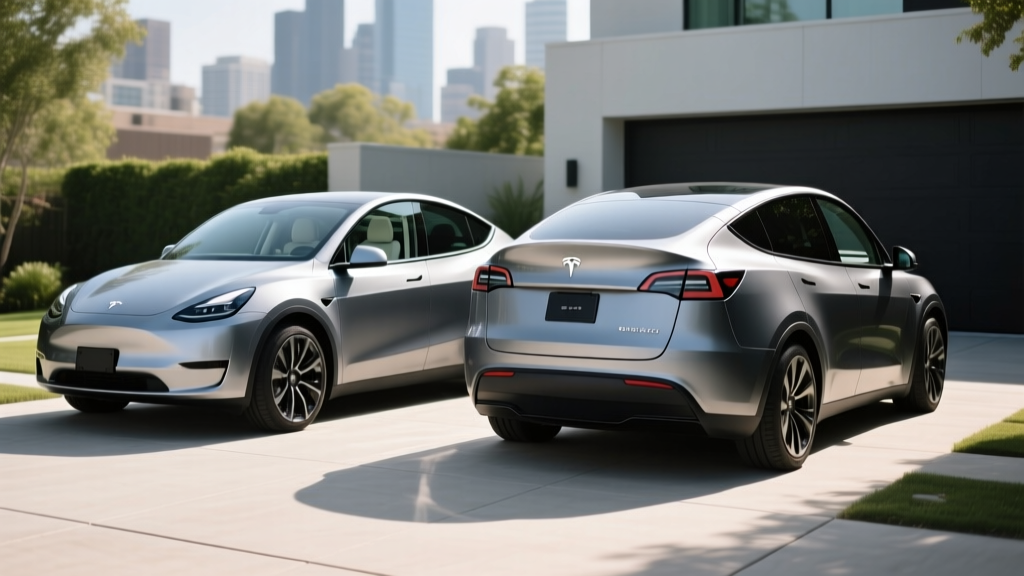
The Tesla Model Y has been the default electric crossover for years, but the introduction of the longer-wheelbase Model YL (sometimes referred to as the Model Y Long or 7-seat variant in various markets) complicates the buying decision. If you are cross-shopping the Model YL vs Model Y in 2026, the choice is not simply "bigger versus smaller." The wheelbase stretch alters range, curb weight, charging behavior, and interior utility in ways that shift the value equation depending on your household size and driving patterns.
This guide compares the current-generation 2026 Tesla Model Y (the refreshed Juniper platform) against the extended Model YL across every metric that matters to EV buyers: EPA range, real-world efficiency, DC fast-charging curves, 0-60 performance, cargo volume, and total ownership cost after the §30D federal tax credit.
Side-by-Side Spec Table: Model YL vs Model Y (2026 Long Range AWD)
| Specification | Model Y (Long Range AWD) | Model YL (Long Range AWD) |
|---|---|---|
| EPA Range (est.) | 320 mi | 300 mi |
| Battery (usable, chemistry) | 78 kWh, NMC | 78 kWh, NMC |
| Peak DC Fast Charge | 250 kW | 250 kW |
| 10–80% DCFC Time | ~24 min | ~26 min |
| Level 2 Charge Rate | 11.5 kW | 11.5 kW |
| 0–60 mph | 4.8 sec | 5.2 sec |
| Horsepower | 384 hp | 384 hp |
| EPA Efficiency | 111 MPGe (30 kWh/100mi) | 104 MPGe (32 kWh/100mi) |
| Cargo (behind 2nd row) | 30 cu ft | 34 cu ft |
| Cargo (max, seats folded) | 72 cu ft | 76 cu ft |
| Seating | 5 (optional 7) | 7 standard |
| Curb Weight | 4,398 lb | ~4,580 lb |
| Base MSRP | $48,990 | $51,990 |
| Battery/Drive Warranty | 8 yr / 120,000 mi | 8 yr / 120,000 mi |
Sources: fueleconomy.gov, Tesla USA spec sheets. Figures are for the Long Range AWD trims; Performance and RWD trims differ. Model YL specs reflect the long-wheelbase 7-seat configuration currently sold in select markets and expected for broader US availability.
Range and Efficiency: Where Physics Favors the Shorter Car
On paper, the standard Model Y Long Range AWD posts an EPA-estimated 320 miles, while the longer, heavier Model YL drops to approximately 300 miles. Both use the same 78 kWh (usable) NMC battery pack, so the 20-mile gap is entirely a function of weight, frontal area, and rolling resistance from the stretched wheelbase.
EPA numbers assume a mixed city/highway cycle. In sustained 75-mph highway driving at 70°F, expect roughly 270–285 miles from the Model Y and 250–265 miles from the Model YL. Add cold weather (below 32°F) and you should subtract another 15–25% — putting the Model YL in the 190–220 mile real-world corridor on winter road trips. Plan charging stops around 200 miles to keep a safety buffer.
Efficiency tells the same story. The Model Y returns about 30 kWh per 100 miles (111 MPGe), while the Model YL consumes roughly 32 kWh/100mi (104 MPGe). Over 15,000 annual miles, that 2 kWh/100mi gap translates to about 300 extra kWh per year — roughly $45 at the national average residential electricity rate of $0.15/kWh, or closer to $120 if you rely exclusively on DC fast charging at $0.40/kWh. It is not a dealbreaker, but it compounds over a five-year ownership horizon.
Charging Speed and Network Reality
Both vehicles share Tesla's 250 kW peak DC fast-charge capability on V3 Superchargers and the newer V4 posts. The 10–80% session takes roughly 24 minutes in the Model Y and about 26 minutes in the Model YL — the slightly larger thermal mass and heavier pack load slow the charge curve marginally in the upper SoC range.
Here is what the charge curve actually looks like in practice. Neither vehicle holds 250 kW for the entire session. Peak power is available roughly between 10% and 35% SoC, after which the rate tapers to ~170 kW near 60%, and drops to ~90 kW past 80%. Preconditioning the battery by routing through the car's navigation to a Supercharger is essential — arriving cold can cut peak power in half. Both the Model Y and Model YL support this automatically.
At home on a Level 2 wall connector at 11.5 kW (48A circuit), a full 10–100% charge takes about 7.5 hours for either vehicle. That is overnight-friendly for most owners, though the Model YL's slightly higher consumption means you will pull a few extra kWh from the grid per session.
Network access is identical: both use the NACS connector natively and have full access to the Tesla Supercharger network, which remains the most reliable DC fast-charging ecosystem in the US. Non-Tesla networks (Electrify America, EVgo) are accessible via adapter but are rarely needed for Tesla owners.
Performance: Quick Enough in Both, Noticeably Different at the Limit
The dual-motor AWD powertrain produces 384 horsepower in both vehicles. The standard Model Y hits 60 mph in 4.8 seconds; the Model YL adds about 0.4 seconds due to its ~180-pound weight penalty, landing at 5.2 seconds. In daily driving, both feel immediate and responsive — electric torque delivery masks the difference at city speeds. It is only during highway merges and sustained high-speed passing where the Model Y's lighter curb weight gives it a perceptible edge.
Handling also favors the shorter wheelbase Model Y on twisty roads. The Model YL's longer wheelbase improves straight-line stability and rear-seat ride comfort but makes it feel less eager in corners. If you prioritize a planted, comfortable highway cruiser with three rows, the YL is the better fit. If you want the sportier drive, the standard Y wins.
Interior Space, Cargo, and the Third-Row Question
This is the category where the Model YL earns its premium. The extended wheelbase translates directly into rear cargo volume: 34 cubic feet behind the second row versus 30 in the standard Model Y. With all seats folded, the YL offers 76 cu ft versus 72 cu ft. The more important difference is the standard 7-seat layout in the YL, which includes a usable third row rated for children and smaller adults on short trips.
The standard Model Y does offer an optional third row in some markets, but the shorter wheelbase makes that third row significantly tighter — suitable only for small children. If you regularly need to carry more than five passengers, the Model YL is the only realistic choice within the Tesla lineup short of stepping up to the Model X.
Second-row legroom also improves in the YL by roughly 2–3 inches, which matters for rear-facing child seats and taller passengers on longer trips. Front-seat space is effectively identical.
Pricing, Tax Credits, and Total Ownership Cost
The 2026 Model Y Long Range AWD starts at $48,990, while the Model YL Long Range AWD begins at $51,990 — a $3,000 gap before options. Both fall under the $80,000 MSRP cap for SUVs under IRS §30D, and both are assembled at Tesla's Austin Gigafactory, which has historically satisfied the North American final-assembly requirement.
- MSRP cap: Vehicle must be under $80,000 (SUVs/vans) — both qualify.
- Buyer income cap: AGI ≤ $150,000 (single), $225,000 (head of household), $300,000 (joint) — verify against your tax situation.
- Battery sourcing: Critical minerals and battery components must meet phased-in percentage thresholds that tighten annually. Confirm current-year compliance on the IRS qualified vehicle list before purchase.
- Point-of-sale transfer: You can transfer the credit to the dealer at purchase to reduce your out-of-pocket cost, rather than waiting to claim it on your tax return.
If both vehicles qualify for the full $7,500 credit, the effective prices drop to approximately $41,490 for the Model Y and $44,490 for the Model YL. That keeps the gap at $3,000 — a meaningful but not overwhelming premium for the added space and seating.
Five-Year Ownership Cost Estimate
| Cost Category | Model Y LR AWD | Model YL LR AWD |
|---|---|---|
| Purchase (after $7,500 credit) | $41,490 | $44,490 |
| Electricity (15k mi/yr, blended) | $3,375 | $3,600 |
| Insurance (avg. annual) | $1,400/yr ($7,000 total) | $1,500/yr ($7,500 total) |
| Maintenance (tires, cabin filter, fluid) | $1,800 | $1,950 |
| Estimated Depreciation | $16,000 | $17,500 |
| Total 5-Year Cost | ~$69,665 | ~$75,040 |
The Model YL costs approximately $5,375 more to own over five years. The bulk of that gap is the higher purchase price and steeper depreciation (heavier, more complex vehicles tend to depreciate slightly faster in the EV segment). Electricity and insurance differences are real but modest.
Tech, Autopilot, and Safety
Both vehicles share the same Juniper-generation interior: a 15.4-inch center touchscreen, rear-seat entertainment display, ventilated front seats, and Tesla's current Autopilot hardware suite. Adaptive cruise, lane-keeping, and automatic emergency braking are standard. Full Self-Driving (Supervised) remains an $8,000 add-on — and it is critical to note that FSD is an SAE Level 2 driver-assist system, not autonomous driving. You must remain engaged and supervise at all times.
Tesla Autopilot and FSD (Supervised) are SAE Level 2 systems. The driver must keep hands near the wheel and eyes on the road. True self-driving (Level 4) is currently limited to geofenced robotaxi services like Waymo in select metro areas. Do not treat any Tesla driver-assist feature as a substitute for active driving.
Safety ratings from NHTSA and IIHS have historically placed the Model Y among the top-rated electric SUVs. The Model YL, sharing the same structural platform, is expected to perform similarly, though its added weight may marginally affect crash-test dynamics in specific scenarios. Confirm the latest ratings at the time of purchase.
Decision Framework: Which One Should You Buy?
Choose the Tesla Model Y if:
- You rarely carry more than four passengers and do not need a third row.
- Maximizing EPA range and efficiency is a top priority (road-trip-heavy lifestyle).
- You want the lowest total cost of ownership and best resale value.
- You prefer sharper handling and a slightly quicker 0–60 time.
- Your garage or parking space is tight — the shorter length matters in urban environments.
Choose the Tesla Model YL if:
- You regularly need seating for six or seven (families with 3+ children, carpool duty).
- Maximum cargo volume is essential (strollers, sports gear, large grocery hauls).
- You prioritize rear-seat legroom and ride comfort over sporty handling.
- The 20-mile range gap and ~$5,400 higher 5-year cost fit comfortably within your budget.
- You want to avoid stepping up to the significantly more expensive Model X for three-row EV seating.
Final Recommendation
For the majority of EV buyers — couples, small families, and commuters — the standard Model Y Long Range AWD remains the more rational choice. It is lighter, more efficient, cheaper to buy and own, and offers essentially the same technology and charging experience. The 20-mile range advantage compounds on road trips, and the lower curb weight means less tire wear over time.
The Model YL exists to solve a specific problem: three-row seating in a Tesla package that does not cost $90,000+. If that problem is yours — if you have outgrown a five-seat crossover and refuse to buy a minivan or a Model X — the YL justifies its $3,000 premium and modest efficiency penalty. It is the best value in the Tesla lineup for larger families, and it has no direct rival at its price point among electric SUVs with genuine third-row space.
Neither vehicle is a wrong choice. The question is whether your household needs the space, and whether you are willing to trade 20 miles of range and ~$5,400 in five-year costs to get it.
Frequently Asked Questions
Does the Model YL qualify for the same $7,500 federal tax credit as the Model Y?
Yes, provided both vehicles meet the current-year §30D battery-sourcing and critical-mineral requirements, and your income falls within the AGI caps. Both are assembled in Austin and fall under the $80,000 SUV MSRP cap. Always verify eligibility on the IRS qualified vehicles list at the time of purchase, as sourcing rules tighten annually.
Is the Model YL's third row actually usable for adults?
It is best suited for children and smaller adults on trips under an hour. A full-size adult will find the knee room and seat cushion height cramped for longer drives. For regular adult passengers in a third row, the Model X or a larger electric SUV is a better fit.
Will the Model YL's extra weight affect tire wear?
Yes, modestly. The ~180-pound weight increase accelerates tire wear by an estimated 5–10% based on load-proportional wear models. Budget for tire replacement at roughly 30,000–35,000 miles on the YL versus 35,000–40,000 miles on the standard Y, depending on driving style and rotation discipline.
Can I add a third row to the standard Model Y after purchase?
Not through Tesla. The optional third row in some markets is a factory-installed configuration. Retrofitting is not supported and would void warranty coverage. If you need seven seats, order the YL or specify the factory third-row option on the standard Y where available.
Which model charges faster at home?
Both charge at the same 11.5 kW Level 2 rate. Because the Model YL consumes slightly more energy per mile, a full charge delivers fewer usable miles — but the actual charging time from 10% to 100% is effectively identical at approximately 7.5 hours on a 48A Wall Connector.