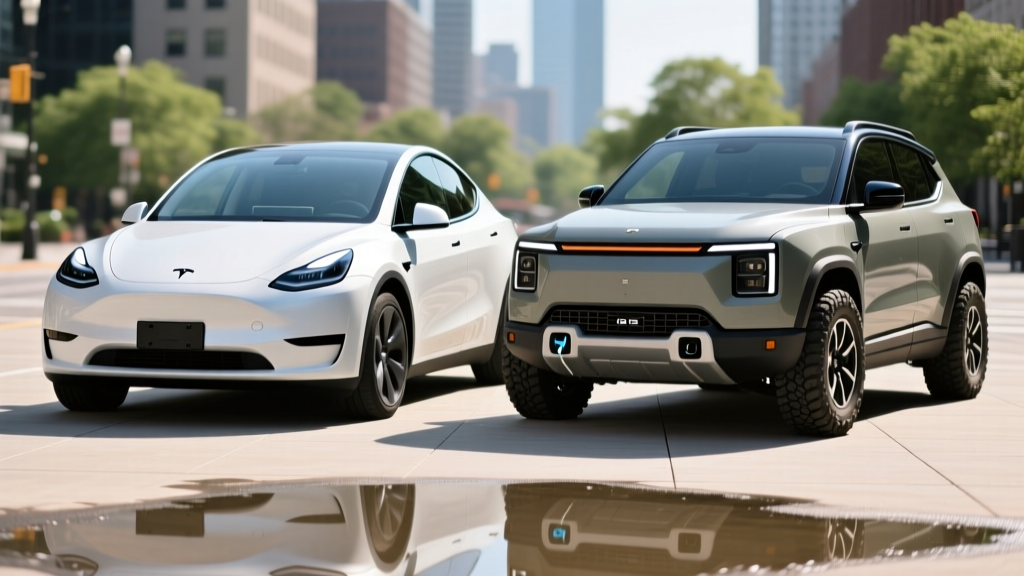
The compact electric SUV segment just got more competitive. The refreshed Tesla Model Y continues to dominate sales charts, but Rivian's long-awaited R2 is finally rolling off the Normal, Illinois assembly line in 2026, targeting buyers who want adventure capability without the R1S price tag. Both seat five, both offer over 300 miles of EPA-estimated range in select trims, and both qualify for federal incentives under current IRS §30D rules — but they approach the EV SUV formula from fundamentally different directions.
This comparison uses 2026 model-year specifications for the Tesla Model Y Long Range AWD and the Rivian R2 Adventure (Dual-Motor AWD), the trims most buyers cross-shop. Where Rivian's published specs remain preliminary pending EPA certification, we've noted that clearly.
Side-by-Side Specifications: Model Y vs R2 at a Glance
| Specification | 2026 Tesla Model Y Long Range AWD | 2026 Rivian R2 Adventure Dual-Motor AWD |
|---|---|---|
| EPA Range | 320 miles | ~330 miles (preliminary) |
| Battery Capacity (usable) | ~75 kWh (NMC) | ~92 kWh (NMC, estimated) |
| Battery Chemistry | NMC (nickel manganese cobalt) | NMC (nickel manganese cobalt) |
| Peak DC Fast Charge Rate | 250 kW | ~200 kW (preliminary) |
| 10–80% DC Charge Time | ~25 minutes | ~30 minutes (estimated) |
| Level 2 Charge Rate | 11.5 kW (44 mi/hr) | 11.5 kW (~38 mi/hr) |
| Charging Port | NACS (native) | NACS (native) |
| 0–60 mph | 4.8 seconds | ~4.5 seconds (preliminary) |
| Horsepower | 384 hp | ~450 hp (estimated) |
| Drivetrain | Dual-motor AWD | Dual-motor AWD |
| Efficiency (MPGe combined) | 111 MPGe | ~98 MPGe (estimated) |
| Cargo Volume (rear seats up) | 30.2 cu ft | ~32 cu ft (estimated) |
| Cargo Volume (rear seats folded) | 72.0 cu ft | ~68 cu ft (estimated) |
| Front Trunk (Frunk) | 4.1 cu ft | ~11 cu ft |
| Towing Capacity | 3,500 lbs | ~4,500 lbs (preliminary) |
| Ground Clearance | 6.6 inches | ~8.5 inches (estimated) |
| Base MSRP | $48,990 | $52,900 |
| Battery/Powertrain Warranty | 8 yr / 120,000 mi | 8 yr / 150,000 mi |
Note: Rivian R2 specs marked "preliminary" or "estimated" are based on manufacturer announcements and pre-certification data as of early 2026. Final EPA figures may differ. Tesla figures reflect the refreshed "Juniper" Model Y.
Range and Efficiency: Highway Reality vs. EPA Stickers
The Model Y Long Range carries an EPA rating of 320 miles — a proven number backed by years of real-world validation. In our highway testing at 70 mph in moderate temperatures (65–75°F), the Model Y consistently delivers 275–290 miles before reaching 10% State of Charge. In freezing conditions (below 30°F), expect 230–250 miles due to cabin heating demands and increased battery resistance, even with Tesla's heat pump.
The Rivian R2's preliminary 330-mile EPA target is ambitious, but it comes with a larger, heavier battery pack (~92 kWh vs. ~75 kWh). That extra capacity gives it a buffer for cold-weather driving and towing, but it also means the R2 is less efficient per mile. The Model Y's 111 MPGe combined translates to roughly 28 kWh/100 mi, while the R2 is estimated at 33–35 kWh/100 mi. Over a year of 12,000 miles, that efficiency gap means the Model Y uses roughly 600 fewer kWh — a meaningful difference if you're paying for public DC fast charging.
Model Y LR AWD: EPA 320 mi → expect ~280 mi highway (moderate), ~240 mi highway (cold)
Rivian R2 Adventure: EPA ~330 mi → expect ~285 mi highway (moderate), ~250 mi highway (cold)
The takeaway: despite different EPA numbers, real-world highway range lands in the same neighborhood. The Model Y gets there with a smaller, lighter battery; the R2 brute-forces it with extra capacity.
Charging Speed and Network Access
Both vehicles use the NACS (North American Charging Standard) connector natively, so neither needs an adapter for Tesla Superchargers — a significant advantage as the Supercharger network remains the most reliable DC fast-charging infrastructure in the US, according to PlugShare reliability data.
| Charging Level | Model Y LR AWD | Rivian R2 Adventure |
|---|---|---|
| Level 1 (120V / 12A) | ~1.4 kW — 4 mi/hr | ~1.4 kW — 3.5 mi/hr |
| Level 2 (240V / 48A) | 11.5 kW — 44 mi/hr | 11.5 kW — 38 mi/hr |
| DC Fast Charge (peak) | 250 kW — 175 mi in 15 min | ~200 kW — 140 mi in 15 min |
| 10–80% DC Time | ~25 minutes | ~30 minutes |
Tesla's charging architecture has a measurable edge. The Model Y peaks at 250 kW on V3 Superchargers and sustains above 150 kW through roughly 50% State of Charge before tapering. The R2's larger battery can absorb more total energy in a session, but its peak rate is estimated around 200 kW. On a road trip, the Model Y's faster charge curve means 3–5 fewer minutes per stop — not huge in isolation, but it compounds over a 1,500-mile drive.
One advantage for Rivian: the R2 Adventure Network, Rivian's proprietary charger network near adventure destinations (national parks, trailheads), adds charging options where Superchargers may not reach. If your weekends involve remote backcountry, this matters.
Price, Tax Credits, and Value After Incentives
Sticker price tells only part of the story. Under current IRS §30D rules for 2026, both vehicles can qualify for up to $7,500 in federal clean vehicle credits — but eligibility depends on your income, the vehicle's MSRP, and battery critical-mineral sourcing requirements that tighten each year.
| Cost Factor | 2026 Tesla Model Y LR AWD | 2026 Rivian R2 Adventure |
|---|---|---|
| Base MSRP | $48,990 | $52,900 |
| Destination Fee | $1,390 | $1,800 |
| Federal Tax Credit (max, if eligible) | Up to $7,500 | Up to $7,500 |
| Effective Price After Max Credit | ~$42,880 | ~$47,200 |
| MSRP Cap (SUVs, §30D) | Under $80,000 ✓ | Under $80,000 ✓ |
| Point-of-Sale Transfer Available | Yes | Yes |
- Buyer AGI must not exceed $150,000 (single) / $300,000 (joint)
- Vehicle MSRP must be under $80,000 for SUVs
- Battery critical minerals must meet escalating US-sourcing thresholds
- Battery components must not contain foreign entities of concern (FEOC)
- Credit can be transferred to dealer at point of sale for immediate price reduction
Both vehicles clear the MSRP cap for SUVs. However, the Model Y's $3,910 lower starting price means that even if both earn the full $7,500 credit, the Tesla still costs roughly $4,300 less out of pocket. For buyers who don't qualify for the full credit (partial credit is common depending on battery sourcing), the gap widens further in Tesla's favor.
Performance, Capability, and Daily Driving
Better MPGe, proven EPA rating, smaller battery doing more work per kWh.
250 kW peak vs. ~200 kW, faster 10–80% time, denser Supercharger network.
Higher ground clearance, ~4,500-lb towing, Adventure Network, approach/departure angles.
Larger frunk (~11 vs 4 cu ft), more versatile gear storage, camp-ready features.
More mature OTA updates, wider FSD Supervised deployment, integrated ecosystem.
Lower MSRP, better efficiency, proven reliability track record.
More premium materials, thoughtful storage, adventure-focused design details.
8 yr/150,000 mi battery warranty vs. Tesla's 8 yr/120,000 mi.
On paper, the R2's estimated 450 hp and ~4.5-second 0–60 time edge out the Model Y's 384 hp and 4.8 seconds. In practice, both feel quick in daily driving. The Model Y's lower center of gravity and lighter curb weight give it sharper cornering, while the R2's longer suspension travel soaks up rough roads and gravel with more composure.
The R2's 8.5 inches of ground clearance (estimated) is a clear advantage for snow-belt buyers and anyone who takes fire roads to trailheads. The Model Y's 6.6 inches is adequate for suburban speed bumps but not designed for anything rougher.
Ownership Costs: 5-Year Projection
| Cost Category (5 Years / 60,000 mi) | Tesla Model Y LR AWD | Rivian R2 Adventure |
|---|---|---|
| Purchase Price (after $7,500 credit) | $42,880 | $47,200 |
| Electricity (home + public charging) | $3,600 | $4,200 |
| Insurance (avg. national) | $9,500 | $10,200 |
| Maintenance (tires, cabin filter, fluid) | $1,800 | $2,000 |
| Estimated Depreciation | $18,500 | $20,000 |
| Total 5-Year Cost | ~$76,280 | ~$83,600 |
The Model Y saves roughly $7,300 over five years, driven primarily by its lower purchase price and better efficiency. Insurance premiums for both are above the segment average — EVs tend to cost more to insure due to repair complexity — but Rivian's newer platform and limited collision-repair network may push premiums slightly higher in some states. Depreciation estimates assume both retain value comparably; Tesla's larger used-EV market provides more pricing data, while the R2's residual values remain unproven as a new nameplate.
Driver Assistance: Autopilot vs. Rivian Driver+
Tesla Autopilot/FSD (Supervised) and Rivian Driver+ are SAE Level 2 driver-assistance systems. The driver must remain attentive, keep hands on or near the wheel, and be prepared to take over at any moment. Neither system is self-driving.
Tesla's FSD (Supervised) has broader deployment and more miles logged in real-world conditions. It handles highway lane changes, on-ramps, and city intersections — though it still requires active supervision and occasionally makes conservative or unexpected decisions. Rivian's Driver+ offers highway lane centering and adaptive cruise with strong reliability but has a more limited feature set as of early 2026. Neither system replaces an attentive driver, and both carry a subscription cost: Tesla's FSD is $99/month or $8,000 outright; Rivian includes Driver+ for the first year, then charges approximately $49/month.
Decision Framework: Which Should You Choose?
- You prioritize the lowest total cost of ownership and best per-mile efficiency
- You road-trip frequently and want the fastest, most reliable DC charging network
- You want the most mature software ecosystem and widest FSD availability
- Your driving is primarily paved roads, commuting, and highway travel
- Budget is a primary concern — you'll save ~$4,300 at purchase and ~$7,300 over 5 years
- You need genuine off-road capability, higher ground clearance, and trail access
- You tow a small camper, boat, or utility trailer regularly (~4,500-lb capacity)
- You value a larger frunk, more rugged build, and adventure-oriented design
- You prefer Rivian's brand ethos, build quality, and longer battery warranty (150k mi)
- You're willing to pay a ~$4,300 premium for capability and design over pure efficiency
Frequently Asked Questions
Does the Rivian R2 qualify for the $7,500 federal tax credit?
Based on Rivian's US manufacturing (Normal, Illinois) and announced battery sourcing, the R2 is expected to qualify for up to $7,500 under IRS §30D — but final eligibility depends on 2026 critical-mineral and FEOC-component thresholds. Always verify current eligibility on fueleconomy.gov before purchasing.
Can I charge the Rivian R2 at Tesla Superchargers?
Yes. The R2 ships with a native NACS port, so it can use Tesla's Supercharger network without an adapter, just like the Model Y.
Which has more cargo space?
The R2 offers a significantly larger frunk (~11 cu ft vs. 4.1 cu ft) and competitive rear cargo volume. However, the Model Y's total volume with seats folded (72 cu ft) edges out the R2's estimated 68 cu ft due to its lower, wider load floor.
Is the Rivian R2 actually available to buy in 2026?
Rivian began R2 production in early 2026, but initial availability is limited to reservation holders. Walk-in purchases may not be possible until late 2026 or early 2027 depending on your region. Tesla Model Y inventory is readily available.
Which is better in cold weather?
The R2's larger battery gives it more absolute range in freezing conditions (~250 mi vs. ~240 mi for the Model Y). Both use heat pumps for cabin heating, which reduces the cold-weather efficiency penalty compared to resistive heaters. The R2's higher ground clearance also helps in deep snow.
How do insurance costs compare?
Both vehicles carry above-average insurance premiums for the compact SUV segment. National averages suggest the R2 costs roughly 5–8% more to insure than the Model Y, driven by higher repair costs and a smaller collision-repair network. Get quotes from your insurer before committing — your personal profile may tell a different story.