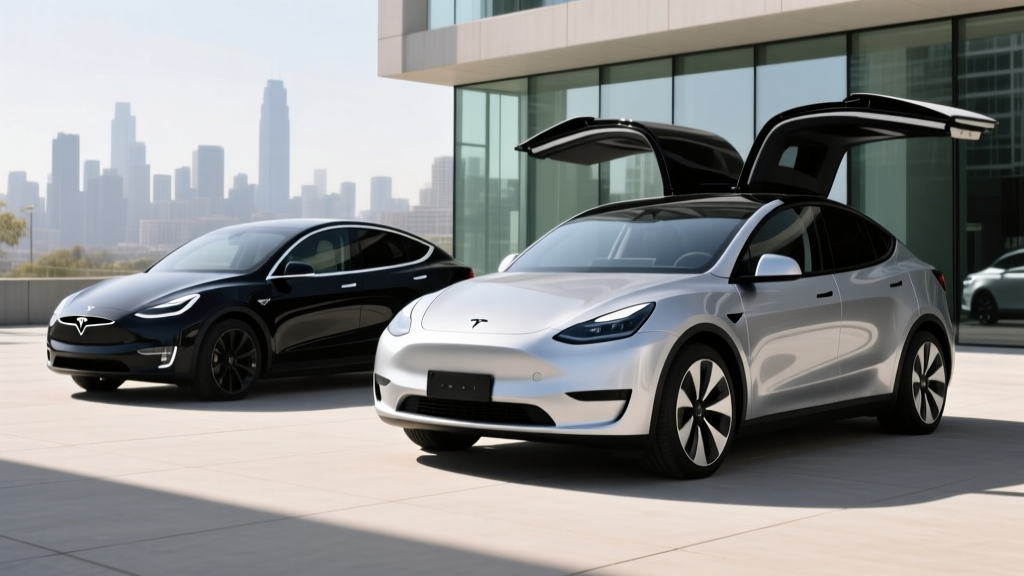
Tesla's two SUV offerings share a brand, a Supercharger network, and a minimalist interior philosophy — but they target very different buyers and budgets. The compact Model Y is Tesla's volume seller and one of the best-selling vehicles of any kind globally, while the flagship Model X is a premium, falcon-wing-doored family hauler with supercar-rivaling acceleration. If you're weighing the difference between Model Y and X, the answer comes down to how many passengers you carry, how much cargo space you need, and whether the Model X's premium features justify a price gap that can exceed $35,000 after incentives.
This head-to-head uses current 2026 model-year specifications from Tesla, EPA data, and real-world ownership variables to break down every measurable difference.
Side-by-Side: 2026 Tesla Model Y vs Model X Specifications
Before subjective impressions, here's the raw data. All figures reflect the Long Range AWD trims, which represent the volume configurations for both vehicles. The Model X Plaid is noted where relevant.
| Specification | Model Y Long Range AWD | Model X Long Range AWD |
|---|---|---|
| EPA Range | 320 miles | 335 miles |
| Battery (usable, chemistry) | ~75 kWh, NMC | ~95 kWh, NMC |
| Efficiency (MPGe combined) | 122 MPGe (28 kWh/100mi) | 103 MPGe (33 kWh/100mi) |
| Peak DC Fast Charge Rate | 250 kW | 250 kW |
| 10–80% DC Fast Charge Time | ~25 minutes | ~32 minutes |
| Level 2 Charge Rate | 11.5 kW (44 mi/hr) | 11.5 kW (34 mi/hr) |
| 0–60 mph | 4.8 seconds | 3.8 seconds |
| Horsepower | 384 hp | 670 hp |
| Seating Capacity | 5 (7-seat option available) | 5, 6, or 7 |
| Cargo Volume (rear seats up) | 30.2 cu ft | 37.1 cu ft |
| Cargo Volume (rear seats folded) | 72.1 cu ft | 70.9 cu ft |
| Towing Capacity | 3,500 lbs | 5,000 lbs |
| Base MSRP | $46,630 | $79,990 |
| Federal §30D Tax Credit Eligibility | Up to $7,500 (subject to sourcing/income rules) | Up to $7,500 (subject to sourcing/income rules) |
| Powertrain Warranty | 8 years / 120,000 miles | 8 years / 150,000 miles |
Sources: fueleconomy.gov, Tesla Model S/X specs, Tesla Model Y specs. Specs reflect 2026 model year as published; verify at time of purchase.
Range, Efficiency, and Real-World Charging
On paper, the Model X Long Range edges out the Model Y with 335 miles of EPA range versus 320 miles. But the more important metric for daily ownership is efficiency, and here the Model Y dominates. At 28 kWh per 100 miles, the Model Y uses roughly 15% less energy than the Model X (33 kWh/100mi) to travel the same distance. That translates into lower electricity costs over time and means the Model Y's smaller ~75 kWh battery does more work per kilowatt-hour.
Charging speed reveals a nuance the peak-kW spec hides. Both vehicles peak at 250 kW on V3 Superchargers, but the Model X's larger ~95 kWh battery means it can sustain higher charge rates longer before tapering. In practice, the Model X takes about 32 minutes for a 10–80% charge versus 25 minutes for the Model Y — but the Model X adds more total miles in that session because of its larger battery. If your road trips involve frequent short top-ups (the typical Supercharger pattern), the Model Y gets you back on the road faster. For fewer, longer charging stops, the gap narrows.
Pricing, Tax Credits, and Total Purchase Cost
This is where the comparison becomes stark. The Model Y Long Range AWD starts at $46,630, while the Model X Long Range AWD starts at $79,990 — a $33,360 gap before any incentives or options.
- MSRP cap: SUVs must be priced at or below $80,000. The Model X base price of $79,990 clears this — but adding options (paint, wheels, FSD Supervised) can push it above the cap, disqualifying it.
- Buyer income limits: Modified AGI must not exceed $150,000 (single), $225,000 (head of household), or $300,000 (joint filers).
- Battery sourcing: Critical minerals and battery component requirements phase in annually. Verify current-year compliance on IRS.gov or the Tesla checkout page at time of purchase.
- Point-of-sale transfer: You can transfer the credit to Tesla at purchase to reduce your out-of-pocket cost immediately, rather than waiting to claim it on your tax return.
| Cost Factor | Model Y LR AWD | Model X LR AWD |
|---|---|---|
| Base MSRP | $46,630 | $79,990 |
| Est. §30D Credit (if eligible) | −$7,500 | −$7,500 |
| Effective Price (before state incentives, fees) | ~$39,130 | ~$72,490 |
| Typical Options Add-On (paint, wheels, interior) | +$1,500–$4,000 | +$2,000–$6,000 |
| FSD Supervised (add-on) | $8,000 | $8,000 |
The critical tax-credit trap: the Model X sits within roughly $2,000 of the $80,000 SUV MSRP cap. Selecting premium paint ($2,000), larger wheels, or virtually any combination of options will push the as-configured price above the threshold and eliminate the $7,500 credit entirely. The Model Y, by contrast, has over $30,000 of headroom below the cap, making its credit far more robust against option creep.
Category-by-Category Verdicts
While the Model X has 15 more EPA miles, the Model Y's 122 MPGe combined versus 103 MPGe means lower energy cost per mile and less frequent charging on equivalent trips. Efficiency is the more practical daily metric.
A 25-minute 10–80% session versus 32 minutes gives the Model Y a meaningful edge on road trips with frequent Supercharger stops. Both peak at 250 kW, but the smaller battery fills faster.
670 hp and a 3.8-second 0–60 in the Long Range (2.5 seconds in the Plaid at 1,020 hp) make the Model X one of the quickest SUVs ever built. The Model Y is quick at 4.8 seconds, but this isn't close.
A $33,360 base-price gap — widening further when the Model X loses its tax credit to option pricing — makes the Model Y the clear financial choice unless you specifically need its extra space and features.
37.1 cu ft behind the second row, available 6- or 7-seat configurations, and 5,000-lb towing capacity. The Model Y offers a 7-seat option, but the third row is best suited for small children only.
Falcon-wing rear doors, standard adaptive air suspension, a 17-inch center touchscreen (vs. 15.4-inch in the Model Y), ventilated front seats, and a power-folding second row. The Model X is the premium experience.
Ownership Costs: What You'll Spend Over 5 Years
Purchase price is only the beginning. Here's how the ongoing costs compare over a typical 5-year / 60,000-mile ownership period.
| Cost Category | Model Y LR AWD | Model X LR AWD |
|---|---|---|
| Electricity (home charging, $0.14/kWh avg, 60k miles) | ~$2,350 | ~$2,770 |
| Insurance (national avg, annual) | ~$2,200/yr ($11,000 total) | ~$3,100/yr ($15,500 total) |
| Maintenance (tires, cabin filter, wiper, brake fluid) | ~$1,800 | ~$2,400 |
| Depreciation (est. 5-yr, % of effective price) | ~$18,000 (46%) | ~$32,000 (44%) |
| Total Estimated 5-Year Cost | ~$33,150 | ~$52,670 |
Insurance is the biggest recurring differentiator. The Model X's higher replacement value, more expensive body panels (those falcon-wing doors and their sensors carry a premium in collision repair), and higher performance profile push premiums roughly 40% above the Model Y. The Model Y's efficiency advantage saves about $420 in electricity over 60,000 miles — meaningful but not decisive.
Depreciation percentages are similar, but the Model X's larger starting price means larger absolute dollar loss. Both Teslas benefit from over-the-air updates that help sustain residual values relative to competitors, though Tesla's frequent price adjustments on new vehicles can pressure used values unpredictably.
Real-World Practicality: Daily Life With Each Vehicle
The Model Y is the easier vehicle to live with daily. It fits in standard garages and parking spaces without drama, its liftgate opens conventionally, and its 30.2 cu ft of rear cargo space handles groceries, strollers, and luggage without compromise. The Juniper-refreshed interior (introduced for the 2025 model year) added ventilated seats, ambient lighting, a rear touchscreen for passengers, and improved ride quality through revised suspension tuning. It's a genuinely comfortable compact SUV that happens to be electric.
The Model X demands more consideration. The falcon-wing doors are undeniably dramatic and genuinely useful in tight parking spaces (they articulate upward, requiring minimal side clearance), but they add mechanical complexity and are expensive to repair if damaged. The Model X is 6 inches wider and nearly 14 inches longer than the Model Y — you'll notice this in parking garages and drive-throughs. The adaptive air suspension is excellent on highway trips, lowering at speed for efficiency and raising for rough roads, and the Model X's 5,000-lb towing capacity opens up small trailer and boat duty that the Model Y's 3,500-lb rating can't match.
For families with three or more children, the Model X's genuine third row (usable by adults on short trips) and 6-seat captain's chair configuration are the deciding factors. The Model Y's optional third row is realistically a child-only space and eliminates most cargo room when deployed.
The Decision Framework: Which Should You Choose?
Choose the Tesla Model Y if:
- You're a household of 1–4 people (or 5 with small children who can use the optional third row occasionally)
- You want the lowest total cost of ownership in a premium electric SUV
- You prioritize charging speed and efficiency on road trips
- You need a vehicle that fits easily in standard garages and parking spaces
- Your budget is under $55,000 (after credit) and you want to avoid the Model X's MSRP-cap risk with options
- You value simplicity and don't need air suspension or falcon-wing doors
Choose the Tesla Model X if:
- You regularly carry 5–7 passengers, including adults in the third row
- You need 5,000-lb towing capacity for a trailer, boat, or camper
- You want flagship performance (3.8s 0–60 LR, 2.5s Plaid) in a family vehicle
- You value adaptive air suspension for ride comfort and adjustable ride height
- Falcon-wing doors appeal to you for tight-space access or aesthetic reasons
- Your budget comfortably accommodates $75,000–$90,000+ after incentives and options
Frequently Asked Questions
Is the Model X worth $33,000 more than the Model Y?
Only if you need what it uniquely offers: genuine 6/7-passenger seating with adult-capable third row, 5,000-lb towing, air suspension, and flagship performance. If you're a 4-person household that values efficiency and lower running costs, the Model Y delivers 90% of the Tesla SUV experience at less than 60% of the price.
Which gets better real-world highway range?
The Model X edges ahead in absolute miles (~280–300 highway vs. ~270–290 for the Model Y), but the Model Y costs less per mile to drive because of its 15% efficiency advantage. On a 300-mile road trip, the Model Y will use about 84 kWh while the Model X uses about 99 kWh — a meaningful difference if you're paying $0.40+/kWh at public DC fast chargers.
Do both vehicles qualify for the full $7,500 federal tax credit?
Both can qualify, but the Model X is at risk. Its $79,990 base MSRP is just $10 below the $80,000 SUV cap. Adding virtually any factory option (premium paint at $2,000, larger wheels, FSD) pushes the configured price above the cap and eliminates the credit entirely. The Model Y, at $46,630, has over $30,000 of headroom. Always check IRS.gov for current sourcing requirements and confirm eligibility at point of sale.
Which is cheaper to insure?
The Model Y, by a wide margin. National average premiums run roughly $2,200/year for the Model Y versus $3,100/year for the Model X — a $4,500 difference over five years. The Model X's higher value, expensive falcon-wing door mechanisms, and performance profile drive the gap. Get quotes from your insurer for both before deciding.
Does the Model Y or Model X have better Autopilot and FSD capability?
Both use Tesla's current Hardware 4 (AI4) computing platform and camera suite, and both offer the same Autopilot (standard) and FSD Supervised ($8,000 upgrade) features. The driving-assistance experience is identical between the two. Note that FSD Supervised is an SAE Level 2 system — it requires continuous driver attention and does not make the vehicle autonomous.
Which has lower long-term maintenance costs?
The Model Y, modestly. Both vehicles eliminate oil changes, transmission fluid, and most traditional maintenance. The main wear items are tires (the heavier Model X wears tires faster), cabin air filters, wiper blades, and brake fluid checks. Expect to spend roughly $1,800 over 5 years on the Model Y versus $2,400 on the Model X, with tire replacement being the primary cost driver for the heavier, more powerful Model X.