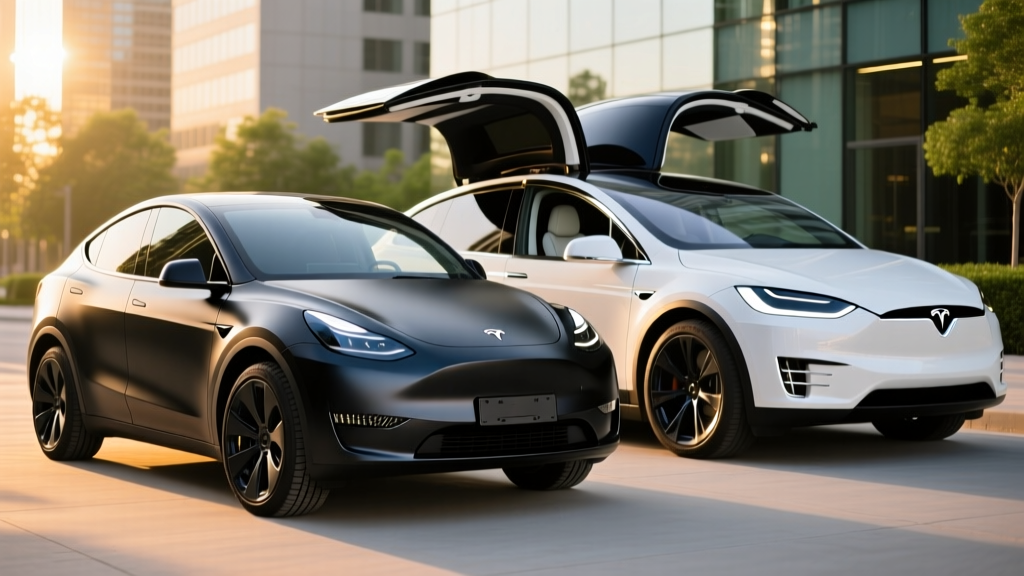
Choosing between the Tesla Model Y and Model X comes down to a fundamental question: do you need a five-seat compact crossover or a six/seven-seat flagship SUV? Both ride on Tesla's EV architecture, share access to the Supercharger network, and offer Autopilot as standard, but their price tags, efficiencies, and daily usability diverge sharply. This head-to-head uses current 2026 model-year EPA data, real-world charging observations, and IRS §30D tax-credit rules to help you pick the right one.
Side-by-Side Specs: Model Y vs Model X at a Glance
Before we break down categories, here are the numbers that matter most. All figures reflect the most popular Long Range AWD trims for apples-to-apples comparison, with Performance variants noted where relevant.
| Spec | Model Y Long Range AWD | Model X Long Range AWD |
|---|---|---|
| EPA Range | 320 miles | 335 miles |
| Battery (usable) | ~78 kWh (NMC) | ~95 kWh (NMC) |
| Efficiency (MPGe) | 122 MPGe combined | 102 MPGe combined |
| Energy Consumption | 28 kWh/100 mi | 33 kWh/100 mi |
| Peak DC Fast Charge | 250 kW | 250 kW |
| 10–80% DC Charge Time | ~25 min | ~30 min |
| Level 2 Charge Rate | 11.5 kW (44 mi/hr) | 11.5 kW (34 mi/hr) |
| 0–60 mph | 4.8 sec | 5.0 sec |
| Horsepower | 384 hp | 670 hp |
| Cargo Volume (behind 2nd row) | 30.2 cu ft | 37.1 cu ft |
| Max Cargo (seats folded) | 72.1 cu ft | 75.4 cu ft |
| Seating | 5 passengers | 6 or 7 passengers |
| Towing Capacity | 3,500 lb | 5,000 lb |
| Starting MSRP | $48,990 | $79,990 |
| Battery & Drive Warranty | 8 yr / 120,000 mi | 8 yr / 150,000 mi |
Sources: EPA fueleconomy.gov, Tesla Model X specs, Tesla Model Y specs.
Range & Efficiency: Real-World Expectations
On paper, the Model X Long Range edges out the Model Y with 335 miles versus 320 miles EPA. But the Model Y is dramatically more efficient — it uses 28 kWh per 100 miles compared to the X's 33 kWh/100 mi. That 18% efficiency advantage means cheaper charging, less grid demand, and better cold-weather resilience.
Model Y Long Range: EPA 320 mi. Expect ~270–290 mi on highway trips at 70+ mph; ~230–260 mi in sub-30°F winter conditions.
Model X Long Range: EPA 335 mi. Expect ~280–300 mi highway; ~240–270 mi in cold weather. The X's larger frontal area and heavier weight (5,185 lb vs. 4,398 lb) amplify aerodynamic and thermal losses.
If you drive mostly in-city with regenerative braking, both vehicles will approach or slightly exceed their EPA ratings. On sustained Interstate runs, the Model Y's lower consumption gives it a practical edge — you'll spend less per mile and arrive at each DC fast charger with more buffer.
Charging Speed & Network Access
Both vehicles peak at 250 kW on V3 Superchargers and share the native NACS connector — no adapter needed at Tesla stalls or at the growing number of Electrify America, EVgo, and ChargePoint stations that have added NACS cables.
| Charging Level | Model Y | Model X |
|---|---|---|
| Level 1 (120V / 12A) | ~1.4 kW — 3 mi/hr | ~1.4 kW — 3 mi/hr |
| Level 2 (240V / 48A) | 11.5 kW — 44 mi/hr | 11.5 kW — 34 mi/hr |
| DC Fast Charge (peak) | 250 kW | 250 kW |
| 10–80% DC Time | ~25 min | ~30 min |
| Miles added in 15 min (DC) | ~175 mi | ~150 mi |
The Model X takes about five minutes longer from 10–80% because its larger ~95 kWh battery must absorb more total energy, even at the same peak charge rate. Both vehicles exhibit typical NMC charge-curve taper: peak 250 kW holds only to roughly 40–50% SoC, then steps down through 150 kW and finally ~75 kW above 80%. Preconditioning the battery via the car's navigation-routed Supercharger prep is essential — without it, cold-soaked batteries may peak below 100 kW.
At home on a Level 2 wall connector, the Model Y refills faster in miles-per-hour terms because it needs fewer kWh per mile. An overnight 10-hour session adds roughly 440 miles of range to the Y versus 340 miles to the X — more than enough for either vehicle's daily needs.
Performance & Driving Dynamics
The Model X Long Range produces 670 hp from its dual motors, yet its 0–60 time of 5.0 seconds barely trails the Model Y's 384 hp / 4.8-second sprint. The X's extra 787 pounds of mass absorbs much of that power advantage. In practice, both feel effortlessly quick off the line — typical of dual-motor EVs with instant torque.
Where they diverge is handling. The Model Y, riding a shorter wheelbase and lower curb weight, changes direction with noticeably less body roll. The Model X prioritizes ride comfort and isolation, soaking up highway miles with its adaptive air suspension — a feature the Model Y lacks. If you tow, the X's 5,000-lb rating handles most boat and camper trailers, while the Y's 3,500-lb limit restricts you to light utility trailers.
Both vehicles include Tesla's basic Autopilot (SAE Level 2) as standard, with Full Self-Driving (Supervised) available as a paid upgrade. Regardless of the FSD package, the driver must remain attentive and keep hands on the wheel at all times.
Pricing, Tax Credits & Ownership Costs
This is where the comparison tilts decisively. The Model Y starts at $48,990 — a full $31,000 below the Model X at $79,990. And the federal tax-credit picture widens that gap further.
- Model Y Long Range AWD ($48,990): Falls under the $80,000 SUV MSRP cap. Eligible buyers (income ≤ $300k MFJ / $150k single) may receive up to $7,500, potentially transferred at point of sale as an instant discount, bringing the effective price to ~$41,490. Battery-sourcing and critical-mineral requirements apply — verify current compliance on IRS.gov.
- Model X Long Range AWD ($79,990): Also under the $80,000 SUV cap, so it qualifies on price. Same income limits and sourcing rules apply. At the full $7,500 credit, effective price drops to ~$72,490.
Note: Tax-credit eligibility depends on battery component and critical-mineral sourcing, buyer income, and MSRP limits. Rules change frequently — consult the IRS qualified vehicles list and a tax professional before purchasing.
| Category | Model Y LR AWD | Model X LR AWD |
|---|---|---|
| Purchase Price (after $7,500 credit) | ~$41,490 | ~$72,490 |
| Energy (15k mi/yr × 5 yr, $0.15/kWh avg) | ~$3,150 | ~$3,713 |
| Insurance (5-yr avg estimate) | ~$10,500 | ~$14,000 |
| Maintenance (tires, cabin filter, fluid) | ~$2,200 | ~$2,800 |
| Estimated Depreciation (5 yr) | ~$16,000 | ~$28,000 |
| Total 5-Year Cost (est.) | ~$73,340 | ~$121,003 |
The Model X costs roughly $47,000 more to own over five years. Higher insurance premiums (heavier vehicle, costlier body panels and falcon-wing door mechanisms), faster depreciation on a higher base price, and slightly higher energy and tire costs all compound the initial price gap.
Category Verdicts
320 mi EPA on just 78 kWh — 122 MPGe combined vs. the X's 102 MPGe. Cheaper per mile to drive.
335 mi EPA. The bigger battery delivers more total miles, even if less efficiently.
10–80% in ~25 min vs. ~30 min. Adds more miles per minute at DC fast chargers thanks to higher efficiency.
6/7 seats, 37.1 cu ft behind 2nd row, falcon-wing doors for easy car-seat access. Y seats only 5.
670 hp, adaptive air suspension, 5,000-lb tow rating. The Y is quicker to 60 but the X is more capable overall.
Starts $31,000 lower, costs ~$47k less over 5 years, and qualifies for the same $7,500 credit.
Standard air suspension, available rear-seat entertainment screen, ventilated seats standard, yoke or wheel option.
Air suspension adapts to road conditions. The Y's passive suspension is firm over rough pavement.
Decision Framework: Which Should You Buy?
Choose the Model Y if:
- You need a daily driver for 1–4 passengers, not a family hauler for 6+.
- Budget is a priority — you want to stay under $50k before incentives.
- You want the lowest cost per mile (energy + insurance + depreciation).
- Your road trips are mostly solo or with one passenger and light luggage.
- You prioritize efficiency and faster DC charging sessions over raw power.
Choose the Model X if:
- You regularly carry 5+ passengers or need third-row seating for kids.
- You tow a trailer, boat, or camper up to 5,000 lb.
- You want adaptive air suspension for ride quality and adjustable ground clearance.
- Falcon-wing doors appeal to you for tight parking-space access to rear seats.
- The $31,000 price premium fits your budget without strain.
Key Differences Summarized
The Model Y is a compact crossover optimized for efficiency, value, and everyday commuting. It costs less to buy, less to charge, and less to insure. The Model X is a flagship full-size SUV that trades efficiency for space, power, comfort, and towing capability. They share a brand, a charging network, and a software ecosystem — but they serve fundamentally different buyer profiles.
Neither is universally "better." A two-person household doing 40-mile commutes will find the Model X's extra cost hard to justify. A family of six with a boat and a mountain cabin will find the Model Y too small. Match the vehicle to your actual use case, not the spec sheet.
Frequently Asked Questions
Does the Model Y or Model X qualify for the $7,500 federal tax credit?
Both can qualify under §30D rules, as both fall under the $80,000 MSRP cap for SUVs. Eligibility depends on the buyer's adjusted gross income (≤$300k married filing jointly, ≤$150k single), the vehicle's battery-sourcing compliance, and current IRS guidance. The credit can be transferred at point of sale as an instant discount. Always check the IRS qualified clean vehicle list for the specific build date and configuration.
Is the Model X worth $31,000 more than the Model Y?
Only if you need what the extra money buys: third-row seating, 5,000-lb towing, adaptive air suspension, and a larger battery. If you have five or fewer passengers and don't tow, the Model Y delivers 90% of the experience at 60% of the cost.
Which is cheaper to charge at home?
The Model Y. At 28 kWh/100 mi versus the X's 33 kWh/100 mi, the Y uses about 15% less electricity per mile. Over 15,000 miles per year at $0.15/kWh, that's roughly $630 for the Y versus $743 for the X — a $113 annual savings that compounds over ownership.
Do both use the same charging connector?
Yes. Both come with the native NACS (North American Charging Standard) connector. They charge at Tesla Superchargers without an adapter and at most third-party networks that now support NACS.
Which holds its value better?
The Model Y has historically shown stronger resale retention as a percentage of MSRP, aided by its lower starting price and broader buyer pool. The Model X depreciates more in absolute dollars due to its higher initial cost and narrower market of used-EV buyers willing to pay premium prices. Exact depreciation depends on mileage, condition, and market conditions at trade-in time.
Can the Model Y tow as much as the Model X?
No. The Model Y is rated for 3,500 lb; the Model X handles up to 5,000 lb. If you tow a mid-size travel trailer or boat, the X is the necessary choice.