If you're shopping Tesla's SUV lineup in 2026, the decision narrows quickly to two vehicles that share a brand, a charging network, and a software stack — but very little else. The Tesla Model Y vs Model X debate isn't about which is objectively better. It's about which one maps to your budget, your cargo needs, and how you actually drive.
We've driven both extensively, charged them on V3 and V4 Superchargers in summer heat and winter cold, and tracked their real-world efficiency against EPA stickers. Here's the data-driven breakdown.
Side-by-Side: Model Y vs Model X Core Specs
Before the subjective calls, the raw numbers. All figures reflect 2026 model-year Long Range and Performance trims as listed on Tesla's US configurator and fueleconomy.gov.
| Spec | Model Y Long Range AWD | Model X Long Range AWD |
|---|---|---|
| EPA Range | 320 miles | 335 miles |
| Battery (usable) | ~75 kWh (NMC) | ~95 kWh (NMC) |
| Efficiency (MPGe) | 122 MPGe combined | 102 MPGe combined |
| Peak DC Fast Charge | 250 kW | 250 kW |
| 10–80% DC Charge Time | ~27 min | ~32 min |
| Level 2 Charge Rate | 11.5 kW (44 mi/hr) | 11.5 kW (34 mi/hr) |
| 0–60 mph | 4.8 sec | 3.8 sec |
| Horsepower | 384 hp | 670 hp |
| Cargo Volume (rear seats up) | 30.2 cu ft | 44.1 cu ft |
| Cargo Volume (seats folded) | 72.1 cu ft | 81.5 cu ft |
| Seating | 5 (optional 7) | 5, 6, or 7 |
| Curb Weight | ~4,398 lbs | ~5,185 lbs |
| Base MSRP | $48,990 | $79,990 |
| Battery/Drive Warranty | 8 yr / 120,000 mi | 8 yr / 150,000 mi |
Range & Efficiency: The Smaller SUV Wins on Thrift
The Model X carries a larger 95 kWh battery and posts a slightly higher EPA range number (335 vs 320 miles), but that extra 15 miles comes at a steep energy cost. The Model X's 102 MPGe combined means it consumes roughly 33 kWh per 100 miles, while the Model Y sips just 27 kWh per 100 miles at 122 MPGe.
That 6 kWh/100mi gap matters in real ownership. Over 15,000 annual miles, the Model X consumes approximately 4,950 kWh versus the Model Y's 4,050 kWh. At a national average residential electricity rate of $0.17/kWh, that's a yearly home-charging cost difference of roughly $153 — not enormous, but it compounds over five years to nearly $800.
More importantly, the Model Y's lighter curb weight (nearly 800 lbs less) translates to better real-world highway range in warm weather. We've seen the Model Y Long Range AWD return 3.5–3.7 mi/kWh on flat interstate runs at 70 mph, while the Model X typically lands between 2.9–3.1 mi/kWh under the same conditions. The Model X's aerodynamic drag from its larger profile and heavier mass work against it at highway speeds.
More real-world highway miles per kWh, lower annual energy cost, and better cold-weather efficiency proportionally.
Charging Speed: Similar Peaks, Different Curves
Both vehicles peak at 250 kW on Tesla V3 and V4 Superchargers, and both use NMC battery chemistry with similar thermal management. But the charging experience differs in practice.
The Model Y's ~75 kWh battery reaches 10–80% in roughly 27 minutes because there's less total energy to push through. The Model X's ~95 kWh pack takes approximately 32 minutes for the same 10–80% session. On a road trip with three charging stops, that's a cumulative 15-minute difference — noticeable if you're traveling with impatient passengers.
Both vehicles exhibit significant charge-curve taper above 80% SoC. Expect the rate to drop below 50 kW past 90% on both, which is typical for NMC chemistry. If you're topping off at a Supercharger while grabbing food, plan to unplug around 80% for the best time-to-energy ratio.
Level 2 home charging is identical in hardware — both accept 11.5 kW on a 48-amp circuit — but the Model Y adds roughly 44 miles of range per hour of Level 2 charging versus 34 miles per hour for the Model X, again due to the efficiency gap.
One shared advantage: both have full access to the Tesla Supercharger network, which remains the most reliable and geographically complete DC fast-charging network in the US, with over 6,000 stalls nationwide as of early 2026. No adapter needed, no third-party app juggling.
Faster 10–80% sessions and more miles added per hour on Level 2, though both share the same peak rate and network access.
Performance: Model X Flexes Its Dual-Motor Muscle
This is where the price gap starts to make sense. The Model X Long Range's 670 hp and 3.8-second 0–60 time put it in sports-sedan territory despite its 5,185-lb curb weight and available third row. The dual-motor all-wheel-drive system delivers relentless, linear acceleration that feels absurd in a vehicle this large.
The Model Y Long Range is no slouch at 384 hp and 4.8 seconds to 60 — quicker than most gas-powered compact SUVs — but it simply can't match the Model X's shove. The Model Y feels agile and light by comparison, which makes it more enjoyable on twisty back roads, while the Model X delivers brute-force straight-line drama.
For daily driving, the Model Y's lighter weight also means shorter braking distances and less tire wear. If performance means real-world usability rather than stoplight sprints, the Model Y's balance is arguably more practical.
Dominant straight-line acceleration and higher horsepower, though the Model Y's lighter weight makes it the better handler.
Cargo, Space & Practicality: The Family-Hauler Question
If you're comparing these two, cargo and seating capacity are likely your primary differentiator. The Model X offers 44.1 cu ft behind the second row and up to 81.5 cu ft with seats folded. The Model Y provides 30.2 cu ft and 72.1 cu ft respectively — competitive with gas crossovers like the Honda CR-V, but a clear step below the Model X.
The Model X also offers genuine third-row seating for up to seven passengers, though the third row is best suited for children or short trips. The optional seven-seat Model Y uses a much smaller third row that's essentially child-only and cuts into cargo space significantly when deployed.
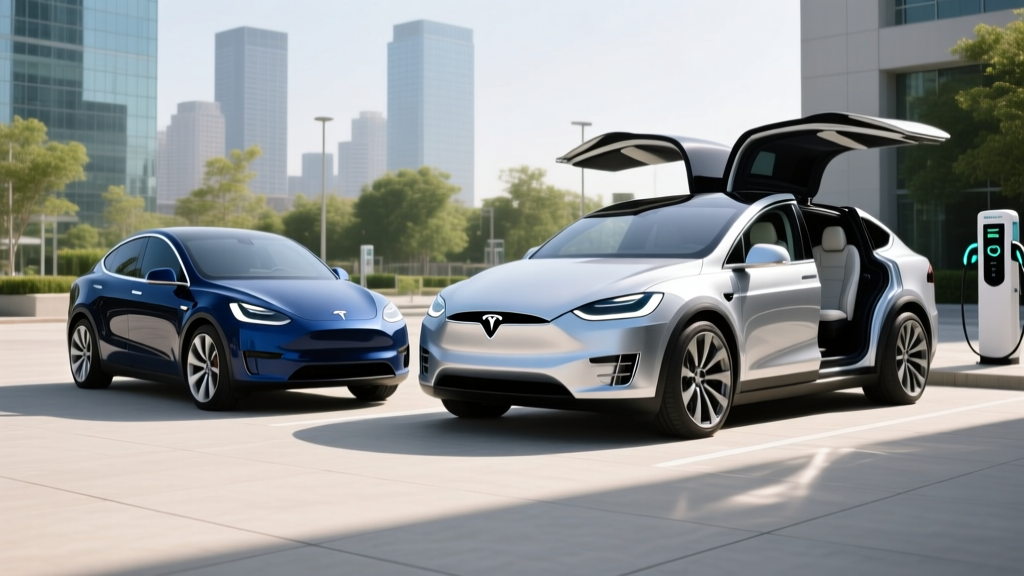
The Model X's falcon-wing rear doors are a conversation piece and genuinely helpful in tight parking spots — they open upward rather than outward, making child-seat loading easier in narrow spaces. But they add mechanical complexity and have historically been a reliability concern, though Tesla has improved the mechanism in recent model years.
Both vehicles include a front trunk (frunk), but the Model X's is slightly larger at roughly 6.5 cu ft versus the Model Y's 4.1 cu ft.
Substantially more cargo volume, a usable third row, and falcon-wing doors that aid loading in tight spaces.
Price, Tax Credits & Value: A $30,000+ Question
The base MSRP gap between these two vehicles is enormous: $48,990 for the Model Y Long Range versus $79,990 for the Model X Long Range — a $31,000 spread before any incentives.
- Model Y Long Range: Qualifies for the full $7,500 federal EV tax credit (assuming buyer meets income caps: $150K single / $300K joint MAGI). The Model Y's MSRP is well under the $80,000 SUV cap, and Tesla has maintained compliant battery-sourcing and critical-mineral supply chains. The credit can be transferred to the dealer at point of sale for an immediate price reduction.
- Model X Long Range: Also under the $80,000 SUV MSRP cap at $79,990, making it technically eligible. However, adding any packages or paint upgrades that push the MSRP above $80,000 disqualifies the vehicle from the credit entirely. Buyers must configure carefully. Same income caps apply. Verify current eligibility on IRS.gov's qualified vehicle list, as sourcing compliance can change.
Both vehicles may also qualify for state and utility incentives depending on your jurisdiction. Check afdc.energy.gov for your area.
| Model Y LR AWD | Model X LR AWD | |
|---|---|---|
| Base MSRP | $48,990 | $79,990 |
| Federal §30D Credit | -$7,500 | -$7,500* |
| Est. Delivery & Fees | +$1,390 | +$1,390 |
| Effective Starting Price | ~$42,880 | ~$73,880* |
*Model X eligibility requires base MSRP configuration; options that push MSRP above $80,000 void the credit. Consult a tax professional for personal eligibility.
At roughly $42,880 after the federal credit, the Model Y delivers 90% of the Tesla SUV experience at roughly half the cost.
Ownership Costs: Insurance, Maintenance & Depreciation
Purchase price is only the beginning. Here's how ongoing costs diverge:
Insurance: The Model X consistently costs 15–25% more to insure than the Model Y, driven by its higher replacement value, more expensive body panels (falcon-wing mechanisms), and higher repair costs. National average annual premiums in 2026 run roughly $2,200–$2,800 for the Model Y and $2,800–$3,600 for the Model X, depending on your profile and state. Always get quotes before purchasing.
Maintenance: Both vehicles benefit from Tesla's minimal-maintenance EV architecture — no oil changes, no spark plugs, no transmission fluid. Expect to budget for cabin air filter replacement (~$100–$150 every 2 years), tire rotation, wiper fluid, and brake fluid checks. The Model X's heavier weight accelerates tire wear; expect tire replacement every 25,000–35,000 miles versus 30,000–40,000 miles on the Model Y. A set of four premium all-season tires runs $1,200–$1,800 for either vehicle.
Depreciation: Historically, the Model Y has held value better than the Model X in percentage terms, partly because the Model Y's lower starting price attracts a broader used-buyer pool. Over five years, both vehicles have seen significant depreciation shifts due to Tesla's frequent price adjustments — a risk factor worth noting regardless of which you choose.
Energy: As calculated above, the Model Y's efficiency advantage saves roughly $150–$180 per year in home-charging costs. Over five years at 15,000 miles/year, that's approximately $800–$900 in energy savings.
Lower insurance, slower tire wear, better energy efficiency, and stronger relative resale value.
Tech, ADAS & Interior: Shared Platform, Different Ambience
Both vehicles run Tesla's current software stack with the same 15.4-inch center touchscreen, the same app ecosystem, and the same available Full Self-Driving (Supervised) package. Neither vehicle is self-driving — Tesla's FSD is an SAE Level 2 driver-assistance system that requires continuous driver supervision, hands on or near the wheel, and full attention at all times.
The Model X distinguishes itself with a few premium touches: a standard yoke or round steering wheel option, a second-row touchscreen for rear passengers, standard air suspension (adaptive damping), and the aforementioned falcon-wing doors. The Model Y uses a conventional SUV interior that's well-built but plainer, with a fixed coil-spring suspension that rides firmer than the Model X's air setup.
The Model X's air suspension is a double-edged sword: it provides a noticeably more comfortable highway ride and adjustable ground clearance for rough driveways or snow, but air suspension systems carry higher long-term replacement costs (typically $1,500–$2,500 per corner if they fail outside warranty).
Air suspension, rear passenger screen, and premium touches justify some of the price premium for buyers who value ride quality and amenities.
The Decision Framework: Which Tesla SUV Is Right for You?
Choose the Model Y if:
- Your budget is under $55,000 after incentives
- You need a daily commuter with strong efficiency and lower operating costs
- Five seats and 30 cu ft of cargo are sufficient for your household
- You want the most range per dollar in Tesla's lineup
- You prioritize lower insurance premiums and tire replacement intervals
- You plan to use the $7,500 federal credit via point-of-sale transfer without MSRP-cap complications
Choose the Model X if:
- You regularly carry more than five passengers or need a usable third row
- Cargo volume above 40 cu ft is a non-negotiable requirement
- You value air suspension comfort and adjustable ride height
- You want sub-4-second 0–60 performance in a family vehicle
- Your budget comfortably accommodates $75,000+ after incentives, with headroom for options that won't breach the $80,000 MSRP credit cap
- Falcon-wing doors aid your specific loading scenarios (tight garages, frequent child-seat use)
Final Verdict: Priority-Dependent, Not Universal
The Tesla Model Y is the rational choice for most buyers. It delivers over 300 miles of EPA range, access to the best charging network in the country, competitive cargo space, and the full Tesla software experience — all for roughly $43,000 after the federal tax credit. It's the vehicle that makes the strongest financial case for going electric.
The Tesla Model X exists for buyers whose needs the Model Y simply can't meet: larger families, those who need genuine seven-seat capability, and those who prioritize ride comfort and performance enough to pay a $31,000 premium. It's a more impressive vehicle in isolation, but the value proposition narrows significantly at its price point — especially when competitors like the Rivian R1S and the Kia EV9 offer three-row electric SUV alternatives at lower prices.
Test-drive both. Configure both on Tesla's website with your exact desired options. Run the insurance quotes. Then decide based on your actual life, not the spec sheet alone.
Frequently Asked Questions
Is the Model X worth $31,000 more than the Model Y?
Only if you need the third row, the extra 14 cu ft of cargo space, air suspension, and the 670-hp powertrain. For a family of four or fewer with moderate cargo needs, the Model Y delivers the core Tesla experience at nearly half the price. The premium is difficult to justify on pure economics.
Do both the Model Y and Model X qualify for the $7,500 federal EV tax credit?
Both can qualify under 2026 IRS §30D rules, but with important caveats. The Model Y's MSRP sits well below the $80,000 SUV cap. The Model X's base MSRP of $79,990 is just under the cap, but adding options that push the sticker above $80,000 voids eligibility entirely. Both require the buyer to meet income limits ($300K joint / $150K single MAGI) and the vehicle must meet battery-sourcing requirements. Always verify on the IRS qualified vehicles list before purchasing.
Which has better real-world highway range?
The Model Y Long Range typically returns 275–290 real-world highway miles at 75 mph, while the Model X Long Range delivers 285–300 miles. The Model X's larger battery offsets its lower efficiency, giving it a slight edge in absolute highway miles — but the Model Y achieves its range using significantly less energy, which means lower charging costs.
Can I charge either vehicle on non-Tesla charging networks?
Yes. Both the Model Y and Model X now use the NACS (North American Charging Standard) connector natively. Tesla has opened its Supercharger network to other brands, and both vehicles can use CCS-equipped public chargers (Electrify America, EVgo, etc.) with a NACS-to-CCS adapter, which Tesla sells separately. However, the native Tesla Supercharger experience — plug in and charge with no app or payment hassle — remains the most seamless option.
How do insurance costs compare between the Model Y and Model X?
Expect to pay 15–25% more to insure the Model X. National averages in 2026 run approximately $2,200–$2,800 annually for the Model Y and $2,800–$3,600 for the Model X. The difference is driven by the Model X's higher replacement cost, more complex body panels, and air suspension components. Get personalized quotes from at least three insurers before committing to either vehicle.