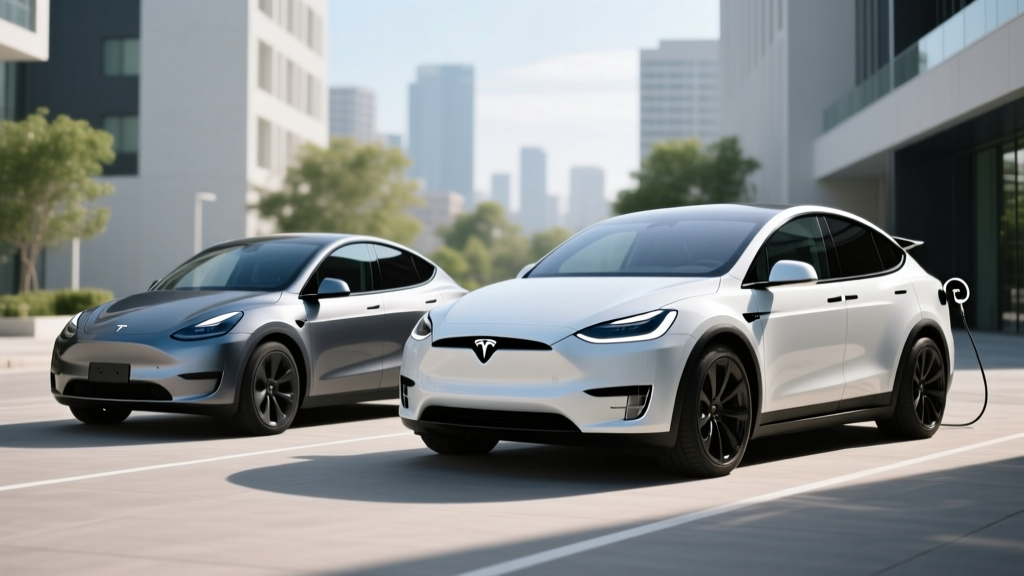
If you're cross-shopping Tesla's lineup, the Model Y vs Model X decision comes down to a fundamental question: do you need a premium three-row family hauler, or is a highly efficient two-row crossover the smarter buy? Both share Tesla's Supercharger network, software stack, and general design DNA, but the gap in price, efficiency, and daily usability is wider than most shoppers expect.
We've driven, charged, and tracked ownership costs on both platforms across multiple model years. Below is a data-driven teardown using current 2026 model-year EPA figures, real-world charging behavior, and IRS §30D tax credit rules — so you can match the right vehicle to your actual driving life, not a marketing brochure.
Side-by-Side: 2026 Tesla Model Y vs Model X Specs
Before we get into subjective impressions, here are the hard numbers that matter most. All figures reflect the most popular Long Range AWD trims for an apples-to-apples comparison, with Plaid/performance variants noted where relevant. Battery chemistry for both is NMC (nickel manganese cobalt), optimized for energy density and cold-weather performance.
| Specification | 2026 Model Y Long Range AWD | 2026 Model X Long Range AWD |
|---|---|---|
| EPA Range | 320 miles | 335 miles |
| Real-World Highway Range (est.) | ~270–285 mi | ~275–290 mi |
| Battery Capacity (usable) | ~78 kWh (NMC) | ~95 kWh (NMC) |
| Combined MPGe | 111 MPGe | 102 MPGe |
| Efficiency (kWh/100 mi) | 28 kWh/100 mi | 33 kWh/100 mi |
| Peak DC Fast Charge Rate | 250 kW | 250 kW |
| 10–80% DC Fast Charge Time | ~25 min | ~30 min |
| Level 2 Charge Rate (max) | 11.5 kW (48A) | 11.5 kW (48A) |
| 0–60 mph | 4.8 sec | 3.8 sec |
| Horsepower | 384 hp | 670 hp |
| Cargo Volume (max) | 76 cu ft | 88 cu ft |
| Seating | 5 (7-seat option avail.) | 5, 6, or 7 |
| Towing Capacity | 3,500 lbs | 5,000 lbs |
| Base MSRP | $48,990 | $79,990 |
| Battery/Drive Unit Warranty | 8 yr / 120,000 mi | 8 yr / 150,000 mi |
Sources: fueleconomy.gov (EPA), Tesla specifications. Real-world highway estimates based on 70–75 mph sustained driving at moderate temperatures.
Range and Efficiency: Where the Model Y Pulls Ahead
On paper, the Model X Long Range posts a slightly higher EPA range number (335 vs. 320 miles), but that's misleading without context. The Model X achieves it with a significantly larger ~95 kWh battery pack, while the Model Y extracts nearly the same distance from just ~78 kWh. That makes the Model Y substantially more efficient — 28 kWh per 100 miles compared to the Model X's 33 kWh/100 mi.
Expect to lose roughly 12–18% of EPA range during sustained highway driving at 70–75 mph, and an additional 15–30% in freezing temperatures (below 32°F). For the Model Y Long Range, plan for ~270–285 real highway miles in fair weather, dropping to ~220–240 in winter. The Model X tracks similarly in percentage terms: ~275–290 fair-weather highway miles, ~230–250 in cold conditions. The heat pump on both models helps mitigate cold-weather cabin energy draw, but battery chemistry physics still dominate.
Efficiency matters for two reasons beyond the electricity bill: charging speed and charging cost on road trips. The Model Y's lower consumption means every kWh added at a Supercharger translates to more miles of range. On a 300-mile road trip, the Model Y will cost roughly $2–4 less to recharge than the Model X (at typical Supercharger rates of $0.28–$0.36/kWh), and it reaches 80% state of charge about five minutes faster because there's simply less energy to push into a smaller pack.
More miles per kWh, lower road-trip charging cost, faster 10–80% charge times. The Model X has a longer EPA number, but the Model Y does more with less.
Charging Speed and Network Access
Both vehicles peak at 250 kW on V3 Tesla Superchargers and use the NACS (North American Charging Standard) connector natively. Neither needs an adapter on Tesla's network, and both can access the growing number of NACS-equipped third-party stations (Electrify America, EVgo, and others adding NACS cables through 2025–2026).
| Charging Level | Model Y Long Range | Model X Long Range |
|---|---|---|
| Level 1 (120V, 12A) | ~1.4 kW / ~4 mi/hr | ~1.4 kW / ~3.5 mi/hr |
| Level 2 (240V, 48A) | 11.5 kW / ~37 mi/hr | 11.5 kW / ~32 mi/hr |
| DC Fast (V3 Supercharger) | 250 kW peak / ~180 mi in 15 min | 250 kW peak / ~170 mi in 15 min |
The key difference is miles added per minute. Because the Model Y is more efficient, each minute on a Supercharger yields more usable range. At a V3 stall, the Model Y adds approximately 180 miles in 15 minutes; the Model X adds roughly 170. Both vehicles exhibit significant charge-curve taper above 80% state of charge — expect the last 20% to take as long as the first 60%. For road trips, plan to charge from 10–80% and skip the top-off unless your next stop requires it.
Home Level 2 charging is identical in hardware (both accept 11.5 kW via a 60-amp circuit), but the Model X's larger battery means a full overnight charge from 10% takes about 8.5 hours versus 7 hours for the Model Y. If your home electrical panel is limited to a 40-amp circuit (yielding ~9.6 kW), both vehicles still charge fully overnight for typical daily use — but the Model Y fills faster and wastes less energy in the process.
Same peak kW, but more miles per minute due to superior efficiency. Faster home fill times. The gap narrows if you always charge overnight at home and rarely road-trip.
Performance and Driving Dynamics
This is where the Model X asserts itself. The Long Range Model X puts down 670 horsepower and hits 60 mph in 3.8 seconds — sports-sedan territory in a 5,000-pound SUV with falcon-wing rear doors. The Model Y Long Range's 384 hp and 4.8-second 0–60 time are quick by any normal standard, but the Model X is in a different league for straight-line acceleration and highway passing confidence.
The Model X Plaid (1,020 hp, 2.5-sec 0–60) exists for buyers who want hypercar performance in a family vehicle, but at $94,990 it's a niche pick. For most buyers comparing these two, the Long Range variants are the relevant ones — and the Model X's extra 286 hp is noticeable every time you merge onto a freeway or climb a mountain grade.
Handling is a different story. The Model Y is roughly 700 pounds lighter and feels more agile in corners, easier to park, and less taxing in stop-and-go traffic. If your daily drive involves tight urban streets or parking garages, the Model Y's compact dimensions (187" length vs. the Model X's 199") make a real-world difference.
Substantially more power, faster 0–60, higher towing capacity (5,000 vs. 3,500 lbs). But the Model Y wins on agility and everyday maneuverability.
Pricing, Tax Credits, and Total Purchase Cost
The price gap between these two vehicles is enormous, and the federal EV tax credit widens it further.
| Model Y Long Range AWD | Model X Long Range AWD | |
|---|---|---|
| Base MSRP | $48,990 | $79,990 |
| Federal §30D Tax Credit (max) | $7,500 (point-of-sale) | $0 (exceeds MSRP cap) |
| Effective Price After Credit | ~$41,490 | $79,990 |
| Price Gap (after credit) | $38,500 | |
The Model Y qualifies for the full $7,500 §30D federal tax credit (subject to buyer income caps: $150K single / $300K joint, and battery sourcing requirements). The Model X exceeds the IRS §30D SUV MSRP cap of $80,000 at many trim/configurations and typically does not qualify. Always verify current-year eligibility at irs.gov and consult a tax professional. Credit can be transferred to the dealer at point of sale as an instant discount.
That's a nearly $38,500 effective price difference — enough to cover roughly 10 years of electricity and insurance for the Model Y. The Model X's premium buys you more space, more power, falcon-wing doors, and a longer wheelbase, but from a pure financial standpoint, the Model Y is overwhelmingly the better value.
$31,000 lower MSRP before incentives, plus the Model Y qualifies for the $7,500 federal credit while the Model X generally does not. The effective gap is enormous.
Interior, Cargo, and Family Practicality
The Model X is the clear pick if you regularly carry more than five passengers or need maximum cargo volume. Its available third row (seating up to seven), 88 cu ft of max cargo space, and 5,000-lb towing capacity make it a genuine large-family vehicle. The falcon-wing rear doors are more than a gimmick — they open vertically, making it dramatically easier to load children into car seats in tight parking spaces.
The Model Y is no slouch. Its 76 cu ft of cargo space (with rear seats folded) rivals many midsize SUVs, and the optional third-row seat accommodates small children on short trips. But that third row is best described as emergency-only for anyone over about 5'4". For a family of four or fewer, the Model Y's interior is spacious, well-organized, and features a generous front trunk (frunk) for additional storage.
Both vehicles share Tesla's minimalist interior: a single 15.4" (Model Y) or 17" (Model X) center touchscreen, no physical instrument cluster, and a heated/ventilated front seat package. The Model X adds a rear-seat entertainment screen and slightly more premium materials (real wood and aluminum trim vs. the Model Y's more utilitarian surfaces), but the gap in perceived quality has narrowed with the 2025+ Model Y "Juniper" refresh.
If you need three rows and 5,000-lb towing, the Model X is the answer. For families of four or fewer, the Model Y's cargo space and lower cost are hard to beat.
Ownership Costs: Insurance, Efficiency, and Maintenance
Electric vehicles eliminate oil changes, transmission fluid, and most brake wear (thanks to regenerative braking), but insurance and electricity costs still vary meaningfully between these two models.
| 5-Year Cost Category | Model Y Long Range | Model X Long Range |
|---|---|---|
| Purchase Price (after credit) | $41,490 | $79,990 |
| Electricity (15K mi/yr, $0.15/kWh home) | ~$3,150 | ~$3,710 |
| Insurance (avg. annual) | ~$2,200/yr ($11,000 total) | ~$3,100/yr ($15,500 total) |
| Maintenance & Tires (5 yr) | ~$2,000 | ~$2,800 |
| Estimated 5-Year Depreciation | ~$16,500 | ~$30,000 |
| Approx. 5-Year Total Cost | ~$74,140 | ~$132,000 |
Insurance premiums for the Model X run 30–40% higher than the Model Y, driven by its higher replacement cost, more expensive body panels (those falcon-wing doors are costly to repair), and higher performance profile. Depreciation in dollar terms also hits the Model X harder — luxury EVs in the $80K+ range tend to lose value faster in absolute dollars than vehicles in the $40–50K sweet spot where the Model Y sits.
On the efficiency side, the Model Y's 28 kWh/100 mi vs. the Model X's 33 kWh/100 mi translates to roughly $560 less per year in home charging costs (at 15,000 miles/year and $0.15/kWh). Over five years, that's $2,800 in electricity savings — a meaningful sum, though small relative to the purchase price gap.
Lower insurance, lower electricity costs, lower depreciation in dollar terms, and a dramatically lower entry price. The 5-year total cost gap exceeds $57,000.
Tech, Autopilot, and Software
Both vehicles run Tesla's current software stack with identical feature availability. Basic Autopilot (lane centering, adaptive cruise, traffic-aware features) is standard on both. Full Self-Driving (Supervised) — which adds automatic lane changes, navigation-on-autopilot, traffic light/stop sign recognition, and city street steering — is an $8,000 add-on for either vehicle.
Both Autopilot and FSD (Supervised) are SAE Level 2 driver-assistance systems. The driver must remain fully attentive, keep hands on the wheel, and be prepared to take over at any moment. These are not self-driving systems. Only Level 4 robotaxi services like Waymo operate without a human driver — and those are limited to specific geofenced areas.
The Model X includes a slightly larger center display (17" vs. 15.4") and a rear-seat entertainment screen as standard, which matters if you're keeping passengers entertained on long road trips. Both vehicles support over-the-air software updates, Sentry Mode dashcam recording, and Tesla's app-based remote climate/preconditioning controls — which warm or cool the cabin and precondition the battery for fast charging before you arrive at a Supercharger.
Identical software, identical Autopilot/FSD availability. The Model X adds a rear entertainment screen; the Model Y's refreshed interior design is more modern. Pick based on preference, not features.
Decision Framework: Which Should You Choose?
Choose the Tesla Model Y if:
- Your household has four or fewer regular passengers
- You want the lowest total cost of ownership in Tesla's lineup
- You qualify for the $7,500 federal tax credit (income ≤ $150K single / $300K joint)
- Daily efficiency and lower charging costs matter to you
- You navigate tight urban streets, parking garages, or narrow driveways
- You want a practical EV under $50K (before credit) that still delivers 320 miles of range
Choose the Tesla Model X if:
- You regularly carry 5–7 passengers or need a genuine third row
- You need 5,000-lb towing capacity for a boat, trailer, or camper
- You want maximum cargo volume (88 cu ft) without moving to a full-size SUV
- Sports-car acceleration (3.8 sec 0–60) in a family vehicle is a priority
- Falcon-wing doors add real utility in your parking situations
- The $80K+ price tag (with no federal credit) fits your budget without strain
Final Recommendation
For the majority of EV shoppers, the Model Y Long Range AWD is the rational choice. It delivers 320 miles of EPA range, charges quickly, costs roughly $38,500 less after incentives, and is cheaper to insure and fuel. It's the best-selling vehicle in Tesla's lineup for a reason — it hits the intersection of range, practicality, and price that most buyers need.
The Model X earns its premium for a specific buyer: large families who need three rows, frequent towers, or drivers who want effortless performance and don't flinch at an $80K price tag with no federal tax credit. It's an excellent vehicle — just one that solves a problem most shoppers don't have.
Test-drive both, but go in knowing which problem you're solving. The spec sheet makes the answer clear for most people.
Does the Tesla Model X qualify for the $7,500 federal EV tax credit?
Generally, no. Under current IRS §30D rules, SUVs must have an MSRP at or below $80,000 to qualify. The Model X Long Range starts at $79,990, and any options or destination charges push it over the cap. Some base configurations may technically qualify, but most buyer-configured Model X vehicles exceed the limit. Always verify at irs.gov and with your tax professional before relying on the credit.
Is the Model Y big enough for a family of four?
Yes. With 76 cu ft of max cargo space, a front trunk, and comfortable rear seats, the Model Y handles a family of four easily — including strollers, groceries, and luggage for road trips. The optional third row exists but is best for small children on short trips only.
Which charges faster on a road trip?
Both peak at 250 kW on V3 Superchargers, but the Model Y adds more miles per minute due to its superior efficiency. Expect ~180 miles of range added in 15 minutes for the Model Y vs. ~170 for the Model X. Both taper significantly above 80% SoC — plan your stops around 10–80% charges for the fastest experience.
Are insurance costs really that different?
Yes. Based on national averages, Model X insurance premiums run 30–40% higher than Model Y premiums, driven by the higher vehicle value, expensive falcon-wing door repairs, and higher performance profile. Budget an extra $900–$1,200 per year for Model X insurance.
Which is better in cold weather?
Both use NMC chemistry and Tesla's heat pump, so cold-weather performance is similar in percentage terms (expect 15–30% range loss below freezing). The Model Y's higher efficiency means it starts with a slight advantage, and its smaller battery preconditioning draws less energy. For cold-climate buyers, both are solid choices — but pre-conditioning the battery before Supercharging is critical for both vehicles.