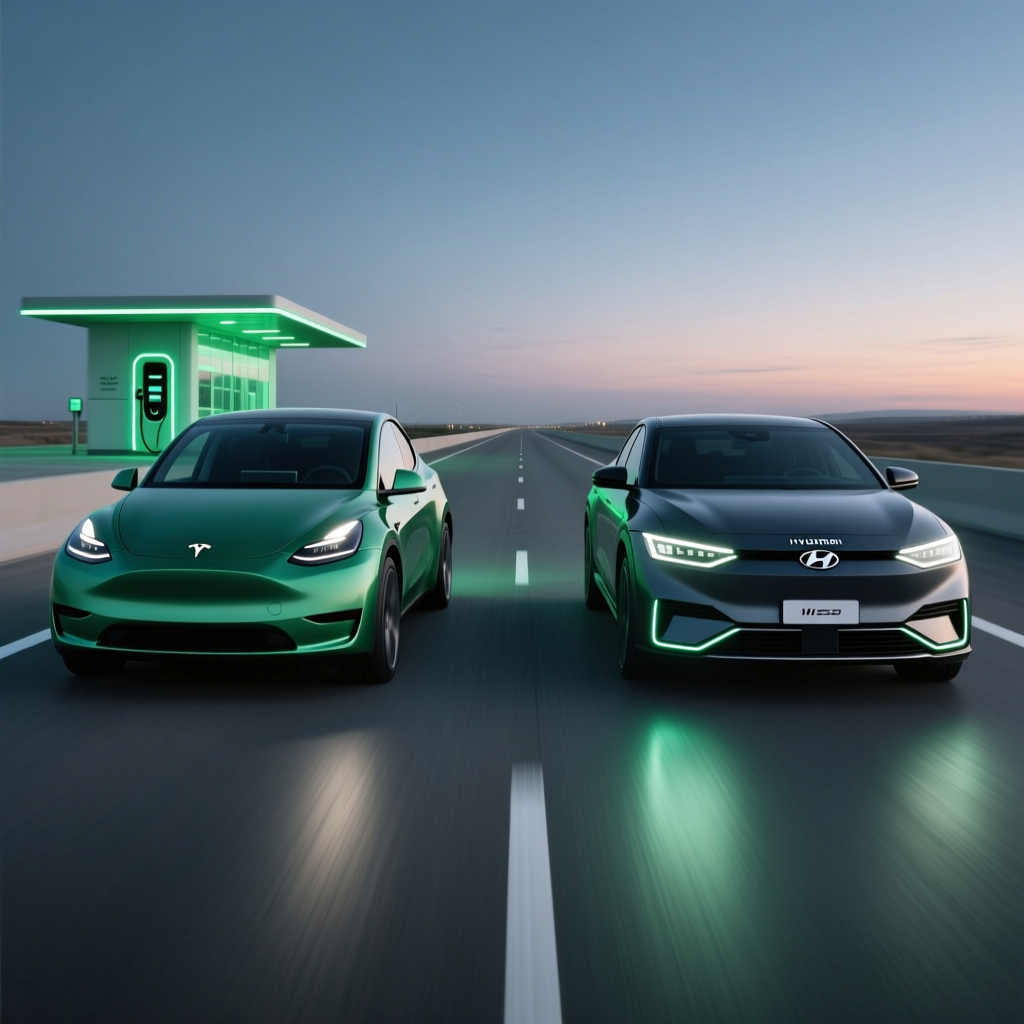
Tesla Model Y vs Hyundai Ioniq 5: Which Electric SUV Wins?
The midsize electric SUV segment has become one of the most competitive spaces in the automotive market, and two nameplates consistently rise to the top of buyer shortlists: the Tesla Model Y and the Hyundai Ioniq 5. Both vehicles offer compelling blends of range, technology, practicality, and value — but they take distinctly different approaches to the electric vehicle formula.
Whether you are cross-shopping these two EVs for the first time or have been debating between them for months, this comprehensive head-to-head comparison will help you make a confident decision. We will break down every critical category — from range and charging speed to interior space and warranty coverage — so you can determine which electric SUV best fits your lifestyle.
For our individual takes on each vehicle, check out our full Tesla Model Y review and our in-depth Hyundai Ioniq 5 review. You can also see how both stack up in our best electric SUVs rankings.
Overview: Tesla Model Y and Hyundai Ioniq 5
The Tesla Model Y is a compact-to-midsize crossover SUV that has become one of the best-selling electric vehicles in the world. Built on Tesla's proven platform, the Model Y emphasizes efficiency, software integration, and access to Tesla's Supercharger network. It is available in multiple trims including a Long Range version that prioritizes maximum distance per charge and a Performance variant tuned for spirited driving. An optional third row adds occasional seating for up to seven passengers, making it one of the few EVs in its class to offer that flexibility.
The Hyundai Ioniq 5 is a retro-futuristic crossover built on Hyundai Motor Group's dedicated Electric-Global Modular Platform (E-GMP). It stands out with its striking pixel-inspired design, ultra-fast 800-volt charging architecture, and a surprisingly spacious cabin thanks to its flat floor and long wheelbase. The Ioniq 5 is offered with both rear-wheel drive and all-wheel drive configurations, as well as a high-performance N variant for driving enthusiasts.
While the Model Y leans into minimalist design and tech-forward branding, the Ioniq 5 appeals to buyers who want bold styling, physical controls alongside digital interfaces, and the peace of mind that comes with Hyundai's generous warranty coverage. Both vehicles have earned top safety ratings and strong critical acclaim, making this a genuinely difficult choice for many shoppers.
Side-by-Side Spec Comparison
| Specification | Tesla Model Y Long Range | Hyundai Ioniq 5 (AWD) |
|---|---|---|
| Starting Price (approx.) | $48,000 – $53,000 | $46,000 – $53,000 |
| EPA-Estimated Range | 310 – 330 miles | 260 – 305 miles |
| Battery Capacity | ~75 kWh (usable) | 77.4 kWh (usable) |
| Horsepower | ~384 hp (AWD) | 320 hp (AWD) |
| 0–60 mph | ~4.8 seconds | ~5.1 seconds |
| Charging Architecture | 400V | 800V |
| Max DC Fast Charging | ~250 kW | ~235 kW |
| 10–80% Charge Time (DC) | ~28–35 minutes | ~18–25 minutes |
| Cargo Volume (rear seats up) | ~30 cu ft | ~27 cu ft |
| Front Trunk (Frunk) | ~4.1 cu ft | ~0.85 cu ft |
| Seating Capacity | 5 (optional 7) | 5 |
| Drivetrain | AWD / RWD | AWD / RWD |
| Basic Warranty | 4 years / 50,000 miles | 5 years / 60,000 miles |
| Battery Warranty | 8 years / 120,000 miles | 10 years / 100,000 miles |
Note: Specifications are based on the most current data available from the EPA Fuel Economy website and manufacturer sources. Prices and specifications may vary by trim level and region.
Range and Efficiency
Range anxiety remains one of the most common concerns for EV shoppers, and this is an area where the Tesla Model Y holds a clear advantage. The Model Y Long Range achieves an EPA-estimated range of approximately 310 to 330 miles on a full charge depending on wheel size and configuration. Tesla's industry-leading efficiency — measured in watt-hours per mile — means the Model Y extracts more distance from every kilowatt-hour of battery capacity than nearly any competitor.
The Hyundai Ioniq 5 with its larger 77.4 kWh battery delivers an EPA-estimated range of approximately 260 to 305 miles depending on drivetrain and trim. The rear-wheel-drive variant with the long-range battery achieves the highest figures, while the dual-motor AWD version trades some range for added traction and performance. Independent testing from outlets like Edmunds has shown the Ioniq 5 can occasionally exceed its EPA estimates in favorable conditions, though real-world highway driving at higher speeds tends to narrow the gap between the two vehicles.
On the efficiency front, the Model Y's lighter curb weight and more aerodynamic profile give it an edge. It typically consumes around 26–28 kWh per 100 miles, while the Ioniq 5 averages closer to 30–32 kWh per 100 miles in mixed driving. Over the course of a year and thousands of miles, that difference can translate into meaningful savings on electricity costs and fewer stops at charging stations.
Winner: Tesla Model Y — If maximizing range and efficiency is your top priority, the Model Y is the stronger choice. However, the Ioniq 5's range is more than adequate for most daily commutes and road trips, especially when paired with its superior charging speed.
Price and Value
Pricing for both vehicles occupies a similar band, but the details matter. The Tesla Model Y typically starts in the low-to-mid $40,000s for a base rear-wheel-drive variant, with the popular Long Range AWD version climbing to approximately $48,000–$53,000 before options and destination fees. Tesla frequently adjusts pricing, and incentives or price cuts can shift the value equation at any time. The Performance trim pushes closer to $55,000 or more. Tesla's direct-to-consumer sales model means there is no dealership negotiation, which some buyers appreciate and others find limiting.
The Hyundai Ioniq 5 starts in a similar range, with the SE Standard Range (RWD) opening around $42,000 and the well-equipped SEL and Limited AWD trims reaching into the low-to-mid $50,000s. Hyundai dealers often have room for negotiation, and regional incentives or dealer discounts can make the Ioniq 5 more affordable than its sticker price suggests. Both vehicles may qualify for federal and state EV tax credits depending on your eligibility and where the vehicle is manufactured — be sure to consult the latest IRS guidance on clean vehicle credits.
When it comes to standard equipment, the Ioniq 5 tends to offer more features at each price point. Hyundai includes amenities like a heads-up display, ventilated seats, and advanced driver aids on mid-level trims that Tesla reserves for higher-priced configurations or does not offer at all. That said, Tesla's over-the-air software updates continuously add features to the vehicle after purchase, which can enhance long-term value in ways that are harder to quantify.
Winner: Tie — The Model Y may have a slight edge in base pricing and resale value, while the Ioniq 5 offers richer standard equipment and more room for negotiation. Your experience will depend heavily on which trims you compare and what incentives are available.
Charging Speed and Infrastructure
This is one of the most fascinating matchups in the EV world because each vehicle excels in a different dimension of the charging experience.
The Hyundai Ioniq 5 is built on an 800-volt architecture, which allows it to accept DC fast charging at rates up to approximately 235 kW. On a compatible 350 kW charger, the Ioniq 5 can go from 10% to 80% in roughly 18 minutes under ideal conditions — one of the fastest charging times in its class. This is a genuine advantage on road trips, where every minute spent at a charging station matters. Independent tests by Car and Driver have confirmed that the Ioniq 5 sustains high charging rates for longer portions of the charging curve compared to many 400-volt competitors.
The Tesla Model Y uses a 400-volt architecture and peaks at around 250 kW on Tesla Superchargers. A 10–80% charge typically takes 28 to 35 minutes. While that is slower than the Ioniq 5 on paper, Tesla's Supercharger network is widely regarded as the most reliable, widespread, and easy-to-use public charging infrastructure available. Superchargers are consistently operational, well-maintained, and seamlessly integrated into the vehicle's navigation system — which preconditions the battery automatically as you approach a station.
The Ioniq 5 can access Electrify America and other third-party networks that support 800V charging, but the reliability and availability of those networks can vary significantly by region. As other automakers adopt the North American Charging Standard (NACS), the landscape continues to evolve, and Hyundai has been working to expand its charging partnerships.
Winner: Depends on your priorities. If raw charging speed matters most, the Ioniq 5 wins. If charging network reliability and convenience are paramount, Tesla's Supercharger ecosystem gives the Model Y the edge. For a deeper look at how charging infrastructure factors into ownership, see our guide to the best electric SUVs for road trips.
Performance and Driving Dynamics
The Tesla Model Y Performance is genuinely quick, sprinting from 0 to 60 mph in approximately 3.5 seconds — a number that rivals many sports cars. Even the Long Range variant manages the dash in about 4.8 seconds, which is brisk by any measure. The Model Y's low center of gravity, thanks to its floor-mounted battery pack, contributes to composed handling with minimal body roll. The steering is precise, if somewhat numb, and the regenerative braking system offers strong one-pedal driving capability that most Tesla owners quickly come to prefer.
The Hyundai Ioniq 5 in its dual-motor AWD configuration produces 320 horsepower and reaches 60 mph in approximately 5.1 seconds. While not quite as quick as the Model Y Long Range, the Ioniq 5 delivers its power smoothly and offers a more comfortable, compliant ride quality. The suspension absorbs bumps and road imperfections with a sophistication that the Model Y's firmer setup cannot always match. For enthusiasts, the Ioniq 5 N variant cranks output up to 641 horsepower with overboost and adds track-focused hardware that transforms the vehicle into a legitimate performance machine.
In everyday driving, both vehicles are quiet, refined, and effortless. The Model Y feels more like a tech product that happens to be a car, while the Ioniq 5 feels more like a traditional car that happens to be electric. Neither characterization is inherently better — it comes down to personal preference.
Winner: Tesla Model Y for outright acceleration and performance. The Ioniq 5 N is a compelling wildcard for enthusiasts, but in standard form, the Model Y holds the advantage. For ride comfort, however, the Ioniq 5 takes the crown.
Interior Space, Comfort, and Cargo
Both vehicles are remarkably practical, but they approach interior design from very different philosophies.
The Tesla Model Y embraces radical minimalism. The cabin is dominated by a single 15-inch center touchscreen that handles virtually every function — from climate controls to mirror adjustment. There is no instrument cluster; all driving information appears on the central display. The interior materials are generally good, with vegan leather upholstery and soft-touch surfaces, though some critics note that panel gaps and finish quality can be inconsistent. The Model Y offers approximately 30 cubic feet of cargo space behind the second row and a usable 4.1-cubic-foot frunk that is ideal for storing charging cables or groceries. The optional third row is best suited for small children and significantly reduces cargo capacity when deployed.
The Hyundai Ioniq 5 takes a more conventional yet still modern approach. The cabin features dual 12.3-inch displays — one for the instrument cluster and one for infotainment — along with physical buttons and knobs for climate control and volume. The flat floor, enabled by the E-GMP platform, creates an airy, spacious feeling, and Hyundai's "Universal Island" center console can slide forward and backward to accommodate different storage needs. Rear-seat legroom is generous, arguably more comfortable for taller passengers than the Model Y. Cargo space measures approximately 27 cubic feet behind the second row, which is slightly less than the Model Y, and the frunk is quite small at under 1 cubic foot on AWD models.
For families, the Model Y's larger cargo area and optional third row may tip the scales. For couples or smaller households who prioritize cabin ambiance and rear-seat comfort, the Ioniq 5's interior is hard to beat.
Winner: Tesla Model Y for cargo versatility. Hyundai Ioniq 5 for cabin design and rear-seat comfort. Explore more family-friendly options in our best electric vehicles for families roundup.
Technology and Software
Technology is where the Tesla Model Y has long set the benchmark — and where the Hyundai Ioniq 5 has made impressive strides.
The Model Y runs Tesla's proprietary software, which is widely considered the gold standard for EV infotainment. The interface is fast, intuitive, and packed with features including streaming video, gaming, a web browser, and detailed energy consumption analytics. Tesla's over-the-air (OTA) updates are frequent and substantive, sometimes adding entirely new features to vehicles that are already on the road. The available Autopilot and Full Self-Driving (FSD) capability represent some of the most advanced driver-assistance systems available, though it is important to note that FSD still requires active driver supervision and is not a fully autonomous system. Tesla's navigation with real-time Supercharger routing remains one of the best trip-planning tools in the industry.
The Ioniq 5 features Hyundai's well-regarded infotainment system with wireless Apple CarPlay and Android Auto — something the Model Y does not offer. The dual-screen layout is easy to read at a glance, and the system supports OTA updates for navigation and vehicle settings. Hyundai's suite of driver-assistance features, branded as Highway Driving Assist 2 (HDA2), includes adaptive cruise control with stop-and-go, lane-centering, and lane-change assistance. It is not as ambitious as Tesla's FSD, but many drivers find it predictable and confidence-inspiring. The Ioniq 5 also offers a digital key feature that allows you to use your smartphone as a key, as well as vehicle-to-load (V2L) capability that lets you power external devices — even appliances — directly from the car's battery.
The V2L feature is a genuine differentiator for the Ioniq 5. Whether you are camping, tailgating, or need backup power during an outage, the ability to draw up to 3.6 kW from your vehicle is a practical advantage that Tesla does not currently match in the Model Y.
Winner: Tesla Model Y for overall software sophistication and ecosystem integration. The Hyundai Ioniq 5 earns points for wireless phone integration, V2L capability, and a more traditional interface that some buyers will prefer.
Warranty and Ownership Costs
Long-term peace of mind is a significant factor in any vehicle purchase, and this is where Hyundai's reputation shines.
The Hyundai Ioniq 5 comes with a 5-year/60,000-mile basic warranty and a 10-year/100,000-mile battery warranty. Hyundai also includes complimentary maintenance for the first three years or 36,000 miles, which helps reduce early ownership costs. The company's roadside assistance program covers five years with unlimited mileage. For buyers who plan to keep their vehicle for a decade or more, this level of coverage is a powerful selling point.
The Tesla Model Y includes a 4-year/50,000-mile basic warranty and an 8-year/120,000-mile battery and drive unit warranty. Tesla's battery warranty covers degradation below 70% capacity, which provides reasonable assurance against premature battery failure. However, Tesla does not include complimentary scheduled maintenance, and the company's service network, while expanding, can involve longer wait times for repairs in some regions compared to Hyundai's extensive dealership footprint.
Insurance costs tend to be higher for the Model Y due to its higher repair costs and performance profile. Depreciation data has historically favored Tesla, though the used EV market is evolving rapidly and resale values for both vehicles will depend heavily on market conditions at the time of sale.
Winner: Hyundai Ioniq 5 — Hyundai's warranty coverage is among the best in the entire automotive industry, and the included maintenance program adds tangible value.
Verdict: Which One Should You Buy?
Both the Tesla Model Y and the Hyundai Ioniq 5 are outstanding electric vehicles that will serve most buyers extremely well. The "right" choice depends on what you value most in your daily driving experience and long-term ownership journey.
Choose the Tesla Model Y if you:
- Prioritize maximum range and energy efficiency
- Want access to the Tesla Supercharger network for hassle-free road trips
- Value cutting-edge software, OTA updates, and a minimalist tech-forward cabin
- Need optional third-row seating or maximum cargo capacity
- Prefer a direct-purchase model with no dealership negotiation
- Want the quickest acceleration in the segment
Choose the Hyundai Ioniq 5 if you:
- Want the fastest DC charging speeds for quick pit stops
- Prefer a more traditional interior with physical controls and dual displays
- Value a long, comprehensive warranty and complimentary maintenance
- Want wireless Apple CarPlay and Android Auto
- Are interested in vehicle-to-load (V2L) capability for camping or backup power
- Appreciate bold, distinctive exterior design
- Prefer a more comfortable, compliant ride quality
Ultimately, there is no wrong answer here. Test-drive both vehicles back-to-back if possible, and pay attention to how each one feels in terms of visibility, seating position, and interface usability. For more guidance, browse our complete best electric SUV rankings and our EV buying guide to make the most informed decision possible.
Frequently Asked Questions
Is the Tesla Model Y or Hyundai Ioniq 5 better for road trips?
The Tesla Model Y generally holds an advantage for road trips thanks to its longer EPA-estimated range and the extensive, reliable Supercharger network that makes route planning effortless. The vehicle's navigation system automatically routes you through Supercharger stations and preconditions the battery for optimal charging speed upon arrival. That said, the Hyundai Ioniq 5's ultra-fast 800V charging means shorter stops when you do pull over, and as third-party charging networks continue to expand and improve, the gap in convenience is narrowing. If your road trips primarily follow well-served corridors with Electrify America or similar fast-charging stations, the Ioniq 5 is a perfectly capable road-trip companion.
Which vehicle has lower long-term ownership costs?
Both vehicles benefit from the inherently lower maintenance requirements of electric drivetrains — no oil changes, no spark plugs, and reduced brake wear thanks to regenerative braking. The Hyundai Ioniq 5 generally has the edge in long-term ownership costs due to its longer warranty coverage, included complimentary maintenance, and typically lower insurance premiums. The Tesla Model Y may hold its resale value better in some markets, which can offset higher insurance and service costs. Actual ownership costs will vary based on your location, driving habits, electricity rates, and how long you plan to keep the vehicle.
Can the Hyundai Ioniq 5 use Tesla Superchargers?
The charging landscape is evolving rapidly as more automakers adopt the North American Charging Standard (NACS). Hyundai has announced plans to transition to NACS ports on future vehicles, and adapters may become available to allow current Ioniq 5 owners to access Tesla Superchargers. However, compatibility and availability depend on ongoing agreements between manufacturers and charging networks. It is always best to check the latest information from both Hyundai and Tesla regarding Supercharger access for non-Tesla vehicles in your region.
Which is safer: the Model Y or the Ioniq 5?
Both the Tesla Model Y and the Hyundai Ioniq 5 have earned top safety ratings from major testing organizations. The Model Y has received 5-star overall ratings from the National Highway Traffic Safety Administration (NHTSA) and Top Safety Pick+ awards from the Insurance Institute for Highway Safety (IIHS) in applicable testing. The Ioniq 5 has similarly earned 5-star ratings from NHTSA and has performed exceptionally well in IIHS crash tests. Both vehicles come standard with comprehensive suites of active safety features including automatic emergency braking, blind-spot monitoring, and lane-keeping assistance. You can review the latest crash test results on the NHTSA ratings page and the IIHS website.