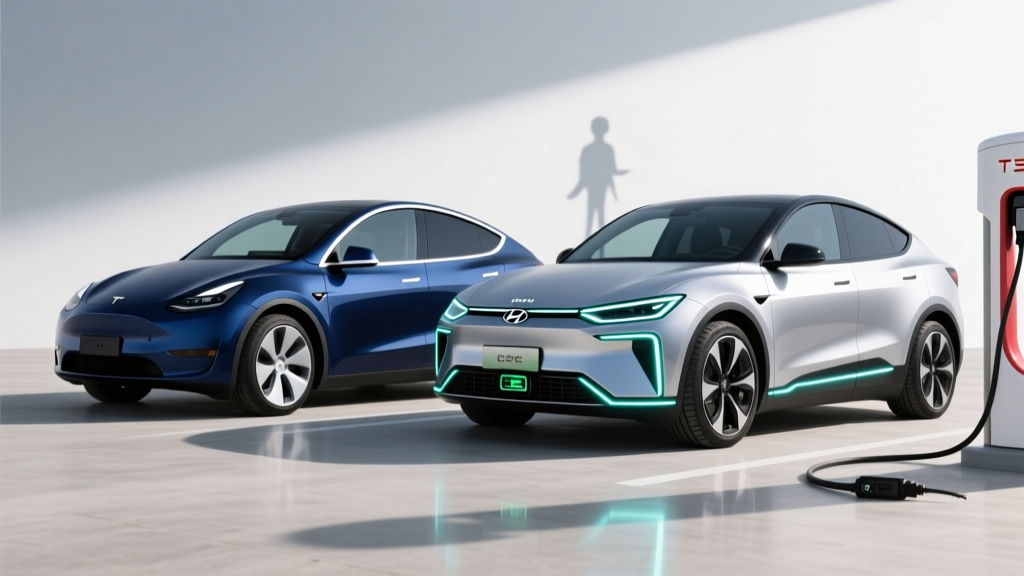
If you've ever stared at an EV spec sheet and wondered why some numbers say kW while others say kWh, you're confronting the single most common source of confusion in electric vehicles. The electric power and electric energy difference isn't just semantics — it's the key to understanding how far an EV can drive, how fast it charges, and whether it fits your life. To make this distinction concrete, we're pitting the two best-selling EV crossovers in America against each other: the 2026 Tesla Model Y Long Range and the 2026 Hyundai Ioniq 5 SEL AWD.
Think of it this way: kWh (kilowatt-hours) is the size of your gas tank — the total energy stored. kW (kilowatts) is how fast you can fill that tank or how hard the motor can push at any given moment — that's power. A bigger battery (more kWh) generally means more range. A higher charge rate (more kW) means shorter stops. A more powerful motor (more kW) means quicker acceleration. Once you internalize the electric power and electric energy difference, every EV buying decision becomes clearer.
Side-by-Side: 2026 Model Y vs Ioniq 5 Core Specs
| Specification | 2026 Tesla Model Y Long Range AWD | 2026 Hyundai Ioniq 5 SEL AWD |
|---|---|---|
| EPA Range | 320 miles | 290 miles |
| Battery (Usable) | 78.1 kWh, NMC | 77.4 kWh, NMC |
| Efficiency | 122 MPGe (28 kWh/100mi) | 110 MPGe (31 kWh/100mi) |
| Peak DC Fast Charge | 250 kW (CCS via adapter / NACS native) | 238 kW (NACS, 2026 refresh) |
| 10–80% DCFC Time | ~25 min | ~18 min |
| Level 2 AC Charge Rate | 11.5 kW (44 mi/hr) | 10.9 kW (40 mi/hr) |
| Powertrain Output | 384 hp / 346 lb-ft | 320 hp / 446 lb-ft |
| 0–60 mph | 4.8 sec | 5.1 sec |
| Cargo (rear seats up) | 30.2 cu ft (+ 4.1 cu ft frunk) | 27.2 cu ft (+ 0.85 cu ft frunk) |
| Base MSRP | $48,590 | $47,850 |
| Battery/Powertrain Warranty | 8 yr / 120,000 mi | 10 yr / 100,000 mi |
Notice how the battery sizes (kWh) are nearly identical, yet the Model Y extracts 30 more miles of range. That's efficiency — the car using less energy per mile. Meanwhile, the Ioniq 5's 800V architecture lets it accept charge at a higher sustained rate, even though its peak kW number is slightly lower. This is the electric power and electric energy difference in action: similar energy stores, very different power delivery profiles.
Range and Efficiency: Where kWh Meets the Road
The Model Y's 320-mile EPA rating edges out the Ioniq 5's 290 miles, and Tesla's drivetrain efficiency is the reason. According to fueleconomy.gov, the Model Y consumes roughly 28 kWh per 100 miles versus the Ioniq 5's 31 kWh/100mi. Over a 300-mile road trip, that translates to about 84 kWh used by the Tesla versus 93 kWh by the Hyundai — a meaningful gap when you're searching for chargers in rural corridors.
Real-World Range Reality Check
Model Y LR AWD: EPA 320 mi. Expect ~270–290 mi at sustained 75 mph highway speeds; ~225–250 mi in sub-30°F winter conditions.
Ioniq 5 SEL AWD: EPA 290 mi. Expect ~245–265 mi highway; ~200–220 mi in deep cold. The Ioniq 5's standard heat pump helps mitigate winter losses better than many competitors, but physics still wins.
Neither vehicle uses LFP chemistry in these AWD trims — both rely on NMC (nickel manganese cobalt) packs for their higher energy density. If you prioritize longevity and daily 100% charging over maximum range, the RWD Standard Range variants from both brands shift to LFP, but you sacrifice roughly 50–70 miles of EPA range and AWD traction.
Charging Speed: Peak kW vs Sustained Power Delivery
This is where the electric power and electric energy difference becomes tangible at the charger. The Model Y peaks at 250 kW on a V3 Supercharger, but like all EVs, it doesn't sustain that rate. Tesla's charge curve tapers noticeably above 50% state of charge, which is why its 10–80% time lands around 25 minutes.
The Ioniq 5's 800V architecture (versus Tesla's ~400V pack) allows it to sustain higher charge power deeper into the session. Even though its peak is listed at 238 kW, the area under the charge curve is larger, yielding an 18-minute 10–80% session. On a long road trip, those seven saved minutes per stop add up — especially with kids or pets in the car.
| Charging Level | Model Y LR (kW / mi per hr) | Ioniq 5 SEL (kW / mi per hr) |
|---|---|---|
| Level 1 (120V household) | 1.4 kW / ~4 mi/hr | 1.4 kW / ~4 mi/hr |
| Level 2 (240V home) | 11.5 kW / ~44 mi/hr | 10.9 kW / ~40 mi/hr |
| DC Fast (peak) | 250 kW / ~200 mi in 15 min | 238 kW / ~175 mi in 15 min |
Network considerations: The 2026 Model Y uses the native NACS connector and accesses Tesla's Supercharger network — the most reliable and widespread DC fast-charging network in the US, with over 6,500 stations. The 2026 Ioniq 5 now ships with a NACS port (Hyundai transitioned for the 2026 model year), granting access to Tesla Superchargers via the North American Charging Standard without an adapter. Both vehicles can also use Electrify America, EVgo, and ChargePoint DC stations, though adapter requirements vary for older CCS-only infrastructure.
Performance and Drivetrain: Power (kW) in Motion
Here, kW measures motor output — how much power the drivetrain delivers to the wheels. The Model Y's 384 hp (approximately 286 kW) dual-motor setup launches to 60 mph in 4.8 seconds. The Ioniq 5's 320 hp (approximately 239 kW) is slightly softer off the line at 5.1 seconds, but it produces more torque (446 lb-ft vs 346 lb-ft), which you feel as a stronger initial shove around town.
Neither vehicle is slow. Both deliver instant electric torque with no transmission lag. The gap matters only if you frequently merge onto fast-moving highways or enjoy spirited canyon driving. For commuting and family hauling, both powertrains feel effortlessly adequate.
Price, Tax Credits, and Value After Incentives
Sticker prices are close, but the IRS §30D federal tax credit can dramatically reshape the math. Both vehicles are assembled in the US (Model Y in Austin, TX; Ioniq 5 in Ellabell, GA as of 2025+), which is one prerequisite for the credit. However, battery sourcing and critical mineral requirements under current 2026 rules determine the actual credit amount — and these rules have tightened significantly since the credit's inception.
§30D Credit Requirements (2026):
- MSRP cap: $80,000 for SUVs — both qualify
- Buyer AGI cap: $150,000 single / $300,000 joint — verify your eligibility
- Battery components manufactured in North America (percentage threshold increases annually)
- Critical minerals sourced from US or FTA partners (percentage threshold increases annually)
- Point-of-sale transfer available — dealer applies credit at purchase, reducing drive-off price
| Cost Factor | 2026 Model Y LR AWD | 2026 Ioniq 5 SEL AWD |
|---|---|---|
| Base MSRP | $48,590 | $47,850 |
| Est. Federal Credit (§30D) | Up to $7,500 (verify sourcing compliance) | Up to $7,500 (verify sourcing compliance) |
| Effective Price After Max Credit | ~$41,090 | ~$40,350 |
| Destination Fee | $1,390 | $1,395 |
| Typical State Incentives | Varies — check DSIRE | Varies — check DSIRE |
Important caveat: As of 2026, the critical minerals and battery component thresholds have risen substantially. Always verify current eligibility on fueleconomy.gov's credit lookup tool before purchasing. A vehicle that qualified in 2024 may not qualify in 2026, or may qualify for only a partial credit ($3,750 if it meets one of two sourcing requirements but not both). Consult a tax professional for your specific situation.
Ownership Costs: 5-Year Breakdown
Purchase price is only the start. The electric power and electric energy difference also manifests in your wallet over time — a more efficient vehicle (lower kWh/100mi) costs less to charge, whether at home or on the road.
| 5-Year Cost Category | Model Y LR AWD | Ioniq 5 SEL AWD |
|---|---|---|
| Effective Purchase (after $7,500 credit) | ~$42,480 (incl. dest.) | ~$41,745 (incl. dest.) |
| Electricity (50,000 mi, $0.14/kWh avg) | ~$1,960 | ~$2,170 |
| Insurance (5-yr avg, national) | ~$10,500 | ~$9,200 |
| Maintenance (tires, cabin filter, fluid) | ~$2,200 | ~$2,400 |
| Estimated Depreciation | ~$18,000 | ~$16,500 |
| Estimated 5-Year Total Cost | ~$75,140 | ~$72,015 |
The Model Y's insurance premiums run roughly 10–15% higher nationally, driven by Tesla's higher repair costs and parts pricing. The Ioniq 5's slightly higher electricity cost reflects its lower efficiency. Depreciation favors Hyundai slightly — Tesla's used values have softened more aggressively in the 2024–2026 period due to new-vehicle price cuts flooding the used market. Both vehicles eliminate oil changes, transmission fluid, and spark plugs, keeping maintenance costs a fraction of a gas-powered equivalent.
Tech, Interior, and Daily Livability
🏆 Range & Efficiency Winner: Tesla Model Y
320 EPA miles and 122 MPGe lead the segment. Tesla's thermal management and drivetrain efficiency extract more distance from every kWh.
🏆 Charging Speed Winner: Hyundai Ioniq 5
800V architecture delivers a faster 10–80% session (18 min vs 25 min). The charge curve sustains higher power for longer, saving real time on road trips.
🏆 Value Winner: Hyundai Ioniq 5
Lower MSRP, lower insurance, longer powertrain warranty (10yr/100k), and comparable credit eligibility give it the edge in total cost of ownership.
🏆 Tech & Software Winner: Tesla Model Y
Tesla's infotainment, OTA updates, route-based preconditioning, and Supercharger integration remain best-in-class. Hyundai's system is solid but less seamless.
🏆 Interior & Comfort Winner: Hyundai Ioniq 5
More traditional controls, physical HVAC buttons, a quieter cabin, and a flat-floor lounge mode make the Ioniq 5 more livable day-to-day for most buyers.
🏆 Cargo & Practicality Winner: Tesla Model Y
34.3 cu ft total (including frunk) vs 28.1 cu ft. The Model Y swallows more gear, and its optional third row (small children only) adds flexibility.
The Decision Framework: Which EV Fits Your Life?
Choose the Tesla Model Y Long Range if:
- You regularly drive 250+ miles between charges and need maximum EPA range
- You prioritize Supercharger network reliability for frequent road trips
- You want best-in-class software, OTA updates, and route-based battery preconditioning
- You need maximum cargo volume or the occasional (small-child) third row
- You value Autopilot's highway driving assist for long commutes (SAE Level 2 — driver must remain engaged)
Choose the Hyundai Ioniq 5 SEL AWD if:
- You want the fastest DC charging sessions and a flatter charge curve
- You prefer physical buttons, a quieter ride, and a more conventional interior layout
- Total cost of ownership matters — lower insurance and a 10-year powertrain warranty add up
- You value Hyundai's V2L (vehicle-to-load) capability to power devices or appliances from your car
- You want a 10-year/100,000-mile battery and powertrain warranty for long-term peace of mind
Frequently Asked Questions
What exactly is the electric power and electric energy difference in an EV?
Electric energy (measured in kWh) is the total amount of electricity stored in the battery — analogous to the size of a gas tank. Electric power (measured in kW) is the rate at which energy is delivered or consumed — analogous to the flow rate of a fuel pump or the output of an engine. A 78 kWh battery holds a fixed amount of energy. A 250 kW charger can deliver energy into that battery at a rate of 250 kilojoules per second (at peak). A 384 hp motor converts that energy into motion at up to ~286 kW of mechanical power.
Does a bigger kWh battery always mean more range?
Not necessarily. Range = battery capacity (kWh) ÷ consumption rate (kWh/mile). A heavier, less aerodynamic vehicle with a 90 kWh battery might deliver fewer miles than a sleek, efficient vehicle with a 78 kWh pack. The Model Y demonstrates this: its 78.1 kWh battery out-ranges the Ioniq 5's 77.4 kWh pack because Tesla's efficiency is roughly 10% better.
Why doesn't a 250 kW charger deliver 250 kW the entire session?
Battery chemistry and thermal limits require the charge rate to taper as the battery fills. Think of filling a glass of water — you pour fast when it's empty, then slow down near the top to avoid overflow. Most EVs hit peak kW only between 10–40% state of charge, then taper. The Ioniq 5's 800V system sustains a higher rate for longer, which is why its 10–80% time beats the Model Y's despite a lower peak kW number.
Which vehicle qualifies for the full $7,500 federal tax credit in 2026?
Both the Model Y and Ioniq 5 are US-assembled SUVs under the $80,000 MSRP cap, making them potentially eligible. However, the actual credit amount depends on battery component manufacturing and critical mineral sourcing thresholds that increase each year. As of early 2026, verify each vehicle's current credit status on fueleconomy.gov before purchasing. Your personal income must also fall below the AGI cap ($150K single / $300K joint). The credit can be transferred to the dealer at point of sale, reducing your drive-off price directly.
Is Tesla's Autopilot or Hyundai's Highway Driving Assist self-driving?
No. Both are SAE Level 2 driver-assistance systems. They can manage steering, acceleration, and braking on highways, but the driver must remain fully attentive, keep hands on or near the wheel, and be prepared to take over instantly. Neither system handles all driving scenarios, construction zones, or adverse weather reliably. True self-driving (Level 4) currently exists only in geofenced robotaxi services like Waymo, not in consumer vehicles.
How long will these batteries last before needing replacement?
Modern NMC batteries in both vehicles are engineered for 150,000–200,000+ miles before reaching 70–80% of original capacity. Tesla warranties the Model Y battery for 8 years/120,000 miles (minimum 70% retention). Hyundai warranties the Ioniq 5 battery for 10 years/100,000 miles (minimum 70% retention). Real-world degradation data from high-mileage Tesla fleets shows roughly 10–12% capacity loss at 150,000 miles. Full battery replacement costs $12,000–$18,000 out of warranty, though most owners never need one within typical ownership periods.
Final Verdict: Your Priorities Decide the Winner
The electric power and electric energy difference is the Rosetta Stone of EV shopping. Once you understand that kWh governs how far you can go and kW governs how fast you charge and accelerate, the Model Y vs Ioniq 5 decision sharpens considerably.
The Model Y wins on range, efficiency, cargo, and software — the practical advantages for high-mileage drivers and frequent road-trippers who lean on the Supercharger network. The Ioniq 5 wins on charging speed, interior comfort, warranty, and total cost of ownership — the smarter play for cost-conscious buyers who want a refined daily driver with fast charging when needed.
Neither is a wrong choice. Both are excellent, well-rounded EVs that have earned their sales volume. The right answer depends on whether your next five years involve more cross-country highway miles (Model Y) or more daily commuting with occasional weekend trips (Ioniq 5). Test-drive both, verify your tax credit eligibility, and let the numbers — not the marketing — guide your decision.